Please enable javascript to view this page in its intended format.

Queen's University
 

Art History and Conservation conference has "context & meaning"

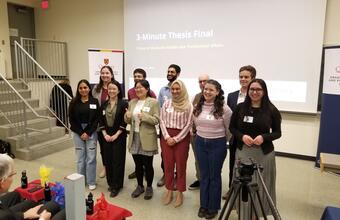
arthistorypicone.jpg Katlin Schwan (left), Susan Cahill and Julia Skelly at the Context & Meaning Conference.

Graduate students from Queen's recently hosted the 7th annual Art History and Conservation conference at the Agnes Etherington Art Centre called "Context & Meaning." Students from Queen's and international universities, scholars, and interested members of the public were invited to examine the concept of art in context. The event, held on Jan. 18 and 19, provided a forum for graduate students to present their current scholarly research and participate in thought-provoking academic discussion to inspire further research.

The conference was organized by the members of the Graduate Visual Culture Association of Queen's University and it allowed students to network and practise presenting their research. "A lot of people present their first conference paper here," says organizer Susan Cahill, Art History PhD candidate at Queen's. "It's a really friendly atmosphere and the audience is very engaged. People are willing to ask you questions that challenge your research, in ways that aren't personally challenging - you're not defending your position - you're just elaborating."

Another aim of the conference was to raise the profile of the departments for prospective graduate students. "Both the art history and art conservation programs are really great and really well-known," says Cahill. "The conference provides a way for people to see the student body and support that is offered by fellow students and faculty and allows people to know what other research is going on."

Sessions ranged from cross-cultural influences in painting to intertextuality, memory and image, 19th-century photography and art, activism and resistance. Eric Weichel, a first-year PhD student at Queen's spoke on cultural hybridity in British group portraiture. He discussed the social and cultural context of early 18th-century portraiture in England and its function as a means of distinction for new social upcoming classes in British society. 

Julia Skelly, a PhD candidate at Queen's, presented a paper on the social history of female alcoholics in 19th-century Britain, and representations of women consuming alcohol in Victorian British art.  Specifically, her research examines why there was a lack of representation of female consuming alcohol in Montreal's illustrated press in the 19th-century. "One of the consequences was that by further hiding the fact that women drank, women who were struggling with addiction at the time, (and there were a number of women struggling with addiction of all classes), women felt more ostracized by a lack of representation so they would hide their drinking even more," says Skelly. "Montreal was, from the early 19th-century, identified as having one of the heaviest drinking populations in the province of Canada, and it later became the centre of the Canadian temperance movement."    

One PhD student travelled from Poland to present at the conference. Filip Lipinski, from the Department of Art History at Adam Mickiewicz University in Poznan (Poland), analyzed selected works of Edward Hopper in the context of movies which are explicit "quotations" of the American artist's paintings (New York Movie, Nighthawks, House by the Railroad).

Speakers for the conference were selected by a peer-review committee of five upper-level graduate students, a jury which looked at anonymous submitted abstracts that had an unknown school affiliation. "You have to work your best to get in here, and the papers that get in are the best of those submitted, and that just makes for a better, stronger conference," says Cahill.

Kingston, Ontario, Canada. K7L 3N6. 613.533.2000