Please enable javascript to view this page in its intended format.

Queen's University
 

School of Graduate Studies

iScore: A Case Study That Has An Impact

Education


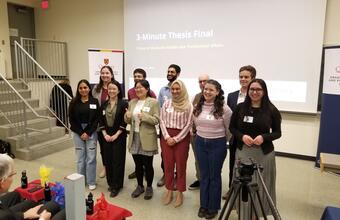
iScore team group photo

The iScore team group photo

by Megan Bond
20th April 2012

Studio music teachers’ lives could become more enriched this year, and a research and development team from the Faculty of Education has a lot to do with it.

Dr. Rena Upitis and her team of graduate and teacher advisors have collaborated with Concordia University and The Royal Conservatory to develop an online instruction tool that has the potential to revolutionize the music studio learning experience in Canada, and around the world.

In 2007, Dr. Upitis met with Angela Elster, Vice President (Academic) at The Royal Conservatory, and Dr. Phil Abrami, Director of the Centre for the Study of Learning and Performing at Concordia University, to brainstorm how they could take an online learning tool, ePEARL, and revamp it into an arts-based tool that could be used beyond the classroom, which has never been done before. After two to three hours, it became clear that studio teaching deserved attention, and the ideas behind what would become iSCORE began to take shape.

Dr. Upitis described the need for iSCORE, “The genesis of this tool was to fill a gap for a massive teaching population, namely independent studio teachers who have no digitally based tools for studio teaching. There are hundreds of thousands of kids taking private lessons - a half a million alone with the Conservatory - and hundreds of thousands of teachers out there who really don’t get PD (professional development), they don’t get tools, they don’t get attention, and they do incredible work in their own isolated ways.”

Another purpose for creating iSCORE was to appeal to the many youth who have the tendency to lose interest in music instrument instruction as they get older. The team wanted to fill a void in such a way that actually encouraged kids to stay with their instrument and to become more engaged musicians. In assessing the technologically savvy needs of today’s teenagers, Dr. Upitis contemplated, “What would happen if we designed a tool that looked like Facebook? Would they stay?”

Since the official release of the tool this past January, iSCORE has had an overwhelming response with over 300 teachers (and growing) signing up.

So what makes iSCORE so appealing? Marie Anderson, (M.Ed.'09) is one of six teacher advisors on the iSCORE team. She believes that it is the attractive look of the program and the way that it allows students to participate at the beginning, intermediate and advanced levels. “The built-in recording allows students to record their work, and the teachers can evaluate the recordings at any time, ” Anderson explained. “Recordings can be linked to iTunes and YouTube, and students and teachers can contact one another in a way similar to Facebook.” The program is formatted to encourage self-regulated learning and to feel like everyone is connected to a community that supports musical growth and achievement.

Screen-shot-notes & goals


Screen shot of notes & goals for the students


Meagan Troop, another teacher advisor and Education PhD candidate involved in the development of iSCORE, found that the tool was well received in a community based setting like a music ensemble based in Kingston. “I was working with adults to see how they could apply it effectively to their music learning, and teaching. In piloting the project, some of the projects were group ensemble contexts, where a studio full of singers could come together to form a choir. Royal Conservatory offers group based learning of 10-40 people in certain instructional settings so iSCORE can accommodate those needs as well.”

The success of iSCORE also lies in its user-friendly design, as Scott Hughes, another member of the iSCORE team and Education PhD candidate explains, “I’m not a technically savvy person. Technology has not always been a big part of my practice so I’ve had a healthy skepticism, and because I came in towards the end of the year when the major elements of the tool were beginning to be developed, what I was able to see was how this could be really successful in the studio and the elements that would really benefit instruction. One is the communication piece and how that builds community amongst an often isolating experience, and the other being that it really supports student practice. The reality is that youth these days are being raised in a social media culture and this tool is really relevant to that media savvy 8-year-old, 12-year-old, or 15-year-old who just expects, or needs, or wants that kind of communication and feedback.”

Screen-shot-creating


Screen shot of creating work


Communication was also a theme in the research and design phase of iSCORE. The Queen’s team played a key role in the progress of the project. Dr. Upitis noted Queen’s unique relationship to the project, “The irony is that we are the smallest of the institutions, and because of that we could easily make decisions. So that put us in the position to play a role in every single part of the project.”

Dr. Upitis worked hand-in-glove with another member of the iSCORE team and former PhD student, Dr. Julia Brook, to troubleshoot and smooth out the problems. Dr. Brook liked how the project fit well alongside her own research interests. “I finished my dissertation in tandem with the project. It was nice to do research that’s linked to my own background as a musician and studio teacher. On a more personal note, what the project gave me was another nice opportunity to gain experience in a project manager type role, which is what I hope for in a job in the future.”

As graduate supervisor to Dr. Brook, Anderson, Troop, and Hughes, Dr. Upitis has strong beliefs on what graduate work should look like, and what her role should entail. “This is a really beautiful case study of research that really has an impact, and what graduate education should be at the graduate, particularly doctoral level. This is what we should be doing if we want people to be graduating with the whole sense of what the big picture is and to see how our own research can have an impact at the grass roots level. We can apprentice people into the process so by the time you’re finished you’re colleagues.”

And there is more potential for impact, as Dr. Brook explained, “Now that the PhD students, Scott and Meagan, know the tool, they can carry on to mentor the new masters students who may become PhD students.”

Dr. Upitis hopes to continue researching and continuing to develop iSCORE, but at this point she is just elated that a project of this kind received funding in the first place. “We have this Achilles’ heel: the Arts. I’m absolutely thrilled that the Arts has received this kind of funding. Arts alone, music alone, never mind what we do, it’s unbelievable.”

To get a closer look, visit http://rcmusic.ca/iscore-home-page

kids practicing

Kids working on their assignments (L) and one of the kids recording his piano playing onto the computer for the teacher to hear (R).

Back To All Stories

Kingston, Ontario, Canada. K7L 3N6. 613.533.2000