Please enable javascript to view this page in its intended format.

Queen's University
 

School of Graduate Studies

Religion & Diversity Graduate Workshop


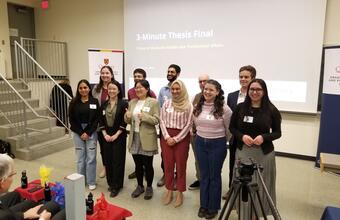
RDP-Workshop group photo

Student team members with workshop facilitator Dr. Beckford (University of Warwick) at The Religion and Diversity Project Graduate Student Workshop Series, Session 1, held last November at the University of Ottawa.

photo courtesy of Cathy Holtmann, PhD candidate, UNB

By Sharday Mosurinjohn
20 June 2012

We all know that sometimes, research can get lonely. Having completed an MA in Cultural Studies at Queen’s last year, I decided to stay for the PhD. In an interdisciplinary program like mine, we CSers have found creative ways to bond and share our work outside the confines of a disciplinary silo.  I have also been exploring another great venue to link up with other students researching similar ideas. At the beginning of this year I became a student team member of the Religion and Diversity Project. According to it’s website “The Religion and Diversity Project/Religion et diversité is a 7 year Social Sciences and Humanities Research Council (SSHRC) funded Major Collaborative Research Initiative (MCRI), hosted at the University of Ottawa, Ottawa, Ontario. This project brings together 36 team members from 24 universities, with Lori G. Beaman, University of Ottawa, as the Project Director on this research initiative.” Now in its third year, the project has spawned numerous studies and other initiatives including a series of public “explore and discuss” sessions at the Canadian Museum of Civilization, a new graduate journal, a forthcoming edited book, and a number of workshops, among them the Graduate Student Workshop Series of which I’m a part.

The 8 other PhD students and I are each supervised by different Religion and Diversity Project team members or working as a research assistant on an MCRI funded project. Getting involved with this workshop has been an amazing professional development opportunity and a way to build an intellectual community. By carving out a space and time to be with each other outside of our normal work routines, we've gotten into an impressive breadth and depth of topics in an intense way. To name just a few, I’ve learned about secularism in post-WWII Japan, cross national research on religious identities and perinatal care in health systems, and the information-seeking practices of churches in transition. We’re from Ontario, Quebec, New Brunswick and Nova Scotia, based in Religious Studies, Sociology, Interdisciplinary Studies, and of course Cultural Studies, and we range from our first to third year of doctoral work. There was definitely no way I could have predicted all the things we could offer each other, in terms of theory, methodology, research inspiration and support.

It’s also impossible to overestimate the value of working closely with a variety of established scholars. Our thesis committees are one way of ensuring that we make these connections, but it's good to be on the lookout for other opportunities as well. Each session of the three-part RDP grad workshop is convened by a professor from a different university. We began in November 2011 on the theme of intellectual directions and research design under the guidance of Professor Jim Beckford from the University of Warwick, and continued in May on the topic of knowledge transfer (teaching and community) with Professor Kim Knott, of Lancaster University. Our third and final session on results dissemination (conference publication), led by Professor Nancy Nason-Clark, will happen this October here at Queen’s.

Whether your graduate research spans disciplines or has a clear academic home, being attentive to transferable skills and concepts can be an important way for us to start defining a niche for ourselves as scholars. So take this as a word of encouragement to keep an eye open for opportunities in your field(s), beyond the usual conference circuit, that put you into productive, sustained conversations with other researchers or even maybe cultural producers, industries and communities. It's motivating, keeps you on task, and introduces you to potential new friends and colleagues. Plus, if familiarity breeds contempt, then maybe sometimes looking at your work through someone else's eyes is just the break you and your growing stack of chapters need from each other.

Back To All Stories

Kingston, Ontario, Canada. K7L 3N6. 613.533.2000