Please enable javascript to view this page in its intended format.
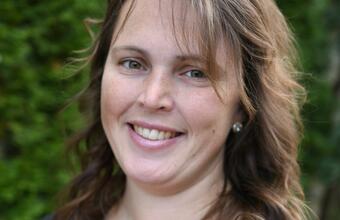
Photo of Arlinda Ruco
By Christine Elie
August 2012
Arlinda Ruco, a Master’s of Public Health student, dreams of working in health promotion focusing on chronic disease and program evaluation. She hopes to encourage people to combat diabetes and obesity. Arlinda aspires to one day complete a PhD and “research how physical activity guidelines could be adapted to specific disease populations...If I could do anything in the world with my degree I would get everyone motivated to be more active. Everyone knows physical activity is good for you, but getting people motivated to actually get up and move is the hard part!”
When Arlinda entered into the MPH program, she had just completed a Bachelor’s Science Honours Kinesiology degree at Queen’s University. She was part of the first graduating class of this program and was drawn to the small class sizes that it offered. This was one of the primary reasons that she chose to pursue her Master’s in Public Health at Queen’s. She appreciates the benefits of a more personal learning experience claiming that “In a program that small you learn everyone’s name and the professors quickly learn yours as well. With a class size of around 28 students, it’s hard not to get to know everyone.”
After completing her Bachelor’s degree, Arlinda knew that she wanted to pursue her Master’s. She was not ready to commit to a topic for a thesis: “as an undergraduate student I had been involved in numerous research projects and I wasn’t sure if I had found something that I was willing to research and write a thesis about for 2 years.” This issue was quickly resolved when she looked to the MPH as a viable alternative. Arlinda praises the course-based design of the program as it offers the flexibility to take courses in topics that she is interested in without the constraint of the extensive researching and writing process that is required of a thesis-based degree.
In her fourth year of her undergraduate degree, Arlinda started considering the MPH program, “I thought an MPH degree would give flexibility in the sense that it would allow me to guide my work in numerous directions.” Having already spent several years at Queen’s and in Kingston, she claims that returning to Queen’s was an easy choice: “I was already acquainted with Kingston and I already loved living and studying here.” More than this, though, Arlinda was drawn to the MPH program because it did not require her to declare a specialization, “instead, the program covers a wide range of public health topics, instead of focusing on global health or health promotion for example.”
The icing on the cake for Arlinda was the 16-week practicum placement that the program allows students to undertake in the summer after their first year. She argues that “the experience and knowledge that I am currently gaining not only expands on what I have learned in the classroom, but is also an excellent opportunity to acquire and strengthen the Public Health Core Competencies, which were developed to strengthen and advance public health practice and may not always be addressed in a classroom setting.”
She is currently working at Public Health Ontario. The project that she is involved in evaluates physical activity programs that aim to improve academic performance and achievement in secondary school students who have been identified as at-risk. She could not have found a more perfect placement: “my work is perfectly aligned with my background, having a strong foundation in chronic disease and physical activity from my undergraduate career, and having taken courses such as Program Evaluation throughout my MPH degree.”
In her third year of her undergraduate degree, Arlinda travelled overseas on an exchange to Oslo, studying at the University of Oslo in the Faculty of Humanities. She was also able to work with the Schizophrenia Society of Ontario through the work-study program offered at Queen’s. During her time at the university, Arlinda has been involved in many different groups on campus. In addition to working for Athletics and Recreation, she has volunteered for many on-campus groups including Sexual Health and Resource Centre, Best Buddies, Math Bridge, Step and WAG.
With only a few months left of her degree, Arlinda hopes that the programs will leave her with a wide array of skills and knowledge. “My expectations of the program are that it will cater to my interests and prepare me to succeed as a future public health professional while challenging me in ways beyond what I am used to.”