
As the adventurous voyager stood there, gazing upon all this
mystery and weirdness, he pictured the time when birds sang in
the branches of the now stony trees, when balmy breezes rustled
their leaves into pleasant music, and thousands of bright glad
insects hummed their praises among the waving grasses and the
nodding flowers. Flin knew that all these things must have been
in far-off ages, until some incomprehensible convulsion of nature
turned this part of the world upside down, and buried forever
out of sight this glorious forest.
J.E. Preston Muddock, The Sunless City, 1905
It was one lake among hundreds of thousands that bless the Canadian
landscape. Crowding down to its rocky shore, spruce and pine mixed
with birch and aspen, tamarack and fir. Its waters were filled with pickerel
and suckers, northern pike and perch, the usual menu. Frogs and ducks
and leeches called it home. Beavers built their scrappy hideaways. Loons
and cormorants paddled its waters in summer, and an occasional pelican
might drop by. Eagles and ravens patrolled above, sometimes tangling in
mid-air because these species did not like each other. Bears, wolves, foxes,
lynx, martens, and other fur-bearing animals knew the lake, and yes,
there were insects, buzzing all summer long, competing to eat and escape
being eaten.
It was an inconsiderable body of water compared with nearby Amisk
and Athapapuskow, where from mid-lake the shoreline is a thin black line
that disappears altogether in morning mists and snow squalls. Indigenous
hunters and trappers snowshoed or paddled the lake, had camped on its
shores for thousands of years. Near its east shore was a quarry where they
chipped scrapers and spear points. They gave the lake a name: transliterated
from Cree it was called Fishpole, perhaps referring to the gaffing stick used
in springtime to haul the bounty from creeks that ran into its depths. Then
white men came and gave the lake a new name and sacrificed it to their
restless need to conquer and prosper. Because of that impulse, I exist.
What happened on the shore of Fishpole Lake is documented, but
the man for whom it was renamed is a preposterous fiction.
Josiah Flintabbatey Flonatin was conceived in the overheated brain of
J.E. (Joyce Emmerson) Preston Muddock, a writer whose own handle was
mouthful enough that he took a penname from his most successful
fictional creation, a detective he called Dick Donovan. Muddock was an
Englishman, a Victorian more energetic than eminent, who lived long and
riotously. Among many exploits, he claimed to have been caught up in the
1857 Indian Rebellion, panned for gold in Australia, and, he said, dined
with cannibals in the South Pacific. Prolific hardly begins to describe his
literary output. He wrote 42 novels and short story collections as Dick
Donovan, and 30-some novels more as Muddock, including science
fiction, historical fiction, and horror stories. Toss in a few non-fiction books
and journalism.
In 1905, Muddock, using his own name, turned out The Sunless City, a
truly awful book. Its hero, Flintabbatey Flonatin, is a bankrupt storekeeper
who builds a one-man submarine in the shape of a fish, which he pilots
into the depths of Lake Avernus, so deep it is reputed to be bottomless.
Flintabbatey descends overnight to a depth of 1,100 fathoms, and, upon
awakening, breakfasts “right royally on a bottle of superb claret, some
hard-boiled eggs, which had been prepared the day before, a few delicate
slices of delicious ham, and finished off with a choice cut from a
magnificent boar’s head stuffed with truffles.”
An underwater current carries his sub to a land whose inhabitants
have tails and live for hundreds of years. They speak English but write
the language backwards. The streets are paved with gold, which is
considered valueless – tin is used as currency. Most disconcerting for
Flin, the women he meets are robust and rule over soft, unmanly men.
Frightened, the hero escapes back to the earth’s surface by climbing
the magma chamber of an extinct volcano. Sigmund Freud, whose career
was taking shape about the same time, would have had a field day
with Muddock.
Despite the extravagant plot and florid detailing, Muddock’s book is
almost unreadable. Its fate, like most of his output, was to be dropped into
the Avernus of bad books, there to be forgotten.
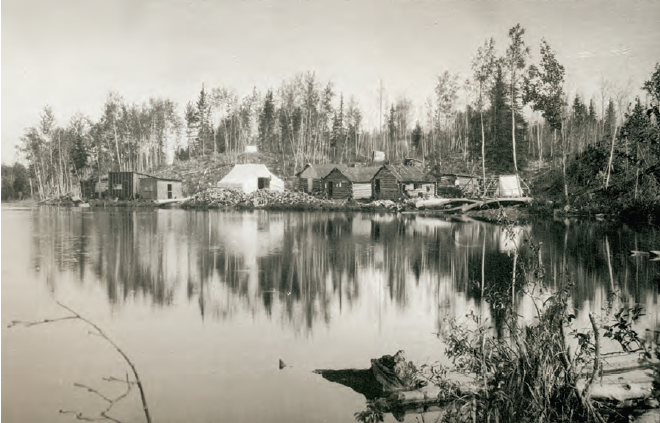
potential had been recognized (image: Geological Survey of Canada).
Except, someone always finds a forgotten a book. In this case, he
was a prospector in the company of four or five others who in 1913 were
paddling the lakes and streams of the Churchill River system in northern
Saskatchewan. When the prospectors stopped for lunch on a portage, one
of them noticed what looked like a tattered book half hidden under a fallen
tree. It was The Sunless City. Fresh reading material being in short supply
in the bush, the men kept and read the book. Despite its shortcomings,
they were drawn to its descriptions of gold in abundance. It was the very
thing they were looking for. The bigger problem for them was that the final
few pages had been torn away. How did it end? Speculation was that
the missing pages had been used to light a fire, or, as likely, were required
to assist in a bodily function that might also have been taken as critical
comment by its last reader.
The prospecting party was making its way from Lac la Ronge to Amisk
Lake, or “Beaver Lake,” as the white men translated from Cree. A couple
of years earlier gold had been found near Amisk, not in any great quantity,
it turned out, but enough to set off a prospecting rush. The 350-squarekilometre
island-studded lake was well situated among the network of
waterways that flowed through the northern forests. It was, and still is, a
great fishing lake, a place for Indigenous people, and later Europeans, to
camp and stock up.
Nearby is Frog Portage, a hill hardly noticeable under its forest cover,
but a watershed that divides rivers and lakes that flow north toward Hudson
Bay from those that channel south, eventually joining the Saskatchewan
River and connecting to the Prairies. Legend has the portage getting its
name because a frog was nailed to a tree to demarcate a boundary between
two feuding Cree bands.
A year or so after the bush had yielded its copy of The Sunless City,
Tom Creighton, first among equals in the prospecting crew, was at
Phantom Lake, a few kilometres east of Amisk, where the rest of his crew
had camped. Creighton was a frontier original, a former Great Lakes sailor,
amateur hockey player, and fortune seeker given to hard and somewhat
careless living. His men were of similar outlook, all seeking the main
chance. The most important event in their lives was about to occur, but
it came in a skein of so many retellings and embellishments that it is
hard to untangle. Delicately phrased by a prospector in his later years:
“If that’s what they say, who am I to give it lie?” Creighton himself probably
uttered the words, the “they” in question being himself.
One version, recounted by George E. Cole in the 1948–49 report for the
Manitoba Historical Society, goes like this: Not long after New Year’s 1915,
Creighton was tending a trapline near Fishpole Lake and hoping a moose
might present itself to offer some fresh meat. Typically, prospectors spent
the summer looking for riches, and in winter they trapped and hunted to
pass the time, fill the larder, and provide some ready cash. On Fishpole’s
shore, Creighton noticed a rock outcrop the wind had blown free of snow.
The sparkling flecks in the rock attracted his attention. He stowed away
what he saw. He returned to the camp on Amisk, and he informed the
others. Later, in summer, the prospectors visited the site.
When one of his crew panned dirt from a hole near the lakeshore,
promising gold flecks appeared. Very promising. He showed the pan to
Creighton who is reputed to have said, “Boys, this must be the place where
old Flin Flon came up from the bowels of the earth and shook the gold
from his whiskers!” The prospectors gave the lake a new name, Flinflon,
later amended to Flin Flon.
A variation of the story I heard as a kid: Creighton fell through the ice
on the lake in spring while hunting a moose. When he lit a fire to dry out,
he thought he saw the flickering flames reflected in the eyes of what he
took to be a fox in the bush. He threw his prospector’s pick at it. He heard
it clink as it hit a rock, and when he retrieved the pick, there was the lode
for which he had been looking.
Then there is the account, recorded in a 1917 report by geologist E.L.
Bruce, in Memoir 105 of the Geological Survey, Canada Department of
Mines: “Creighton, Mosher, Dion and their associates … were shown some
pieces of sulphides by an Indian named Collins whose hunting territory
lay about the north arm of Athapapuskow Lake. They recognized the
possibilities of mineral such as he showed them and guided by him found
and located the sulphide bodies at Flinflon Lake.”
“The Indian,” David Collins, whose mother was Cree and whose father
was Euro-Canadian, was a trapper who had picked up knowledge about
what prospectors were looking for. In the myth-making that attended
Creighton’s part in the story, Collins was more or less forgotten, although
his descendants later said the prospectors gave him $6.30 worth of flour,
lard, and bulk tea for his role in discovering what became one of Canada’s
richest mines.
In the end, Creighton and his partners didn’t prosper from the discovery
any more than had Collins. It was one thing to find and stake an ore body
and quite another to create a mine. One such mine was developed nearby
at the start of the First World War, when copper was in demand. Scraping
the earth’s surface was sufficient, but what to do with those rocks? The
nearest railhead was in The Pas, a town 140 kilometres away as the crow
flies, so, for several years, thousands of tons of ore were sledged – drawn
by horses on corduroy roads through the bush and over swamps – then
barged across two lakes and down the Saskatchewan River through The
Pas. There it was loaded onto trains to be hauled to a smelter in Trail,
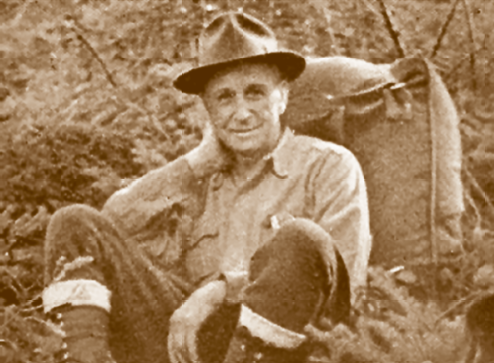
Renowned prospector Tom Creighton takes a break in the
bush, c.1910 (image from the Reminder, Flin Flon).
British Columbia. It was a journey of 230 kilometres by water and road and
1,930 by rail.
Horses, barges, and crows were not going to cut it on the shore of
Flin Flon Lake. It had been determined that gold was only the third most
plentiful of its riches. There was more copper and zinc. But there were
great quantities of all three, enough to keep a mine going for years. To get
it built, capital was needed, raised in the United States and eastern Canada.
Creighton and his crew were squeezed out.
Big money’s threefold solution to the lake’s problem: push a railway
through to the camp; build refineries and a smelter on site; and
create a source of electricity at Island Falls, 100 kilometres away. In 1927,
the Hudson Bay Mining & Smelting Company – known as HBM&S, or
simply “the Company” – was formed. The mine was up and running by
decade’s end.
Collins went back to trapping while Creighton moved to Flin Flon – by
then a town as well as a lake – to work for the Company. It gave him
Apartment 1 in the Staff House, near the main entrance to the mine. The
Staff House was part of a colonial-style compound where mine executives
and their families lived and where visitors stayed. Creighton was a
Company fixture, a kind of public relations mascot trotted out when
important people came to town. But he seemed not entirely under the
Company’s control. The more he drank, the more outlandish became the
versions of how he made his great find.
For his part, Collins retired to Cranberry Portage, a village south of
Flin Flon on Athapapuskow Lake. He became a respected elder to whom
people went for counsel. He died in 1931 and was buried in a little seen
spot on Athapap’s shore. On his grave the words in the usage of his day:
“The half breed who showed the prospectors the Flin Flon ore body. His
generous contribution to northern Canada will be eternally remembered.”
But for a while it wasn’t.
Creighton died in 1949. Three years later, a village was named after him,
in Saskatchewan, a couple of kilometres from Flin Flon, which was mostly
in Manitoba. Creighton is where I grew up. The prospector was also
awarded a cairn, placed in a corner of the town’s schoolyard. Contrary to
what I believed in first grade, the prospector’s remains were not enclosed
within the pile of stones, but rather in a cemetery in Flin Flon under a
marker that says, “Here lies a man,” an epitaph at once true, purposeful,
and generic.
It took years for Collins to get so much as a street with his name on it,
and that was in Creighton. But First Nations advocacy has retrieved him
from obscurity. In 2015, after a vigorous campaign, a large boulder with a
plaque on it was placed at a spot on the south end of Flin Flon’s Main
Street, right at the border as the road enters Saskatchewan and winds its
way to Creighton. It’s where the Halfway, one of the town’s more renowned
brothels, used to be, as I was reminded by Gerry Clark, a retired teacher
and chronicler of Flin Flon’s past.
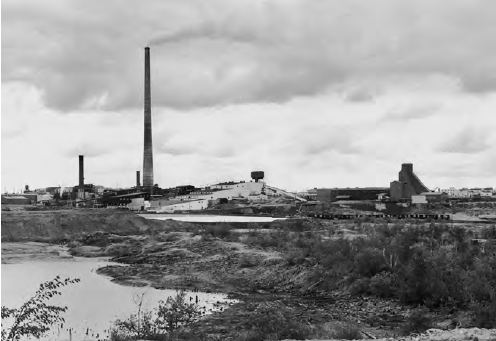
(image by the author).
Clark also headed the committee that helped give Collins his due.
“Whether Creighton or Collins deserves more credit is neither here nor
there to me,” he told the Reminder, the town’s surviving weekly newspaper.
“One helped the other and never got any kind of credit for that.”
The marker didn’t come without initial resistance from those who
preferred the more fantastical versions of Flin Flon’s founding story. The
Company, it was said in the usual way news gets around a small town
when it doesn’t make the paper, had doubts. Hudbay Minerals, as new
owners called the Company, considered stonewalling the project, Clark
told me, lest there be residual claims on the land by Indigenous interests.
They might demand a share of Hudbay’s take from what had been their
traditional hunting ground.
“If you give any sense there was an injustice, you’d have the chief of
Pukatawagan [a neighbouring First Nations community] down your throat
– he was on our committee, by the way,” Clark said. In the end, it was all
smoothed over, and Hudbay did not dispute Collins’ role in the discovery.
It might have had something to do with the ore in the vicinity having been
mined out.
David collins’ granddaughter, Amelia McNichol, said Collins
came to regret leading Tom Creighton to the ore body because of
what happened to his hunting and trapping territory. By the time he died,
Collins would have seen the construction of the mill, smelter, zinc refinery,
assorted shops, and the digging of the open pit. All of these, in their own
ways, disfigured the land he knew.
Shafts would eventually go a kilometre and a half underground, but
at the start of operations, scratching the earth’s surface – creating the
so-called open pit – was enough. Part of the lake was dammed and drained.
Another part of the lake became a sea of mud held back by a dike.
Meanwhile the smelter belched sulphurous fumes into the air, killing or
stunting much of the vegetation for kilometres around.
The destruction of one lake among so many seemed a small price to pay
for what was gained. Indeed, the timing of the mine’s appearance, coming
at the start of the Depression, couldn’t have been better. As one of the
largest development projects on the continent rolled out, thousands of
jobs were created when they were most needed. Flin Flon thrived, and,
human adaptability being what it is, other uses were found for the lake
bottom: a baseball field and small golf course (with “greens” of sand, so,
really, “browns”).
As toxic waste accumulated, other places were found for those activities,
but the lake bottom remained a playground, informally. It was on the other
side of a rock outcrop behind the house where I grew up. For the children
in my corner of Creighton, the weirdness of the muddy expanse was more
interesting than the usual bush that crowded upon the rest of the town.
Two artifacts my friends and I found where the lake used to be: a golf ball
that got away and the skeleton of a fish that did not.
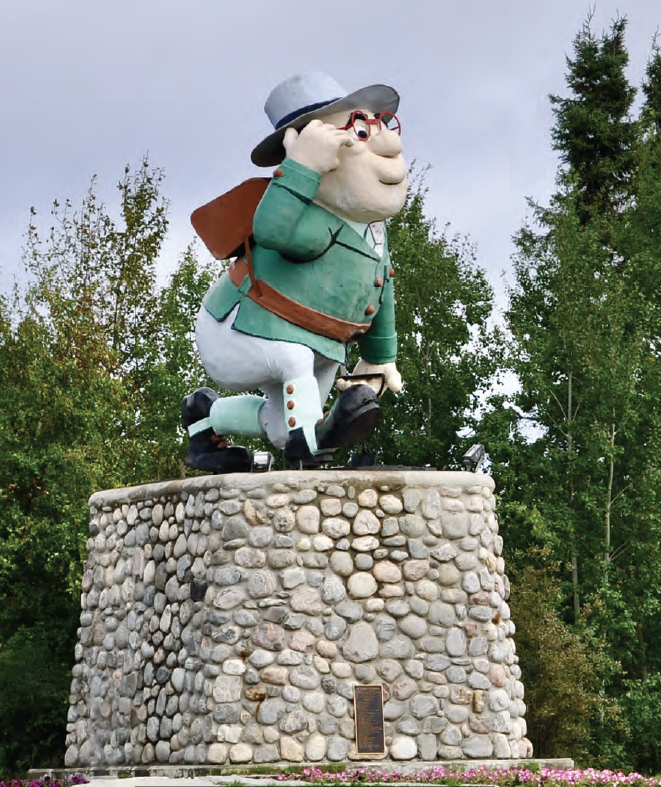
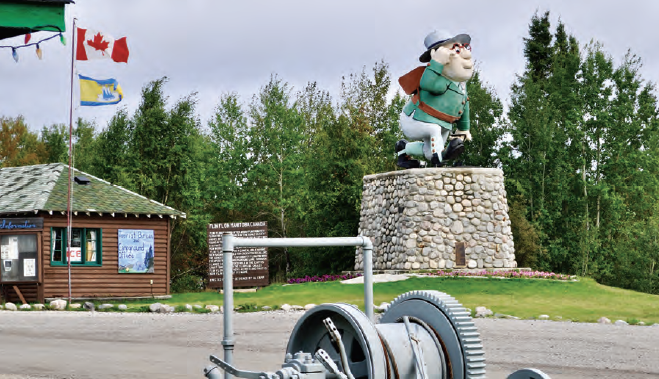
In the 1960s, the town raised a monument to Flintabbatey Flonatin –
a fibreglass caricature designed by the American cartoonist Al Capp, creator
of Li’l Abner and a menagerie of other Dogpatch denizens. Capp outfitted
one of his Dogpatchers, the bulbous preacher Marryin’ Sam, in prospector’s
garb for the monument. For several decades, the two-storey statue stood
guard on a stone plinth next to an arched gateway (“WELCOME”) at the
entrance to town (it was later moved to a park a few metres away). One
hand raised to his brow, Flinty peered into the distance, his plump bottom
turned toward town and the open pit, the hole from which he had been
mythically emitted. I imagine Creighton and crew would have laughed and
approved of this turn of events,
Today, Flin Flon looks a little down at the heels. Its population – 5,200 –
is less than half of what it was when Flinty stood guard. The mineworks are
almost entirely closed, the minerals that fed them extracted and gone.
But there are more Indigenous people living in town, which has become
more a service centre for their outlying communities. And bald eagles are
returning to compete with the ravens as the land heals itself. David Collins
would have smiled at that.
Bio:
BRYAN DEMCHINSKY is a Montreal writer and editor. After many years working at newspapers, mainly the Montreal Gazette, where he was the books section editor and later business editor, he left daily journalism. He continues to work from home and is the author of several books, including After Auschwitz: One Man’s Story (McGill-Queen’s University Press). “Fishpole Lake” is an excerpt from an upcoming memoir tentatively titled My Ukrainian Family.