
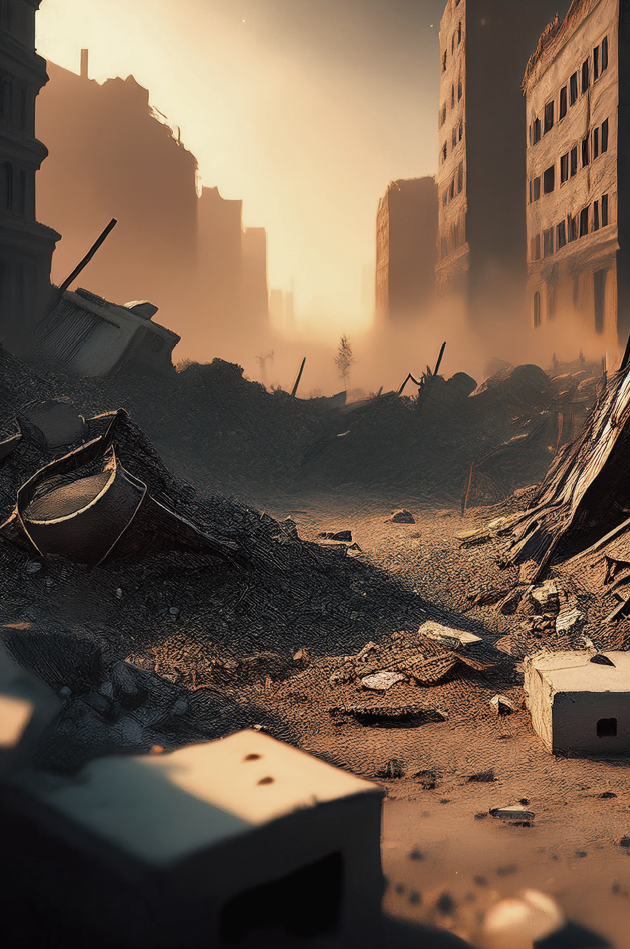
 There is something to be said about searching for your child beneath the rubble of your destroyed home. You don’t have time to be disappointed because you’re numb all around. It is a sea of foreboding destruction, and your task is to unearth your beloved from its murky waters. You search, but it is not clear what you’re searching for: a hand, leg, toy, hair. Anything that is not grey and hard is an object of interest within this dusty carnage. I know the rubble should not be called carnage: it dilutes the term, lessens its impact – but it is: these fallen walls were my home. They couldn’t keep my family safe. Like the land they were built on, they failed.
I amputated six limbs today. My hand was steady, my mind white. My movements were quick and precise, the bandaging as neat and sparse as possible. I did not look at the faces whose bodies I operated on. My movements now are hysterical. There is only so much searching before something is found. “Wael.” Mona’s firm hand steadies my arm. “You need to come with
me.”
Utter stillness is my only response. I’ve known Mona my whole life and worked with her professionally for almost ten years now: I recognize every inflection within her voice. Mutely, I follow as we trek over the wreckage that takes us to the opposite side of where I had been searching.
Finally, when there is still nothing but grey in sight, I have to ask: “Is anyone alive?”
Had I been looking away, I would have missed the jerky shake of her head, the almost imperceptible convulsion of her shoulders. No one alive. There’s a fire now that threatens to burn me from the inside out. Like lava, it rises in my throat and reaches my eyes too. I imagine the lava pouring out, scorching away my ability to see. How I wish I could cry lava. I bite my cheek to quell the fire, bite as hard as I can, but there’s no relief.
We’ve reached a small clearing. There I see what appear to be two adult bodies. Through the dusty, blackened blood and mottled features, I recognize my father and my grandmother. Three generations gather in this clearing: two generations utterly destroyed, one generation remains. Perhaps I should instead be grateful that they had reached old age in Jabaliya, unlike many of their counterparts. We have always known that the longer you live in Gaza, the greater the probability that you’ll die, until you’re living against time; that’s my father and grandmother now come to meet their fate. I can’t bring myself to feel, but I am keenly aware of the missing fourth generation. “Mona,” I demand through set teeth, “where’s my daughter?”
Mona turns her head into my shoulder. I can’t bring myself to move, remain instead a statue beneath her touch. “I haven’t found her, Wael.”
I wake up to Ayah’s hair tickling my nose. Over the past six weeks, I have seen her once a week as dictated by the rules of war. At 6:00 p.m. every Tuesday evening, the ambulance drives me home from the hospital: what would have normally taken thirteen minutes now takes one hour and ten minutes, but it’s the only way; even so, you cannot predict if you will or will not be struck. Ayah, at five years old, grasps the gravity of the situation and understands all too well why she must share her father with the world in Gaza. From the onset, there were no tears or even pleas to spend more time with me. Instead, she had made one request: that I sleep beside her at night. At first, I told her to come sleep in my bed instead – more space, more comfort when I desperately needed it. But she refused: “What’s the point,” she had asked, “of having you sleep next to me when you’re going to sleep on one side all alone? No. You sleep in my bed and hug me all night long.”
My heart had broken. Somewhere in a part of my consciousness I did not want to dwell too long in, I had recognized what my daughter was asking me: in not so many words, she had finally admitted her fear that I would die and leave her. And so every Wednesday and Thursday morning, I wake up with her fine hairs in my nose and warm breath against my throat. Her little body folds around me and invades my presence entirely, and it’s the most welcome invasion.
Thursday mornings at 5:00 a.m., the ambulance arrives to take me back to the hospital. The return is harrowing. It is no longer a place to cure the sick or heal the wounded. Instead it is a place to tally the dead, dismember the injured, and host the parentless. I remove myself – I have to. Otherwise, I’ll see Ayah in every child whose limb I sever, in every little girl whose hair is matted with blood, in every child whose heart stops and every child who, in their survival, must carry the weight of Palestine on their shoulders.
I inhale Ayah’s sleepiness into me. I inhale the scent of baby powder she unfailingly dabs behind her ears to remember the mother and brother waiting for us beyond the seas. What washes over me is so much more than love, so much more than all that I am. I swallow it, push it deep within, and implore myself to rise. Gently, with a featherlight touch, I smooth Ayah’s hair away and attempt to extract myself from her limbs.
The hitch in her breath alerts me that she’s woken. “You’re not trying to leave without saying goodbye, are you?”
“No, of course not.” The lie rolls off quite easily. “But your fly-away hair won’t keep still!”
“You’re so funny, Baba,” she mutters. “As if your beard is any better!”
I rub my scruffy beard jokingly against her cheek, and she complains louder. How to tell her that I can’t bring myself to shave when we are trying to hold on to all that we have? How to tell her that I keep my beard in mourning for all that we’ve lost? How to tell her that which rings as utterly irrational even to me when I think about it too hard?
“Are you leaving already?” Her plaintive question has become a familiar pattern.
I press a soft kiss into her hair. “Yes, habibti. It’s time for me to go.”
A quick headshake scatters the remaining sleep from her eyes. “Wait, wait. Tell me the story one more time.”
I allow myself a few more minutes of luxury in my daughter’s arms. It is difficult to temper a dream in front of a child; difficult more so to put to sleep the suffocating despair that threatens a stranglehold upon the prayer within this “story.” As much as I love Gaza, we no longer live in Gaza in this dream of mine; instead, we live in Kuweikat, where my father was born, where his father was born, where his grandfather’s father was also born. The dwelling is modest; no sprawling mansion for us, but a simple, two-story home where one can spread their arms and see a blue sky. Perhaps it wouldn’t be the same home that my parents left behind all those years ago; perhaps the key lying unforgotten within the ceramic seashell box on my mother’s bedside table – destroyed now, surely – would not be the same key opening the front door; but the land, I’m certain, would be the one that had bred my very bones.
Amir, the son I have yet to meet, born in Canada one month and eighteen days ago after I sent Asala with my life’s savings to give him a chance at a better future, would be a few years older in the story’s setting. Ayah too would be around seven or eight in my imagined, unrealized fantasies. It would be the weekend; I would have the day off to spend in the lemon fields with my family. Asala would complain that we weren’t letting her focus on her “angles.” I would tell her to paint us instead, that fate wanted her to paint our faces rather than the trees. She wouldn’t deign to glance at me, but the set of her shoulders would tighten. Her head would tilt, and that curve of her neck would say, “Our bodies and faces will disappear one day anyway. But the land – the land, if not destroyed, will remain.” Maybe in my story of all stories, the land would remain.
“There,” I announce, casually extricating myself from Ayah’s arms.
“That’s the story, and your Baba, my lovely Ayah, is very late.”
“I miss Mama,” Ayah says with one last squeeze. “But I am so happy I’m here with you.”
It feels as though the rubble has found its way into my eyelids. I blink the grittiness away. Miraculously, I had fallen asleep, but there’s no guilt. I remember shadows of an angry conversation with Mona, banishing her and the dead away. There’s no guilt at not saying goodbye to my father or grandmother either: the living take precedence, and I know my daughter is alive. There’s so much grey, I may as well be blind, and I am aware, almost intuitively, that I do not rely on my sight as much as my other un-deadened senses. Immediately, I acknowledge an internal slippage: the pragmatic materialism of before has broken down into a reliance on the incorporeal.
This newfound immateriality finds its way to my hoarse voice. Somehow, there’s a confidence there. “Ayah,” I call out. I am unsurprised when I hear a sound-like shift in return: perhaps an imperceptive sigh, a breath of life that I should not have heard, but my body is pulled forward by a force hitherto unexperienced. I stop when I notice a disruption in the greyness – possibly a shade of another colour, now wholly forced to accede to the grey. Another small shift of grey. My hands, almost removed from my body, start forging a clearing, and the debris, large or small, falls away.
She is broken, bloodied, and unpresent, but a quick search for a pulse tells me she’s alive. I clutch her to me, the frail body painfully familiar though rendered yet more frail. There’s a soaring of warmth within me, but I cannot whoop out in exhilaration: there is too much to do. I collect Ayah to my chest: there’s a dragging in her body, something pulling her away from me – something of her, yet not quite anymore, and I gather her and her near-fragments and head to the small enclave where I have left my bag. I stay close to the rubble because I am also aware of the non-stop airstrikes delivered upon Jabaliya: a christening, perhaps, of rose petals thrown upon the delusionally hopeful.
There’s a thrumming in my heart. I ignore it, and it recedes to the background, just like the rumble of war around us. I scuff my shoes back and forth on a piece of dead earth until I’ve cleared enough space for Ayah’s body. I lay her on the ground, but I forbid my eyes from seeing her.
There’s a pulse fluttering in her neck that matches the thrumming of my heart, and it is enough.
Gloves on. Tourniquet first, two inches above left knee. Makeshift, but will suffice. Wrap twice around, rod above the knot. Elevate leg. Don’t look yet.
Deep laceration along right abdomen. Check for swelling. Clammy fingers. Pause, breathe. Check again. Trust instinct; all must be well. Thread needle– fumble for it first. Stitch in then out. Pause, breathe, steady hand. Final stitch. There will be a scar. Sterilize, bandage. Move on. Dare to look up.
Blood caked around left eye. Fresh blood, innermost corner. Leave it closed. Move on.
Tenderness along left rib. Purple discolouration even in the dim grey. Nothing you can do.
Left shoulder unstable. Dislocated. Image flashes before your eyes of child flying upon impact, landing on her left. You banish the image away. Fingers check beneath matted hair on left side of head. They come away
with blood, sticky blood. Almost congealed. A sigh of relief, rush of elation. Can’t last long.
Left hand, two broken fingers. Makeshift splint, nothing else you can do.
Cuts here, scrapes there. Clean what you can. Nothing left, breathe. No more reason to avoid the leg. No more reason to postpone.
Unsalvageable. Like Jabaliya, your mind says. Like Gaza, you tell it back. Broken in two places. Where it matters most, hangs on by unicorn hair. You can’t bear to reduce your daughter to carnal knowledge. Unsalvageable.
But – before your eyes: movement. Your heart tremors.
“Baba,” she says. An apparition? Have you died alongside her? Pulse flutters in her neck. Heart thunders in your chest. You sense the dragging in her body again, loud as the screech of death.
“Keep me together, Baba.”
You observe the man slink against the shadows, stealthy as night, though night is no longer stealthy in Jabaliya. It is dark, yes: no power, no phone lines, but still loud with the same explosions that rock the ground in the daytime. You watch him as though in a theatre, bemused, amused, at his actions. Alarm registers at a distance, not enough to warn or stop him. You, aware of every impulse within him, every errant thought, are impelled to watch, only. His mind has caved, you realize. Everything within his interior points inward to one motivation: keep her together, just as she had requested. You watch this man search for something, anything, to fulfill your daughter’s bidding. He has lost himself, you think. If he manages and then dares do what he plans, he will destroy her with the two hands desperate to heal her.
You glance at your own two hands; no rope ties them together, but they are bound. You submit to being an observer, and the alarm you’d registered slinks away. The broken man prowls the night, and the minutes fall as you watch him. You are unsurprised when he jolts to a stop. He looks first to the left, then to the right, making sure he remains unseen. He doesn’t see you – but maybe you can’t be seen. He crouches against the ground, and his practised movements are quick. Checks the pulse of the small body on the ground. Smiles when it’s not there despite the warmth of skin. Beads of sweat form on his brow as he grips his wire saw and meticulously works
through the child’s femur. He knows what he’s doing. He has prepared a case for the limb. Wraps it in carefully and hurries off, leaving a bleeding body behind him.
Something falls within you, but your hands are tied. Unthinkingly, you wipe the sweat from your brow. You follow, and he feels the hollowness inside.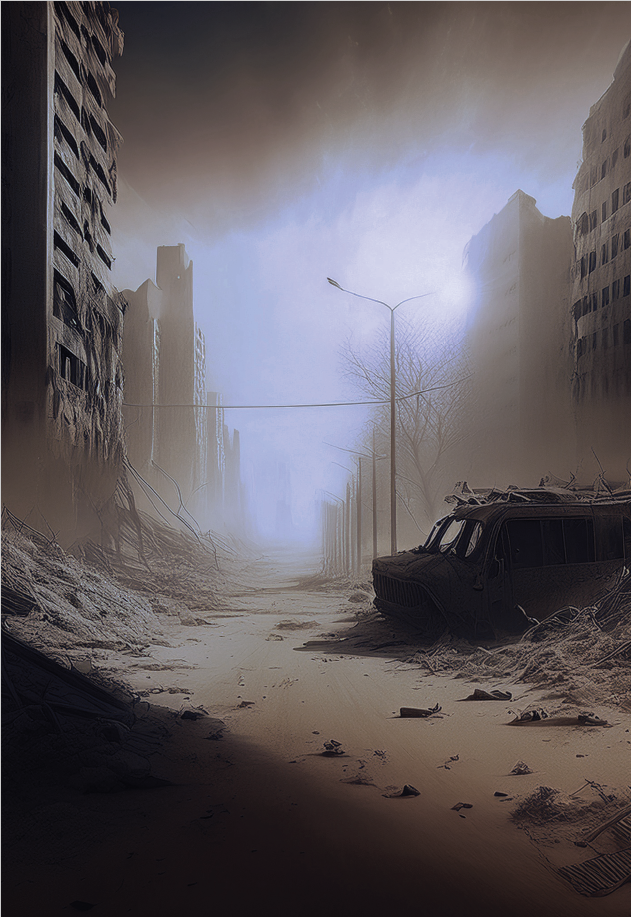
Bio:
FATIMA ABDALLAH is a PhD candidate in Western University’s Department of English and Writing Studies. Her research interrogates Arab women’s prison literature and builds on anticolonial, postcolonial, and feminist methodologies. Her work, literary and academic, has appeared or is forthcoming in the Lamp, Journal of Palestine Studies, and Studies in Canadian Literature (SCL/ÉLC), among other publications.