
“Soft hands” is hockey term praising a player with a deft and
unhurried scoring touch in frenetic scrums around the net.
I don’t have soft hands. What I do have are fragile hands. And wrists.
And, I discovered recently, ankle.
In a half-century of playing non-contact recreational hockey as boy
and man, I’ve broken a wrist (40 years ago), the tip of my thumb (around
10 years back), and most recently, and debilitatingly, my right ankle.
After 10 months away, disabled by that break, I have returned to playing
hockey. Almost everyone I knew advised – Don’t! Quit! or You’re done!
I never had any doubt I’d return. Well, few.
To be honest, I’m not very good at hockey. I never have been. However
that hasn’t, at any stage, interfered with my enjoyment in “lacing ’em up”
and getting out there with my peers – well, mostly my betters – and playing
the game for the joy and camaraderie and sheer Canadianism of it.
On a morning in late November playing seniors’ shinny, I slid oddly
backwards into the boards by the blue line with my foot pinned underneath
my bum. I hit and knew it was bad. Play stopped immediately, as is the
custom in a gentlemen’s pickup game. I was ringed in by players and a
chorus of “Are you okay?” I wasn’t and was coasted off the ice and hopped
to the dressing room, heavily supported by a teammate on each arm.
Lathered with the perspiration of pain, I took the skate off the foot below
the damaged ankle, and “Doc” came in to take a look. In my decades of
experience, there always seems to be a guy called “Doc” on one team or
the other, and sometimes he actually is.
He didn’t like the look of things. That made two of us. He suggested I get to the hospital toute de suite. In any language, “Now!”
A series of X-rays and sweet serendipity followed. A break, a particularly bad break (dislocated fracture), was indicated, but someone’s fortuitous cancellation with an orthopedic surgeon at that same hospital, on that same day, made lickety-split surgery miraculously available. Seven hours after lying on the ice by a blue line, I was lying in an even chillier operating theatre counting backwards from one hundred as an anesthetic was taking hold.
I awoke, repaired, three metal plates and nine screws heavier. Rehabilitation was to begin two weeks later when the plaster cast
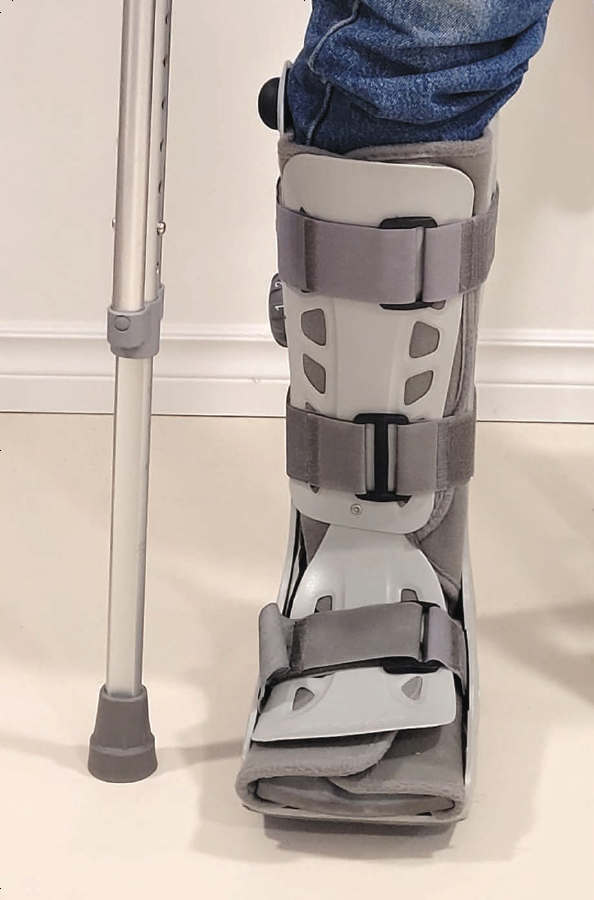
would be replaced by a removable hard plastic boot. Sometime during that spell while lying in bed feeling sore and sorry for myself, a surprising – even to me – resolution kicked it. Damn what all these people – loved ones, friends, and opinionated acquaintances – were telling me; I was going to heal, to rebuild bone and stamina and get back on skates and back to playing hockey.
I was going to pick up the puck and wheel low and fast behind my own net doing driving crossovers, power up through the neutral zone, spine erect over legs bent for power, dance with stutter-step cadence by the defence, and roof it into the net after a highlight reel deke to score the first goal, of many, on my return.
Some of this fantasy may have been the pain meds talking, but then and there I committed to returning to the game. Even if it was a return to mediocrity.
My diet changed. I stocked up on a cornucopia of bone builders culled from Internet searches: sardines, herrings, dates, figs, yogurt, almonds and almond milk, kale, broccoli, blueberries, odd cheeses, vitamins D, C, and K, and nary a comforting Twinkie or nacho chip amongst them.
I’d never eaten kale. I detest broccoli. I was unaware you could milk an almond. Never mind. I ate it all and more every day, for weeks, then
months. I came to love dates. Almonds replaced potato chips as snacks. Kale was okay. Broccoli remained unloved.
Once I could remove The Boot, I subjected myself religiously to a regimen of ankle twirls and flexes, oscillations and toe pointing. All of the
above could be combined into rehab-doctor-recommended writing of an imaginary alphabet with my big toe.
If you are going to break an ankle and use crutches, it is recommended that you do so in April. There are fewer snowdrifts, ponds of slush, and ice patches. These are the mortal enemy of the encrutched. It is quite easy to slip, fall, and break the other ankle. Or hip. Or both. I came close.
Through the winter, into spring, then summer, I progressed from crutches to cane to limp … to frightened. Hockey season was starting in
September. I had to put on skates. The very thought of doing so had me scared stiff. I could point my toe and write endless alphabets, but had real difficulty imagining pointing my toe, then foot, into a rigid, precariously balanced ice skate. And then stepping onto a slippery surface while teetering on two of them.
But I did. I sat in civvies and socks in an arena change room full of moms with tots and preteen girls readying for a pleasure skate. The latter wore leg warmers. I wore the grim expression of a man certain he was shortly to stand, hear a “crack,” then fall in a writhing heap. I’m not kidding.
It didn’t happen.
I walked oh-so-gingerly to the gate of the rink and stood regretting being there, regretting the months of kale and the broccoli eaten and the
Nanaimo bars forsaken. I stood there for some time before stepping onto the ice, clutching at the surrounding dasher boards like a miser to his first nickel.
Without the accustomed hockey stick for balance, I clomped and
clutched along the boards, circumnavigating the rink in short Frankensteinian
strides. Gradually, fearfully, I loosened, and my strides lengthened. I was
skating – skating like a novelty bear in some seedy Eastern European circus.
Within the hour, I was skating for real, but bathed in perspiration from the concentration. I couldn’t stop – that is, I could arrest my forward
progress only by grabbing something solid, such as the boards, a stanchion or, in one case, an unamused mom.
I left wet and elated. I’d skated. I went again the next day. And the day after that, just circling. If the crowd skating was thin, down to a handful, I’d ask if we could reverse the direction, explaining that I was rehabbing
and needed the ankle strain of circulating in both directions. People understood. They complied.
Effecting a stop in hockey skates is simple physics; one arrests forward motion, often rapid forward motion, by a little hop and turn perpendicular to the direction of motion while leaning slightly back and digging the sharpened edges of the skate blades forcefully into the ice. In stopping thus, the force of the stop and the weight of one’s body are concentrated wholly on the ankles.
I’d seen my X-rays. My right ankle was a Meccano set of metalwork – rectangular plates fixed to bone by a vertical palisade of screws.
I’d skated in circles, in both directions, for more than a month. My legs were getting stronger. My stamina was building. A medical doctor had said I was good to go. Hockey would resume in a week. A spot was saved on a team. I had to start stopping.
Winding up behind the blue line, I picked up speed and aimed for centre ice. I held my breath, gritted my teeth, jumped lightly, spun sideways … and stopped in a spray of ice that would have made NHL superstar Connor McDavid proud. Well, Connor McDavid aged six, perhaps, but I was proud – hugely, inordinately proud of myself.
For the last ten minutes of that pleasure skate session, oblivious to the stares of the few circulating lunch hour moms and tots and entirely out of step with the ubiquitous arena skating music, I stopped and started, stopped and started, again and again, jerking back and forth in the middle of the rink like a manic fiddler’s elbow.
I was back!
I’d forgotten I was lousy. And that I would return to senior men’s hockey both damaged and lousy.
The first game back I was slower than usual. I kept well away from the corners of the rink, from the boards, and from everybody on
either team, if I could avoid them. Players knew why and kept away from me, showing respect (for my damage, not my talent) and welcoming me warmly.
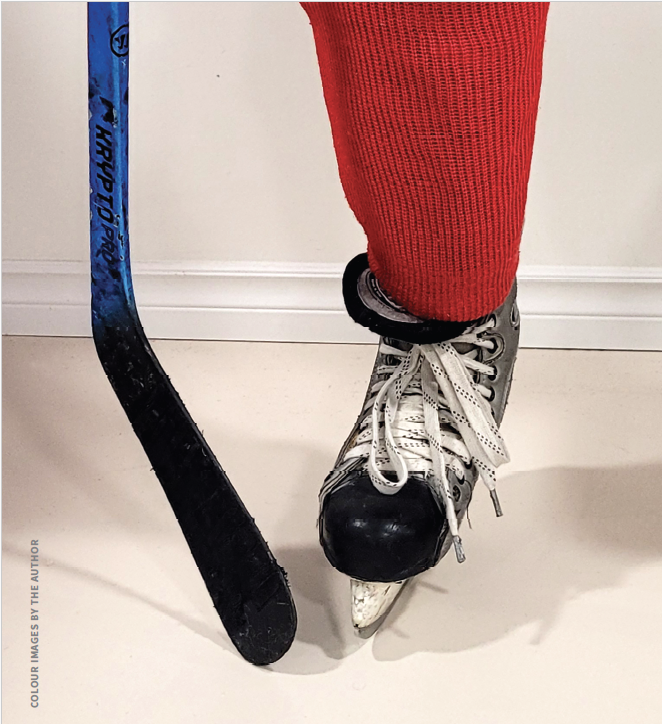
After the game, as I sat in a small, smelly dressing room stripping off skates, shin pads, and long red hockey socks, my ankle hurt. It always will after hockey. It felt great.
Bio:
Anthony Jenkins proudly plays hockey and types with two fingers near Stirling, Ontario.