
For a few years I believed the name I’d heard myself called in East Africa was Wazungu. Later though, after returning home, I discovered that what I’d really been hearing was Mzungu, and a bit of poking around confirmed something I’d been told at the time – that the word suggested someone who goes about in circles. According to a quick look at Wikipedia, Mzungu is used predominantly among Swahili speakers as a blanket term for white people, dating back to when a good number of the early Europeans who showed up in that part of the world tended to wander about, without appearing to have much purpose or sense of direction. This was not the only word from my drifting about in southern and eastern Africa that ended up a bit muddled. There was also samosa – which I first heard pronounced by a pretentious-sounding white Zimbabwean a samohsah, and from there went on to transform during my travels, becoming samoosa, then on to sambusa and ending up a little uncomfortably in Madagascar as sambo.
Another term that proved difficult to pin down at the time was how to describe myself when I showed up in another country carrying luggage. The first time I fumbled my way around the world, in 1986–87, it was with what resembled a suitcase, my then wife and I having started out with the decided intent of wanting to distinguish ourselves from “backpackers.” Why? If anything coherent could be said about it, it probably had more to do with appearances than anything philosophical, though there may have been a little of that to it as well. So, that first time round the world I was … Well, what was I? Evidently not a “backpacker.” Was I trading in hard distinctions between “tourist” and “traveller” at that point? Possibly – but by the time I stepped off the plane in Zimbabwe in late February 1989 I was none of these. Because if I’m to be honest, I was a 25-year-old runaway. Running from the work I hated, from a system that insisted I sell my time and labour, from a place that would be cold for nearly half the year, and of course from myself and the ridiculously short-sighted marriage I’d impetuously thrown myself into, and which had all too predictably fallen apart. Zimbabwe turned out to be a good place to hide from all that. My mother was there – she’d run away too – and though in some sense she was never a very motherly mother, she did have me stay with her – her and the other people in the house where she was living, in Bulawayo.
But back to my tangled notions of what it is to wander about in unfamiliar places. At some point during my stay with my mother, I was talking to one of the other people in the house, a man who’d driven overland from Algeria to Cape Town in a VW bus. He told me about someone he’d bumped into along the way, a young white man going about on foot in what was then Zaire. According to the story, this young man had next to nothing with him – no bags, no plan, no expectations – just himself and a mosquito net stuffed in his back pocket, and when he’d arrive in a village he’d simply present himself and see where things went from there.
Was it true? Could a person really put their trust in the cosmos in this way? Well, whether they could or not, for me this mythical person and his mosquito net became a kind of icon, a symbol standing at the furthest end of the continuum, an extremity that existed as the polar opposite of the package tour. I found the idea of him both inspiring and daunting. And in the months following my stay with my mother, once I’d set off beyond Zimbabwe, he took a seat at the edge of my thoughts and would smirk at me from time to time as he watched me go about in circles.
I hadn’t any set plan of what to do when I arrived in Zimbabwe. My main ambition was to get to India at some point, though I never did. Besides my mother, the only other excuse I had for arriving in Southern Africa was, for some unfounded reason, a desire to see Madagascar – and I did get there, but only after what felt like a fumbling episodic sequence of Fellini-esque steps that started in the Zimbabwean border town of Mutare – entry point to Mozambique.
A sensible person would not likely have started out as I did, by heading for Beira on the Mozambican coast, but a couple I’d stayed with in Harare had spent some time in Mozambique, and when I told them about my desire to get to Madagascar and wondered out loud if it was possible to get there by ship, they helped me obtain what I was led to believe was a bit of a rarity – a one-month visitor’s visa for Mozambique, the country on the African coast facing Madagascar. I found no ship when I got there – didn’t even look, really – but I did discover a little of what it felt like to shamelessly thrust myself on the world to see what would happen.
Getting to Beira took a couple of days. I began at the border crossing bright and early, intent on hitchhiking. Actually, there were no other options. Mozambique was in the middle of a civil war, and there were no trains or buses to catch. I have no recollection of who picked me up or how long it took to make it to Chimoio, the town where I stayed at the end of that first leg, though I’ve a general impression of the route being the crappiest road I had ever seen in my life, not so much a road as a series of enormous holes connected by ridges of dirt, the odd scrap of pavement, and a bit of wishful thinking.
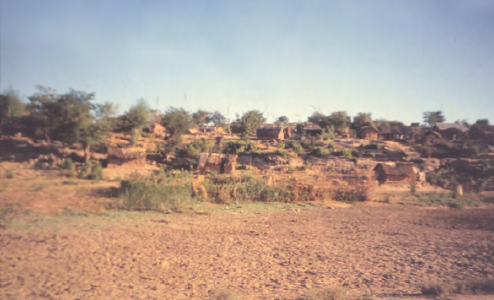
What I do remember is that I got to Chimoio not long before it started getting dark and soon realized that my efforts to find any kind of I rode through the countryside of Mozambique over the worst highway I had ever seen, a result of the country’s ongoing civil war. accommodation were unlikely to get anywhere because of the crowds of people seeking refuge in town as a result of the war. I tried a few places without any luck, and kept wandering. I watched some kids playing a dancing game in a park, was approached by some nutcase with a transistor radio, who let on in broken English that he was receiving messages on his radio directly from the CIA, and finally I spotted what would turn out to be a piece of good luck – another white man. He was wearing a loose-fitting white shirt and white pants and, fortuitously, spoke English. His name was Yves, I think, and he was a doctor from France working for Médicins Sans Frontières. When I asked if he knew of any place I might be able to find a bed, he said to come with him. He had one.
He lived with one other person, a Belgian, who worked alongside him in some sort of driver/person-Friday capacity. They fed me and gave me the address of someone they knew in Beira who might be able to put me up, and the Belgian told a traveller beware story about popping a raw cashew in his mouth, which resulted in him getting blisters on his lips. And then the Belgian lit up a joint, and I did something I’ve only rarely done – I had some – and almost immediately had to climb into bed.
In the morning, they dropped me off at the outskirts of town on the road leading to Beira and wished me luck. A couple of women in a rattly old Peugeot stopped for me and asked how far I was going, but when I said “Beira,” they shook their heads. Once or twice Zimbabwean army helicopter gunships swept by, close overhead – it was the Zimbabwean armed forces that kept the Mozambican road and parallel rail line open. Since landlocked Zimbabwe shunned apartheid South Africa, the road and rail links to Beria were among Zimbabwe’s few viable surface routes for trade with the outside world. Keeping them open was an economic necessity.
I don’t think I waited terribly long before getting a ride. A couple of men in a small pickup truck squashed me into their cab alongside them, and off we went, the road about as bad as the day before, the air growing warmer and more humid as we drew nearer the coast. At some point, a wall of dark cloud stood in front of us, putting the brightness of the foreground into stark and breathtaking contrast. Did it rain? I think so. A heavy downpour, the streets of Beira all wet when we got there. The two men took me to a restaurant, bought me a meal, and then drove me to the address I’d been given the night before. Then we shook hands, and off they drove.
The building where I was dropped was three or four stories tall, the apartment I was looking for on one of its upper floors. When I knocked on the door and said that Yves had given me the address, the two men who lived there, both British, unquestioningly took me in and showed me a room I could have. Altogether, I was there something close to a week.
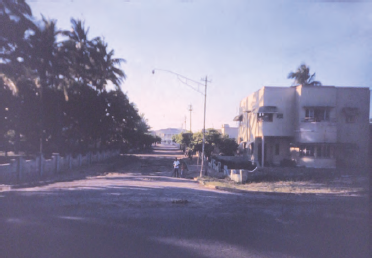
Though much bigger than Chimoio, Beira was also clearly feeling the effects of the war. Its population had swelled. The fighting might have been largely confined to rural areas, but this effectively turned most towns and cities into something like islands or life rafts dotted about the country, each cut off from all the others. And whether it was because of the war or other strains, water was being rationed. I forget how often it came on – once or twice a week, perhaps – but when it did the bathtub would get topped up and stay that way, a sort of permanent reservoir. I seem to recall electricity being rationed as well, but perhaps I’m wrong about that, because it was certainly always on through the night, and powered the fan that was in my room, the fan that kindly kept the mosquitos away while I slept.
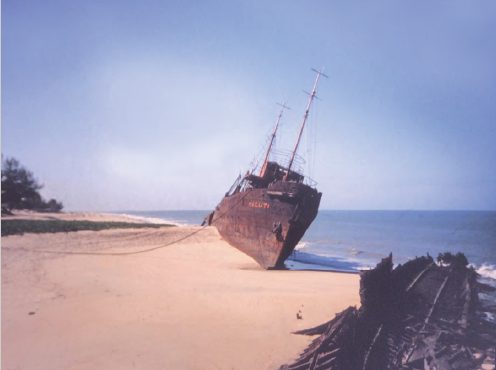
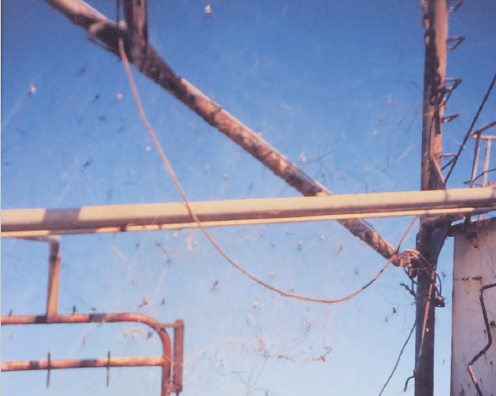
I spent my days wandering about town. I visited the railway station, a large, modern-looking concrete thing that would have gone mostly unused at the time. I stopped in at the post office, where I bought stamps – I bought these in every country I passed through, whole sheets of them when I could. I can’t remember any restaurants I visited, but I was down on the beach several times, a long stretch of sand that ran for kilometres along the waterfront, dotted with several shipwrecks, one of them inescapably making an enormous impression on me because of the number of massive spiders and spider webs strung in a patchwork between the various masts, as if trying to manifest some macabre notion of a sail. I’m not sure where it came from, but I was given the impression these ships had been scuttled when the colonial era came to an end in 1975, one of several acts of purported destruction at the hands of the departing Portuguese, in what was painted for me as an attitude that seemed to say, “If we can’t have it then neither can you.” I’ve since seen some doubt shed on the degree to which this was true, but true or not, this was what was being said when I was there.
I visited some shops, and I made a special visit to the market because I wanted to do something to thank the two Brits for putting me up, so I offered to make them a meal. When I asked where would be best to pick up a few things, Davy, one of the Brits, mentioned the market, and when he found out I knew a little French, he said, “You’ll do fine. Portuguese is just like French.” This was simply untrue. Portuguese is not just like French. At least, the Portuguese I was hearing was nothing like the French I’d learnt in high school. But I muddled through, and the vendors in the market were only too happy to do business. I can’t recall what I ended up cooking, but I think it went over well enough. There’ve been more than a few times when it’s been helpful knowing my way around a kitchen.
Visiting the shops was another thing. I went to them because I had to. At some point I washed a bunch of my clothes, socks and underwear mostly, and hung them out on the clotheslines on the balcony of the apartment – a balcony that was completely encaged with thick iron bars in order to discourage thieves, but which apparently only presented them with a challenge, because while I slept all my socks and underwear were fished through the small gaps between the bars, despite being three or four floors up, and supposedly with some kind of security person down below who was meant to be keeping an eye on things through the night. This left me with the socks and underwear I was wearing. So, off to the shops I went – and was sorely disappointed. I did find what I was looking for but soon discovered that the socks, though cotton or cotton-like, were eager to slink earthwards into my boots, and the underpants … well, the only ones I could find were bikini-like, mint green, two sizes too small, and made of some sort of synthetic fibre that my skin objected to almost at once.
It must have become obvious fairly soon after I’d arrived in Beira that being there was not going to help me get to Madagascar, and that if I wanted to get there I was going to have to try something else – so I decided to head north and bought myself a ticket on a state-subsidized flight to the city of Tete, where I could meet the daily convoy called “the gun run,” which made its way along another travel corridor the Zimbabwean army helped keep open through Mozambique, the trade route connecting Zimbabwe and Malawi.
The night before the flight to Tete, the two Brits had some people over, and we stayed up late drinking. One of their guests was a beautiful woman who became strangely outspoken in her interest towards me – which, I’ll admit, had me thinking I’d gotten lucky – but as the evening wore on she drank exactly as much as was needed to pass out, and that was that. I woke early in the morning and walked to the airport. I had to. There was no other way to get there. It took about an hour, and when I arrived people were crowded two and three deep around the counter where I needed to check in. It was one of those moments where I had to abandon an idea or two of what it means to be me – and became assertive. I gripped my ticket tightly and thrust my arm through the wall of people in the direction of the counter, where some unseen person on the other side accepted it and exchanged it for a boarding pass.
The plane was packed, the flight not very long, like island hopping, but instead of water it would have been a kind of unseen misery that went rolling by beneath us. After getting off in Tete, I was once again faced with a good walk, this time into town, but in the parking lot outside the airport I saw my opportunity, a woman loading a couple of bags into a Toyota Land Cruiser – yes, a white woman. And for the second time that day I put aside my normal self and approached her. It turned out she spoke English, so I asked if she knew anything about how to get into town, and she told me what I hoped she would, that she could give me a lift. It was probably this woman who filled me in on the where and when of how to meet up with the convoy going towards Malawi; it turned out that it would set off the following morning from a staging area that was a little farther along the same road that served the airport. It might also have been this woman who told me that, whatever I did, I should not take a picture of the bridge in the middle of town crossing the Zambezi River. Being caught doing this would lead to all sorts of trouble, because of the war and fears of sabotage.
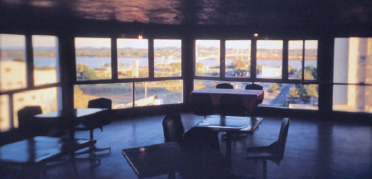
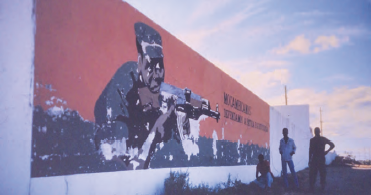
She took me to a hotel in the middle of town, a big modern thing, five or six stories tall, which somehow had plenty of empty rooms. I paid for one – the first and only room I paid for in Mozambique – and dropped my pack, then went to the restaurant on the top floor for something to eat. I must have been the only one there and can’t remember if I ate anything or maybe just had something to drink, but I do remember there being a decent view of the town and the river and the bridge – and when the server left the room for a moment I snapped a picture of it. Why? I’m pretty sure I couldn’t tell you. But afterwards I wandered the streets of Tete for a few hours and wound up attracting a bit of attention in one dusty neighbourhood and was followed about by a few young people, including a soldier who spoke a few fragments of English and asked if I’d send him a dictionary when I got back to Canada. I took a picture of him and some of the others standing next to a revolutionary mural, then went back to the hotel and turned in.
As I had the morning before, I set out early towards the edge of town – a walk of ten or twelve kilometres, maybe more. More than anything, I wanted to be sure I wasn’t late. I went along for a good while, had even made it past the airport, I think, when a large army dump truck that was going past slowed to a stop and someone in the cab motioned me to climb up in back, into the box. Others were already in there, locals, and they reached down and took my pack and helped me clamber up and in, and off we went, the kilometres dropping away much more quickly than they otherwise would have. And for me, I think this probably wins for least conventional ride of all time, though I don’t believe it got me all the way to the convoy’s staging area. Close, perhaps.
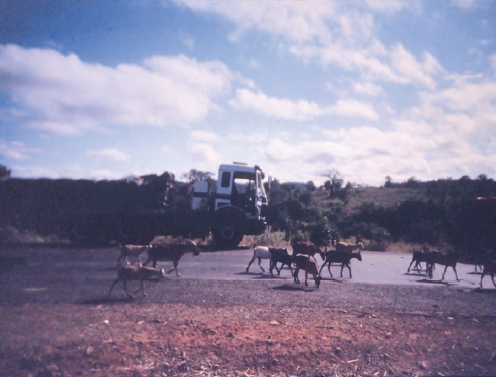
I’m not sure how I knew where to wait – someone must have told me – but it looked and felt like the middle of nowhere, just a stretch of road and nothing to say whether it was the right place or not. For a long while I was pretty much the only one there – me, my pack, a couple of dried up bushes, one or two leafless baobab trees in the distance, and at one point a shepherd going by with his goats. I stretched out in the dirt in the shade of one of the bushes for what had to be a couple of hours. Eventually vehicles began to show up – transport trucks, mostly. These trucks were what I’d been waiting for. I’d heard that if I wanted to get a lift with the convoy I’d have to make a deal with one of the drivers – and I tried. I went from truck to truck, but it was always the same. No driver would take me. I don’t think I ever found out why. Had it become policy not to give anyone a lift? Were there insurance concerns, or fears that a white face might draw potentially lethal attention? In the end someone pointed me down the row of vehicles to a bus – there was actually a bus – a decrepit old thing with the name “Marco Polo” affixed somewhere to the side of it. Company name? Bus model? I don’t know. In any case, I got on. They had room for me, or made room. The way I remember it, I had a seat, but it’s just as likely I had to stand, and I’m sure I would have been fine with that.
There was another spell of waiting, but finally the army escort arrived. An armoured car zipped past to the head of the column, and shortly after that things got underway. Once again, the road would have been terrible, and we barely crept along, but for some reason I hardly recall any of that. It may seem strange, but I’ve only one memory of this leg – a small village we skirted past, a column of smoke rising from it, evidence of recent conflict, I supposed – a few people standing woodenly at the side of the road watching us go by. If not for them and their village, and the very idea of having to travel by convoy, the whole of it might easily have been mistaken for any other crawl down a crappy road.
The distances involved weren’t all that great; still, it was already growing dark by the time we hit the Malawi border. Getting through was no problem and went quickly. The issue was how to get from there to somewhere I could spend the night. An elderly friend of my mother’s in Bulawayo had given me the address of her nephew in Blantyre, which wasn’t that far from where I was. It was just that even if I could get there it would be a little late for a call out of the blue from a stranger. There was no chance of getting there on the bus I’d been on – it went no farther than the border.
So, with no other choice, I decided to try once more getting a lift on one of the transport trucks, and to my surprise one of the first drivers I asked said sure, but wanted to know what I could pay. “How much do you want?” I asked. He shrugged. Somewhere along the way, on the bus or while waiting to go through customs, I’d traded the last of my Mozambican currency for a handful of Malawian kwacha. It wasn’t much, but I offered that to the driver, and he was okay with it.
A couple of minutes later we were on our way, driving down a road that was so different from the one on the Mozambican side it was almost surreal. It was smooth and paved, freshly painted and sign-posted. Malawi, at that time, was one of the few African countries to have an open trading relationship with apartheid South Africa. The truck I was riding in – and pretty much the whole gun-run convoy – was part of that, bringing goods to the Malawian market, and the result of this trade, at least in part, appeared to be a relatively plump economy and a few well-maintained roads.
After an hour or so on the road, I was dropped in the centre of Blantyre and began looking for a place to stay, but everything was so expensive – ten times more pricy than I could afford. I consulted the guidebook I had with me and saw an option listed that I decided to try. It said there was a country club in town that would allow me to pitch the small tent I had with me in some grassy corner, so that’s what I did – went to the club, pitched my tent, then went and sat at the country club’s bar, which was still open, and splashed out for a meat pie and a scotch, both of which were ridiculously well appreciated. And it was absurd, the differences – where I’d been that morning, not all that far away, and where I was sitting just then.
In the morning, I called the nephew of my mother’s friend, and in no time he came and picked me up and drove me to his home, a townhouse of sorts, where I met his wife and their baby daughter. I stayed with them a couple of days, and I feel we were all maybe a little puzzled at my being there. I know I was. They seemed so upright and clean-cut, a bit as though they’d been stamped from a mould labelled “Nothing Odd Here.” I don’t imagine my intrusion was hugely gratifying to them. Still, they were good to me. The nephew’s wife drove me around town and showed me the sights, which included a large field arrayed with tents that had been set up to welcome the Pope, who’d visited just recently. We stopped in at the post office, where I bought more sheets of stamps, and I can’t remember where else we might have gone, but one thing was certain – it was a town that looked to be doing fairly well. When I wandered about on my own I was surprised by how tidy everything was, and the one bookstore I stepped in felt every bit like something from back home. It was bright and shiny and modern and had a fair selection of recent titles, something I hadn’t come across in my time in Zimbabwe.
And there was another thing I came across that I hadn’t seen in Zimbabwe – fish and chips. Fresh fish was nearly unheard of in landlocked Zimbabwe, but in Malawi, also landlocked, it turned out to be a different story – Lake Malawi, one of the enormous Rift Valley lakes, had more species of fish than any other lake in the world. I got all excited and ordered myself a plate – it was just a small shop – and I’d hardly settled myself into a chair before I’d wolfed it all down. It was so good I ordered a second plate, and down it went too – all of which turned out to be a bad idea, because that evening I was in rough shape.
It might have been for my benefit, I don’t know, but the people I was staying with had a few others around to dinner. In the meantime, in the wake of my fish-and-chip bonanza, I’d become quite ill. Ill is maybe the wrong word for it, but I was having trouble focusing on what people were saying and could think of almost nothing I’d like better than to climb into bed. When asked questions, I was barely able to come up with a reply. I don’t know why I didn’t just say how I was feeling, but I didn’t, and somehow I fudged my way through dinner and went to bed as soon as I could, incapable of worrying any longer what anyone might think.
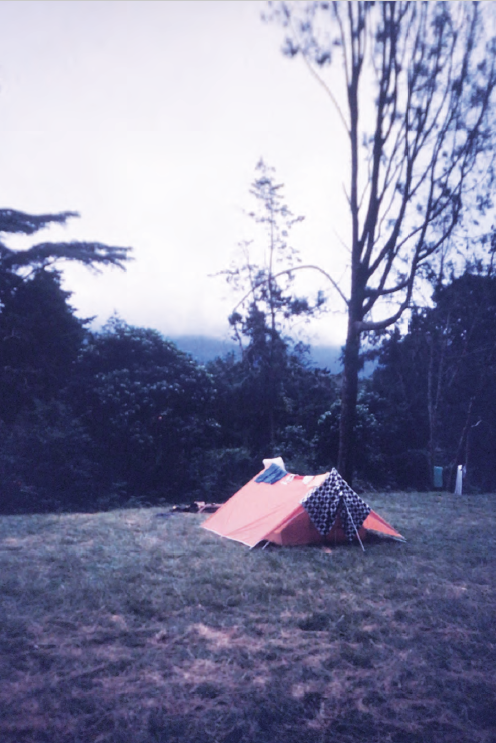
The next morning, it was as if nothing had happened. I felt fine and got on a bus and headed north, and stepped off a short while later in the town of Zomba, at the foot of the small, self-contained Zomba Plateau, where I’d heard it was possible to camp. I thought that getting onto the plateau was going to be a bit of work. There was a paved road that wound its way up, and I either stubbornly or stupidly decided to just start walking. This, however, turned out to be a lucky choice, because before I’d made it far at all a truck pulled up alongside me, and like the dump truck driver in Mozambique, this driver motioned me to hop up in back – which was not so simple. It was a flatbed truck without the flatbed, just the frame. I hauled myself onboard, behind the cab, and braced myself as best I could, legs spread wide, a foot on each of the frame’s steel beams, the naked drive shaft spinning round beneath me. This ride got me to the top in a fraction of the time it would have taken walking, and when I jumped off, someone was kind enough to point me in the direction of the campground – basically, an open stretch of grass the size of a soccer pitch, surrounded on all sides by trees.
It was only after I’d set up my tent and unrolled my sleeping bag that the previous day’s fish and chips decided they weren’t done with me, and I found myself running for the toilet, thankfully not far away. Rarely in my life have I been caught that short – undignified, embarrassing, yes – but at least it proved the last of my paying for that particular bad idea.
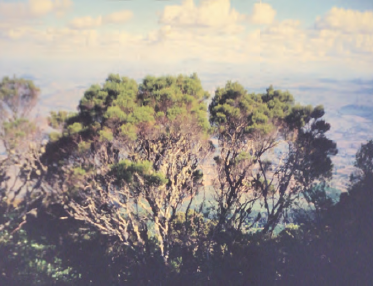
I can’t remember if I stayed up on the plateau one night or two, but I know I spent a while exploring. It was cooler up there, and I can remember there being dense evergreen forest and a path that traced the plateau’s edge, the country spread out so far below it looked almost map-like. With little to do, and surrounded by a kind of calm I hadn’t known for nearly two weeks (but which almost certainly felt longer), the plateau felt like something of an interlude, an intermission of sorts – but it’s quite possible my thinking of it this way owes a good deal to my looking back on it now.
Bio:
Joe Davies’ writing has appeared in the Dublin Review, eFiction India, the New Quarterly, the Missouri Review, EVENT, Planet: The Welsh Internationalist, and now and again in Queen’s Quarterly. He lives in Peterborough, Ontario, and aspires to no other claim to fame.