
Queen’s AI (artificial intelligence) governance model provides a coordinated approach for guiding the responsible use of artificial intelligence across the university.
The structure connects academic and administrative decision makers, supports informed planning, and ensures that AI activity aligns with institutional values, strategy, and academic policy.
The AI Nexus provides advice and recommendations to the Queen's Digital Planning Committee, and where academic matters are implicated, to Senate subcommittees.
Role of the Queen’s Digital Planning Committee
The Queen’s Digital Planning Committee (QDPC) oversees how GenAI will be integrated and used at the university and how risks will be reduced or mitigated. QDPC ensures that AI deployment aligns with organizational values and goals. Within its mandate, QDPC will:
- guide the development of policies, standards, guidelines, and controls that support responsible AI innovation.
- prioritize and monitor AI initiatives and projects, assessing them against other strategic needs.
- direct activities such as risk management, technical standards, and implementation planning.
QDPC serves as the central body for guiding digital strategy, digital integration, and university wide AI priorities.
Queen's AI Nexus
Purpose and Goals
The Queen’s Artificial Intelligence (AI) Nexus will act as a strategic advisory body, reporting to its three sponsors: the Queen’s Digital Planning Committee, the Senior Leadership Team, and Board of Trustees. It operates under the supervision of the Provost in service of its sponsors. Its primary focus is on AI, ensuring alignment with institutional objectives through collaboration with the Nexus panels on teaching and learning, research and research administration, and operations.
The Nexus will report to the three aforementioned sponsors. Membership will include: the special advisor on Generative AI and the chairs of the three Nexus Working Groups, plus assorted ex officio members as chosen by the Provost.
With a defined scope of activities inclusive of teaching and learning, scholarly activity, and operations related to generative AI, the AI Nexus shall though its actions and subcommittees:
-
Lead AI-related projects with institutional relevance for staff, faculty, researchers, and students.
-
Uphold transparent governance and ethical integration.
-
Align AI practices with university values, policies, and legal standards.
-
Foster engagement with the Queen’s community on AI issues.
-
Assess and respond to AI’s broad institutional impact, including ethical risks, financial considerations, and operational sustainability.
-
Support informed decision-making across faculties and administrative units with review of decisions, advise on approaches, and sharing ideas across campus and beyond.
-
Promote external and internal collaborations that enhance AI’s role in academia and the public sphere.
Meeting Frequency, Duration, and Modes of Communication
-
The subcommittees will meet monthly for its first year, re-evaluating the schedule thereafter.
-
Ad Hoc Working Groups may convene between meetings to maintain progress.
-
Communication will be facilitated via Microsoft Teams and direct correspondence with the Special Advisor on Generative AI.
-
The committee has an initial two-year term, with the potential for renewal based on evolving university needs.
AI Nexus Subcommittees
The Nexus Subcommittees operate under the AI Nexus’s direction, offering expertise in teaching and learning, research, and operations. Their primary function is to guide AI-related initiatives through evidence-based recommendations, constructive feedback, and strategic identification of emerging AI applications.
Each subcommittee consists of a multidisciplinary group. Participation is open to all, with an initial membership call concluded on September 1st, 2025.
Operations Subcommittee
Mandate: To guide AI’s integration into administrative and enterprise operations, ensuring ethical usage, security, privacy protection, and efficiency in university workflows in service of its mission and values.
Membership: Chaired by delegate(s) of the Vice-Principal Finance and Administration (For 2025-2026 it is Jeff Glassford and Leah Wales), with a diverse pool.
Key Initiatives:
Establish, review, and disseminate AI usage guidelines, as appropriate, in operations, procurement, and development of content, tools, apps, and resources.
While this subcommittee is focussed on operational and institutional initiatives, specific consideration to their impact on the people of Queen’s remains a priority
Develop protocols for privacy and security in AI technologies.
Support new and existing spaces at the university to guide and refine AI solutions proposed by university personnel within their various roles.
Develop procedures for piloting, assessing, and appraising the utility, sustainability, and ethical implications of new AI-powered technologies.
Consult on AI’s ethical implications in university functions.
Recommend professional development opportunities for AI literacy, responsible AI use, articulation of novel use cases, development of tools, and other opportunities for integration of AI into workflows and procedures.
Participate in cross-institutional discussions to refine best practices.
Name | Representation |
|---|---|
Jeff Glassford (Co-Chair) | IT Services |
Leah Wales (Co-Chair) | Student Affairs |
Sarah Williams | Human Resources |
Stuart McPherson | Registrar |
Michael Polpette | University Affairs |
Troy St John | Business |
Catherine Stinson | Computing/Philosophy |
Nadia Jagar | Athletics/Recreation |
Stephen Hunt | IT/Facilities/ Smith Engineering |
Jill McCreary | Emergency Medicine/Clinical Operations |
Sandra Morden | Research Librarian |
Jess Bolland | Corporate Relation/ Smith Engineering |
Peter Vivieros | Financial Services |
Nicole Hunniford | Budget & Resource Planning |
Mike Ferguson | Communications/Web and Digital Strategy/QHS |
Eleftherios Soleas | Office of the Provost |
Diana Gilchrist | Bader College |
Meeting Minutes
- September 30, 2025
- October 23, 2025
- November 21, 2025
- December 16, 2025
- January 13, 2026
- February 10, 2026
- March 19, 2026
- April 14, 2026
- June 10, 2026
Minutes for Operations
September 30th, 2025
Present: Leah Wales, Jeff Glassford, Eleftherios Soleas, Diana Gilchrist, Catherine Stinson, Peter Viveiros, Stephen Hunt, Sandra Morden, Sarah Williams, Troy St. Johns, Jess Boland, Nicole Hunniford, Nadia Jagar
Regrets: Mike Fitzpatrick, Stuart MacPherson
The meeting was called to order promptly at 2:00 p.m. The virtual session began with a formal land acknowledgment recognizing Queen’s location on the traditional territories of the Anishinaabe and the Haudenosaunee and that today was the National Day for Truth and Reconciliation, reminding folks that ceremonies and events were occurring across campus and beyond.
2. ADOPTION OF THE AGENDA AND PROCESS OF MINUTES
Following the opening acknowledgments, the distributed agenda for the session was reviewed. Given that this was the inaugural meeting of the Operations AI Subcommittee, there were no previous minutes to reference. The agreement was reached to use the transcript of the meeting as the principal record for the minutes. The agenda was discussed in detail, and consensus was reached to adopt it as presented. Members underscored the importance of establishing a robust set of guiding priorities that would ensure coherent institutional decision making as AI tools become increasingly integrated into the operational landscape of Queen’s.
3. ROUNDTABLE INTRODUCTIONS AND EXPECTATIONS
The meeting proceeded with a roundtable session, during which each member offered introductory remarks and articulated their expectations for the subcommittee. The discussion yielded several themes across the group:
A. Unified, Safe Enablement of AI at Queen’s
Members stressed the need for a unified institutional approach to AI, balancing the drive for innovation with a commitment to prudent risk management. There was a shared vision to deliver high-quality, safe AI experiences that mitigate risks while capitalizing on opportunities.
B. Consistency with Flexibility
Participants emphasized that while a consistent set of guidelines was essential, operational realities across different units required a degree of flexibility. The approach should support coherent processes while accommodating the unique needs of diverse units. Members also expressed support for innovative, agile endorsement of AI applications through support of pilot projects for particular use cases.
C. Governance, Ethics, and Values Alignment
Robust ethical frameworks were a central concern. Members discussed the importance of maintaining academic integrity, ensuring privacy and security, and aligning AI deployments with Queen’s mission and core values.
D. Education and Capacity Building
A unanimous call was made for comprehensive AI literacy initiatives for all as well as specialized professional development for those who wished to develop AI solutions to their issues. The aim is to equip the university community with the necessary capabilities to both understand and harness AI effectively within their roles.
E. Human-Centred Approach
The subcommittee agreed that AI should augment human work rather than replace it. A human-centered focus was encouraged, advocating for addressing tedious tasks to allow staff to concentrate on high-value tasks that require human insight and engagement.
F. Coordination and Transparency
Finally, the need for a “one-stop” reference point and improved communication channels was highlighted. Enhanced coordination is expected to reduce fragmented experimentation through guidance and coordination ensuring that the broader community can monitor emerging AI initiatives.
4. OVERVIEW OF GOVERNANCE STRUCTURE AND PURPOSE
A detailed briefing was provided on the emerging governance model – informally known as the “AI Nexus.” This model formalizes the division of responsibilities across three subcommittees:
• Operations (the current body)
• Teaching & Learning
• Research & Research Administration
Key discussion points included:
– The role of subcommittees in an advisory capacity accountable to the Queen’s Digital Planning Committee and the Senior Leadership Team, offering input on issues spanning safety, policy, procurement, and academic alignment.
– The process for transmitting advice through the AI Nexus to senior governance bodies, ensuring that critical recommendations shape resourcing, policy directives, and novel pilot initiatives.
– The prescribed meeting cadence, planned as monthly sessions during the first year with subsequent reassessment of frequency.
– Membership term expectations, with a one-year commitment encouraged and the option for renewal, and clear communication channels primarily via Microsoft Teams and direct correspondence.
The governance overview cemented a mutual understanding that effective management of AI initiatives requires both a rapid decision-making process and careful alignment with Queen’s institutional priorities.
5. REVIEW OF DRAFT TERMS OF REFERENCE (ToR)
A substantial portion of the meeting was dedicated to a structured review of the draft Terms of Reference for the Operations AI Subcommittee. In this review, members debated and refined several aspects focused on “Key Initiatives.” The following categories and associated points were discussed and refined by consensus:
5.1 Person-Centred Scope and Mission Alignment
– It was agreed that language referencing impacts solely “on students” should be expanded to encompass “people/community.” This reframing ensures that the operational benefits of AI are recognized across all constituencies, including staff.
– Moreover, the mandate was revised to clearly emphasize the connection between operational efficiency and Queen’s academic mission, thereby avoiding an exclusively efficiency-driven approach.
5.2 Education, Professional Development, and Use Cases
– The discussion extended beyond the notion of “responsible use” to incorporate initiatives for practical capability building.
– Professional development was proposed to include concrete steps for solution development and process improvement, supported by an extensive AI literacy framework.
– A charge was made for curating relatable, real-world use cases that illustrate where AI can add operational value.
5.3 Evaluation, Procurement, and Agile Experimentation
– An agile assessment pathway was called for to enable rapid yet safe evaluation of emerging tools, with particular attention to privacy, security, and accessibility considerations.
– The committee agreed that any evaluation models should ideally mirror established risk and governance patterns while addressing unique AI-specific concerns such as data flows and model behavior.
5.4 Equity, Bias, and Ethical Assurance
– The need for systematic measures to check and mitigate bias in training data and outputs was earmarked as a high priority
– The ToR must ensure that any implementations are reflective of Queen’s institutional values, equity commitments, and inclusion objectives.
5.5 Spaces for Innovation and Existing Practice
– There was recognition that various units within Queen’s are already experimenting with AI. As such, the subcommittee should both support these efforts and serve as a conduit for connecting different innovation spaces, rather than “creating” entirely new ones.
– It was further proposed that the subcommittee act as an internal focus group, providing early feedback on member-driven pilots to supplement formal security, privacy, and procurement reviews.
5.6 Licensing, Copyright, and Access to Scholarly Content
– The ToR revision will include guidance on responsible content use, particularly with respect to licensed materials and copyright.
– AI literacy initiatives were to incorporate educational material outlining how to avoid unauthorized ingestion of licensed content and ways to discover institutionally licensed scholarly material through appropriate channels.
5.7 Cross-Committee Coordination
– Members concurred that topics relevant to more than one subcommittee should undergo parallel review processes in collaboration with other subcommittees (i.e., Teaching & Learning and Research & Research Administration).
– A mechanism for consolidating and streamlining feedback was deemed essential, ensuring that cross-domain tools benefit from coordinated input.
The facilitator was tasked with incorporating the aforementioned refinements into a revised draft of the ToR. This updated document will be circulated to the cochairs for review, and subsequently to the full committee for comment during the next session.
6. EXAMPLES AND EMERGING PILOTS
During this segment, members briefly discussed several early pilots that are currently in various stages of development. Noteworthy examples included departmental chatbots and other AI-driven tools. Key points discussed in this session were:
– The identification of valued features for institutional deployment
– The potential for knowledge reuse across units if clear guidelines and review processes are established. These emergent pilots are expected to serve as valuable reference points for the development of guidelines and criteria for readiness and release protocols, thereby informing the committee’s broader strategic framework.
7. ESTABLISHING NEAR-TERM PRIORITIES AND INITIATIVES
Time constraints necessitated a pragmatic approach in defining near-term initiatives. As a result, members agreed to compile and submit candidate priorities and initiatives asynchronously to the co-chairs and the SAGAI. These proposals will be consolidated into an initial list for detailed discussion and prioritization at the next meeting. Proposed initiatives include, but are not limited to:
• An AI Literacy Curriculum (“AI Essentials”) designed to generate baseline understanding and capability among staff and faculty.
• Establishing a “Safe to Try” pilot framework aimed at offering lightweight yet secure pilot assessment pathways.
• Developing an AI UseCase Library (“OneStop” Catalogue) containing succinct, relatable examples that outline the problem, approach, and associated risks and benefits.
• Drafting Evaluation & Procurement Guidance, with input from procurement, legal, privacy, and security teams, to ensure that criteria around data residency and model auditability are met.
• Issuing specific guidance on the responsible use of licensed and scholarly content within AI workflows.
• Coordinating effective cross committee reviews, with an emphasis on establishing clear mechanisms for consolidating feedback across all relevant subcommittees.
• Developing readiness criteria for public-facing AI services, including guidelines addressing content quality, tone, safety filters, and continuous monitoring protocols.
These initiatives will form the basis of the committee’s workplan and be integrated into a structured workflow moving forward.
8. NEXT STEPS AND APPROVAL WORKFLOW
As the meeting drew to a close, the following next steps were agreed upon:
A. The SAGAI is responsible for preparing a draft of these minutes based on the meeting transcript. This draft will be sent first to the cochairs for review and approval before distribution to the entire committee.
– Target timeline for cochair review: End of the current week.
– Full committee distribution: The following week, subject to signoff.
B. Members are invited to submit additional candidate initiatives asynchronously prior to the next scheduled session.
– A shared document will be circulated for this purpose, which will aid in the compilation and prioritization of proposals.
C. The facilitator is to incorporate the agreed-upon revisions into the draft Terms of Reference. A revised draft will be circulated for further review and comment during the subsequent meeting.
D. Assigned action items – including drafting the AI Literacy Pathway (“AI Essentials”), establishing the “Safe to Try” Framework, curating the AI UseCase Library, and preparing Evaluation & Procurement Guidance – will move forward concurrently, with ownership assigned to the SAGAI and key volunteer members. Coordination across IT, security, procurement, legal, and library units is to be initiated immediately.
These clear and actionable next steps underline the committee’s commitment to maintaining momentum and ensuring that AI initiatives are deployed responsibly and in alignment with Queen’s operational and academic missions.
9. ADJOURNMENT
After a comprehensive review of the agenda items and animated discussions on key strategic and operational points, the meeting was adjourned at approximately 2:56 p.m.
Operations AI Subcommittee Meeting Two Minutes
October 23, 2025
Present: Leah Wales, Jeff Glassford, Eleftherios Soleas, Diana Gilchrist, Catherine Stinson, Peter Viveiros, Stephen Hunt, Sandra Morden, Sarah Williams, Troy St. John, Jess Boland, Nicole Hunniford, Nadia Jagar, Brian Chan, Michael Ferguson, Stuart MacPherson
Regrets: Jill McCreary
1. CALL TO ORDER AND AGENDA REVIEW
The meeting was called to order at 1:00 p.m. The agenda was circulated in advance, and members were invited to suggest additions or changes. No revisions were proposed and the agenda was approved as distributed.
2. APPROVAL AND DISCUSSION OF PREVIOUS MINUTES
Members confirmed having reviewed the minutes from the first meeting. Comments included praise for their thoroughness and clarity. Questions were raised about the incorporation of previous discussions into the Terms of Reference (ToR), confirming that a tracked changes version reflecting prior feedback was available for review. The committee agreed to approve the minutes and supported the intent to post approved minutes on the AI governance website to promote transparency and invite ongoing community feedback.
3. COMMUNICATIONS STRATEGY
Discussion ensued on the approaches to internal and external communications related to committee work. Members emphasized the importance of sharing information with their respective groups to maintain transparency and facilitate informed dialogue. It was noted that all AI-related subcommittees would adopt a similar transparency approach by posting their minutes.
The need for a coordinated communication plan at the governance level was acknowledged, with early work underway involving central university communications. The committee observed that specific outreach related to products or initiatives emerging from subcommittees might require additional tailored strategies. Members agreed that this remains an evolving consideration aligned with the progress of committee work.
4. TERMS OF REFERENCE REVIEW
An updated draft of the Terms of Reference was presented, incorporating revisions based on the prior meeting’s discussions. Key points debated included clarifications regarding the committee’s remit around AI usage guidelines, especially with respect to marketing and communications. Instead, the committee would aim to establish overarching guiding principles applicable university-wide and serve as a resource and review body for guidelines developed by specific units.
The committee suggested including explicit language around the review and dissemination of such guidelines to promote awareness and accessibility across the university community.
Ethical considerations related to data privacy and chatbot monitoring were flagged as important for developing AI tool guidelines. Members underscored the need for anonymization of user interactions and clear communication of data usage to end users.
Several members highlighted the significance of maintaining a consistent “Queen’s tone” for chatbots and the need to manage legitimate concerns about conflicting or incorrect information generated by AI systems. The committee recognized that although chatbots and other AI applications currently exist within the university, many operate in siloed fashion, creating potential risks around consistency and governance. There was wide agreement on the need for centralized guidance and coordination to support successful institutional deployment of chatbots.
5. PRIORITIZATION OF AI INITIATIVES
Initial prioritization conversations identified AI chatbots as a prevalent and high-impact area warranting focused attention. Discussion covered the complexity of current chatbot deployments, their varied purposes, and the risks posed by inconsistent content or degraded user trust. Members emphasized developing guidelines encompassing governance, content ownership, and evaluation criteria.
Other emerging priorities included resume screening automation, scheduling tools, and foundational AI literacy initiatives. The committee discussed plans to consolidate and condense the extensive list of submitted use cases and proposals to facilitate focused deliberation at upcoming meetings.
The SAGAI is committed to circulating a curated and deduplicated list of initiatives as a precursor to the next session. Additionally, a review of existing AI literacy efforts led by ITS, the library, and the Centre for Teaching and Learning would be compiled for committee consideration by the special advisor.
6. ETHICAL AND PRIVACY CONSIDERATIONS FOR CHATBOT USAGE
Participants reflected on ethical dimensions surrounding chatbot user data, including privacy, access controls, and transparency. It was suggested that any logging or transcription of chatbot interactions should be strictly anonymized and regulated to prevent misuse.
Input from legal and privacy specialists was recommended to guide these considerations in alignment with institutional obligations.
7. DEMONSTRATION OFFER
An offer was made by Co-chair to provide live demonstrations of existing AI chatbot technologies deployed on campus to aid committee understanding and support informed decision-making.
8. NEXT STEPS
Finalize the updated Terms of Reference incorporating discussed amendments.
Circulate a consolidated list of AI initiative proposals for prioritization.
Gather and present an inventory of AI literacy programs active across relevant units.
Continue deliberations on chatbot governance, privacy, and ethical guidelines.
9. ADJOURNMENT
The meeting was adjourned at approximately 2:00 p.m. The committee thanked all members for their valuable contributions and engagement.
Operations AI Subcommittee Meeting 3 Minutes
Date: November 21, 2025
Time: 11:00 AM – 12:00 PM
Location: Virtual Meeting
Present: Jeff Glassford (Co-Chair; Chairing this meeting), Leah Wales (Co-Chair), Eleftherios Soleas (Special Advisor, Generative AI; SAGAI), Stephen Hunt, Sarah Williams, Stuart McPherson, Peter Viveiros, Troy St John, Sandra Morden, Brian Chan, Nicole Hunniford, Jess Boland, and Michael Ferguson, Ahmed Samy (Guest)
Regrets: Diana Gilchrist
Agenda and Purpose
Review ongoing AI literacy initiatives and proposals
Discuss proposed AI Operations Education course
Demonstrate and discuss the Quan chatbot platform
Review consolidated AI project priorities
Plan next steps including security assessment presentation
1. Welcome and Introductions
Meeting opened by Chair with a land acknowledgment. Approval of previous minutes was confirmed without amendments. Introductions were made for new or returning participants.
2. AI Literacy Initiatives Update
SAGAI presented an overview of AI literacy efforts occurring across campus, highlighting resources from the Center for Teaching and Learning, Student Academic Success Services, and the Library. Key points included:
Development of foundational AI literacy modules focusing on vocabulary and concepts
Campus-wide community of practice and sandbox events for faculty and staff
Student-facing modules integrated into first-year academic programs and offerings
Coordination with Communications to improve awareness and accessibility of AI resources
Members endorsed centralizing information for easier access and visibility.
3. Proposed AI Operations Education Course
Eleftherios shared a draft proposal for a four-session cohort-based AI operations course designed to equip staff with skills to identify operational challenges and apply AI solutions. Outline includes:
Session 1: Understanding AI fundamentals and capabilities
Session 2: Identifying AI-appropriate problems and prototyping solutions
Session 3: Logistics of implementation, including finance, approvals, and building coalitions
Session 4: Presentation of participant proposals to university leaders
The course requires an application process where participants articulate a problem and secure supervisor support. The format includes in-person sessions complemented by asynchronous learning.
Feedback from members stressed:The importance of making the course accessible to a broad range of staff, not only managers
The need for structured work sessions between meetings to foster progress
Clarification that course participants will primarily integrate existing AI tools rather than build new AI systems
Recommended prerequisites include completion of foundational AI literacy training before participation
4. Quan Chatbot Platform Demonstration
University AI architect demonstrated the Quan chatbot platform featuring:
Rapid creation of chatbots based on intake of documents or SharePoint sites
Capabilities for prompt engineering, setting accuracy and creativity parameters
Features like embedding into external sites, session preservation, and access controls allowing collaboration on chatbots
Logging and analytics tools to monitor questions asked and bot responses
Management of overlapping or contradictory content through content owner governance
Upcoming features include scheduled retraining and stricter security guardrails to prevent bias and harmful content
Members discussed usage scenarios, content governance, and emphasized the need for clear guidelines, dedicated resources, and ongoing maintenance to ensure chatbot quality.
Questions addressed included handling conflicting data, collaborative access, retraining frequency, and building trust in AI outputs.
5. Consolidated AI Project Priorities
Eleftherios introduced a compiled list of 28 AI initiatives gathered from subcommittee members and campus stakeholders. Due to volume, members were invited to review and provide feedback and prioritization offline before the next meeting.
6. Security Assessment and Next Steps
Chair Jeff Glassford announced that Matt Simpson will join the next meeting to present on integrating AI tool security considerations into existing security assessment processes (SAP). The goal is to develop clear security guidelines aligned with subcommittee principles.
Motions and Decisions
Previous meeting minutes approved as circulated
Agreement to circulate draft Operations AI course materials and consolidated priorities for member feedback
Next meeting to include security presentation with a focus on AI tool assessments
Action Item | Owner | Deadline | Notes |
Circulate draft Operations AI course materials and seek feedback | Eleftherios Soleas | Before next meeting | Feedback to guide course refinement |
Distribute consolidated AI initiatives list for review | Eleftherios Soleas | Before next meeting | Members to prioritize and comment |
Prepare security assessment briefing for AI tools | Matt Simpson | Next meeting | Outline integration with SAP process |
Increase communications on centralized AI literacy resources | Communications Team / Eleftherios Soleas | Ongoing | Improve accessibility and awareness |
Next Meeting
Date: December 16th.
Focus: Review of Operations AI course feedback, prioritization of AI initiatives, security assessment presentation by Matt Simpson
Adjournment
The meeting was adjourned with thanks from the Chair to all participants.
Operations AI Subcommittee Meeting 4 Minutes
Date: December 16th, 2025
Time: 2:00 PM – 3:00 PM
Location: Virtual Meeting
Present: Jeff Glassford (Co-Chair), Leah Wales (Co-Chair; chairing this meeting), Eleftherios Soleas (Special Advisor, Generative AI; SAGAI), Stephen Hunt, Sarah Williams, Nadia Jagar, Stuart McPherson, Peter Viveiros, Troy St John, Sandra Morden, Nicole Hunniford, Jess Boland, and Michael Ferguson, Diana Gilchrist, and Matthew Simpson (Guest)
Regrets: Catherine Stinson, Brian Chan, Jill McCreary
Agenda and Purpose
Security Assessment Process and Discussion of Authentication for Applications that include AI
Review Consolidated Priorities & Initiatives
1. Welcome and Introductions
Approval of previous minutes was confirmed without amendments. Introductions were made for our guest, Matthew Simpson of ITS.
Presentation and discussion: Security assessment process and Authentication
Matt Simpson (Information Security Office) described work to develop acceptance/decision criteria for Microsoft Authentication consent grants and how those approvals intersect with the security assessment process.
Background: When users click “Sign in with Microsoft” an Auth consent grant may be created granting an external application access to user data (varies from basic profile to broad rights like mailbox/OneDrive/SharePoint).
Objective: Automate decision-making where possible and provide Identity and Access Operations (IAO) with clear, repeatable criteria so high-risk or AI-tagged applications are escalated for additional review rather than being self-approved by end users.
How the proposed process will work (high level)
IAO will evaluate new application access requests (e.g., via ServiceNow) and check whether the application exists and how it is categorized for Cloud Apps / Cloud App Catalog.
If an application is categorized as AI or has higher-risk permissions, the proposal is to surface it to this committee (Operations AI) for input/approval or to apply a pre-agreed automated decision rule.
Aim: reduce ad hoc approvals while enabling timely access for legitimate low-risk apps.
Key discussion points and concerns raised by committee
Data access, retention and location:
What specific data will the app access and retain?
Where is data stored and processed (e.g., if stored in Canada but processed offshore)?
How long is data retained?
GDPR / privacy/regulatory implications for storage and processing locations.
Thirdparty sharing and model training:
Will prompts or other data be used to train vendor models or otherwise be shared with third parties?
If vendor uses customer prompts to train models, that should be a disqualifying factor (suggested).
AI-specific vs. general SAP questions:
Several members observed many AI questions overlap with existing security / SAP assessments; the committee discussed defining the narrow set of AIspecific questions that should be automated.
Volume and operational capacity:
Concern about review volume; need to automate simple yes/no questions where feasible and only escalate the higher-risk cases to the committee.
Scoring / decision model:
Members suggested using a scoring approach (multiple answers weighted) rather than a single yes/no question; extreme negative answers could veto approval outright.
Mitigations and escalation:
Where low scores arise, consider whether mitigations are possible (some risk items may have no acceptable mitigation).
Escalation pathways and logging/visibility for confidential prompts and chatbot logs were raised (who can access logs, auditability).
Scholarly/licensed content:
Library raised concerns about AI interacting with licensed/scholarly content (copyright/ licensing obligations) and the need to avoid model training on restricted content.
Use cases and ubiquity of AI:
Many common tools (browsers, productivity apps) increasingly include AI features; the AI tag in catalogs will broaden and potentially become ubiquitous.
Committee needs to define boundaries and be pragmatic.
Automation and inputs:
Committee members asked for the initial criteria and suggested that IAO provide lists of applications in AI categories to prioritize review and automation.
Alignment and prioritization:
Members suggested the committee should align prioritization with university strategy/mission and the foundational principles already published on the university AI website.
Decisions / agreements from discussion
The committee agreed that:
The next practical step is for Matt to draft a set of AIspecific assessment questions (based on today’s discussion) that could be automated into the IAO workflow.
The committee will review those draft questions and the university’s AI principles to determine which questions are already covered by existing processes and which are new/AIspecific.
A multi-factor scoring approach is preferred; individual catastrophic answers should be able to block approval.
The committee should prioritize building/confirming foundational principles and then use those principles to evaluate and prioritize specific projects.
Action items arising (owner and target)
Draft AI-specific decision questions for the IAO process
Owner: Matt Simpson (Information Security Office)
Notes: Incorporate items discussed (data accessed/retention/location; third-party sharing; model training; access by vendor/third parties; regulatory aspects). Provide the initial criteria and example workflow to the committee.
Target: Share initial draft with Terry / committee for review (Matt volunteered to send; expected before Jan meeting).
Identity & Access Operations / IAM to provide the committee with app data (as required)
Owner: Identity & Access Operations (to coordinate with Matt)
Notes: Consider providing the list of applications flagged in Microsoft Defender Cloud App Catalog (AI-tagged) or otherwise relevant data to inform automation / prioritization.
Target: Coordinate timing with Matt and Terry.
Priorities document — open discussion (led by Terry / Leah)
Terry explained the consolidation approach to the priorities list and the intent to keep items broad enough to represent multiple parts of the university.
Members suggested approaches to prioritize (committee ranking survey; choose demonstrable cross-university pilot projects; central vs. local responsibilities).
Nadia and others emphasized the value of establishing foundational principles/guidelines first (so local pilots/tools conform to consistent practices) and then deciding which specific priority projects to pursue centrally.
Decision: Committee endorsed the approach of mapping priorities to the established AI principles, generating a short ranking exercise, and then using those results to identify initial focus projects (practical pilot(s)).
Other notes
The committee discussed use-case pilots (e.g., high-volume email boxes, registrar, scheduling, scribe/automation tools) as potential demonstration projects that could show productivity gains across units. The group noted some use-cases may require central coordination (e.g., recruitment A I use affected by legislation).
A committee member emphasized licensed/scholarly content concerns and suggested the committee apply principles to concrete examples to identify gaps.
Jeff suggested using university strategic priorities (mission/vision/values) as an additional sorting criterion in prioritization.
Action items recap (owners & tentative timing)
Matt Simpson — Draft AI-specific decision questions and initial criteria; send to Terry / committee (January; for either the next meeting or the one after)
Eleftherios (Terry) Soleas — Consolidate, map priorities to AI principles, prepare ranking/survey instrument; circulate to committee (target: early January).
All committee members — Review university AI principles and consolidated priorities; be prepared to discuss at Jan 13 meeting.
Next Meeting
Date: January 13th
Focus: Review of Consolidated Priorities
Adjournment
The meeting was adjourned with thanks from the Chair to all participants.
Operations AI Subcommittee Meeting 5 Minutes
Date: January 13, 2026
Time: 9:30-10:30
Location: Virtual Meeting
Present: Jeff Glassford (Chairing), Leah Wales (Co-Chair), Eleftherios Soleas (SAGAI), Nadia Jagar, Troy St. John, Peter Viveiros, Stephen Hunt, Michael Ferguson, Diana Gilchrist, Nicole Hunniford, Jess Boland, Sarah Williams, Sandra Morden, and Stuart McPherson
Regrets: Jill McCreary, Catherine Stinson
1. Call to Order and Approval of Previous Minutes
The meeting was called to order and the minutes from the previous meeting were approved.
2. Agenda Review and Additions
The proposed agenda was reviewed and amended to introduce a new resource from the Alberta Machine Learning Institute (AMII).
3. Information Item: AMII “Module Zero” Resource
Eleftherios introduced “Module Zero,” a three-hour, student-facing learning module developed by AMII.
The module:
Is built in Rise and intended for foundational AI literacy.
Covers ethics, implications of AI, and risks of misuse.
Includes interactive content.
Is being evaluated by the Teaching and Learning subcommittee.
An onQ shell will be created to allow interested members to review the content.
4. LibreChat Uptake and Institutional Adoption Discussion
4.1 Awareness and Promotion
Chair provided an update following a recent Gazette article promoting approved AI tools and survey activity and findings from a recent EDUCAUSE survey:
LibreChat and Microsoft 365 Chat were highlighted as approved secure tools.
Most institutions report enthusiasm or cautious enthusiasm toward AI.
Approximately 17 percent remain cautious or very cautious.
Many institutions are piloting AI tools and encouraging individual skill development.
4.2 Usage Metrics
LibreChat metrics indicate approximately 1,329 unique users since launch.
Monthly active users are declining since a peak in October 2025.
Undergraduate usage remains very low.
Comparable Microsoft Copilot usage is approximately 300 monthly active users and trending downward.
Usage appears to reflect moderate recurring engagement rather than daily integration into workflows.
4.3 Member Feedback on Adoption Barriers
Key themes raised by members:
Training and Practical Use:
Users often experiment initially but reduce usage without ongoing training or clear use cases.
Members suggested showcasing effective prompts and real-world examples.
Lack of time to learn prompt strategies is a barrier to adoption.
Undergraduate Engagement:
Low undergraduate usage may reflect:
Greater familiarity with consumer tools such as ChatGPT.
Lower sensitivity to data privacy concerns.
Limited awareness and relevance of institutional tools.
Awareness Limitations:
Awareness alone may not drive sustained adoption.
Change management, training, and clarity on appropriate use are required.
Functionality and Usability:
Some workflows (e.g., generating Excel or Word outputs) are less intuitive compared with commercial tools.
Usability improvements are ongoing.
Trust and Privacy Perception:
Students may worry about monitoring or traceability of their usage.
Transparency about data handling remains important.
5. Discussion: Guidelines for AI Use in Operations and Administration
5.1 Rationale for Operational Guidelines
Eleftherios outlined the need for practical operational guidance rather than policy-level rules. Proposed focus areas included:
Intellectual property
Confidentiality
Use of enterprise-secure tools
Appropriate tool selection
Practical examples and prompts
The goal is to provide principles and examples that support responsible use in administrative and operational contexts.
5.2 Approval and Governance Considerations
Sarah raised concerns about approval pathways for releasing AI tools such as chatbots.
Jeff explained that existing chatbots are subject to multiple approval layers including content validation and brand oversight.
The group noted the need for clearer criteria and approval pathways to reduce delays and uncertainty.
5.3 Clarity of Existing Guidance
Several members expressed confusion about how current guiding principles apply to operational use cases. Concerns included:
Ambiguity around what qualifies as confidential or internal data.
Uncertainty about when enterprise tools may be used with internal data.
Overly cautious language that discourages responsible experimentation.
Eleftherios clarified that internal data may be used with enterprise tools such as LibreChat and Copilot, but this distinction is under-communicated.
5.4 Audience Differentiation:
Members emphasized that guidance should distinguish clearly between staff, students, and faculty. Staff operate under different data governance obligations than students and require more prescriptive guidance.
5.5 Data Literacy and Risk Awareness:
Members noted that many staff lack foundational understanding of data classification, privacy, and governance.
AI guidance should reinforce broader data literacy and responsible data handling.
5.6 Language and Framing:
A proposal was discussed to treat staff-held data as institutional data by default. Members recommended avoiding punitive or accusatory language and instead emphasizing awareness and responsible judgment.
6. Training and Capacity Building:
Members supported the idea of:
Short mandatory foundational training modules on AI use and data sensitivity.
Practical, hands-on training for staff focused on real operational use cases.
Suggestions included:
Leveraging existing external training resources where appropriate.
Avoiding duplication of training already available through vendors.
Integrating training into a broader AI roadmap.
SAGAI noted both Provost and Principal leadership support for developing an operations-focused AI course and for using appropriate operational sponsors rather than defaulting to senior executives.
7. Survey Timing Update
The “AI in the Wild” survey will be delayed until February 4 to avoid competing with the Human Resources Employee Experience Survey.
The delay is intended to preserve response quality and participation.
8. Next Steps and Actions & Adjournment
SAGAI will: Draft revised operational guidance language reflecting the discussion; clarify distinctions between enterprise and non-enterprise AI tools; address data classification clarity and tone; bring a draft back to the committee for review.
Chairs will: Consolidate feedback on LibreChat adoption and usage barriers.
The committee will: Revisit training approaches and guideline development at a future meeting.
The meeting was adjourned by the chair.
Operations AI Sub-committee Meeting 6 Minutes
Date: 10 February 2026
Location: Virtual
Attendees: Troy St John, Stephen Hunt, Jess Boland, Stuart McPherson, Jeff Glassford, Leah Wales, Nadia Jagar, Sandra Morden, Nicole Hunniford, Mike Ferguson, Sarah Williams, Diana Gilchrist, Peter Viveiros and Eleftherios Soleas
Regrets: Jill McCreary, Michael Poblete
1. Opening
Agenda accepted as circulated.
2. Prioritized initiatives — survey results
The committee reviewed the ranked list of initiatives (based on mean survey scores). Top items highlighted for potential Year 1 focus included:
Email interception for high-frequency questions (intelligent triage).
Enterprise chatbot program with governance and standards.
Agent-assisted/agentic tools for high-volume processing and triage.
AI meeting minutes / transcript tools and guidelines.
AI for academic and operational scheduling.
Lower-ranked items (e.g., AI billing review, AI image/video generation, compliance dashboards) were noted as still useful but likely later or more specialized.
3. Year 1 focus — discussion
Consensus to pursue a small number of “flagship” pilots that:
Have clear, measurable impact (e.g., response time, volume reduction).
Are broadly applicable across units.
Align with risk appetite and governance maturity.
Emerging Year 1 directions:
Operational pilots: email triage/agentic tools and a constrained scheduling pilot.
Enterprise chatbot program: develop governance and test with at least one exemplar chatbot.
Capacity-building: QUIP interns as AI implementation/integration resource across pilots.
4. Revised AI guidance and initial outputs
The group reaffirmed the need to advance core guidance in parallel with pilots:
“Capability limits” guide (what AI is appropriate for Queen’s now).
A practical AI adoption checklist for units and procurement.
A resource library web page (approved tools, examples, FAQs).
A short recorded demo/workshop to help staff use AI safely and effectively.
Several higher-risk initiatives (e.g., AI in recruitment, billing, compliance dashboards) were flagged as dependent on stronger guidance, legal review, and bias/privacy controls.
5. Next Steps
Finalize a short list of Year 1 pilots and draft use cases for the website
AI Operations Course Communications
Discussion of mandates for working groups
Possibility of AI Interns for Streamlining Operations and Administrative Tasks
Operations AI Sub-committee Meeting 7 Minutes
Date: March 19, 2026
Location: Virtual
Present: Eleftherios Soleas (SAGAI), Leah Wales, Nadia Jagar, Sandra Morden, Michael Ferguson, Michael Poblete.
1. Call to Order
Previous minutes were considered approved without objection. Agenda proceeded as planned.
2. Discussion: AI Use Cases Document (Operations Focus)
2.1 Current State of the Document
A draft AI use case framework has been developed and shared on the AI website. Structure includes:
Problem / use case
Rationale for AI use
Decision logic (e.g., internal vs external tools)
Recommended tools with links
Website updates now include:
Governance structures
Committee roles and terms of reference
Increased transparency (minutes, guiding principles)
2.2 Feedback on Approach:
Members agreed the document is a strong, practical starting point and concrete and accessible for users. A strength noted was a clear connection between problems and AI-enabled solutions
2.3 Key Enhancements Identified
A. Add Real-World Examples (Major Recommendation)
The committee expressed a strong consensus that users may struggle to map their tasks to abstract categories
Recommendation: with the goal of improving usability, relatability, and rapid recognition, add a new column or section with “real-life examples” using plain language and first-person framing, e.g.
“I need to summarize survey responses”
“I need to create action items from meeting notes”
B. Maintain High-Level Buckets
Current categorization (use case “buckets”) should remain
Avoid over-complicating or trying to capture every edge case
Document should: cover ~80 percent of common administrative work & allow users to generalize from examples
C. Expand Use Case Coverage Iteratively
Current list is strong but incomplete. Additional examples suggested:
Broken link detection for websites
Space utilization (e.g., room occupancy tracking)
Survey summarization and analytics
Plan: grow use cases over time using survey data (834 responses, ~85 use cases identified) & community submissions
D. Include Training and Tool Guidance
To improve "last mile" usability, add links to: training resources for recommended tools & AI literacy materials
3. Future State: Integration with AI Tools
Discussion of transforming the document into a chat-enabled interface (e.g., Copilot Studio or internal bot). Concept:
User inputs a task in plain language
System maps it to relevant use case + tool guidance
Seen as a way to:
Reduce cognitive load
Improve accessibility of guidance
4. AI Literacy and Training Ecosystem Updates
AI website to include expanded AI Literacy section, including:
Library resources
Research guides
Teaching and learning support
Copyright and fair use guidance
Operations-focused AI course:
Applications open: April 6
Start date: May 13
Format: 4 sessions (monthly)
Cap: ~20 participants
Model: “Arrive with a problem, leave with a solution”
Committee members invited to: review course applications (~25 min per review) & promote course within networks
5. Strategic Initiative: AI Student Intern Program
Proposal in development for QUIP-style 12-month AI interns to support development of:
Chatbots
Operational AI tools
Institutional solutions
Rationale:
Current work is ad hoc and capacity-limited
Dedicated support would enable scale
Collaboration Opportunity - suggested expansion beyond Engineering/Business to include DDQIC (pan-institutional innovation lens). Benefits include:
Broader perspectives
Reduced supervision burden
More diverse application areas (including health)
6. Key Insights and Themes
Operations is the dominant AI use domain across the institution.
Adoption barriers include:
Lack of relatable examples
Limited time and training
High-value strategy:
Move from abstract guidance to task-based, example-driven support
Document should be: practical, iterative, & user-centered
7. Action Items & Adjournment
SAGAI will: Revise use case documents, explore chatbot integration, add links to training resources, advance proposal for student intern support, explore collaboration with DDQIC & other units
Committee members will: contribute real-world examples from daily workflows, promote and support AI course applications, provide ongoing feedback on document usability
Meeting adjourned following discussion.
Operations AI Sub-committee Meeting 8 Minutes
Date: April 14, 2026
Location: Virtual
Present: Eleftherios Soleas, Jeff Glassford, Nicole Hunniford, Sandra Morden, Leah Wales, Peter Viveiros, Jess Boland, Sarah Williams, Steven Hunt, Michael Poblette, and Troy St. John
1. Opening
The meeting began with an acknowledgment of the traditional Anishinaabe and Haudenosaunee territory, expressing gratitude for the land on which the university operates.
A revised agenda was approved
2. Update on Use Cases
The Special Advisor on Generative AI (SAGAI) presented an updated table of AI use cases. This table includes:
Specific use cases for AI tools.
Explanation of why each AI tool is useful.
Decision logic for selecting appropriate tools.
Direct links to specific AI tools relevant to each use case.
Feedback from the previous meeting was highlighted, emphasizing the need for plain language to articulate use cases clearly. The presenter shared examples of how to translate ambiguous tasks into clear AI use cases. Concerns were raised about mixing internal and external AI tools, leading to discussions on labeling tools clearly to avoid confusion among new users.
3. AI Roadmap Update
The roadmap for AI initiatives across the institution was conceptually introduced, emphasizing its purpose to consolidate feedback from various AI subcommittees, the community needs assessment, and the emergent needs of the community.
Key components of the roadmap include a clear vocabulary and frameworks to understand AI applications.
Different levels of AI maturity were outlined, borrowed from existing models in InfoTech. A proposed three-year plan indicated strategic goals and milestones. Committee members were encouraged to review the document and provide feedback before the next committee meeting on May 14th.
4. InfoTech AI 101 and AI Certificate Pilot Course Update
An update was provided regarding the AI 101 course developed by InfoTech, which underwent revisions based on feedback from previous sessions.
The pilot course is now deemed suitable for a wider audience, including members of the AI Nexus and the IT leadership team.
Attendees will receive invitations to participate in this course, focusing on educating users with limited AI knowledge.
For the Operational Excellence program with ODL we noted that the programs application period has closed and applicants will be reviewed in advance of accepted applicants starting the program on May 13th.
5. Working Group Development
Two working groups were proposed: one focused on AI use case development and the other on establishing AI guidelines and governance.
The use case development group will explore institutional-wide AI applications, allowing committee members to:
Evaluate prototypes of AI tools.
Set principles for what effective use cases should encompass.
Members noted the importance of documenting questions and concerns raised in discussions to create a checklist for future evaluations of AI proposals.
6. Discussion on AI Meeting Agents
The committee discussed challenges associated with using AI agents for meeting minutes and summaries. A recurring issue was the need for informed consent from participants before any meetings are recorded. Recommendations included:
The chair or organizer of a meeting should proactively notify participants in the chat about the use of AI for recording.
Incorporation of a standardized notice of intent to record in meeting invitations to make this practice routine and transparent.
This guidance will be shared through a guideline and hosted on the AI website with broad networked links elsewhere. Members raised concerns about potential risks of using unapproved AI tools, particularly in relation to sensitive or confidential information.
7. Proposal for Additional Use Case
A proposal was made to explore the creation of chatbots for internal processes (e.g., service desk Q&A). The intention is to recognize and document this as an evolving use case that requires discussion and guidance. The committee emphasized the significance of balancing productivity gains from AI tools with safeguarding privacy and intellectual property rights.
8. Action Items and Adjournment
Revise and upload use cases document
Enhance instructional content
Give feedback on AI roadmap
Develop checklist
Draft policy recommendations
Explore chatbot use cases
The meeting was adjourned with thanks from the Chair to all participants.
Operations AI Sub-committee Meeting 9 Minutes
Date: June 10, 2026
Time: 2:15 – 3:00 PM
Location: Virtual Meeting
Present: Eleftherios Soleas, Jeff Glassford, Leah Wales, Peter Viveiros, Troy St. John, Jess Boland, Kavita Khera, Sandra Morden, Stuart McPherson, Michael Ferguson, and Sarah Williams
Opening
The meeting was called to order by the Chair, who welcomed all attendees to the virtual session.
Approval of Agenda
The agenda was circulated in advance. No adjustments were requested, and the agenda was approved as presented.
1. InfoTech AI Literacy Partnership Update
The Special Advisor on Generative AI (SAGAI) provided an update on the conclusion of the university's partnership with InfoTech for foundational AI literacy module development. Key points included:
- Queen's contributions to the partnership focused on humanizing the content and incorporating ethical and societal considerations, moving the material meaningfully beyond traditional cybersecurity-style digital upskilling.
- The partnership produced solid foundational content; however, InfoTech's proposed deployment model was deemed unsuitable, as it would have required Queen's personnel to navigate InfoTech marketing materials prior to accessing the modules.
- As a result, the university is proceeding with building its own institution-specific AI literacy modules, allowing for Queen's-specific links, tools, and standards to be embedded directly into the content.
Jeff Glassford confirmed that while progress was made collaboratively, the pivot to internally developed content allows the university to deliver learning in a manner aligned with its own goals and values.
2. AI Literacy Module Development – Six-Part RISE Series
The SAGAI shared an outline of a six-part foundational AI literacy module series currently being developed in RISE. Key points included:
- The series is designed for faculty, staff, and learners using Queen's systems and is intended as a digital hygiene measure before broader AI use.
- The modules are grounded in an AI literacy definition approved by the Vice Provost Teaching and Learning and the Provost, drawing from several established frameworks:
Leo Lowe's AI Literacies for All framework
The Digital Education Council's AI Literacy for All framework
UNESCO's AI Competency Framework for Teachers
- The five components of AI literacy addressed across the series are:
- Technical knowledge
- Ethical awareness
- Critical thinking
- Practical use
- Societal impact
- The series is designed to be completed in approximately 45 minutes and is scenario-driven, light, and accessible to users with limited prior AI knowledge.
- A key advantage of building these modules internally is the ability to link directly to Queen's-specific resources, including data classification standards and approved enterprise AI tools.
Committee members provided the following feedback on the module outline:
- Peter Viveiros recommended strengthening coverage of AI security, including clearer distinctions between subscribed/approved and public AI environments.
- Kavita Khera raised a question about the data classification module and whether it would reference Queen's existing data classification standard, noting that much institutional data has not yet been formally classified. The SAGAI confirmed the module would link to the standard and provide definitions for general, internal, and confidential data classifications.
- Troy St. John suggested reordering the modules to place data-related content before the prompting module, to reduce the risk of participants jumping to tool use before understanding data considerations. A proposed compromise included adding an explicit note directing users to complete data modules before engaging with AI tools.
- Jess Boland noted that 45 minutes appears brief given the breadth of content and suggested the modules may naturally grow as storyboards are developed.
- Stuart McPherson recommended including content on the probability and perpetuation of AI bias, including how bias in training data is reproduced and amplified. This addition was accepted, with plans to include discussion of AI and colonialism and racism.
- Kavita Khera raised the broader importance of data quality and data governance for AI use, noting that poor data quality amplifies bias and errors in AI outputs. It was agreed this topic would be addressed at an awareness level within the current modules, with deeper content reserved for future learning pathways targeted at specific audiences.
- Jeff Glassford suggested the data quality section focus on raising awareness rather than depth, and on reinforcing that users remain accountable for AI outputs regardless of data quality.
- Peter Viveiros echoed this point, emphasizing that data quality does not transfer accountability from the user to the tool, and that this message should be woven throughout the content.
- Sandra Morden recommended including content on information resources, copyright, attribution, intellectual property rights, and the distinction between using general AI tools versus library-curated and licensed institutional resources.
3. AI Literacy Offerings by Audience Type
The SAGAI shared a mapping document (AI Literacy Offerings by Audience Type) developed following a June 5 convening of campus stakeholders from the Library, ITS, Student Academic Success Services, the Centre for Teaching and Learning, Computer Science, and Smith Business Executive Education.
Key findings included:
- Existing offerings were mapped against the AI literacy framework across four levels of maturity: precursor, apply, evaluate, and govern.
- Faculty++ (educators, researchers, librarians, instructional designers, TAs, and others in teaching and research roles): A reasonable number of offerings exist across levels, though coverage at the higher levels remains limited. The primary gap identified is in technical knowledge.
- Staff and employees: Only two free offerings are currently optimized for staff. The Operational Excellence AI Certificate program serves approximately 20 participants annually, and Smith Business Executive Education courses are priced at approximately $2,000–$3,000 per course, limiting broad accessibility.
- Learners: More options exist; however, many (e.g., undergraduate AI specializations, Master of Science in AI) are not broadly accessible to the general learner population.
The SAGAI noted that the six-part RISE module series is specifically designed to address the gap for staff. Future plans include:
- Developing a curriculum map that sequences free and accessible learning pathways for each audience group.
- Building a completely free learning path capable of bringing any staff member from foundational knowledge to Level 3 (the ability to evaluate and make sound decisions with AI).
- Publishing learning plans and resource links on the AI website with clear pathways for each audience.
4. Additional AI Learning Resources
Two new resources were identified for inclusion in institutional learning pathways:
- Digital Education Council: Queen's University has joined the Digital Education Council. Free AI literacy resources are available to all Queen's community members upon account creation, with no commercial marketing barriers to access.
- Soft Choice ATC Portal: As an approved vendor with an existing institutional relationship, Soft Choice offers free AI learning resources including an AI Essential Series and an AI driver's license course. Participants can sign in using their Queen's email address. Jeff Glassford committed to sharing relevant links in the meeting chat.
5. AI Meeting Agents – Guidelines Discussion
Jeff Glassford provided context for this discussion by describing two recent incidents in which AI recording agents joined large virtual meetings without adequate prior notice to participants. In one instance, an objection raised by a participant was acknowledged but the agent was not removed. In another, multiple AI agents joined with no introduction or opportunity for participants to object.
Key points from the ensuing discussion included:
- Guidelines vs. Policy: The committee expressed a preference for developing guidelines in the near term, with the possibility of formalizing into policy over time. Guidelines are expected to be developed and adopted more quickly and can be adapted as practice evolves.
- Notice vs. Consent: The committee discussed the distinction between informed consent and notice, referencing privacy frameworks (including FIPPA) that favour a notice model. It was noted that verbal nodding or passive silence may not constitute free and informed consent. The appropriate standard was understood to be proactive, clear notice with an opportunity to object.
- Role of the Meeting Chair: It was proposed that meeting chairs bear responsibility for ensuring advance notice is given, and that any well-founded objection from a participant should result in discontinuation of AI recording. An objection should function effectively as a veto, with the chair responsible for enforcing this.
- Third-Party Vendors: Jeff Glassford noted that separate guidance is needed for situations where external vendors introduce AI agents to meetings, as the privacy and trust expectations differ significantly from internal Queen's contexts.
- Legal and Accessibility Considerations: Troy St. John raised the question of whether there may be legal considerations, such as accessibility requirements in cases where transcription tools are necessary for accommodation. The SAGAI suggested consulting the Special Advisor on Accommodations and the University Secretary to clarify any legal dimensions.
- Complexity of Recording and Privacy: Michael Ferguson drew parallels to model release and consent processes used in media and marketing contexts, and noted increasing risks related to AI-generated voice replication and deepfakes. He emphasized that the complexity of this issue warrants broader campus consultation, including involvement of the Privacy Office.
The committee reached consensus that the SAGAI will draft institutional guidelines for the use of AI meeting agents and consult with the Special Advisor on Accommodations and the University Secretary prior to finalizing guidance.
6. AI Needs Assessment Survey Planning
The SAGAI noted plans to conduct a revised AI needs assessment survey targeted for deployment in August or September 2026, combining elements of the prior AI Needs Assessment with lessons from the AI in the Wild survey.
Key considerations included:
- Emphasizing participant anonymity to encourage more candid responses about AI use patterns.
- Coordinating with Institutional Research and Planning for an updated distribution list.
- Aligning the survey timeline with Human Resources and Faculty Relations to avoid conflicts with other institutional surveys.
- Sandra Morden suggested the survey could include questions about what AI use cases people are interested in or already exploring, to better inform use case development work.
The Chair noted that September may be a more appropriate deployment window than August, given typical pressures associated with the start of term.
Committee members interested in reviewing the survey prior to deployment were invited to contact the SAGAI directly via Teams.
Action Item | Deadline | Notes |
|---|---|---|
Build Six-Part RISE AI Literacy Module Series | September 2026 | Develop storyboards and share with committee for review when ready; modules to be mobilized through ITS |
Develop AI Literacy Curriculum Map and Learning Pathways | September 2026 | Sequence free and accessible offerings for faculty++, staff, and learners; build a free pathway to Level 3 for staff; publish on the AI website |
Research Data-for-AI Learning Resources | September 2026 | Identify existing courses or resources focused on use of data for AI; share findings with Kavita Khera and the committee |
Draft AI Meeting Agent Guidelines | September 2026 | Develop institutional guidance covering notice requirements, chair responsibilities, objection protocols, and third-party vendor considerations |
Consult on Legal and Accessibility Considerations for AI Recording | September 2026 | SAGAI to consult with the Special Advisor on Accommodations and the University Secretary regarding legal implications of AI transcription tools in meetings |
Share Soft Choice Learning Resource Links | Immediate | Jeff Glassford to post links to the Soft Choice ATC portal and AI learning resources in the meeting chat |
Revise and Deploy AI Needs Assessment Survey | August–September 2026 | Coordinate with Institutional Research and Planning, HR, and Faculty Relations; invite interested committee members to review the draft via Teams prior to deployment |
Next Meeting
Date: September 2026 (exact date to be confirmed)
Note: No meetings are scheduled for July or August. Updates may be shared via email during the summer recess.
Adjournment
The meeting was adjourned with thanks from the Chair to all participants.
Research and Research Administration Subcommittee
Mandate: To ensure ethical, responsible and creative use of AI in scholarly research and academic pursuits at Queen’s.
Membership: Chaired by the delegate of the Vice-Principal Research (For 2025-2026 it is Dr. Amir Fam), with a diverse pool of faculty, staff, administrators, and students.
Key Initiatives:
Address both emerging AI-related opportunities and concerns in research.
Engage with Queen’s research community on AI’s impact.
Develop guidelines informed by government agencies and peer institutions.
Prioritize AI tool development or adaptation related to research and/or research administration that would offer the maximum benefit to the Queen’s research community
Consult departments on ethical AI applications.
Provide resources and propose a set of training opportunities for responsible AI use in scholarly activities.
Meeting Frequency & Communication
All Nexus Panels will follow the same structure as the AI Nexus, meeting monthly for the first year (for this subcommittee meetings will be in person with on-line Zoom access for members with extenuating circumstances), with subcommittees convening in between. Communication will be conducted primarily through a newly developed Microsoft Teams Group and email communications with the Chair and Special Advisor on Generative AI.
Duration
The AI Nexus and Nexus Subcommittees will operate for an initial term of two years, with the possibility of renewal based on institutional priorities.
Name | Representation |
|---|---|
Amir Fam (Chair) | SGS and VPR Research, Engineering |
Karen Samis | Office of Vice-Principal Research |
Gunnar Blohm | Biomedical and Molecular Sciences |
Murray Lei | School of Business |
Maggie Gordon | Library & Archives |
Xiaodan Zhou | Engineering and School of Computing |
Samuel Dahan | Law |
Tracy Trothen | Religion and Rehabilitation Therapy |
Jacqueline Galica | QHS/Cancer Clinical Trials |
Ian Matheson | SGPSA/ Education |
Noreen Haun | Computing |
Jennifer Hossek | Gender Studies, Language and Literature |
Kyster Nanan | Molecular Pathology |
Meghan Roth | SGPS Representative |
Il-Min Kim | Engineering and School of Computing |
Eleftherios Soleas | Office of the Provost |
Meeting Minutes
- September 24, 2025
- October 24, 2025
- November 25, 2025
- December 15, 2025
- January 27, 2026
- February 24, 2026
- March 17, 2026
- April 22, 2026
- May 11, 2026
Meeting Summary Minutes
Date: September 24th, 2025
Duration: 1-Hour
Format: In-person meeting with virtual participation option
1. Opening and Administrative Matters
- The committee commenced with a land acknowledgement, recognizing the Indigenous peoples as traditional custodians of the university's lands and acknowledging the need to consider environmental sustainability, thoughtful use of technology, and shared humanity as upholding the values of reconciliation and justice.
- The Chair welcomed all members attending both in-person and online and noted apologies from members unable to attend.
- The meeting agenda was reviewed, encompassing introductions, committee scope and purpose, member priorities, and subsequent steps.
Present: Amir Fam (Chair), Vera Kettnaker, Il-Min Kim, Gunnar Blohm, Maggie Gordon, Jacqueline Galica, Kyster Nanan, Karen Samis, Jennifer Hosek, Patty Douglas, Murray Lei, Tracy Trothen, Noreen Haun, Xiaodan Zhu, and Eleftherios Soleas (Special Advisor to the Provost on Generative AI: SAGAI).
Regrets: Samuel Dahan, Megan Roth
2. Committee Introduction and Member Overview
- Each member introduced themselves, detailing their academic backgrounds and areas of expertise. Committee concluded that we have representation from across campus and experiences on the roster. Ex officio and ad hoc members can be added as needed.
- Representation spanned engineering (civil, electrical/computer), health sciences, humanities, nursing, business, education, research services administration, information literacy, sciences, AI-related research support, ethics, interdisciplinary approaches, and research administration practices.
3. Committee Purpose, Scope, and Organizational Context
- The committee is tasked with addressing AI’s role in two broad domains: AI as a component/tool of research and AI’s impact on research administration practices.
- Emphasis was placed on the committee’s purpose to develop practical, ethical, and adaptable guidance and tools supporting researchers and administrators.
- The committee operates as a subcommittee interfacing with related groups focused on teaching and learning and operational concerns within university AI governance: The Queen’s AI Nexus which reports into the Senior Leadership Team through the Queen’s Digital Planning Committee (QDPC).
- It is recognized that the field is evolving and is constantly changing. As such, the mandate of the subcommittee is viewed in the context of a continuous long term process independent of the term served by members
- An in-person primary, hybrid meeting modality was acknowledged to maximize participation and accessibility for those serving on the committee, while emphasizing the benefit of in-person interaction. On-line participation would be the exception, for extenuating circumstances.
4. Key Themes and Issues Identified by the Committee
4.1 Ethical and Responsible Use
- Committee members underscored the critical need for establishing ethical principles guiding AI use in research, including:
- Proper citation and authorship attribution.
- Transparency regarding AI assistance or augmentation.
- Avoidance of plagiarism or uncited AI-generated content.
- The humanities and social sciences were highlighted as essential contributors to framing ethical considerations and understanding AI’s societal impact.
- Maintaining integrity in research culture was seen as vital, particularly in fields where AI-generated content could blur lines of originality.
4.2 Researcher and Student Guidance
- Members shared concerns on how AI may be used by students and researchers, covering:
- Extent of permissible AI assistance in manuscripts, grant proposals, and peer reviews.
- Anxieties among students and employees about AI potentially replacing jobs, affecting enrollment and career prospects.
- Need for clear, consistent institutional guidelines for AI use in research and educational contexts.
4.3 Operational Use and Administrative Efficiencies
- Possible applications of AI to alleviate administrative burdens were discussed, including:
- Automating alignment checks between grant proposals, budgets, and central databases.
- Enhancing legal and service agreement drafting with AI-assisted language recognition (without replacing lawyers).
- Creating user-friendly chatbots for research logistics and funding opportunity navigation.
- Improving documentation and meeting minutes through AI transcription and summarization.
- Attention was cautioned on potential “vicious cycles” where AI layers bureaucratic review upon review, which could lead to inefficiencies.
4.4 Security and Infrastructure Considerations
- Concerns about data security with third-party vendors were widely expressed, especially regarding:
- Confidential research information.
- Vendor ownership, geopolitical risk, and dependency.
- Potential inability to access or retrieve data if access is revoked.
- Recommendations included exploring local or enterprise-hosted AI models to maintain control and security.
- Suggested investments in hardware and software infrastructure to support these local AI solutions.
4.5 Inclusivity and Interdisciplinary Perspectives
- The importance of involving diverse disciplinary perspectives was reaffirmed, with calls to elevate voices from humanities, philosophy, and social justice into AI discussions.
- Accessibility considerations were emphasized, including supporting neurodivergent populations within research.
- Preparing students to thrive in a future shaped by AI was discussed as a core university responsibility.
5. Summarized Contributions and Initiatives from Committee Members
- AI assistance tailored for students with English as an additional language to support research communication.
- Evaluating the appropriate extent of AI use in grant proposals and research outputs.
- Alerts to the chilling threats posed to humanities if AI use goes uncited, risking the foundation of academic dialogue.
- Focus on actionable frameworks for socially responsible AI innovation and research impacts.
- Development of a research AI framework including security risk evaluation.
- Preparing researchers to critically evaluate AI tools’ potential to disrupt academic integrity.
- Adherence to funders’ guidelines (e.g., Tri-Council) around AI use in research.
- Addressing students’ and employees anxiety about job security in an AI-augmented future.
- Ensuring research on AI incorporates humanities and ethics to complement technical AI research.
- Improving accessibility in research support and communication.
- University role in attracting and preparing students via instructional guidelines on evaluation.
- Investing in local hardware and software resources to host secure AI models.
- Incorporating community engagement and participant communication importance in research amidst AI evolution.
- Operational pilots for proposal reviews, legal agreement assistance, research services chatbots, and administrative task automation.
- Emphasizing data-informed decision-making for adopting AI tools in research administration.
6. Organizational Decisions and Process Recommendations
- The committee agreed to extend the meeting duration to 90 minutes monthly to accommodate deep discussion.
- Emphasis on leveraging offline work (e.g., priority collation, environmental scans, drafting) to maximize in-person meeting productivity.
- Members to participate in priority
- Adoption of collaborative digital platforms (Teams) to collect documents, meeting minutes, surveys, policy drafts, and research materials.
- Agreement on iterative refinement of the committee’s terms of reference and scope based on emerging AI trends and university needs.
7. Action Items and Next Steps
| Action Item | Description | Lead | Suggested Due Date |
|---|---|---|---|
| Priority Collection | Members submit top 3 priorities and comments via shared document or email for collation and ranking. | Chair / SAGAI | Before next meeting |
| Review Terms of Reference (ToR) in Teams Folder | Subcommittee members review terms of reference and propose changes and comments for improvement that the committee will consider | Subcommittee members | Before Next meeting |
| Environmental Scan | Update and expand an environmental scan of comparable university AI governance policies and frameworks. | SAGAI | Immediate |
| Resource Repository Setup | Create and organize a Teams folder for shared resources: policies, training, use cases, scans. | SAGAI/ Subcommittee Administrative Support | Immediate |
| Researcher Guidance Draft | Consider practical, clear guidelines covering ethical AI use, citation norms, and disclosure expectations in research. | Subcommittee members | To be discussed next meeting |
| Pilot Project Identification | Identify potential to collaborate with Research Services and IT to identify feasible AI-enabled admin pilot projects. | Subcommittee members | To be discussed next meeting |
| Training Program Outline | Review a modular training curriculum on AI literacy, ethics, and secure AI usage targeted at faculty, students, and staff. | Subcommittee members | To be discussed next meeting |
8. Closing Remarks
- The Chair emphasized the committee’s mission to enhance researcher productivity and ethical AI integration while fostering broader communities of practice.
- The importance of continuous alignment with university governance bodies (Provost’s Office, Senior Leadership Team, Digital Planning Committee, Senate, Board of Trustees) was noted.
- Members expressed enthusiasm for the collaborative, interdisciplinary approach and appreciation for the balance of philosophical and practical perspectives.
- The next meeting date and agenda will be announced shortly. In the meantime, the members will work on priority initiatives and idea collections and draft committee Term of Reference review.
Meeting Summary Minutes
Date: October 24th, 2025
Duration: 1-2:30PM
Format: In-person meeting with virtual participation option
1. Opening and Administrative Matters
- The meeting commenced with a welcome from the Chair, Amir Fam, who acknowledged participants joining both in-person and virtually.
- Apologies were noted for members unable to attend in person.
- The Chair emphasized the confidentiality of committee discussions due to the sensitive nature of AI-related deliberations and the potential for premature information release to cause anxiety without context.
- The agenda was reviewed and approved with no modifications.
Present: Amir Fam (Chair), Eleftherios Soleas (SAGAI), Gunnar Blohm, Il-Min Kim, Jacqueline Galica, Jennifer Hosek, Karen Samis, Kyster Nanan, Maggie Gordon, Murray Lei, Megan Roth, Samuel Dahan, Tracy Trothen, Xiaodan Zhu, Vera Kettnaker, and Noreen Haun
Regrets: Patricia Douglas
2. Member Introductions
- New members Megan Roth (Society of Graduate and Professional Students) and Samuel Dahan (Law Professor, Conflict Analytics Lab) introduced themselves.
- Returning members briefly restated their roles, areas of expertise, and previous contributions to AI research or administration.
3. Review and Approval of Previous Meeting Minutes
- Minor corrections were made to the spelling of members' names.
- The amended minutes from the September 24th meeting were unanimously approved and will be posted.
4. Terms of Reference (ToR) Discussion
- Feedback submitted by members was reviewed.
- Discussion centered on ensuring the inclusivity of the research community, encompassing graduate and professional students, staff, postdocs, librarians, archivists, and faculty from diverse disciplines, including humanities and social sciences.
- The language of "research" versus "scholarly activity" was debated; consensus was to use "scholarly activity" for broader inclusiveness in documentation.
- The Committee agreed to clarify definitions within the ToR to avoid ambiguity for future reference.
5. Member Priority Initiatives and Ideas
- Members shared their top priorities, which broadly aligned with:
- Developing AI literacy and education tailored to the research community.
- Building and adapting AI tools to support research activities and administration efficiently.
- Ensuring ethical, transparent, and responsible use of AI, including appropriate citation, disclosure, and authorship standards.
- Addressing concerns over data privacy, security, and vendor risk in AI applications.
- Promoting inclusivity, particularly elevating humanities, social justice, and Indigenous perspectives in AI governance.
- Considering environmental impacts of AI use and infrastructure needs.
- Enhancing trust and receptivity among research participants and the broader community.
- The necessity of balancing rapid AI development with responsible usage was emphasized.
- Concerns regarding institutional coordination to prevent redundancy and allow for synergy in AI education and tool development were raised.
6. Key Themes from Discussion
- AI Literacy: A need for layered, accessible AI literacy programs tailored for diverse audiences within the university was highlighted, including the concept of critical AI literacy encompassing societal and ethical impacts.
- Tool Development and Adaptation: The Committee discussed prioritizing the creation or adaptation of AI tools to facilitate research tasks, feedback, communication, and administrative processes.
- Ethical Use and Guidelines: Members underscored establishing clear, adaptable guidelines to support responsible AI integration in research, respecting disciplinary differences.
- Security and Risk Management: The importance of centralized oversight to assess AI tools for privacy and data security was noted.
- Inclusivity and Social Justice: The Committee reaffirmed the imperative to include marginalized voices and communities in AI governance and to be mindful of global social justice implications.
- Environmental Considerations: Members recognized the environmental footprint of AI technologies and the need to consider sustainability in adoption strategies.
7. Next Steps and Action Items
- SAGAI will consolidate members' priority initiatives, and conduct a preliminary environmental scan of comparable universities’ AI governance approaches
- Provide a summary of ongoing AI literacy efforts across campus in an effort to coordinate across units offering AI education and support will continue to reduce redundancy and align resources.
- A preliminary draft of guidelines around ethical and responsible AI use in research and administration will be prepared for committee review.
- The possibility to explore pilot projects for AI-enabled research administration tools and processes will be discussed in subsequent meetings.
- Members are encouraged to continue providing feedback on priorities documents
8. Closing Remarks
- Members expressed appreciation for the rich interdisciplinary discussion and collaboration.
Meeting Summary Minutes
Date: November 25th, 2025
Duration: 90 minutes
Format: In-person meeting with virtual participation option
Present: Amir Fam (Chair), Eleftherios Soleas (SAGAI), Gunnar Blohm, Il-Min Kim, Jacqueline Galica, Jennifer Hosek, Karen Samis, Kyster Nanan, Maggie Gordon, Murray Lei, Megan Roth, Vera Kettnaker, and Noreen Haun
Regrets: Samuel Dahan, Tracy Trothen, Xiaodan Zhu
1. Opening and Administrative Matters
- The meeting commenced with a welcome from the Chair, who acknowledged participants joining both in-person and virtually.
- The agenda for the meeting was reviewed and approved, with an additional item introduced regarding an update from the Tri-Council on AI.
2. Review and Approval of Previous Meeting Minutes
- Members reviewed the minutes from the last meeting held in October
- The amended minutes were unanimously approved and will be posted.
3. Agenda Additions and Updates
- The Chair proposed an amendment to the agenda to include a brief presentation by Vera regarding recent developments and recommendations from the Tri-Council concerning Artificial Intelligence.
- Members agreed on the placement of this presentation after the approval of the minutes.
4. Presentation by Vera on AI Developments
- Vera provided a summary of the Tri-Council's recent input to the Canadian AI Task Force, highlighting three main points:
- AI for Science - There is a shift from funding research on AI to funding AI-supported research.
- Talent as the Future AI Engine - Emphasis on the need for training individuals to use AI responsibly.
- Infrastructure and Data Management - A call for continuous funding to maintain and interconnect fragmented databases to protect Canadian values in AI research.
- Members engaged in a discussion about these points, underscoring the importance of understanding AI's implications on research and data management.
5. Ethical Use of AI in Research
- The group discussed ethical concerns regarding the use of AI in evaluations and research publications.
- Updates were provided on NSERC's announcement regarding the relaxation of rules concerning AI in funding applications. It was noted that applicants no longer need to disclose AI usage in the application preparation but must still do so in publications.
6. Insights from Recent Conferences
- Members shared insights from recent conferences, including the Canadian Science Policy Conference, which positively showcased AI discussions.
- Key topics included bridging trust and accountability in AI governance, emphasizing ethical and community perspectives.
7. AI Literacy and Integration in Education
- SAGAI presented an update on AI literacy initiatives within the university, highlighting:
- Community practice sessions for faculty on AI topics.
- Development of online modules on academic integrity in the context of AI for first-year students.
- Members discussed the need for tailored AI education programs to cater to diverse audiences, fostering an understanding of responsible AI usage in research and administrative processes.
8. Considerations for Inclusivity and Data Management
- Discussion points included the necessity for inclusive dialogue within AI governance, particularly in relation to social justice issues.
- Several members voiced concerns regarding data fragmentation and the urgent requirement for a comprehensive data management strategy to support AI initiatives at the university.
9. Proposed Guidelines for Responsible AI Usage
- Draft guidelines for the responsible use of AI in research were introduced for discussion, covering:
- Definition of acceptable AI usage in scholarly outputs.
- Responsibilities of researchers and administrative staff in assessing and documenting AI tool utilization.
- Suggestions were made regarding the language used within the guidelines to ensure clarity and appropriateness for all audiences.
- We will continue to review and refine these draft guidelines offline between this meeting and the next.
10. Closing Remarks
- The Chair thanked members for their contributions and emphasized the significance of collaboration in shaping AI governance and usage policies.
- Members expressed appreciation for the in-depth discussions and agreed to continue refining the guidelines and exploring strategic initiatives in subsequent meetings.
Next Steps and Action Items
- Submit feedback on the AI usage guidelines to SAGAI by next meeting
- Review list of priority initiatives and provide feedback to SAGAI by next meeting
Meeting Summary Minutes
Date: December 15th, 2025
Duration: 90 minutes
Format: In-person meeting with virtual participation option
Present: Amir Fam (Chair), Eleftherios Soleas (SAGAI), Gunnar Blohm, Il-Min Kim, Jacqueline Galica, Karen Samis, Tracy Trothen, Xiaodan Zhu, Kyster Nanan, Maggie Gordon, Murray Lei, Megan Roth, Vera Kettnaker, and Noreen Haun
Regrets: Samuel Dahan, Jennifer Hosek
1. Opening and approval of previous minutes
- The minutes were approved
2. Feedback on AI Guidelines in Research: Discussions on revisions and next steps
- Document and terminology
- Committee appreciated the feedback provided. The guidelines will be cleaned up
- (excessive bullets/formatting) and revised to reflect the group’s comments.
- Two terms were explicitly distinguished and defined:
- “Human in the loop” — system architecture in which a human operator is embedded as an essential component of a decision or control pipeline.
- “Human oversight” — a person retains responsibility for results produced by an AI tool they use.
- Members agreed that consistent, rigorous terminology improves the document’s credibility.
- International / multi-institution collaborations
- Concern raised about different partners operating under different rules or standards
- (domestic and international).
- Consensus: guidelines should encourage researchers to be mindful of partner standards and to consult existing data transfer / collaboration agreements rather than attempt to unilaterally regulate partner institutions.
- Suggested text: remind researchers to review established collaboration agreements, NDAs, funder terms, and to discuss AI/data use at project outset.
- Recommendation to consult Research Legal/Research Services to determine whether explicit AI-related language should be added to data transfer templates (recognizing capacity and complexity concerns).
- Data safeguarding and model release risks
- Points raised about risks beyond directly uploading data to third-party tools (e.g., releasing trained models that can leak training data; extraction attacks).
- Need to expand “safeguarding data” to cover broader privacy and model-release risks and to include guidance on breach response.
- Accuracy, fairness and equitable access
- Recommendation to split “accuracy” and “fairness” into separate sections.
- “Fairness” to include considerations of equitable access to institutional AI tools (institutional licensing vs. ad hoc access that advantages well-funded labs).
- Acknowledge that inequities exist and recommend consideration of institutional provisioning where appropriate.
- Transparency / disclosure
- Members sought clearer guidance on when and to whom use of AI must be disclosed (e.g., participants in research, data owners, supervisors, co-authors, journals, grant applicants).
- Distinction noted between:
- Routine, low-risk uses (e.g., grammar checks) where some funders do not require disclosure.
- Uses involving others’ data, identifiable data, or outputs that affect third parties
(where consent and disclosure are expected).
- Recommendation: clarify scope and provide examples of “when expected” disclosures (e.g., participant consent forms, peer review handling of third-party IP/data, grant authorship/ownership cases).
- Agentic AI and emerging technologies
- Committee noted agentic systems are already here; guideline should be forward-looking and include references to agentic AI where relevant.
- Research ethics and REB checklists
- Suggested to include recommendations for Research Ethics Boards (REBs) to consider AI-related questions in consent forms and ethics checklists (particularly where AI agents interact with human participants or process participant data).
Decisions and next steps
- The SAGAI will clean up the draft guidelines and incorporate edits that do not require full committee deliberation (terminology clarifications, broken links, basic expansions).
- Areas flagged as requiring further input (legal, technical model-release risks, REB checklist items, cross-institution enforcement) will be highlighted for targeted follow-up and consultation.
3. Draft consolidated priorities discussion
- The draft priorities document mixes strategic and tactical items; members recommend separating them into:
- Short-term, actionable “low-hanging fruit”
- Medium/longer-term strategic initiatives
- Suggested immediate priorities / low-effort wins:
- Short “limits of AI” / capability guide (snackable, multi-format — slides, one-pagers).
- Highlight and aggregate existing vetted resources (library resources, tri-agency guidance) rather than reinventing materials.
- A short checklist for just-in-time decision support (e.g., bias, hallucination, data owner consent, breach steps).
- Short hands-on workshops or recorded demonstrations (case-study prompt examples), plus recorded sessions to scale delivery.
- A central web presence / resource library (and optional newsletter) to publish committee outputs and curate materials.
- Training and formats:
- Different audiences have different needs (faculty, researchers, administrators, students); resources should be tailored.
- Offer multiple modalities: short videos (“snackable”), two-page guides, interactive sandboxes/workshops, and a searchable resource library.
- Sensitivities
- Be mindful that some community members ethically or politically object to using AI (e.g., concerns about training on copyrighted/stolen data). Guidance should respect such positions and avoid marginalizing those who opt out.
- Next steps
- Put consolidated priorities into a survey to allow the committee to rank items and identify which to pursue first.
- Actions and owners (agreed)
- Clean up the AI guidelines document (formatting, broken links, definitions: “human in the loop” and “human oversight,” split accuracy/fairness, expand transparency/disclosure language
- Highlight areas needing legal, technical, or REB input.
- Circulate revised draft to committee prior to next meeting.
5. Priorities for next meeting
- Review of revised AI guidelines (document edited and annotated for sections requiring committee/legal input).
- Review consolidated priorities and survey results (identify items to pursue in Year 1).
- Discuss development of the first outputs (capability limits guide, checklist, resource library page, recorded demo/workshop).
6. Adjournment
- Meeting closed with seasonal greetings. Committee to reconvene in the new year; Chair and SAGAI will circulate their respective drafts and the survey beforehand.
Meeting Summary Minutes
Date: January 27, 2026
Present: Gunnar Blohm, Murray Lei, Tracy Trothen, Kyster Nanan, Eleftherios Soleas (SAGAI), Amir Fam, Xiaodan Zhu, Ian Matheson, Maggie Gordon, Karen Samis, Jacqueline Galicia, Samuel Dahan
Regrets: Il-Min Kim, Megan Roth
1. Welcome, Agenda, and Minutes Approval
- The committee acknowledges the departure of member Vera and expresses thanks for her contributions
- The committee welcomes Ian Matheson, Associate Dean, School of Graduate Studies & Postdoctoral Affairs
- Previous minutes and current agenda are approved
2. Presentation: Large Language Models (LLMs)
- Dr. Xiaodan Zhu gives a presentation on LLMs, their uses, benefits, and drawbacks.
- He recommends treating LLMs as an assistant, always verifying the information they generate, being cautious using LLMs to make decisions, and sharing successes and failures to improve collective knowledge.
- Group discussion agreed that researchers must be held accountable for outputs and showed general interest in creating a repository of successes and failures in AI use cases.
3. Review: Revised AI Guidelines Document
- An updated draft of the AI Guidelines Document was presented
- Key changes: updated definitions, repaired broken links, consolidated a "Roles and Responsibilities" section
- Discussion points: emphasize personal accountability, avoid prescriptive requirements and align guidelines with field expectations and internal requirements, highlight data privacy obligations, leverage existing training offerings.
4. Priority Setting Survey Preliminary Results
- Best-practice guidelines for responsible AI use
- AI literacy resources
- Clarification on the limitations of AI
- Administrative automation opportunities
5. Communications and consultation
- The committee recognized the need to communicate committee membership, minutes, and progress broadly.
- Terry is working with University Relations to update AI webpage.
6. Other business
- Multiple faculties are forming their own AI working groups. Central guidance will be shared to support alignment.
7. Adjournment
- Meeting adjourned with thanks to all participants. Chairs reiterate commitment to safety considering recent inclement weather.
Action items
- Terry will revise AI Guidelines document, circulate priority survey summary, continue working with University Relations on communications
- All members will review forthcoming draft of AI Guidelines and consider sharing AI successes and failures for the development of a repository
- Chairs will plan broader consultation/communication approach for Nexus Working Group outputs.
Meeting Summary Minutes
Date: Feb 24, 2026
Format: In-person and virtual
Attendees: Amir Fam, Eleftherios Soleas, Jacqueline Galicia, Ian Matheson, Jacqueline Galica, Tracy Trothen, Kyster Nanan, Maggie Gordon, Noreen Haun, Jennifer Hosek, Murray Lei, Il-Min Kim, Samuel Dehan
1. Commencement & Approval
- Agenda and previous meeting minutes were reviewed and approved without changes.
2. Updates
- Jennifer Hosek announced her academic leave and a replacement was identified.
- Terry provided updates on consultation and discussed transitioning to breakout groups.
3. AI Guidelines: Revised Draft
- The draft was streamlined to 5.5 pages
- Key Changes: added definitions, policy statements that encouraged personal choice while adhering to existing policies, a revised "Roles and Responsibilities" section that personal accountability and included examples related to collaboration and marginalized populations, a quick reference checklist that includes guidelines and contacts.
- Next steps: Terry will Gunnar and Karen for final touches and circulate draft for feedback.
4. Announcement: AI forum
- Scheduled for June 3, 1-4pm in order to discuss the state of AI at Queen's
5. Priority-Setting Survey Results
An overview of prioritized initiatives showed a focus on:
- AI Literacy & Best Practices
- Enterprise Tools & Infrastructure
- Administrative Automation
- Emerging Researcher Networking
- Emphasis on continuous evaluation for AI effectiveness
6. Librechat & Agentic AI Demonstration
- A presentation was given on Librechat and its capabilities, including simulations and a discussion of the implications of AI use within university protocols.
7. Working Group Structure and Next Steps
- Smaller working groups were proposed for priority clusters.
- Each group will draft recommendations before returning to the full committee for discussion.
8. Other Business
- Guidelines were discussed for updating home units without distributing draft documents prematurely.
- Importance of coordinated communication with VPR/Provost was discussed.
Action Items
- Terry will consult with Gunnar and Karen on multi-institution clause, revise and circulate guidelines, coordinate with VPR/Provost on approval and communication strategy, invite working-group sign-ups, liaise with AI literacy, teaching and learning, and operations.
- Amir and Terry will prepare memo for and format guidelines and determine timeline for approval and communications.
- Noreen and Reps will provide status updates to home units.
- All members will review final guideline draft, consider participating in the AI forum, indicate interest in working groups.
Meeting Summary Minutes
Date: March 17
Format: In-person
Attendees: Amir Fam, Eleftherios Soleas, Jacqueline Galica, Jennifer Hosek, Karen Samis, Kyster Nanan, Maggie Gordon, Megan Roth, Murray Lei, Noreen Haun, and Tracy Trothen
1. Opening Remarks & Administrative Items
Agenda and previous meeting minutes were approved
2. AI Tools in Use at Queen's Survey
The chair presented the findings from the "AI Tools in Use Survey," which originated from the Teaching and Learning Committee and was expanded to all AI Nexus Sucomittees.
Demographics:
803-804 complete responses
Faculty: ~225 responses
Staff: ~480 responses
Administrators: ~22 responses
Other: Unclassified respondents to be organized in final analysis
AI Usage ranked by frequency:
AI Operations & University Administrative Tasks
Research & Research Administrative Tasks
No AI Use / Skeptical of AI Use
Teaching & Learning
Note: 404 of 803 respondents made multiple selections, often combining functional uses with expressions of skepticism about AI.
AI Tools in Use Ranked by Adoption:
ChatGPT - both paid and free versions
LibreChat (Queen's institutional solution)
Microsoft Copilot
Gemini (dedicated users)
Anthropic Claude (multiple users)
Perplexity
Grok (2 users - NOT RECOMMENDED)
DeepSeek (NOT RECOMMENDED)
Research and Literature Tools:
Notebook LLM
Site.ai
ResearchRabbit
Covidence (systematic review management - has inbuilt AI features; cautiously optimistic but not fully trusted vs. human reviewers; most useful as third reviewer, not tiebreaker)
Google Scholar Labs
Anara
Grammarly
Writeful
Coding & Development Tools:
GitHub Copilot
Cursor IDE
Kodak
MATLAB
Various others not yet catalogued
Image & Creative Generation:
Used where stock images unavailable
Concern: Intellectual property sourcing unknown; unclear if AI training data properly licensed
Productivity & Meeting Tools:
Granola (AI meeting notes taker)
Asana (meeting assistant)
False Positive Rates for AI Detection & Queen's Policy:
Range: 15-21% false positive rates documented in research
Comparison: No criminal justice system operates with 15% innocent conviction rates
Queen's Policy: AI detection tools cannot be used as the sole basis for academic integrity findings
Specialized Domain-Specific Tools:
Spellbook (legal research) - noted for future exploration
3. AI Use in Research - Analysis and Concerns
Current Uses:
Literature searching and reviewing
Citation capturing
Tracking down unavailable articles
Identifying seminal articles in topic areas
Identifying specific scholarship in given fields
Areas of Concern: uploading entire papers to AI without author clearance constitutes departure from fair use
Recommendation: Develop clear guidance on fair use thresholds for AI use in research.
Research Planning - Lower Risk Uses:
Brainstorming research concepts
Refining and developing research questions
Generating research plans
Addressing "blank page syndrome"
Rationale: Starting with blank slate and requesting ideas creates less intellectual property risk.
Writing & Communications Uses Identified:
Drafting and polishing research papers
Writing reference letters
General academic writing support
Concern - Reference Letters: Unclear how AI is being used - whether for blank drafts for adaptation or for generating letters based on actual CVs. Requires further investigation and guidance.
Data Analysis & Coding Uses (note: higher than expected usage rates):
General data analysis with de-identified raw data
Writing and debugging R code (R = free statistical software preferred over expensive SPSS)
Code generation and evaluation
Analysis validation ("Did I miss anything?")
Repeat yield calculations
Knowledge synthesis
Security & Risk Assessment:
significant risks:
Unintentional file deletion
Unauthorized data uploads without permission
Training data implications
Decision: Committee endorsed proactive approach to agentic AI governance.
4. Proposed Action Items & Working Groups:
Business School Tutorial - Claude Code: to be organized by research office and hosted by external presenter in a few weeks
Action items: confirm presenter availability and room capacity; consider multiple sessions or expanded venue; assess viability of remote option
Responsible AI Use Workshops: will include both teaching/learning AND research applications, to be made available to multiple faculties, partnered with CTL and Library
Action Item: Reactivate AI Literacies Group
Additional Suggestions from Committee: include considerations of implicit bias and echo chamber effects in both groups, expand beyond tool development to include safe tool deployment for researchers, address installation/setup barriers, and create communication package describing AI tools available to university community for internal distribution
Decision: Framework of two proposed groups accepted. Final mandates and group assignments to be confirmed by committee.
5. Key Discussion Points:
Balanced Perspectives on AI in Education: a committee member emphasized the importance of including both AI proponents and skeptics in forum discussions:
Chair Response: the Gen AI Teaching and Learning Forum is specifically recruiting skeptics with equal prominence to enthusiasts.
Data Privacy & Institutional Safeguards: the committee emphasized that LibreChat use keeps data within Queen's digital domain, reiterated the 10% threshold for fair use with attribution, expressed concern over plain language summaries and paper uploads, and expressed a need for comprehensive research AI guidelines.
7. Next Steps & Timeline:
Before Next Meeting: Editorial review and resubmission of Claude-generated minutes for approval
Before Next Teaching & Learning Committee Meeting: Complete teaching/learning AI tool analysis (timeline: ~1 month)
Immediate: Coordinate with research office on workshop expansion logistics
Ongoing: Formation of two proposed working groups with confirmed mandates and membership
Meeting Summary Minutes
Date: April 22, 2026
Format: Online
Attendees: Eleftherios Soleas, Noreen Haun; Murray Lei, Kyster Nanan, Ian Matheson,
Jennifer Hosek, Amir Fam, and Xiaodan Zhu
Regrets: Il-Min Kim and Karen Samis
1. Overview of AI Use Cases:
The meeting commenced with a focus on creating a document or series of documents outlining various AI use cases; providing examples of how agentic AI may be utilized; detailing specific tasks, the recommended AI tools, and a step-by-step guide for use.
An example from another group was referenced, highlighting the need to separate use cases that involve internal or confidential data from those using general data.
2. Discussion on Document Structure:
There was strong consensus around enhancing the documentation to include interactive elements. Further suggestions were made regarding the inclusion of video tutorials that demonstrate the use of AI tools in real scenarios and potentially testimonials from users. The group also discussed the need for clarity around confidentiality and security when dealing with different types of data.
3. Review of Pain Points in Research Administration:
The discussion revealed that certain bottlenecks, particularly regarding contract execution, were causing significant delays and loss of funding opportunities. The group noted that while AI could enhance administrative functions, the importance of human oversight and expertise in these processes must not be overlooked. There was a consensus that AI should serve as an enabler rather than a replacement of human roles.
4. Next Steps and Roadmap:
Focus on research administration during the next meeting, particularly on areas like literature review processes and contract execution speed.
Explore pain points and potential AI solutions during subsequent sessions, allowing for a more granular analysis of specific issues.
Establish a platform where faculty and staff can contribute their use cases for AI in research, ensuring that the document remains dynamic and reflective of current tools and challenges.
5. Action Items & Adjournment
Finalize the structure and interactive elements of the AI use case document.
Create a shorter section/version of the use document focusing specifically on research administration pain points.
Develop a mechanism for faculty to submit AI use cases and experiences.
Schedule the next meeting focusing on specific pain points related to contract execution.
Adjournment: The meeting was adjourned with a plan to revisit the agenda and refine objectives for the next session.
Meeting Summary Minutes
Location: Queen's University, BMH 310
Date: May 11th, 2026
Chair: Amir Fam
Attendees: Amir Fam, Antonia Behan, Eleftherios Soleas, Gunnar Blohm, Ian Matheson, Il-Min Kim, Jacqueline Galica, Jennifer Hosek, Karen Samis, Kyster Nanan, Maggie Gordon, Megan Roth, Murray Lei, Noreen Haun, Tatyana Grandmaitre, Tracy Trothen, Xiaodan Zhu
Regrets: Samuel Dahan
1. OPENING AND INTRODUCTIONS
The Chair called the meeting to order and welcomed new committee members, noting the addition of two new representatives strengthens the committee's perspective.
2. APPROVAL OF PREVIOUS MINUTES
The committee reviewed minutes from three previous meetings: February, March, and April 2024. The February minutes were initially created with LibreChat’s Claude models and were subsequently revised to address identified deficiencies. The March minutes documented general committee discussions regarding AI governance. The April minutes recorded the Use Cases committee's first meeting.
One correction was requested regarding language in the February minutes. A statement about the Grok language model will be refined for clarity.
Motion: Approve all three sets of minutes with the noted revision to the February minutes. Result: Approved unanimously.
3. RESPONSIBLE USE OF AI GUIDELINE: APPROVAL AND DISSEMINATION
Terry presented the finalized Responsible Use of AI Guideline, noting this is the committee's first major deliverable after several months of collaborative development.
Revisions Completed:
Following feedback from the Vice President Research and the Provost, the following clarifications were incorporated into the final document:
- The OCAP resource scope was clarified to note that while valuable for data governance, it specifically addresses Indigenous peoples' data within Canada. This ensures transparency about the framework's intended application.
- Research phases were expanded to explicitly include knowledge translation and commercialization. The guideline now clearly states that researchers' responsibility for appropriate AI use extends beyond traditional research stages.
- Minor language refinements were made throughout to enhance clarity and establish specific objectives within each section.
A representative from Research Services confirmed these revisions align with institutional policy and research administration priorities.
Dissemination Strategy: The guideline will be posted on the university's AI website within one week. To ensure visibility and adoption, the committee approved a targeted marketing campaign including the following components:
- Email announcements to senior leadership and deans
- Direct communication to unit heads and department heads
- Multiple email contacts, recognizing that initial emails may not be read by all recipients
- Integration with the AI Literacies working group's ongoing educational initiatives
The AI Literacies working group will incorporate the guideline into broader knowledge translation efforts, including updates to teaching and learning guidelines and operational guidance materials.
Implementation Coordination: Research Services committed to presenting the guideline to senior management groups within their portfolio to ensure organizational awareness and adoption. The committee expects that questions about interpretation and application will emerge during implementation and welcomes feedback to guide future refinements.
Action Items:
- Post guideline on AI website with highlighted changes clearly visible
- Circulate final version to all committee members before posting
- Develop and execute marketing distribution plan
- Present guideline to Research Services senior management
4. USE CASES RESOURCE DEVELOPMENT
Terry presented the draft Use Cases resource, designed to provide practical guidance supplementing the high-level Responsible Use of AI Guideline. This resource translates general principles into actionable decision-making tools.
Proposed Format: The resource consists of a table-based guide with the following columns for each use case:
- Use case description
- Why AI would be useful for this task
- Decision logic to consider
- Recommended tools, with preference for university-approved internal tools
- Warnings and limitations specific to that use case
Example use cases presented included grant application refinement, research ethics review, library content search, and grant application eligibility assessment.
Committee Discussion Points:
Support for the Resource: Committee members affirmed the value of providing specific, practical examples that help researchers understand how to apply general principles. The table format allows quick scanning and decision-making. Examples help bridge the gap between abstract policy and concrete action.
Concern Regarding Sustainability: A significant concern was raised regarding the risk that specific use cases may become outdated quickly. The AI field advances rapidly, with new capabilities emerging on a weekly basis. Both technical capabilities and organizational comfort levels with various applications change constantly. There was concern that investing substantial effort in detailed examples would create a resource requiring frequent revision.
Agreed-Upon Solution:
The committee agreed to employ the following approach to address sustainability concerns:
- Keep examples sufficiently general to remain relevant for extended periods, avoiding highly specific implementation details.
- Establish an annual review cycle during which working groups will assess each use case for continued relevance.
- Determine during review whether each use case should be retained, updated, or removed.
- This balanced approach maintains practical value while keeping maintenance requirements reasonable.
Required Front Matter:
The committee identified several essential elements to appear before the use cases table:
- Simple, direct warnings about primary AI risks, particularly data privacy and potential for error. These should be written in accessible language designed to capture reader attention.
- A decision tree providing guidance on evaluating whether and how to use AI, distinguishing between uses that are highly encouraged, requiring careful consideration, or not recommended.
- Links to anchoring documents, including the Responsible Use of AI Guideline and relevant institutional policies.
Critical Thinking and Risk Management: Committee members discussed the phenomenon of "AI-induced tunnel vision," where users become overly confident in AI-generated output and fail to apply critical thinking. When someone carefully prepares a prompt and receives confident-sounding output, they may mistake that confidence for accuracy and overlook significant gaps or errors. For example, AI might misinterpret credentials in a grant application, which the user might not catch without active verification.
The resource should explicitly highlight common mistakes and overlooked areas specific to each use case, helping users maintain appropriate skepticism.
Data Privacy Warnings: Committee members emphasized the need for clear language regarding data privacy risks. Many researchers do not yet understand that entering confidential information or proprietary documents into public AI tools creates significant risks. Simple, direct language should appear prominently in the resource.
One committee member noted that no AI use is truly safe from a data privacy perspective. Even university-approved enterprise tools involve external cloud services subject to potential breaches. The goal is risk management rather than risk elimination. Users should understand that "approved" does not mean "perfectly secure."
Educational Framework: Rather than prescriptive rules about tool selection, the resource should teach users how to think through AI use decisions. The goal is developing critical thinking processes that remain valid as tools and capabilities change.
Maintenance Procedures: The committee established that use case review will be a standing agenda item for relevant working groups. Updates will be made as needed, with annual review as the minimum frequency. The document is the first iteration with ongoing evolution. Over time, the committee may explore crowdsourcing mechanisms including community feedback and voting, with appropriate moderation procedures.
Accessibility Considerations: Committee members noted that busy researchers and administrators may not read extensive guidelines. Suggestions included leading with critical messages in two to three simple sentences, creating decision trees and flowcharts, providing multiple entry points, and framing the resource as an educational "choose your own adventure" tool with clear links to related resources.
Decision: Proceed with developing the use cases resource incorporating the feedback received. Terry will revise the draft for presentation at the next committee meeting.
Action Items:
- Revise use cases resource based on committee feedback
- Develop front matter with warnings, decision tree, and anchoring document links
- Keep examples general to ensure longevity
- Establish annual review procedures with working groups
Timeline: Revised draft for next committee meeting
5. RESEARCH ADMINISTRATION PAIN POINTS UPDATE
A committee member from Research Services provided an update on efforts to address delays and inefficiencies in research administration processes.
Contract Review Process: The university has implemented a contract lifecycle management system that has not been fully optimized for AI-assisted review. A "playbook" feature could enable AI to identify contract terms meeting standard expectations, potentially accelerating review processes. However, current constraints prevent immediate implementation. The systems team supporting the Cayuse research administration system transition is at full capacity, and Ironclad enhancements cannot be prioritized until the Cayuse transition is complete.
Additional Process Improvements: Several other initiatives are underway to improve contract review timelines:
- The Cayuse transition will improve intake processes by requiring structured data entry, reducing back-and-forth communication with principal investigators.
- Three new contracts officers have been hired, with the third beginning work this week, removing files from lawyers' desks and escalating them to trained contracts professionals.
Expected Outcomes:
The committee should anticipate gradual improvements in contract processing timelines due to staffing increases and system improvements, independent of any AI enhancements.
6. AI LITERACY MODULE STATUS
Terry reported on progress with mandatory AI literacy module development in coordination with IT Services.
Current Challenge: IT Services has developed AI literacy modules, but the enrollment process presents participation barriers. Users must navigate to an external website, scroll past offerings for other services, and then access the AI modules. This design is unlikely to achieve broad participation.
Institutional Position: The committee affirmed that Queen's should not require employees to navigate external marketing to access security training. Either direct links to modules should be provided, or the university will develop its own alternatives.
Current Action: Terry is working with the Chief Information Officer to advocate for direct linking or alternative distribution. The CIO has greater institutional authority and will present this case more persuasively to relevant decision-makers.
Next Steps: The committee will be updated as this situation develops. The goal is ensuring AI literacy training is accessible to all Queen's community members without requiring navigation of unrelated marketing content.
| 7. ACTION ITEMS SUMMARY Action | Owner | Deadline |
| Refine Grok statement in February minutes | Terry | Before next meeting |
| Post Guideline on AI website with highlighted changes | Terry | One week |
| Circulate finalized Guideline to committee | Terry | One week |
| Develop and execute marketing distribution plan | Chair and Terry | Two weeks |
| Revise Use Cases resource with committee feedback | Terry | Next meeting |
| Establish annual review process for Use Cases | Chair | Next meeting |
| Coordinate with CIO on AI literacy module linking | Terry | Ongoing |
Teaching and Learning Subcommittee
Mandate: To provide consultation, develop guidelines, endorse best practices, and support the ethical and effective use of AI in teaching and learning.
Membership: Chaired by the delegate of the Vice-Provost Teaching and Learning (For 2025-2026 it is Dr. James Fraser), with a diverse pool of faculty, staff, administrators, and students.
Key Initiatives:
Advise on policy updates related to AI in education.
Develop resources and professional development opportunities in AI literacy.
Foster dialogues between educators and students on AI’s role in learning.
Endorse AI policies and evaluation tools for student assessments.
Meeting Frequency & Communication
All Nexus Panels will follow the same structure as the AI Nexus, meeting monthly for the first year, with subcommittees convening in between. Communication will be conducted primarily through Microsoft Teams and engagement with the Special Advisor on Generative AI.
Duration
The AI Nexus and Nexus Panels will operate for an initial term of two years, with the possibility of renewal based on institutional priorities.
Name | Representation |
|---|---|
James Fraser (Chair) | Arts/Sciences, Graduate Faculty, Physics |
Christian Muise | Arts and Sciences, Graduate and Undergraduate |
Brian Frank | Engineering |
Richard Reeve | Education |
Rosemary Wilson | Nursing/Health Quality Improvement |
Scott Whetstone | QEDN, Law |
Scott-Morgan Straker | English Literature and Creative Writing |
Susan Korba | Academic Integrity and Student Academic Success Services |
Erica Friesen | Library/Faculty of Law |
Prameet Sheth | DBMS/KHSC |
Stephen Thomas | Smith Business |
Satish Kumar Kotha | Engineering |
Stephen Larin | Political Studies/Arts/Sci |
Tanya Joseph | SGPS Appointee |
Alyssa Perisa | AMS Appointee |
Dale Lackeyram | Centre for Teaching and Learning |
Eleftherios Soleas (SAGAI) | Office of the Provost/QHS/Education |
Teaching and Learning Subcommittee Meeting Minutes
- September 26, 2025
- October 27, 2025
- November 24, 2025
- December 15, 2025
- January 12, 2026
- February: AI Literacy Working Group
- February: Faculty-Centered AI Policy Working Group
- February: Student-Centered AI Policy Working Group
- March: AI Literacy Working Group
- March: Faculty-Centered AI Policy Working Group
- March: Student-Centered AI Policy Working Group
- April 7, 2026
- May 4, 2026
- June 1, 2026
Minutes of the Teaching and Learning AI Subcommittee Meeting
Date: September 26, 2025
Time: 9:00 AM – 10:01 AM
Location: Microsoft Teams virtual meeting
Present: James Fraser, Alyssa Perisa, Brian Frank, Christian Muise, Christine Coulter, Dale Lackeyram, Erica Friesen, Laura Shannon (delegate for Satish), Richard Reeve, Scott Whetstone, Scott-Morgan Straker, Stephen Larin, Susan Korba, Tanya Joseph
Regrets: Rosemary Wilson, Satish Kumar Kotha, Prameet Sheth
An editorial note on these minutes: the committee wishes to communicate that while these minutes are a summary of the discussions of the committee they should not be interpreted to mean that the committee members from various disciplines and roles from the community are a monolith. There are varied perspectives on each and every issue just as there likely is in the Queen’s community. These varied perspectives are valuable, respected, and important for considering and implementing AI at Queen’s in a manner that aligns with our community.
1. Call to Order and Welcome
The Chair opened the meeting, welcoming the committee members and acknowledging their expertise and commitment to shaping the university’s engagement with artificial intelligence (AI) in teaching and learning. The Chair emphasized the importance of harnessing collective insights from diverse disciplinary backgrounds to navigate both opportunities and challenges presented by AI technologies. Members were reminded that the meeting intended not only to share perspectives but also to establish actionable directions with long-lasting impact on the institution.
2. Introductions and Member Expectations
Each member introduced themselves, their roles, and their expectations for the committee’s work. Discussion included the balance between embracing AI’s potential to enhance education and preserving the integrity, critical thinking, and ethical standards foundational to the university's mission with varied perspectives.
Representatives brought perspectives from undergraduate and graduate student bodies, instructional design, academic success and writing support, educational technology research, academic integrity leadership, disciplinary faculty, and university governance.
Expectations communicated by members of the commitee included critically evaluating AI’s role within course design, supporting ethical and purposeful adoption of AI tools, fostering AI literacy, ensuring equitable access and inclusivity, and shaping transparent policies that meaningfully support both instructors and students.
Several members noted the rapidly evolving AI landscape and the need for flexible, scalable approaches that could adapt to changes and new insights.
Interest was expressed by several members in promoting AI as a means to strengthen human-to-human educational interactions rather than diminish them.
The committee agreed that it would begin brainstorming and collating priority initiatives that would be reviewed at our next meeting and reported up to QDPC.
3. Committee Purpose and Governance Structure
An overview was provided by the chair and the special advisor regarding how this subcommittee fits into the university’s governance framework for AI strategy as follows:
The Teaching and Learning AI Subcommittee functions as one of several subcommittee groups within the Queen’s AI Nexus, itself accountable to the Queen’s Digital Planning Committee (QDPC) and senior university leadership.
This structure is designed to integrate AI-related expertise and oversight across administrative layers, ensuring ethical, strategic, and value-aligned decisions.
This subcommittee will initially meet monthly, with the flexibility to establish smaller working groups addressing specialised areas within teaching and learning.
Communications and documentation will use Microsoft Teams and targeted email correspondence.
Members were asked to commit to a one-year term with an option to renew, recognizing the importance of continuity and ongoing engagement. It was recognized that for any number of reasons folks can elect to end their terms early and they would be replaced with another member of the Queen’s community. Ex officio members can be added to the subcommittee at the committee’s request.
A culture of transparency and collaborative decision-making was underscored as critical in fulfilling the committee’s mandate.
4. Review and Discussion of Terms of Reference
The committee reviewed draft terms of reference (ToR), with detailed discussion around scope, priorities, and workflows:
The ToR explicitly focus on the ethical and meaningful integration of AI in teaching and learning, seeking not to advocate for uncritical adoption but to identify contexts where AI use aligns with institutional values and pedagogical goals. It was agreed that this includes areas where AI is not to be used.
It was discussed that the committee’s role includes advising on policy development, sharing best practices, supporting educational initiatives, and facilitating cross-campus and external collaborations.
There was broad agreement that the committee will actively monitor emerging AI-related opportunities and challenges, coordinating with other Nexus subcommittees such as operations when issues overlap.
Important clarity was provided regarding tool evaluation: AI technologies proposed for campus use will undergo security assessments procedures (SAP), and this committee will provide input regarding pedagogical appropriateness, ethical considerations, and alignment with academic integrity as appropriate.
Discussion occurred around the idea that the committee should be empowered to recommend acceptance, restriction, or rejection of specific AI tools as appropriate.
The inclusion of student voices (undergraduate and graduate) was welcomed by members of the committee who deemed it vital for grounding recommendations in actual student experiences.
It was also discussed that relevant university offices such as academic integrity experts and privacy officers will be invited to participate on an ad hoc basis, ensuring comprehensive insights inform deliberations.
Members discussed the limitations of narrowly defining “AI” and instead preferred frameworks that focus on responsible delegation of academic tasks such as distinguishing authorized collaborative work from unauthorized delegation to external systems or agents.
5. Broader Perspectives on AI in Teaching and Learning
A rich dialogue occurred around AI’s transformational potential and associated risks:
Members emphasized the importance of recognizing inter- and intra-disciplinary differences in AI applicability, noting that pedagogical goals and ethical considerations vary widely across academic contexts.
Student representatives highlighted the need to address the specific challenges faced by graduate teaching assistants and professional students, as well as the ecological implications of AI use, ensuring that student-centered approaches remain central to committee recommendations.
Members reflected on historical technological adoption in education such as interactive whiteboards—which promised dramatic transformation but largely resulted in enhanced efficiencies and modest pedagogical shifts. Concern was raised about avoiding similar “technology hype” traps with AI.
The RAT framework (Replication, Amplification/Augmentation, Transformation) was cited by a committee member to characterise AI’s current phase at the university as primarily augmentative, rather than transformative
There was an expressed desire by a few committee members to mature beyond augmentation toward genuine transformation that fosters new modes of learning and critical engagement.
It was underscored that there is an urgent need to develop AI literacy that enables both instructors and learners to assess when AI tools are appropriate aids and when use risks trivializing or undermining learning objectives.
This can be in the form of widely available modules as well as longer form courses
Concerns were voiced by a committee member about the anthropomorphizing of AI systems by students, which can foster unrealistic expectations and dependencies, other members agreed with this concern
The descriptions of this anthropomorphising by users and AI’s sometimes sycophantic behaviour ranged from concern to ‘feeling creepy’
The potential for AI to either erode or enhance critical thinking and creativity was debated, with consensus that official guidance must emphasize preserving these core educational values.
Members highlighted disciplinary variability in AI's applicability; for example, some fields may integrate AI fluidly in problem-solving, while others confront stricter integrity challenges.
Noted by a committee member was the importance of transparency in AI use, including proper attribution and clear communication within syllabi and assignments about when and how AI may be employed. Other members of the committee agreed.
6. AI Literacy and Educational Resources
This discussion focused on the landscape of AI literacy initiatives and the committee’s role in resource development and coordination:
Several campus units have begun creating modular AI literacy programs and resources, including efforts from the library, ITS, the Centre for Teaching and Learning (CTL), and individual faculties.
The special advisor highlighted that there are opportunities to coordinate these disparate activities to form a cohesive, tiered AI literacy framework addressing multiple audiences: students (undergraduate and graduate), instructors, staff, and administrators.
The committee discussed and debated the necessity of continuous updating of AI literacy content, as rapid technological advances continually redefine capabilities and use cases.
Environmental impacts of AI were identified as an auxiliary topic intersecting with literacy and ethics; while primary discussion might occur in operations-focused subcommittees, this group expressed openness to addressing related educational aspects, such as raising awareness among instructors and students.
7. Academic Integrity
This issue was pervasive in other discussions and ideas as well, but is presented here as a sign of how seriously this issue is being taken and broadly discussed by the committee.
Members emphasized the development of policy frameworks that clarify sanctioned versus unsanctioned AI use, reinforcing responsible behavior.
Discussion acknowledged the challenge of upholding integrity without perpetrating punitive or prohibitive approaches that disregard AI’s educational utility.
Strategies to integrate AI responsibly into assessments while preserving authentic learning were considered imperative by several members of the committee.
It was widely agreed that AI literacy initiatives should explicitly include academic integrity components, educating students about ethical AI use.
The committee discussed the belief that teachers will require resources and support to adapt assessments and feedback mechanisms considering AI availability.
Members noted the possibility/probability that many AI models have been trained on data that they did not adequately license or procure ethically, meaning that models are themselves subject to serious ethical concerns that must be acknowledged.
8. Key Challenges and Considerations
Beyond policy and resource development, many members raised practical and philosophical challenges:
The necessity to address student and faculty anxiety or confusion about AI was emphasized; anxiety can stem from uncertainty regarding acceptable use or fear of losing academic autonomy.
Members highlighted risks of unequal access and digital divides affecting AI integration equity.
The committee discussed various complexities involved in technology evaluation: AI tools differ substantially in terms of data privacy, security, algorithmic bias, and environmental footprint.
Because AI literacy and policies must evolve, mechanisms for regular review and updating were widely believed to be crucial
Members suggested the creation of an ongoing feedback loop involving students and faculty to monitor AI’s impacts and emerging issues.
Interdisciplinary dialogue was encouraged to balance sometimes divergent priorities, such as innovation vs traditional pedagogical norms.
9. Next Steps and Action Items
Resource Review: Committee members are requested to review a shared background document compiling existing campus AI literacy resources and policies prior to the next meeting.
Initiative Proposals: Members invited to submit up to five AI-related initiatives they believe warrant focus, with a goal to prioritize actionable items for upcoming agendas.
Collaboration: The Chair and SAGAI will coordinate invitations to relevant university representatives for future meetings, including academic integrity officers, privacy office personnel, and sustainability experts.
Community of Practice: Engagement with the CTL-led community of practice on generative AI in education will be formalized, providing the committee with access to emerging best practices and grassroots innovations.
Communications: Plans include developing clear, accessible messaging frameworks on AI use for faculty, staff, and students, potentially integrated into orientation and professional development.
Environmental Considerations: Environmental impact discussions that intersect with teaching, learning, and AI literacy will be facilitated when appropriate.
Policy Development: The committee will begin crafting recommendations on AI citation standards, academic integrity practices, and appropriate tool usage, grounding efforts in ethical principles and institutional values.
Meeting Schedule: Monthly meetings will continue for the first year, with assessment of frequency and format after initial cycles.
10. Other Business
The Chair reiterated appreciation for the wide-ranging and thoughtful contributions.
Members acknowledged the fast-moving nature of AI developments and the need for the committee to remain adaptable and informed.
The committee recognized the importance of maintaining a student-centered focus and ensuring equitable and inclusive adoption of AI.
The Chair noted that meeting materials, recordings, and minutes will be distributed promptly to ensure transparency and ongoing engagement.
11. Adjournment
The Chair adjourned the meeting at approximately 10:01 AM, thanking members for their active participation and commitment. The next meeting will be scheduled for approximately one month from this date, with meeting details to be circulated in advance.
Minutes prepared by: Eleftherios Soleas. Minutes created from the Teams meeting transcript, attendees consented to its use. Queen’s LibreChat AI tool used to format initial themes and grammar check, expanded and revised by Special Advisor Generative AI, submitted to Chair for review, and then to be revised and approved by the subcommittee members.
Date of distribution: To follow shortly after meeting
Next Meeting: To be scheduled for approximately one month later; agenda and links to be provided in advance.
Meeting Minutes: Teaching and Learning AI Subcommittee – Second Meeting
Date: October 27, 2025 1-2PM
Present: James Fraser (Chair), Eleftherios Soleas (SAGAI), Christian Muise, Brian Frank, Richard Reeve, Scott Whetstone, Scott-Morgan Straker, Susan Korba, Erica Friesen, Prameet Sheth, Stephen Larin, Alysa Perisa, Dale Lackeyram, Dawood Tullah (delegate for Tanya Joseph)
Regrets: Rosemary Wilson (teaching conflict)
Agenda Items:
1. Welcome and Introductions
Chair welcomed attendees and invited introductions from members who missed the first meeting.
Purpose of the meeting was reaffirmed: to continue developing priorities for the subcommittee and finalize foundational documents.
2. Communications Strategy
Discussion on how open and transparent the subcommittee’s communications should be.
Chair proposed an open model where members act as conduits to their units.
Committee agreed to publish minutes on the AI Governance website once approved
Agreement to review first set of meeting minutes to fully capture the diversity of perspectives.
3. Finalizing Terms of Reference
Members reviewed the draft Terms of Reference (ToR) with no further revisions suggested.
ToR will also be made publicly available on the AI website.
4. Themed Brainstorming and Priority Setting
The ideas from these breakout rooms have not been reviewed by the committee as a whole and are meant to indicate the variety of thought from the breakout rooms.
Breakout Room 1: Development and Evaluation of AI Tools
Ideas proposed:
Inventory of AI Pilots and Tools: Create a centralized repository of ongoing AI initiatives for cross-disciplinary learning. Editorial: aligned with a similar idea from breakout room 2.
Support for Evaluation: Recommend grant or institutional support for instructors testing AI tools, including help with ethics and assessment.
Long-Term Vision, not immediate: Explore development of a “Co-Intelligence” AI tool acting as a resource for students. This item induced strong interest in discussing ideas and concerns from members of the committee.
Breakout Room 2: Faculty and Student Development and Support
Ideas proposed:
Inventory of AI Literacy Initiatives: Maintain a dynamic, public-facing list of efforts to build AI literacy as well as AI resources. Aligned with an idea from group 1.
Guidelines for AI Use: Develop generalizable, future-proof guidance (by focusing on concepts rather than specific tools) on when and how AI can be used in learning in various disciplines.
Values-Based Communication: Create messaging that clearly outlines both benefits and risks of AI, aligned with Queen’s values. Should be the foundation of consistent messaging across disciplines and considering a diversity of perspectives.
Breakout Room 3: Strategic Frameworks, Governance, and Ethics
Ideas proposed:
Transparency in AI Use: Advocate for policies requiring disclosure of AI use by instructors (e.g., syllabus creation, grading).
Differentiated Guidance: Recognize and address the unique needs of undergraduate, graduate, and professional students.
Academic Integrity and Freedom: Clarify expectations around AI use while respecting academic freedom; promote consistency across courses.
Educational Technology Review: Update policies to ensure AI tools meet criteria for accessibility, equity (I-EDIAA), and environmental sustainability.
Curriculum Development: Revise existing policies to guide in-class research and AI use in instructional activities.
5. Actions & Next Steps
Special Advisor will revise the meeting minutes to provide both detailed and summary versions highlighting the variety of perspectives
Members are encouraged to revisit and update the brainstorming document with new ideas or refinements.
Next meeting will review updated minutes and continue priority development.
Meeting Minutes: Teaching and Learning AI Subcommittee – Third Meeting
Date: November 24, 2025
Time: 1:30 PM – 2:30 PM
Present: James Fraser (Chair), Eleftherios Soleas (SAGAI), Christian Muise, Brian Frank, Scott Whetstone, Scott-Morgan Straker, Satish Kumar Kotha, Richard Reeve, Susan Korba, Stephen Larin, Prameet Sheth, Surabhi Velagala (standing in as delegate for SGPS for Tanya Joseph) Erica Friesen, and Dale Lackeyram
Regrets: Rosemary Wilson, Alyssa Perisa
1. Welcome and Introductions
The Chair welcomed attendees and asked for introductions from members attending their first meeting. The agenda that had been circulated was reviewed. The chair quickly reviewed some external examples of where the question of GenAI in T&L is being discussed: HEQCO Consortium and GenAI, Mark Daley’s presentation at CAGS 2025.
2. AI Literacy Resources and Discussion that came about from that briefing
SAGAI highlighted resources developed around AI literacy initiatives from the CTL, Library, SASS, and from ITS.
The committee also discussed recent developments in AI resources on the university’s website including frameworks for ethical considerations and prompt engineering. Discussions occurred about feedback from various groups about necessary literacy resources.
The discussion shifted to Student Academic Success Services aim to support students in developing their own writing voice, focusing on encouraging independent thought. Discussions focused on fostering an environment where students can express concerns about AI usage safely.
Members initiated a discussion regarding the university’s stance on AI detection tools. It was shared that Queen's policy does not endorse the exclusive use of AI detectors due to high false positive rates, asserting that 20% of cases could wrongfully accuse students of misconduct. These discussions will be ongoing.
Members emphasized the importance of academic freedom concerning the use or non-use of AI tools by instructors. Each instructor as per the collective bargain has the autonomy to decide their approach, and it was suggested that the subcommittee could provide reminders concerning existing policies for ethical use.
3. Facilitated Discussion: Policy and Framework and Development.
Editorial note: the committee was presented a slide deck by Dale Lackeyram including this diagram and then began a discussion that covered the various topics as described below
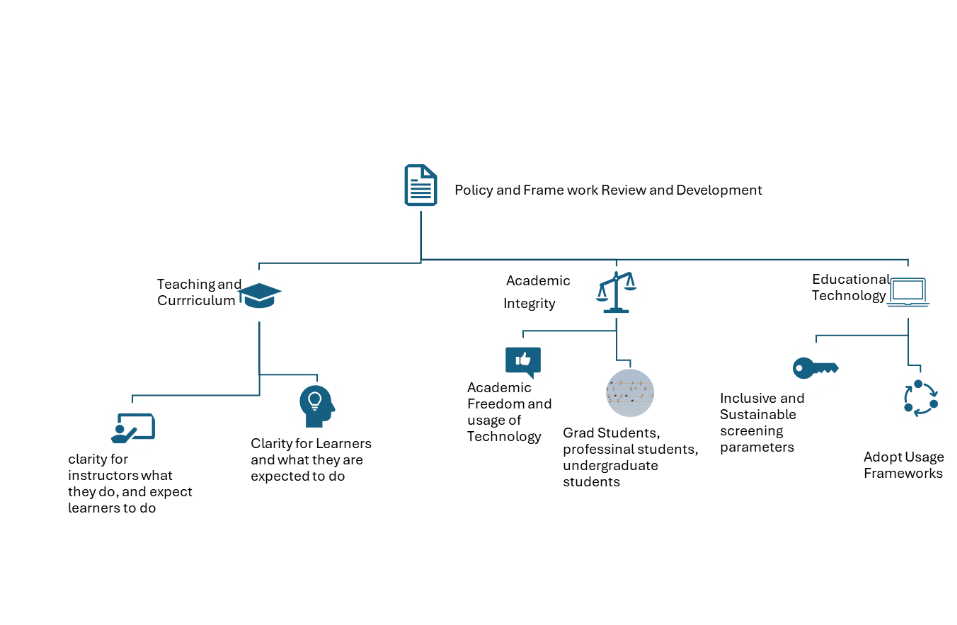
Clarity and Consistency in Policies: Dale (Director of the CTL) was invited to discuss his perspectives as the moderator of the breakout room on policies and cross-institutional perspectives. He (on behalf of the breakout group he led) emphasized the breakout groups desire for clarity in the guidelines and policies surrounding AI use, especially for instructors and students. He noted that many current policies tend to focus primarily on undergraduate students, which may not adequately address the diverse experiences and needs of graduate students or those in professional programs. This inconsistency can lead to confusion and uneven enforcement of academic integrity principles.
Full Disclosure Requirements: The group discussed the importance of full disclosure by instructors regarding their use of AI in course design and assessment methods. The group highlighted the necessity for transparent communication about how AI tools might be utilized to create course content or evaluate students. Establishing clear expectations in syllabi can foster a better understanding and mitigate potential misunderstandings related to academic integrity.
Guidance for Instructor and Student Interaction: It was discussed it is critical to provide instructors with comprehensive guidance on how to effectively integrate generative AI into their curricula while maintaining academic standards. This includes recognizing the different types of learning outcomes they aim to achieve and ensuring that AI tools are used to enhance rather than undermine those goals.
Ethical Considerations and Academic Freedom: The conversation touched on ethical implications of AI usage in education. The committee discussed the delicate balance between maintaining academic freedom for instructors and ensuring that ethical guidelines are followed. It was stressed that there is a need for the subcommittee and the university to respect instructors' autonomy while also providing a framework that promotes equitable and responsible use of AI tools across all faculties.
Equity, Inclusion, and Access: Discussions also revolved around ensuring that the adoption of AI technologies promotes equity and inclusion within the educational environment. Dale emphasized that the selection and implementation of AI tools should align with the broader institutional commitments to accessibility and diversity, ensuring that all students have equitable access to learning resources.
Next Steps for Developing Policies: The subcommittee will recommend reevaluation existing policies and consider the development of a set of guiding principles for the responsible use of AI in educational settings. This would serve to streamline efforts across faculties and offer a cohesive strategy for addressing AI-related challenges.
4. AI Usages in Curriculum and Assessment
A conversation took place about varied forms of AI utilization within courses. It was noted that instructors might restrict or provide guidelines regarding AI’s use, and the committee discussed the implications of these decisions on both students and broader educational policies.
SAGAI proposed launching an "AI in the Wild" survey to assess how instructors are using AI across the university. The goal was to gather quantitative data that could inform adjustments to policies and aid in sharing successful practices among faculties.
It was agreed that the survey would be shared with the chair and a volunteering subcommittee member for a review to ensure neutrality before being administered.
Actions & Next Steps:
Survey Creation: Eleftherios Soleas to coordinate with Chair and Stephen Larin to draft and review, before distributing an "AI in the Wild" survey to instructors across faculties.
Draft priorities collected and shared with committee for ranking and further consideration.
SAGAI to share both RISE module from SASS and the guidelines from Political Studies for consideration. All members are asked to review both of these before our next meeting.
Guidelines Development: Discussion to continue on how best to create useful guidelines around AI use, particularly in relation to academic integrity and student support.
Resource Compilation: The committee will continue to compile an inventory of educational resources and best practices regarding AI literacy across the university.
Adjournment:
Chair concluded the meeting, thanking attendees for their contributions and encouraging ongoing dialogue outside of the formal meeting structure.
Meeting Minutes: Teaching and Learning AI Subcommittee – Fourth Meeting
Date: December 15th, 2025
Time: 2:00 PM – 3:00 PM
Present: James Fraser (Chair), Eleftherios Soleas (SAGAI), Christian Muise, Brian Frank, Scott Whetstone, Scott-Morgan Straker, Satish Kumar Kotha, Susan Korba, Stephen Larin, Prameet Sheth, Rosemary Wilson, Erica Friesen, and Dale Lackeyram
Regrets: Richard Reeve, Alyssa Perisa, Tanya Joseph
Agenda Items:
1. Welcome and Introductions
The Chair opened the meeting, welcoming attendees and introducing new committee member Stephen Thomas, a faculty member from the Smith School of Business. He teaches analytics and AI, and previously launched a Master's program on Management of AI
Dr. Rosemary Wilson from the Faculty of Health Sciences introduced herself, mentioning her roles as a professor in the School of Nursing and Department of Anesthesiology, as well as her teaching focus on advanced statistics and philosophy.
2. External Context and Developments
James shared a recent initiative from Purdue University that now requires basic AI competency for all undergraduates as a graduation criterion. This raises the question of what constitutes AI competency.
He also mentioned the Alan Turing Institute in the UK, which is developing a multifaceted approach to AI that embraces cultural complexity and frameworks for collaborative human-AI systems. This reflects the importance of thinking ahead regarding the evolving role of AI in education.
Additionally, Canadian Institute for Advanced Research (CIFAR) is supporting multiple AI institutes across Canada, providing resources relevant to post-secondary education including one that Queen’s is joining called AMMI.
3. Review of AI Literacy Module
The committee reviewed the AI literacy module developed by Student Academic Success (SAS) and invited feedback on its contents. Susan Korba detailed that it is embedded in the Academic Skills 101 course for first-year students and aimed at enhancing their understanding of AI.
Feedback was gathered, highlighting the module’s strong points, such as its focus on equity considerations regarding AI and issues of bias, particularly in image generation technologies.
Suggestions for improvement included emphasizing the importance of understanding the process over the end product, ensuring the module addresses the implications of using AI versus engaging in critical thinking.
4. Priorities for AI Implementation and Guidelines
The committee discussed a framework for developing resources and guidelines that not only cover baseline literacy around AI but also adapt to the specific contexts of different faculties. Discussion highlighted the importance of having a process for evaluating and adopting AI tools.
Committee members reflected on the need for a structured approach to ensure that the various uses of AI tools align with academic integrity and pedagogical goals.
It was suggested that an inventory of tools and resources be created to aid departments in finding relevant and effective technology for their instructional practices.
5. Discussion on Policy Development
Stephen Larin shared insights on the political studies AI policy drafted in response to increased concerns about academic integrity related to AI use. He emphasized the importance of addressing the teaching and learning processes reinforced by the policy rather than merely focusing on compliance.
The group recognized that while academic integrity is a significant concern, there is also a place for fostering an understanding of AI’s educational potential, and this perspective should be reflected in policy formulations.
6. AI in the Wild Survey
Terry presented the "AI in the Wild" survey draft that aims to gather data regarding AI usage among faculty and staff at Queen's. The survey will assess what tools are being used and the contexts in which they are applied. There was some concern that the information would have a limited shelf life, but other committee members felt the results would have value.
Members discussed the challenges of keeping the survey relevant due to the fast-evolving nature of AI technologies but acknowledged that collecting this data would provide a valuable snapshot of current practices.
7. Next Steps and Future Meetings
The committee agreed to review the survey responses at the next meeting.
Susan invited members to send their feedback directly to her for incorporation into future revisions of the Academics 101 module.
Committee suggested connecting departments interested in developing AI policies with those who have already done so, potentially creating a resource-sharing arrangement.
Actions & Next Steps:
Feedback Collection: Members are encouraged to provide specific feedback on the SAS AI literacy module to Susan Korba, who is collating this information.
Survey Launch: The “AI in the Wild” survey will be sent to faculty and staff in January for data collection on AI usage across departments.
Policy Collaboration: Departments looking to draft or refine their AI policies may reach out to Stephen Larin for insights and examples from the political studies department.
Next Meeting: The committee will reconvene in January to discuss the survey results.
Adjournment:
James Fraser concluded the meeting, thanking attendees for their participation and encouraging a productive break before reconvening in the new year.
Teaching and Learning AI Subcommittee Meeting Minutes
Date: January 12, 2026
Time: 3-4 pm
Location: Virtual
Present: James Fraser, Eleftherios Soleas, Prameet Sheth, Stephen Thomas, Christian Muise, Brian Frank, Susan Korba, Tanya Joseph, Dale Lackeyram, Scott Whetstone, Scott-Morgan Straker, Richard, Stephen Larin
Absent: Rosemary Wilson, Alyssa Perisa
1. Opening and Purpose of Meeting
Chair noted the committee is moving from exploration and information sharing into an action phase focused on producing concrete policy recommendations for the university.
A “working group” model was proposed to enable deeper progress in smaller teams rather than full committee meetings.
Members were advised that this will slightly increase time commitment, estimated at approximately three hours per month, but will accelerate progress and outcomes.
The goal is for each working group to develop a concise set of recommendations or a short white paper to be brought back to the full committee and refined before being circulated to senior leadership.
2. External Scan and Environmental Update
Chair highlighted external work at the University of Toronto on an Artificial Intelligence Virtual Tutor Initiative, emphasizing sandboxed AI environments aligned with instructor-curated content.
Emerging research suggests improved learning outcomes when large language models are properly trained on domain-specific data rather than general web content.
The field is rapidly evolving, with active scholarship and strong evidence generation underway.
3. Updates and Announcements
3.1 AI in the Wild Survey
The survey launch has been postponed to February 4 at the request of HR to avoid overlap with an institutional employee experience survey.
Delaying is expected to improve response rates.
3.2 Alberta Machine IntellegenceIntelligenceAMII) Partnership
Queen’s has been accepted into the AMII consortium and now has free access to “Module Zero,” a three-hour foundational AI and machine learning learning resource.
The module covers:
How AI works
Ethical considerations
Critical thinking impacts
Limits of AI as a substitute for human development
The resource will be placed in onQ for committee review.
Members were encouraged to review the module internally before broader dissemination within Queen’s.
Technical constraints limit access outside Queen’s.
4. Formation of Three Working Groups
The committee reviewed and refined the mandates of three working groups. Members were asked to indicate their preferences for participation at the end of the meeting.
Working Group 1
AI Literacy: Defining What AI Literacy Should Look Like at Queen’s
Purpose: To define what AI literacy means at Queen’s and recommend how the institution ensures all learners and educators achieve foundational competence.
Key Discussion Themes
Definition of AI Literacy
Establish a shared institutional definition of AI literacy grounded in trusted external frameworks rather than reinventing new ones.
Identify core abilities, knowledge, and ethical competencies.
Avoid perfectionism; prioritize a practical, communicable framework that can be adopted quickly.
Differentiated Audiences
Define AI literacy separately for:
Students
Instructors
Staff
Acknowledge overlapping competencies but recognize role-specific expectations.
Embedding AI Literacy in Curriculum
Explore how AI literacy can be systematically embedded rather than treated as optional or ad hoc.
Consider whether institution-wide expectations or graduation-level competencies should be recommended.
Identify who needs to be involved institutionally to make this scalable.
Case-Based Learning
Strong support for using case studies showing:
Appropriate AI use
Inappropriate AI use
Include disciplinary and policy context to support interpretation.
Highlight ethical versus unethical decision-making to help learners recognize boundaries.
Measuring Success
Identify what evidence would demonstrate successful AI literacy:
Competency indicators
Assessment approaches
Institutional uptake
Consider what resources, infrastructure, and expertise are required.
Institutional Recommendation Orientation
The group is expected to recommend processes, structures, and stakeholders rather than directly building all materials themselves.
Outputs may include one or more short recommendation documents to the Provost.
Working Group 2
Student Policy: Student AI Guidelines for Teaching and Learning
Purpose: To examine gaps in current student-facing policies and develop future-proof guidance for ethical and effective AI use in learning.
Key Discussion Themes
Review of Existing Policies
Begin by mapping what currently exists across Queen’s.
Identify gaps, inconsistencies, and areas where guidance is unclear or missing.
Recognize that AI guidance is currently embedded across multiple policies (e.g., academic integrity) rather than as a standalone policy.
Future-Proof, Concept-Based Guidance
Emphasize principles and concepts rather than tool-specific rules.
Develop guidance that remains relevant as technologies evolve.
Transparency and Disclosure
Strong support for requiring disclosure of AI use by students.
Transparency seen as enabling responsible use and reducing underground or hidden practices.
Consider how disclosure mechanisms can be simple, consistent, and discipline-sensitive.
Consistency Across the Student Experience
Address student confusion caused by inconsistent expectations across courses and instructors.
Aim for as much consistency as possible while respecting disciplinary nuance.
Avoid extremes where any AI use is treated as inherently misconduct.
Universal vs Disciplinary Boundaries
Recognize that certain breaches (e.g., plagiarism, misrepresentation of authorship) are universal.
Allow space for discipline-specific interpretation while maintaining institutional standards.
Programs vs Courses
Discussion emphasized the importance of program-level expectations, not only course-level rules.
Program-level coherence may better support developmental progression and accreditation requirements.
Consider alignment with degree-level expectations and cyclical program review processes.
Case Studies
Use case-based examples illustrating aligned and misaligned AI use in real academic contexts.
Academic Integrity Alignment
Ensure strong coordination with academic integrity governance and expertise.
Working Group 3
Faculty-Focused Policies, AI Knowledge, and Transparency in Teaching and Learning
Purpose: To develop guidance and supports for instructors related to AI literacy, transparency, and responsible instructional use.
Key Discussion Themes
Instructor Knowledge and Capacity Building
Instructors require targeted resources and skills development to use AI responsibly and confidently.
Transparency is only meaningful if instructors understand the tools and implications.
Transparency in Teaching Practice
Advocate for policies requiring disclosure of instructor AI use, including:
Syllabus creation
Assessment design
Grading workflows
Promote awareness among students of how AI influences educational practices.
Standardized Disclosure Practices
Consider developing a standard AI disclosure template for syllabi.
Normalize transparency across the institution rather than leaving it to individual discretion.
Distinction from Student Policy
Group 3 focuses on instructor-facing guidance, whereas Group 2 focuses on student-facing policy.
Overlap is expected, but the audiences and implementation mechanisms differ.
5. Working Group Participation and Next Steps
Members were invited to indicate interest in one or more working groups via chat.
Working groups will meet independently before the next full committee meeting. Scheduling doodle sent tomorrow.
Each working group will bring back draft recommendations or early outputs for discussion.
Resources from AMII will be shared for review.
Next full committee meeting will include reports from each working group.
6. Adjournment
Meeting adjourned with appreciation for strong engagement and constructive discussion.
February AI Literacy Working Group Meeting Minutes
1. Scope and Mandate
- The group confirmed its role is to propose processes and recommendations. Final decisions and execution will rest with the Provost’s office, associate deans, and other institutional bodies.
- Members reviewed leadership “marching orders,” discussed how often the group should meet, and agreed that AI literacy will require ongoing work rather than a single deliverable.
2. Existing Initiatives & Assets
A centrally offered first-year course (ARIN 100) serves as a practical model: it’s hybrid, high-demand, and discipline-neutral. It could function as a “backstop” for programs lacking their own AI literacy resources.
Short-form modules exist as well:
Module 0 from AMII is undergoing pilot testing; it’s short (several hours) and would be easy to drop into courses.
The student academic skills team hosts a first-year academic success module which includes some AI content.
Teaching and Learning services (e.g., CTL) already work with faculty on related support for instructors and TAs.
Operational teams are exploring AI training for staff (e.g., HR has tapped subject-matter experts to co-develop submodules)
3. Program-Level Implementation
The group explored updating degree-level expectations (DLEs) at both undergraduate and graduate levels to ensure every program explicitly covers AI literacy. They noted prior precedent for revising DLEs through Senate and emphasized that future-proof language should cover digital/AI competencies broadly rather than individual tools.
Faculties would retain agency in how they meet any updated expectations: some could build new AI-focused courses, others could embed modules into existing curricula, and programs lacking internal capacity could route students through a central offering such as ARIN 100.
Graduate programs pose additional complexity since course requirements vary widely. Shared courses (e.g., research methods, doctoral seminars) offer insertion points, but the group acknowledged the need for flexible solutions and possibly parallel DLE revisions tailored for graduate and professional contexts.
4. Change Management & Governance
Members noted a recurring tendency to jump to solutions before designing a change-management strategy. To address this, they proposed bringing in a specialist to help structure the process so that stakeholders are consulted before decisions are finalized.
The group intends to consult widely—especially with associate deans of teaching and learning, the CTL, HR training, and operational AI committees—to build a coalition and align efforts. They recognized that top-down support from senior leadership (e.g., principal, deans) will likely be necessary to mandate new DLEs and secure curricular changes.
Additional representation (e.g., from CTL and HR training) may be added to ensure student, instructor, and staff needs are covered across the three subgroups (students, instructors, staff).
5. Course & Resource Design
Members stressed that a single centralized course does not have to be mandatory for all students. Instead, it can be one option among many to satisfy a shared requirement.
They discussed how faculty- or discipline-specific modules could be co-created (e.g., business, engineering, environmental studies), while centralized support would provide resources, TA training, and content refreshes to keep pace with AI advances.
There was consensus that voluntary participation is insufficient; institutional expectations should be mandatory, backed by DLEs and program review processes, but instructors should retain flexibility in how they meet those expectations.
6. Next Steps
Change Management: Secure the proposed consultant and prepare for a dedicated session to design the rollout process, stakeholder engagement, and cultural change strategy.
DLE & Policy Framework: Draft a framework for updating undergraduate and graduate DLEs to include AI/digital literacy, with language that is broad yet enforceable.
Stakeholder Consultation: Coordinate with CTL, HR/operations, and associate deans to map current initiatives, avoid duplication, and confirm support for mandatory expectations.
Resource Mapping: Catalogue existing courses and modules (e.g., ARIN 100, CTL offerings, HR training, SASS modules, the AI module pilot) to illustrate an implementation menu.
Reporting: Prepare a presentation for the broader Teaching & Learning subcommittee outlining the shared vision (why AI literacy is essential), preliminary process steps, and proposed stakeholder roles.
February Faculty-Centered AI Policy Working Group Meeting Minutes
1. Scope and Key Points
The working group advanced recommendations for a policy that requires faculty, instructors, and TAs to transparently attribute AI use in teaching and learning (course design, grading, assessment, proposals, classroom materials). The aim is to prevent trust gaps. Members agreed a formal policy, even if lightly enforced, is essential for setting expectations and modeling the responsible practices required of students.
- Scope & Intent: Focus on teaching-and-learning contexts only. Policy must establish a clear minimum standard while leaving room for academic freedom.
Terminology: “Attribution” or “acknowledgment” preferred over “disclosure,” which implies wrongdoing. A glossary may be needed to define “responsible use,” “attribution,” etc.
Transparency Expectations: Require “responsible attribution” whenever AI meaningfully shapes instructional materials. Instructors may use syllabus statements, first-class briefings, assignment-specific notes, or LMS icons as long as recipients understand AI’s role. Overly granular tagging (per slide/image) is discouraged, but a single mention may be insufficient if AI is used throughout a course.
Educational Modeling & Equity: Transparency is a teaching act. Faculty and student obligations can differ, but both groups need explicit norms. Avoid unnecessary clutter while ensuring clarity.
Assessment & Grading: Warn against overreliance on current detection tools (e.g., Turnitin) and emphasize due diligence when using AI for grading; instructors remain accountable and must evaluate potential bias.
Implementation & Support: CTL will integrate these principles into existing AI assessment forums. Coordination with other Teaching & Learning subcommittees will align policy language, pedagogy, and staff training.
2. Transparency Statement Options Discussed
2.1 Course-Level “Meta” Statement (Syllabus or First-Class Briefing)
Instructors could include a paragraph in the syllabus or devote five minutes at the start of the course to explain:
Whether AI is used in their teaching prep or grading.
In what capacity (e.g., idea generation, editing, full draft creation).
Instructor commitment to verify and take responsibility for all AI-influenced content.
Rationale: Models responsible practice without overwhelming students; gives instructors freedom to provide detail once, up front.
2.2 Assignment- or Resource-Specific Labels
Similar to Concordia’s tiered disclosure model:
Tier 0 – “No AI used”
Tier 1 – “AI consulted for planning/conceptualization”
Tier 2 – “AI collaborated in drafting/optimizing content”
Tier 3 – “Content primarily generated by AI and instructor reviewed/edited”
Label could appear on assignment descriptions, lecture slides, or OnQ pages when there is meaningful AI use.
Rationale: Aligns with assessment frameworks already familiar to faculty; keeps statements simple yet informative.
2.3 Icon or Badge System (inspired by Meta/Instagram)
Visual indicator placed on slides, documents, or LMS pages to signal AI involvement (e.g., “AI-assisted image”).
Students may request additional context when they see the icon, and instructors must be prepared to explain.
Rationale: Quick signal that maintains transparency without a paragraph each time; mirrors existing social-media norms.
2.4 Administrative / Cross-Stakeholder Disclosures
Any AI-generated material distributed to colleagues or administrators (course proposals, committee reports, etc.) should carry a short note such as “Draft generated using [tool]; reviewed and edited by [instructor].”
Rationale: Prevents surprises when lengthy AI-generated documents circulate internally; maintains trust beyond the classroom.
2.5 Minimum Expectation vs. Optional Detail
Policy would specify a minimum requirement (e.g., at least a course-level statement plus tagging of major AI-shaped deliverables), while allowing instructors to exceed it (per-slide notes, detailed appendices, etc.).
Rationale: Balances flexibility with a clear institutional floor for transparency.
2.6 Student-Facing Q&A Clause
If a resource carries an AI label, students should be empowered to ask, “What does that mean for this assignment/lesson?” Faculty must be ready to explain how AI contributed and what checks were applied.
Rationale: Reinforces the educational modeling goal and keeps disclosure meaningful rather than perfunctory.
Student-Centered AI Policy Working Group Meeting Minutes
1. Purpose and Context
The group is building student-facing guidance on ethical and effective AI use. The aim is to make the policy practical and understandable so students know when AI supports learning and when it undermines it.
2. Core Themes
- Delegation as the Policy Anchor:
Focus on who is actually doing the work rather than just attribution. Use a decision flowchart to help students evaluate AI use (check syllabus permissions, assess whether the task is central to their learning, apply the “housemate test”). Departments should adapt this framework into a concise, student-friendly guide that reflects their disciplinary expectations.
AI as Learning Partner vs. Assessment Substitute:
Maintain a clear distinction between using AI to support learning (exploring, practicing, scaffolding) and using AI to produce assessed work. Encourage students to learn with AI, but teach them how to verify outputs and understand what constitutes over-delegation. Adopt shared vocabulary such as delegation, scaffolding, and augmentation to provide consistent language across courses.
Literacy and Communication:
Reinforce AI guidance through multiple channels: policy text, short multimedia resources, case studies, and classroom conversations. Embed AI literacy across degree levels, using existing resources like AMII Module Zero, SASS integrity modules, and the UNESCO framework. Revisit these concepts throughout students’ programs rather than relying on a single first-year module.
Skill Preservation and Equity:
Warn students about skill atrophy when AI is used for core competencies such as writing or problem solving. Recognize AI’s value for multilingual students, but clearly distinguish between acceptable support and outsourcing critical thinking.
3. Structural Recommendations
3.1 Central Policy Framework
Define key terms such as delegation, scaffolding, augmentation, learning partner, and skill atrophy.
Provide a decision flowchart that guides students through AI-use choices.
Emphasize ethical reasoning and responsible decision making rather than blanket prohibition.
3.2 Department-Level Customization
Develop a one-page interpretation for each department that contextualizes acceptable AI use.
Supply template language and examples to ease adoption.
Require syllabi to outline AI expectations using consistent terminology.
3.3 Curriculum and Review Integration
Embed AI literacy and ethical use across programs aligned with degree-level expectations.
Ask programs to address AI integration in Cyclical Program Reviews and engage external reviewers for feedback.
3.4 Teaching Practice and Assessment Design
Encourage instructors to explain the purpose of each assessment so students understand why certain AI uses may be inappropriate.
Ensure students encounter varied AI expectations across their program (evaluation-focused, collaboration-focused, AI-free tasks).
Use UNESCO competencies and AMII module concepts as common benchmarks.
3.5 Communication Toolkit
Produce resources such as short videos, discipline-specific scenarios, flowcharts, and plain-language summaries.
Include diverse campus voices to illustrate AI-related issues like data sovereignty or evaluation skills.
Invite instructors to review AI guidance in class and foster open discussion.
4. Next Steps
Develop a Central AI Policy Framework
Define key terms (e.g., delegation, scaffolding, augmentation, learning partner, de-skilling).
Outline the recommended decision flowchart (including checkpoints like “Is this task central to my learning?” and “Would it be acceptable for a peer to do this?”).
Describe the rationale for each element (student learning, skill retention, ethical accountability).
Ensure the policy is written in plain language and accompanied by examples or thought experiments.
Design Department-Level Adaptation Templates
Include sample language, modular statements, and prompts for disciplinary nuance (e.g., “How is AI used in this field professionally?” “What kinds of AI support are acceptable in lab work vs. essays?”).
Encourage departments to link their guidance to program-level learning outcomes and professional standards.
Recommend posting these on departmental websites and incorporating them into syllabi.
Coordinate with AI/Digital Literacy Subcommittee
Align on what competencies should be addressed at the program level (first-year foundations, capstone applications, graduate-level nuance).
Discuss embedding expectations into DLEs, program learning outcomes, CLOs, and eventually into Cyclical Process Review documentation.
Share resources (e.g., UNESCO framework, AMII Module Zero) to avoid duplication.
Outline Communication & Resource Strategy
Identify which formats are needed (e.g., short videos, infographics, case studies, “housemate test” prompts, FAQ pages).
Consider a curated toolkit to share with instructors (sample syllabus statements, discussion prompts, assignment design ideas).
Plan for “layered” communication: policy document, course-level reinforcement, peer-led discussions, future-first-year modules.
March AI Literacy Working Group Meeting Minutes
Date: March 5, 2026
Facilitator: Eleftherios (Terry) Soleas
Guest Speaker: Elspeth Murray (Strategy & Entrepreneurship, Smith School of Business)
Attendees: Susan Korba, Stephen Thomas, Erica Friesen, Christian Muise, and others
1. Key Themes and Discussion
1.1 Understanding the Scale of Change
Elspeth Murray opened by framing AI literacy as a significant cultural shift. Key points included:
AI generative literacy represents a potential paradigm shift for faculty, students, and the university as a whole.
Institutions often underestimate the depth of change required, defaulting to adding a single course rather than addressing deeper cultural and behavioural transformation.
Success depends on three factors: pointing the institution in the right direction, building momentum, and reaching a critical mass of engaged people.
70% of digital transformation initiatives fail — largely due to human resistance — underscoring the need for thoughtful engagement strategies.
1.2 Defining What Success Looks Like
A recurring theme was the importance of defining AI literacy concretely before pursuing change:
Susan Korba emphasized that AI literacy means providing people with knowledge, skills, and understanding to make informed choices — not mandating adoption of AI tools.
AI literacy should be distinguished from AI embracement; literacy is the first step, and embracement may follow organically.
Without a clear vision of the end state, efforts risk becoming scattered and unmeasurable.
1.3 Identifying the Center of Gravity: Students, Faculty, or Staff?
The group debated which stakeholder group should be prioritized first:
Elspeth Murray noted that students, faculty, and staff are deeply interconnected — impacting one group will necessarily affect the others.
Terry Soleas proposed that students may be the best starting point, as student literacy could create a "pull factor" that motivates faculty to upskill.
It was observed that students are often already well ahead of faculty in their day-to-day AI use.
Faculty were identified as harder to convince due to fewer institutional levers, though the concern of being left behind by their own students may serve as a motivator.
Stephen Thomas added that employers should also be recognized as a key external stakeholder, since their expectations shape the value of graduate AI fluency.
1.4 The 20-70-10 Framework for Change
Elspeth Murray presented a model for driving change through peer influence, which aligned closely with existing Queen's data:
20% of the campus are already enthusiastic adopters ("gung ho") — these are the change leaders to engage first.
70% are persuadable and sitting on the fence — the primary target for peer-led influence.
10% are firm resistors with principled objections; it is generally unproductive to focus efforts on convincing this group.
Terry noted this breakdown closely matches Queen's survey data: approximately 30% enthusiastic, 55% convincible, and 15% opposed.
Principled objections from the resistant group include: existential threats to certain professions (e.g., English lit), environmental concerns (data centre water and energy use), and intellectual property issues.
1.5 Persuasion Over Mandate
The group strongly cautioned against a top-down mandate approach:
Big announcements without narrative context and community engagement are likely to generate resistance rather than uptake.
Small, focused group discussions were identified as far more effective than large town halls for genuine persuasion and dialogue.
Peer influence is more powerful than directives from leadership — people are more receptive to peers who share their context and concerns.
1.6 Practical Engagement Strategies
Several concrete ideas emerged for how to advance AI literacy:
Pilot projects and training sessions led by the 20% change leaders within each stakeholder group.
AI literacy champions embedded across campus in different departments and faculties.
Faculty retreats: Erica Friesen described how a Faculty of Law retreat that included hands-on AI tool experimentation was particularly effective, reaching a broader audience than opt-in workshops.
Elspeth Murray suggested that each faculty could host a dedicated half-day AI literacy workshop — structured around meaningful dialogue and small group engagement.
A creative suggestion emerged: leveraging digitally fluent students as peer coaches or interns to work one-on-one with faculty — echoing how universities once used student workers to introduce faculty to PowerPoint.
Terry shared that the upcoming Teaching and Learning AI Forum (June 3rd) is being structured to showcase innovators and change leaders, with the intent to persuade the persuadable majority.
Elspeth recommended structuring forum events around small-group meaningful dialogue rather than broadcast-style presentations.
1.7 Keeping the Cause Alive
Sustaining momentum over time requires ongoing effort:
Visible leadership support — provost and senior administrators consistently championing AI literacy.
Rewards and recognition for those doing excellent AI literacy integration work.
Storytelling and communications: spotlighting faculty and student success stories.
Ongoing engagement rather than "one and done" initiatives.
2. Decisions and Outcomes
The group affirmed that AI literacy is best pursued as a deep cultural shift rather than a surface-level curricular add-on.
Students are the proposed primary initial focus, with the expectation that this will create pull pressure on faculty and staff.
Persuasion through peer influence and small-group dialogue is the preferred change strategy.
The June 3rd AI Forum should be redesigned to maximize opportunities for meaningful two-way dialogue.
Elspeth Murray offered to continue advising the group on change management strategy.
3. Action Items & Next Steps
Terry Soleas to adjust the June 3rd Forum structure to incorporate more small-group, dialogue-driven sessions.
The group to consider how to identify and engage the 20% change leaders across student, faculty, and staff groups.
Explore feasibility of a student-as-peer-coach program for faculty AI onboarding.
Continue coordination with faculty-facing and student-facing policy working groups, as all three streams are interdependent.
The group will continue developing recommendations for the Provost on advancing AI literacy across Queen's University. The connections between this group's work and the student policy (Group 2) and faculty policy (Group 3) subcommittees were noted as essential — AI literacy underpins the effectiveness of both policy streams.
March Faculty-Centered AI Policy Working Group Meeting Minutes
Date: March 4, 2026
Working Group: Group 3 – Faculty-Facing AI Policy
Facilitator: Eleftherios (Terry) Soleas
Attendees: Christian Muise, Prameet Sheth, Dale Lackeyram, Scott Whetstone, and others
1. Key Themes and Discussion
1.1 Faculty Disclosure and Attribution of AI Use
The group discussed how and where faculty should disclose their own use of AI tools in their teaching:
Christian Muise proposed drafting a first version of the disclosure policy (Item 7.1 from previous next steps) and presenting it to the group for review.
Disclosure should extend beyond students — faculty should acknowledge AI use to colleagues and in administrative contexts as well.
A syllabus statement is one natural place for disclosure, but as Prameet Sheth noted, not all students read syllabi — making multimodal disclosure important.
Terry Soleas agreed that putting disclosure in multiple visible places ensures that even students who miss one instance will encounter it elsewhere.
Prameet Sheth raised the issue of language strength: the existing draft uses "could" where the group believes "should" is more appropriate for a faculty policy — the latter signals genuine expectation rather than optional suggestion.
Terry confirmed that a terminology glossary will be a component of the draft policy, providing consistent vocabulary across documents.
1.2 Accountability When Faculty Deploy AI Tools in the Classroom
This was the most extensively debated topic of the meeting, with diverging views on where accountability lies when a faculty-deployed AI tool gives students incorrect information:
Christian Muise's position:
When a faculty member officially deploys an AI tool (e.g., a course chatbot/tutorbot), they take on accountability for the outputs of that tool.
If a student receives incorrect information from an officially sanctioned tool and answers an assessment incorrectly as a result, the student should not be penalized — the accountability sits with the instructor.
An instructor cannot offload accountability by placing a bot between themselves and students.
Prameet Sheth's position:
Students in professional programs (nursing, medicine, pharmacy) retain an obligation to verify all information regardless of source — a chatbot providing wrong clinical information does not absolve the student of professional responsibility.
There is a meaningful legal and ethical difference between a person (e.g., a TA) giving wrong information versus a tool doing so.
Students must always exercise critical judgment and cross-verification — this is a foundational expectation of academic and professional practice.
Dale Lackeyram raised a third layer of complexity:
When AI tools are procured at the institutional level, responsibility is distributed across: the institution and ITS (tool quality, privacy, technical functionality); the instructor (appropriate deployment and oversight); and the student (verification of information and critical engagement).
ITS is generally responsible for the tool functioning as specified, not for the content it generates.
The boundaries of accountability across this chain are currently unresolved and contested.
Key points of agreement:
This question will be sent as a "trial balloon" to the Vice-Provost Teaching and Learning and CUFA for their guidance, as the academic process implications have not been tested institutionally.
"Academic freedom" does not exempt faculty from accountability for the consequences of their pedagogical decisions, including deploying AI tools.
Case law in this space has not yet been tested, and any policy positions taken now are provisional.
Christian Muise requested that student stakeholder groups (including graduate student representatives) be consulted on this issue.
1.3 AI Use in Grading and Assessment Workflows
The group discussed guidance on the responsible use of AI in faculty grading processes:
Terry Soleas shared the current institutional stance:
The use of AI tools to generate grades for open-ended responses at Queen's is currently untested and not recommended.
AI tools that assist with multiple-choice grading or act as intelligent agents entering grades into grade books exist elsewhere, but Queen's has not deployed these.
No Canadian institution is currently known (as of this group's awareness) to have deployed AI for grading open-ended written responses.
Christian Muise raised important definitional concerns:
"AI" in grading encompasses a very wide range of tools — from decades-old automated marking tools to modern generative AI — and policy language must be precise.
Grading free-text essays with generative AI has well-documented bias problems: models may assign systematically lower grades to students with names from certain cultural backgrounds.
A particularly strong use case for AI in grading is as a bias-checking tool: faculty could use it to review their own grades and flag potential discriminatory patterns for human review.
The group agreed that AI should not be used to replace human judgment in grading, but can appropriately support it.
Dale Lackeyram advocated for a firm "human in the loop" requirement:
Whatever AI tools are used in grading workflows, a human must review and approve the output before any grade is assigned.
Trust in the assessment process depends on human expertise and oversight being present — removing humans from the loop would erode institutional credibility.
As tools change rapidly, the policy must be designed with this principle and built-in review mechanisms.
Emerging consensus on grading guidance:
Counsel human-in-the-loop oversight for any AI involvement in grading.
Faculty should not abdicate responsibility for how AI tools function or for the grades they produce.
Policy should explicitly note that grading practices that appear biased or discriminatory are subject to the existing academic appeals and sanctions process — regardless of whether AI was involved.
1.4 AI Detection Tools
Terry Soleas raised the group's position on AI detection tools:
The group reaffirmed its strong stance against encouraging the use of AI detection tools by faculty.
Current detection tools produce approximately 1 in 5 false positives: one in every five organically written human essays may be flagged as AI-generated.
No academic integrity system can function fairly at this error rate.
Christian Muise noted a further complication: students who study using AI-generated content may naturally begin to write in ways that resemble AI output — even in pen-and-paper in-class exams. Detection tools would flag these students unfairly.
This position (discouraging AI detection tools) is a firm and non-negotiable element of the policy guidance.
1.5 AI and Academic Integrity in Exam Settings: Emerging Technologies
Dale Lackeyram raised the challenge of AI-enabled cheating in exam environments (e.g., Google Glass-style devices):
The intersection of assistive technology (AODA obligations) and potential cheating tools creates significant complexity.
Under Ontario accessibility law, faculty cannot compel a student to remove assistive devices such as prescription eyeglasses — even if those glasses are AI-enabled.
Terry committed to consulting the University's Special Advisor on Accommodations to understand how this is being approached institutionally and to report back.
Christian Muise shared a newly available Android app that can detect Meta Ray-Ban smart glasses by their Bluetooth signature — though this was noted as a rapidly evolving space.
Scott Whetstone offered a pragmatic perspective: the goal should be making casual cheating difficult and requiring intent — not attempting to eliminate all cheating, which is impossible. Design assessments to require multiple deliberate steps for cheating, rather than treating it as a binary problem.
1.6 Template Resources for Faculty
The group identified resources to be developed to support faculty implementation:
Sample syllabus attribution statements for AI use — building on existing required AI sections.
A menu of faculty-level AI disclosure or attribution options that faculty can select or adapt.
Coordination is ongoing with the Centre for Teaching and Learning (CTL) and an Open Educational Resource initiative involving Dale Lackeyram; further progress is expected by end of term.
1.7 Coordination with Other Institutional Surveys
Terry raised a concern about survey duplication:
A separate survey on faculty AI use is being advanced by Gavin Watson, prompted by the Senate Subcommittee on Teaching and Learning.
Terry clarified that his survey (834 responses from the AI in the Wild survey) focuses on individual faculty behaviors and tool use, while Watson's survey is departmental in scope and focused on departmental practices.
Both sets of data are useful and complementary, and Terry committed to sharing his data broadly — though he expressed some frustration at the perception of duplication.
2. Key Decisions & Outcomes
Terry Soleas will draft an initial version of the faculty disclosure/attribution policy (Item 7.1) for group review.
The accountability question (what happens when faculty-deployed AI gives students wrong information) will be referred to VPTL and CUFA as a "trial balloon."
Human-in-the-loop oversight is established as the foundational principle for any AI involvement in grading.
AI detection tools will continue to be actively discouraged in the policy guidance.
Items 6 and 7 (assessment guidelines and grading workflows) will be revisited at the next meeting with more institutional information.
3. Action Items & Next Steps
Terry Soleas: Draft faculty disclosure/attribution policy (Item 7.1) and circulate for review, including a terminology glossary.
Terry Soleas: Consult with the Special Advisor on Accommodations regarding AI-enabled devices in exam settings and report findings.
Terry Soleas: Develop template syllabus attribution statements and a menu of faculty-level disclosure options.
The group will reconvene to review Terry's first draft of the attribution policy and to receive feedback from CUFA and the VPTL on the accountability question. Template resources for faculty will continue to be developed in coordination with the CTL. The faculty-facing policy work remains closely linked to the AI literacy (Group 1) and student policy (Group 2) streams.
March Student-Centered AI Policy Working Group Meeting Minutes
Date: February 3, 2026
Chair: James Fraser
Facilitator: Eleftherios (Terry) Soleas
Attendees: Stephen Larin, Scott-Morgan Straker, Brian Frank, Satish Kumar Kotha, and others
1. Context & Opening Remarks
The session focused on conceptual frameworks for how students should think about and be guided in their use of AI tools — particularly around questions of delegation, disclosure, academic integrity, and skill development.
James Fraser opened by noting his hope for "nation-leading policy frameworks." He shared that the Geoffrey Hinton lecture — which he did not attend but received reports about — touched more on how humans and AI think differently than on academic integrity. Notably, no students at the lecture raised academic integrity questions, suggesting that student understanding of responsible AI use may not be where the institution needs it to be.
Terry Soleas noted that questions of student AI literacy, disclosure, academic freedom, and use-case clarity are all within scope for this group.
2. Key Themes & Discussion
2.1 The Concept of "Appropriate Delegation"
Stephen Larin introduced the organizing concept of delegation as a more useful frame than attribution or "cheating" when discussing AI use:
Rather than asking "did you use AI?", the more important question is: "was it appropriate to delegate this task to AI?"
A flowchart model was proposed: Is delegation appropriate? (Check syllabus, instructor guidance.) If yes, then: Is this the right method for this task?
This framework applies across disciplines — in some fields, delegation will almost always be appropriate; in others, almost never.
James Fraser endorsed this framing strongly, noting that delegation — not attribution — should be the central organizing idea of the policy.
2.2 Higher and Lower Order Tasks
Scott-Morgan Straker introduced a distinction between higher and lower order tasks in the context of AI use:
Lower order: transcription, note-taking, formatting, grammar correction — tasks with limited learning value.
Higher order: analysis, synthesis, argument development, strategic decision-making — tasks where AI substitution undermines genuine learning.
Students may not always understand what AI is and isn't good at. A student in an academic integrity appeal mistakenly claimed that AI could have written a stronger paper than their own submission — when in fact AI is weak at many of the higher-order skills they were being assessed on.
Terry Soleas emphasized the distinction between what AI should not do and what AI cannot do — both are important for students to understand.
2.3 Skill Atrophy and De-skilling/Non-skilling
A significant discussion emerged around the risk of students losing skills by over-relying on AI:
Satish Kumar Kotha shared personal experience as a non-native English speaker: using AI for language support can become a crutch that prevents genuine language skill development.
Terry Soleas coined three related concepts the policy should address: skill atrophy, de-skilling, and denial of skill acquisition.
The policy should articulate why preserving the primacy of personal learning is important, not just what is permitted.
Using AI to learn about grammar rules is different from delegating grammar to AI entirely — students may not see this distinction.
2.4 AI as Learning Partner vs. Assessment Tool
Brian Frank drew an important distinction that the group agreed should be reflected in policy:
AI as a learning partner (independent of formal assessment): Students should generally always be free to use AI to support their own learning — just as they might discuss course material with a peer or tutor.
AI in completing assessed work: This is where boundaries, delegation questions, and disclosure requirements apply.
Policy should not conflate the two — it would be inappropriate to prohibit AI use for learning purposes entirely, even in courses where AI is restricted for assessments.
2.5 Communicating Policy to Students: The Challenge of Engagement
A recurring concern was that written policy alone will not reach or resonate with students:
Scott-Morgan Straker proposed building a mandatory module (similar to the existing Student Academic Success Services model) into first-year courses, using case studies tailored to different disciplines.
Stephen Larin noted that first-year students have many competing adjustments and information uptake may be limited — efficacy of one-time training should not be overestimated.
Terry Soleas advocated for multiple, varied delivery modes: policies for those who read them, modules for those who engage with them, and short video clips for those with limited attention.
James Fraser suggested community members from students' own fields making short, engaging video explainers on AI literacy topics.
The "housemate test" was proposed as a quick, memorable heuristic: If it would be inappropriate for your housemate to do this, it is inappropriate for AI to do it.
2.6 Disciplinary Differences
The group emphasized that AI policy cannot be one-size-fits-all across disciplines:
In mathematics or engineering, AI assistance for learning is often straightforward and low-risk.
In English literature, history, or political science, AI tools may misrepresent arguments, flatten nuance, or introduce bias.
Stephen Larin shared an example: testing Google NotebookLM on his own migration research articles produced a podcast that badly misrepresented his argument and introduced partisan framing with gendered voicing dynamics.
Graduate students using AI methodologically (e.g., machine learning in research) face an additional layer of ethical and methodological considerations unique to their discipline and context.
2.7 Transparency, Honesty, and Critical AI Literacy
Scott-Morgan Straker raised the issue of AI tool providers misrepresenting what their tools can do:
Companies actively market AI tools as capable of things they cannot reliably do — and students may not know this.
Students often do not recognize when they are delegating tasks to AI (e.g., Grammarly rewriting vs. spell-checking).
A core policy responsibility should be helping students understand what tools they are using and what those tools actually do.
Web-based AI search results should be approached with the same source-criticism skills applied to any other reference.
2.8. Structural Recommendations
The group began developing concrete structural recommendations for the policy:
A central policy document that establishes shared vocabulary and foundational principles — with department-level interpretation possible within those parameters.
Department-specific one-page policy adaptations using a template provided centrally — informed by faculty-level discussions about what appropriate delegation means in their context.
Embedding AI literacy expectations in curriculum program reviews (CPR) — creating systematic accountability across programs.
Skills-based progression: AI literacy and delegation skills for first-year students are different from what is expected of a PhD candidate; policy and curriculum should reflect this.
Key terminology to standardize across syllabi: delegation, scaffolding, and augmentation — representing three distinct types of AI engagement with different implications.
3. Key Decisions & Outcomes
The concept of appropriate delegation is confirmed as the central organizing principle for the student policy framework.
A flowchart-style decision guide for students will be developed as a practical implementation of this framework.
The policy will explicitly distinguish between AI as a learning partner and AI in assessment contexts.
Policy will address skill atrophy and de-skilling as explicit risks to student learning.
Multi-modal communication strategies (modules, videos, classroom integration) are needed — written policy alone is insufficient.
4. Action Items & Next Steps
Terry Soleas to draft a summary of key concepts and circulate for review.
Group to develop draft flowchart for student decision-making around AI delegation.
James Fraser to explore the concept of department-level policy templates based on central principles.
Terry to identify a volunteer to present this group's work at the full Teaching and Learning Committee.
The group will continue developing the student-facing policy framework, with a focus on operationalizing the delegation concept and developing usable guidance tools for students and instructors. Connections with the AI literacy group (Group 1) and faculty policy group (Group 3) will continue to be coordinated as all three streams are interdependent.
Teaching and Learning AI Subcommittee Meeting Minutes
Date: April 7, 2026
Present: Brian Frank (Chair), Eleftherios Soleas (SAGAI), Susan Korba, Satish-Kumar Kotha, Tanya Joseph, Erica Friesen, Scott Whetstone, Dale Lackeyram, Christian Muise, Stephen Thomas, Scott-Morgan Straker
Regrets: Rosemary Wilson, Prameet Sheth, Tanya Joseph, Alyssa Perisa
1. Updates on AI Research and Findings
A recent paper titled "AI Cubed: Directors for Policy and Practice regarding Artificial Intelligence" was discussed. It focuses on the integration of AI with assessment and academic integrity, providing distinctive directives that may align with current discussions of the committee.
A report from a UK survey indicated that 95% of undergraduate students are using AI tools. There’s a noted increase in their usage from 2024 to 2026 for activities such as summarizing articles and structuring thoughts, predominantly not related to academic integrity issues.
A report from Australia proposed three ways of utilizing AI to support learning in undergraduate courses:
AI as a cognitive mirror.
Students teaching the AI as a Socratic partner.
AI as a verification partner.
2. Engagement with Objectors to AI
Discussion on how to engage with individuals with principled objections to AI, especially concerning environmental impacts and ethical considerations. It was emphasized that such concerns should not be ignored.
Consideration was given to how Queen's is addressing these concerns through sustainability initiatives and AI roadmap development.
3. AI Literacy Framework Discussion
The importance of AI literacy was affirmed, particularly for those skeptical of AI. It was noted that understanding AI's implications is vital for effective engagement.
Emphasis was placed on the framework's role in empowering students and faculty, including the right to choose not to use AI tools.
4. Inclusion of Other AI Types in Literacy Document
The scope of the AI literacy document was discussed, with suggestions to include various AI types, including generative, predictive, and machine learning.
There was consensus on clarifying the types of AI addressed in the document to prevent potential confusion.
5. Addressing Student Reluctance to Use AI
Acknowledgment of the challenge in understanding the proportion of students who may resist using AI tools, with some data suggesting around 5-15% may have principled objections.
The need to educate students on the implications of using AI, particularly concerning their intellectual property and course materials, was highlighted.
6. Faculty Guidelines and Policy Recommendations
Discussion on the importance of clear language in faculty syllabi regarding AI usage.
Suggestions to develop a fallback policy for students, instructing them to check with their instructors for permission on AI use unless explicitly stated otherwise. This will help eliminate ambiguity.
7. Next Steps
It was agreed that the chair would circulate the revised documents based on today’s discussions.
Members were tasked with providing feedback within the following week to ensure readiness for the next meeting.
8. Closing Remarks
Acknowledgment of everyone’s contributions and the importance of ongoing engagement.
The meeting concluded with expressions of appreciation and excitement for the work ahead.
Teaching and Learning AI Subcommittee Meeting Minutes
Date: May 4, 2026
Present: Eleftherios Soleas, Brian Frank, Stephen Thomas, Stephen Larin, Christian Muise, Rosemary Wilson, Satish Kumar Kotha, Susan Korba, Scott Whetstone, and Sakura Koner
1. Approval of Previous Minutes & Agenda
The minutes from the April 7th meeting were circulated via link prior to the meeting. No corrections, revisions, or concerns were raised. The minutes were adopted by consent. The agenda was circulated in advance. No additions or concerns were raised. The agenda was approved by consent.
2. Updates and Developments in AI
2a. Retraction of ChatGPT Learning Efficacy Study
A widely cited study from the previous year on the learning advantages of ChatGPT has been retracted. This was raised not to question the committee's direction, but to underscore the importance of being careful and deliberate given the rapidly evolving research landscape. The link to the retraction was shared in the chat.
2b. Wearable AI and Academic Integrity
Wearable AI (e.g., AI-enabled smart glasses with computer vision) has been raised as an emerging academic integrity concern. A first draft of a wearable AI policy/guideline is in progress and will be circulated to this committee before going to the VPTL. A potential open letter from Gavin to the broader university community on this topic was also noted, similar to the earlier communication on agentic AI.
2c. Agentic AI and Broadening Scope of AI Definitions
Recent revisions to working group documents now reflect a broader view of AI types, moving beyond purely generative AI. This was prompted by concerns raised previously regarding agentic AI.
2d. LibreChat Token Usage Update
Anthropic models on LibreChat (including Claude Opus) have consumed more tokens in four weeks than OpenAI models have since March 2025, with Opus 4.6 costing approximately $0.16 per message compared to less than $0.005 per message for GPT-4o mini.
3. Working Group Review — Faculty-Facing Guidelines
The group focused its review on the faculty-facing guidelines document, accessible via the shared link. Members were invited to add comments directly in the document.
3a. Nature of the Guidelines: Guidance vs. Policy
A question was raised about whether the guidelines would be framed as best practices or requirements. It was clarified that these documents are guidance, not policy; policy requires passage through Senate via SCADP. The vocabulary used reflects expectations rather than mandates.
It was noted that informal feedback from colleagues revealed mixed reactions: most faculty welcomed the guidance, but a vocal minority expressed strong objections, citing academic freedom, union implications, and enforceability. The committee acknowledged this as anticipated pushback and noted that guidelines often evolve into policy over time as they gain broader acceptance and as real-world issues arise from non-compliance.
3b. Attribution vs. Disclosure Language
The committee discussed the intentional shift in language from "disclosure" of AI use to "attribution" of AI use. The rationale is that disclosure carries a connotation of wrongdoing, whereas attribution promotes responsible and transparent practice. It was confirmed that these terms are largely interchangeable but that "attribution" carries a more constructive connotation.
3c. AI-Generated Feedback to Students (Guideline 2)
A question was raised about under what circumstances it is appropriate for AI to provide feedback on student work. This prompted a broader discussion:
Increasing use of AI for rubric-based grading and feedback generation, particularly for formative feedback, was noted. Transparency with students when this occurs was recommended.
A question was raised about whether instructor or TA review should always accompany AI-generated feedback, and the issue of student consent when their work is submitted to AI tools was flagged.
Strong concern was expressed about using AI for summative grading, citing documented cases of significant grade disparities based on student names (potential bias). Recommendations included:
Prohibiting student work from being submitted to non-approved AI services.
Making clear that instructors are fully accountable for any bias or errors arising from AI-assisted grading.
It was confirmed that existing VPTL guidance already prohibits AI tools from adjudicating summative grades, and that this committee's direction aligns with that position.
The group discussed the appeals process as the likely enforcement mechanism for guideline violations, and that liability for AI-grading outcomes rests with the instructor.
The Air Canada chatbot legal precedent was raised as an example of how disclaimers do not absolve responsibility.
Proposed revision to Guideline 2: Add explicit language confirming that (a) AI-generated feedback must be clearly identified as such to students, (b) AI tools should not be represented as instructor feedback, and (c) instructors bear responsibility for the quality and accuracy of any AI tool they deploy.
3d. Student Privacy and Consent Regarding AI Submission of Work
The question of whether students have consented to having their work submitted to AI tools was raised. It was noted that students retain copyright over their work. This issue should be addressed explicitly in the guidelines.
Action: Ensure the guidelines include language affirming student copyright and the requirement for appropriate consent or disclosure before student work is submitted to AI tools.
3e. Accessibility in AI Teaching Materials (Guideline 3)
A recommendation was made to add language addressing accessibility considerations for AI-generated text, images, and media. A comment will be added directly in the document.
3f. Structural Revisions — Overlapping Guidelines
The group identified overlap among guidelines, particularly between Guidelines 1, 3, and 4. It was noted that the document moves from broad (Guideline 1) to narrow (Guidelines 2–3) and then broad again (Guideline 4), making the flow harder to follow. It was suggested that assessment must remain a standalone section due to its distinct risk profile.
Proposed structural changes agreed upon by the group:
Combine Guidelines 1 and 3 (attribution of AI use and AI in teaching materials) into a single, expanded guideline.
Embed decision points from Guideline 4 (faculty checklist and risk/responsibility questions) within each relevant guideline, rather than keeping them as a standalone section, so that practical decision tools follow naturally from each topic.
Guideline 5 (syllabus language options) to be reframed as a proposed policy rather than a guideline, reflecting the existing VPTL mandate that every course syllabus must include an AI use statement. Template language options for syllabi (permissive, restrictive, and conditional use) will be reformatted as a side-by-side comparison table and separated into a policy appendix for potential referral to SCADP.
Net result of proposed revisions: Three guidelines consolidated or absorbed; one new proposed policy item added (syllabus AI statement language).
4. Action Items & Next Steps
Terry will:
Update Guideline 2 with clearer language on AI feedback transparency, instructor accountability, and prohibition of AI for summative grading
Add student copyright and consent language regarding submission of work to AI tools
Add accessibility considerations to the teaching materials section
Combine Guidelines 1 and 3; embed Guideline 4 decision points within relevant guidelines
Reformat Guideline 5 syllabus templates as a side-by-side table and separate into a proposed policy appendix for SCADP consideration
Circulate wearable AI draft policy to committee when ready for review
All members will:
Add specific, plain-language comments directly in the shared guidelines document
Members were encouraged to continue adding comments directly to the faculty-facing guidelines document. Revisions will be made based on feedback received and today's discussion, and updated versions will be brought forward for further review.
Meeting Minutes
Date: June 1, 2026
Time: 6:06 PM
Present: Eleftherios Soleas, Brian Frank, Stephen Larin, Dale Lackeyram, Scott Whetstone, Susan Korba, and Richard
Note: Richard joined late from the CSSE conference. Scott Whetstone participated remotely from a workshop. The meeting was transcribed via Microsoft Teams.
1. Approval of Previous Minutes
Not addressed in the recorded portion of the meeting.
2. Approval of Agenda
Not addressed in the recorded portion of the meeting. The meeting proceeded with the following items:
- Update from the Upper Bound conference
- Working group review: AI literacy products, faculty-facing guidelines, and student-facing guidelines
3. Updates and Developments in AI
3a. Upper Bound Conference: Edmonton
- Soleas reported on the Upper Bound conference attended approximately two weeks prior.
- A central observation was the contrast between the technology sector's orientation (focused primarily on scaling AI capability and positioning Canada as a leader) and the committee's orientation toward what AI should do.
- Questions about responsible use and ethical decision-making were noted as largely unwelcome at the conference.
- The gap between what AI can do and what AI should do was identified as a persistent and underexamined concern in industry-facing contexts.
4. Working Group Review: AI Literacy
4a. AI Literacy Definition and Framework
- The AI Literacy Working Group has developed a working definition of AI literacy, which was shared for committee review.
- A concern was raised that the current draft narrowly specifies generative AI in a way that may be too limiting, given the committee's intention to address a broader range of AI types. Soleas agreed this was an easy revision.
- The operational framework draws primarily from Leo Lowell's five-component model (University of Virginia), supplemented by UNESCO and DEC frameworks. The five components are:
- Technical Knowledge
- Ethical Awareness
- Critical Thinking
- Practical Use
- Societal Impact (including environmental impacts)
- Brian Frank raised a concern about grounding the framework in a pre-print source and recommended that the rationale for selecting and synthesizing frameworks be clearly documented, given the availability of well-established alternatives.
- Soleas acknowledged the feedback and clarified that the intent is to draw from multiple frameworks rather than privilege any single one.
- It was also noted that discipline-specific AI literacy expectations should be reflected within the broader framework, with program-level content remaining the responsibility of individual disciplines.
Proposed revision: Clarify in the AI literacy documentation that the framework is a synthesis of multiple established sources (Leo Lowell, UNESCO, DEC), explain why each was selected, and ensure disciplinary AI literacy is acknowledged as an expected component of the overall framework.
4b. Staff and Operations AI Literacy Modules
Following the dissolution of the partnership with InfoTech (an external IT consulting firm), Soleas has been directed to develop Queen's-specific AI literacy modules for staff and operations.
These modules are distinct from student-facing resources and are focused on foundational digital hygiene for employees interacting with university systems.
Six modules were shared, including:
Module 5: Critical Judgment, Human Oversight, and Verification
Module 6: Putting It Into Practice: decision-making around adopting new AI tools
Interactive elements will be embedded throughout. The modules are conceptualized similarly to existing cybersecurity training, but take a considerably broader view of AI upskilling.
4c. Scope, Audience, and Learning Paths
Discussion arose about the intended audience for the modules. The following was clarified:
- Modules are intended for employees, including teaching and research assistants (learners who hold an employee relationship with the institution), but not conventional undergraduate students.
- It remains unclear whether undergraduate students are expected to complete the same digital hygiene training as employees.
Frank raised the importance of coherence across AI literacy offerings, cautioning against presenting different groups with disconnected or contradictory frameworks. Soleas confirmed that a meeting with campus AI literacy partners is planned to map out distinct learning paths for faculty, staff, and students, and to identify current gaps.
The student-facing resource (Academics 101, maintained by SAS) is being revised over the summer and will be available for September. Faculty can refer students to this resource or embed it into early-year OnQ courses.
5. Working Group Review: Faculty-Facing Guidelines
5a. Attribution and Teaching Materials (Combined Guideline 1 & 3)
- In response to structural feedback from the May 4th meeting, Guidelines 1 and 3 have been combined into a single expanded guideline on attribution and AI in teaching materials. The committee was invited to review the consolidated draft.
- Frank noted that, at approximately 15–17 pages in full, the document is unlikely to be widely read in its current form. He recommended that each guideline be condensed to approximately one page, with links to more detailed supporting content, and that the committee consider supplementary formats (such as infographics or short videos) to increase reach and usability.
- Richard echoed Frank’s recommendation and suggested a narrative or storytelling video format to make the guidance more emotive and accessible.
- Soleas agreed to explore adding a video on AI in assessment to the existing AI literacy video series.
5b. AI Use Categories
Three categories of AI use were introduced to help faculty understand and communicate the nature of their engagement with AI tools:
Category | Description | Attribution Requirement |
|---|---|---|
Scaffolding | e.g., brainstorming discussion questions, suggesting a preliminary slide sequence | Required; course-level statement covers it |
Augmentation | Mid-level AI engagement in course preparation or delivery | Required; instructor reviews and adapts output |
Delegation | e.g., drafting core lecture text or writing case studies end to end | Required; instructor takes explicit responsibility for inclusion |
- It was noted that terms such as "querying" and "consulting" are under consideration and appear to fit within the scaffolding category, though terminology alignment is ongoing.
- Frank asked for clarification on whether the categories are intended to be disclosed by instructors; Soleas confirmed they are meant to help instructors understand and communicate their relationship with AI tools, and that attribution expectations scale with the level of delegation.
5c. AI and Assessment (Guideline 2)
Guideline 2 addresses AI use in assessment contexts with differentiated guidance across assessment types:
- Formative feedback: AI-generated formative feedback is permitted where the instructor has reviewed the tool's behaviour and confirmed its appropriateness. Feedback must be clearly identified to students as AI-generated.
Not acceptable: AI feedback presented as if it were from the instructor or a TA.
- Summative grading: Continues to be restricted in accordance with existing VPTL guidance.
5d. Student AI Use Permission Tiers (Guideline 4)
A three-tier permission framework for student AI use was presented for discussion:
- Tier 1 (AI Prohibited): Students may not use AI tools in any graded or assessed activity in the course, and such use may constitute a breach of academic integrity. The syllabus should explain the pedagogical reasons and identify any narrow exceptions; private, non-assessed uses such as self-quizzing or tutoring are not the target of this tier.
- Tier 2 (Permitted with Disclosure): Students may use AI for specified purposes, such as brainstorming, structuring, or copy editing. They must disclose how AI was used and remain responsible for the substance of their work.
- Tier 3 (AI Required): AI use is part of the learning activity or assessments. Students may be asked to use AI tools and to reflect critically on the outputs. The syllabus should state whether use is optional or required and identify accommodation pathways.
Discussion on Tier 1:
- Frank raised concern that prohibiting AI use for learning purposes (outside of graded activity) cannot be practically enforced.
- Larin agreed enforcement is not feasible but noted the value of setting expectations.
- Dale Lackeyram further raised the issue of intentional versus ambient AI use, noting that platforms such as Google Search and Adobe PDF now automatically surface AI-generated content, making a blanket prohibition difficult to apply consistently.
- The committee agreed that Tier 1 language should be revised to: (a) clearly prohibit AI use in any graded activity, and (b) frame non-use for learning purposes as an instructor expectation or discouragement rather than an enforceable prohibition.
Proposed revision to Tier 1: Replace broad AI prohibition language with (a) an explicit prohibition on AI use in graded assessments and (b) language discouraging reliance on AI for learning in the course, while acknowledging the practical limits of enforcement. Address intentional versus ambient AI use explicitly.
Discussion on Tier 2:
- Lackeyram noted that the term "accommodation pathways" risks confusion with formal academic accommodation processes and recommended replacing it with "alternative pathways" or equivalent language.
- Soleas confirmed a consultation with Brenda Brower, the university's Special Advisor on Accommodations, has been planned but not yet completed.
- Lackeyram also recommended renaming Tier 3 to reflect that AI integration applies to both learning activities and assessments, not assessments alone.
Proposed revision to Tier 2: Rename to reflect full integration context (learning activities and assessments). Replace "accommodation pathways" with "alternative pathways."
An editorial note on these minutes: At the time of the meeting, there was four tiers, with tier 2 being subdivided into "Permitted with Disclosure" and "AI Integrated." They have since been merged into one due to the aforementioned issues.
5e. Faculty Personal Productivity and AI
- Lackeyram raised the question of faculty using AI for personal productivity, for example, generating an entire teaching dossier using generative AI.
- Soleas noted this likely falls under the attribution guideline and may also be addressed by the Research and Research Administration working group.
- Frank observed that regardless of AI involvement, faculty remain responsible for the accuracy and integrity of any submission, and that external awards bodies are beginning to introduce AI attribution expectations similar to those of academic journals.
6. Action Items Summary
# | Action |
|---|---|
1 | Revise AI literacy definition to remove overly narrow reference to generative AI |
2 | Document rationale for framework selection; clarify that the AI literacy framework synthesizes multiple sources (Lowell, UNESCO, DEC) |
3 | Ensure discipline-specific AI literacy is explicitly acknowledged as an expected component of the framework |
4 | Define distinct AI literacy learning paths for faculty, staff, and students; identify gaps in current offerings |
5 | Confirm whether undergraduate students are expected to complete digital hygiene training; report back to committee |
6 | Coordinate with SAS to confirm Academics 101 revisions are on track for September |
7 | Revise Tier 1 language: distinguish between prohibited use in graded activity and discouraged reliance on AI for learning; address intentional vs. ambient AI use |
8 | Revise Tier 3: rename to reflect AI integration across learning activities and assessments; replace "accommodation pathways" with "alternative pathways" |
9 | Consult with Brenda Brower (Special Advisor on Accommodations) regarding accommodation-adjacent language in the tiers |
10 | Separate faculty-facing guidelines into individual documents to facilitate asynchronous review |
11 | Explore video and infographic formats for faculty-facing guidelines; consider adding AI in assessment video to the AI literacy video series |
12 | Schedule one-on-one consultation with Brian Frank |
13 | Consult with Scott Whetstone and Stephen Larin on student AI use language and tier enforcement |
14 | Reach out to committee members regarding service renewal for the coming year |
15 | All members: provide feedback via asynchronous email consultation on revised documents over the summer |
7. Next Steps
Given the absence of scheduled meetings over the summer, the committee will proceed via asynchronous email consultation.
Soleas will circulate revised and separated documents with a defined review window for members to provide written feedback.
Updated materials will be brought forward for review at the start of the fall term, with the goal of having revised guidelines and AI literacy resources ready for September.
Queen’s Senior Leadership Team
The Senior Leadership Team receives recommendations from the Queen’s Digital Planning Committee and implements the strategic direction set by the Board of Trustees through its Finance, Assets, and Strategic Infrastructure Committee.
It serves as the senior administrative body responsible for university wide digital and AI priorities.
When responsibilities intersect with the academic mission, including teaching, learning, and research, this work proceeds in parallel with Senate’s academic authority.
Broader University Governance Context
AI governance operates within the University’s broader governance ecosystem, which includes both academic and administrative oversight structures. On the academic side, Senate and its committees hold responsibility for academic policy, academic standards, and the integrity of teaching, learning, and research. AI-related initiatives that affect academic work are therefore situated within Senate’s governance framework.
In parallel, AI governance also aligns with established administrative and enterprise oversight bodies, including the Data Governors Council, the Data Trusteeship Committee, and units responsible for institutional compliance. It is informed by University-wide frameworks such as the Enterprise Risk Management Framework, the Cybersecurity Program, Internal Audit, and the IT Change Advisory Board.
AI Oversight
![[graphic displaying AI governance structure and oversight at Queen's]](/ai/sites/quaiwww/files/uploaded_files/AI%20governance%20structure.jpg "Figure 1")