
The MRI Facility is open to all peer-reviewed grant funded scientific investigators who have obtained appropriate Ethics approval. Access is subject to the approval of the Facility Management Committee.
Phone (Control Room): 613-533-2811 (x32811 internal) 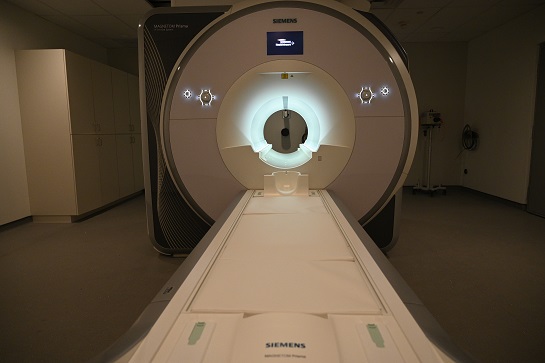
Director: Dr. Douglas Munoz
Lead: Dr. Jason Gallivan
Manager: Donald Brien (613-533-2811)
Directions
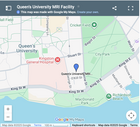
The MRI facility is located in the Cancer Research Institute building at 15 O'Kill Street (Google Maps). O'Kill St runs between Barrie St and George St, parallel to and in between Stuart St and King St W.
To find the MRI facility, go to the south end of the Cancer Research Institute (CRI) building, at 15 O'Kill Street. There is a small parking lot between O'Kill street and the CRI building, and from the street the entrance is not clearly visible because it is in small stairwell.
Once you are at the entrance you will see a sign for the MRI Facility on the wall to the left, and below the sign is a call button. Press the call button to have someone come and open the door to let you in.
Hours of operation
Monday – Friday* +: 09:00 – 17:00
*The hour lunch-break for the technologist is scheduled between 11AM and 1PM to allow flexibility in study start/end times and maximum scheduling, but is usually from 12-1PM. Any change from 12-1PM will be indicated on the facility calendar and must be done with prior arrangement.
+There may be Maintenance or Facility time listed on the schedule. Scanning is not possible during those times. Time for study setup within the control room may be possible during Maintenance Time – contact the technologist to find out.
Scheduling
Please contact the MR Manager at briend@queensu.ca to schedule your time.
In order to maximize the facility schedule users are encouraged to use the following start times for studies whenever possible:
- 9:00 - 1.5 hour booking
- 10:30 - 1.5 hour booking
- 13:00 - 2 hour booking
- 15:00 - 1.5 hour booking
Shorter or longer time slots may be booked, preferably starting at one of these 4 start times, to allow other users to book studies before or after.
NOTE: 72 hours notice is required to cancel studies without being charged for the time booked.
Fees
All rates are predetermined by the Facility Management Committee (FMC) and are subject to periodic review. The current rates are as follow:
Rates for members of the CNS (effective May 1st 2024):
- Research Study rate $500/hr – operator assisted
Additional information on rates is available on SOP #13 Systems Billing Guide and Standard Rates (PDF 956.4 KB)
Standard Operating Procedures
To obtain approval to access the facility all users must attend an MR Safety Training session, read all Facility SOPs and sign the SOP Compliance Statement, and complete a Safety Checklist.
- Definition of Terms (PDF 62.8 KB)
- Disclaimer (PDF 620.1 KB)
- Personnel and Emergency Contacts (PDF 180.3 KB)
- Authorization for Access (PDF 720.5 KB)
- Facility Visitor Approval Policy (PDF 49.3 KB)
- Safety and Operator Training Procedures (PDF 708.2 KB)
- New Protocols and Ethics Procedures (PDF 708.5 KB)
- General Safety Procedures (PDF 849.3 KB)
- Emergency Procedure (PDF 61.5 KB)
- Emergency Fire Procedure (PDF 25.7 KB)
- Emergency Shutdown and Quench Procedure (PDF 67.1 KB)
- General Experimental Procedures (PDF 849.3 KB)
- Exiting the Magnet in an Emergency (PDF 62.3 KB)
- Equipment Handling and Procedures (PDF 44.2 KB)
- Data Handling (PDF 803.5 KB)
- System Billing Guide (PDF 956.4 KB)
- Decontamination Procedure (PDF 44.3 KB)
- Core Services (PDF 16 KB)
- Elevator Access (PDF 18.7 KB)
- Student Run MRI (PDF 895.8 KB)
- Incidental Findings (PDF 819.3 KB)
- Incentive Programs (PDF 758.9 KB)
Equipment
A variety of equipment is available for use in MRI Experiments. Please contact the MR Manager for more details or if you have any other questions.
We provide a state-of-the-art computer system with high performance processors and video cards from Nvidia (GTX 1660 and better), internet connection, high-quality sound card, and connected to the projector and button response box. Matlab and E-Prime are installed for running fMRI studies. Windows and Linux operating systems are available.
If you would like to run from your own laptop, connections are available for connecting the visual display and button response to your laptop via a switchbox.
The PROPixx is a unique DLP LED projector which has been designed to be the most flexible display possible for vision research. The PROPixx features a native resolution of 1920 x 1080, and can be driven with refresh rates up to 500 Hz in RGB mode (1440 Hz greyscale) with deterministic timing. The projector displays images on a rear projection screen that hangs in the bore.
The SV-6011 is a color LCD projection system designed for MR use. The 6011 system accepts an XVGA input (1024x768). Ideal for less time-sensitive studies, this projector is simple to use and displays images on a rear projection screen that hangs in the bore.
Website: http://www.avotecinc.com
fORP fiber-optic button boxes for interactive subject participation. We have bi-manual paddles (8 buttons total), a cylindrical button box (5 buttons), and an X-Box style game controller. We have complementary button boxes for our mock scanner as well.
Website: http://www.curdes.com
The Long Range Mount for the EyeLink 1000 system is optimized for MRI applications. The camera sits in the bore and allows for quick and accurate monocular real-time eye tracking of subjects at a rate of 500Hz.
MRI-compatible audio devices and corresponding ear plugs to allow the delivery of high fidelity audio input to a participant in a MRI environment. The Sensimetrics system is a well-established standard in the field of fMRI sound research and the choice of many MRI research facilities around the world. This high-quality audio device is required to allow the manipulation of sounds in the full spectrum of human hearing. Some MRI parameter conditions do apply with this system.
Website: https://www.sens.com/
The ER-30 is an insert earphone for use in magnetically unfriendly environments. These earphones are ideal for the cramped spaces of our research head coils. These provide 30 dB of noise attenuation and allow for safe, quick, and easy delivery of audio stimuli.
Website: https://www.etymotic.com/
Phone-or Optical Microphone with digital and analog outputs. For auditory response or speech fMRI studies.
Website: http://www.magmedix.com
MR compatible interchangeable prescription eyeglass with lens inserts in Rx powers from -6 to +6.
Website: https://www.safevision.net/
A high resolution in-bore camera for the display and recording of high definition video in the MRI environment. MRC Systems GmbH is well-established and provides many solutions for recording video in the MRI environment.
Website: https://www.mrc-systems.de/downloads/en/mri-compatible-cameras/manual_mrc_highresolution_en.pdf
Monitoring and recording of peripheral pulse (top), ECG (middle) and respiration (bottom) through Siemens wireless physiological equipment.
These devices allow for the recording of the most common biometric signals at extremely high fidelity. These signals include ECG (electrocardiogram), GSR (galvanic skin response), heart rate, respiration, end-tidal CO2, Blood Pressure, and accelerations. We have a complementary system available for our mock scanner.
Template forms
For submitting a protocol for review by the Facility Management Committee and for assistance with preparing ethics protocols. To obtain approval to use the Facility for research please submit a brief proposal using the “FMC Protocol Template" along with a PDF copy of your human ethics submission to Donald Brien (as outlined in SOP 04 - New Protocols and Ethics Procedure).
- New Faculty Agreement (PDF 411.6 KB)
- Compliance Statement (PDF 6.7 KB)
- FMC Protocol Template (PDF 34.5 KB)
- Sample Ethics: Risks and Benefits Form (29.5 KB)
- Subject Information Form (PDF 49.6 KB)
- Safety Checklist for Individuals (PDF 21.1 KB)
- Safety Checklist for Research Subjects (PDF 266.2 KB)