

On a golden September Saturday, down a dirt road, a group of third-year engineering students in steel-toed boots crowded into a windowless bunker tucked into a forested hillside. One clipped two wires to a small orange box. The line ran outside to a sandpit some 50 feet away where a three-foot cardboard tube packed with explosives lay buried.
“Three, two, one,” she called, before pressing a button on the box, appropriately named the “Handi-Blaster.” The group held its breath. A thunderous boom was felt through the concrete walls. Everyone smiled.
Among Canadian universities, there’s nothing like the Alan Bauer Explosives Laboratory at Queen’s. Named for the former mining department head who created it in the 1970s, the lab sits on a rural property an hour north of Kingston.
Here, researchers study blasting and students bound for mining careers connect theory with practice. “Once you understand the science, you can apply it properly,” says Dr. Takis Katsabanis, MSc’83, PhD’88, associate professor and former head of mining engineering.

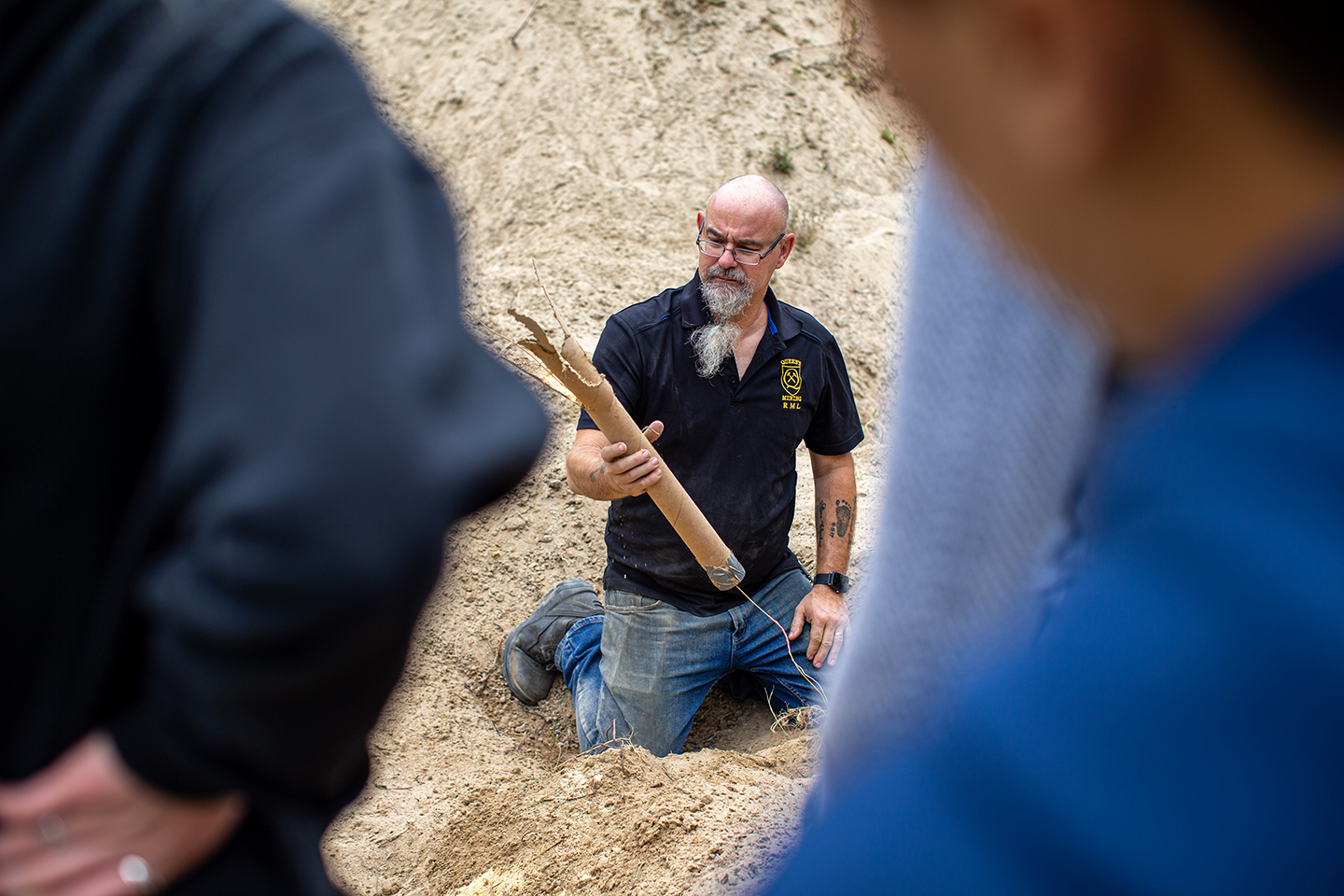


That Saturday began with a lecture in a Quonset-hut classroom before students built charges outdoors: cardboard tubes filled with ANFO, a granular explosive, sealed with duct tape and threaded with a sensor wire to capture data. Then it was off to the sandpit to blow up their work.
“We have students prepare and shoot their samples, closely supervised, of course, because that’s how they’ll learn,” says Oscar Rielo, senior program co-ordinator.
Explosives are critical to mining. Blasts fracture rock so minerals can be extracted. Better blasts mean less grinding later in the mill, lowering costs and carbon footprints. Blasts also send out vibrations that can affect nearby communities. So, students learn how to curb vibration and noise by reducing charge mass and through precise delay-timing between detonations, says Dr. Katsabanis.
Back at the bunker, students checked a monitor for data from their explosion. The shock wave was 1,173 metres per second. The bunker door swung open. Time to set up the next test.