

For a moment in March 2020, as COVID--19 began its deadly sweep through Canada, it seemed a health emergency might trigger an economic meltdown, too. Businesses shuttered overnight. Masses of Canadians lost jobs. Between February and May, unemployment nearly tripled.
For weeks, politicians and economists scrambled to gauge the damage and stave off a worst-case scenario: a broken economy that would take years to heal.
One of those in the thick of the fight was Stephen Poloz, Artsci’78, governor of the Bank of Canada.
That spring should have been a victory lap for Mr. Poloz, whose term was winding down. Appointed in 2013, he had followed Mark Carney, Canada’s celebrated central banker who helped steer the country through the 2008 financial crisis before heading to the Bank of England. By contrast, Mr. Poloz was largely unknown. He joked he was like the player who replaced Wayne Gretzky that no one remembers.
But over his seven-year tenure, Mr. Poloz proved an astute central banker with a knack for plain language and metaphors that any Tim Hortons regular could grasp. He once compared currency fluctuations to walking a dog on a long leash. Frothy oil prices for Canada were like finding a valuable hockey card in your basement.
By March 2018, when he returned to Queen’s to deliver a lecture in Goodes Hall on the future of work (wearing the maroon Arts and Science jacket he’d gotten for Christmas in 1974), Canada’s economy had rebounded from the Great Recession. Unemployment was at a record low and inflation was low and steady. The financial crisis was in the rear-view mirror.
The pandemic, however, was something different: a forced economic shutdown. Bank officials worried about wobbling markets and businesses risked running short of cash. Mr. Poloz recognized the danger wasn’t just money but confidence – cracks in the belief the financial system would keep functioning.
On March 27, he announced an extraordinary move: the bank would buy $5 billion a week in government bonds, for as long as necessary, plus take other measures to keep markets humming. Some critics thought he overreacted. But Mr. Poloz and his team saw the gathering storm. When a reporter asked why so much money for so long, he had a ready reply: “A firefighter has never been criticized for using too much water.”
-
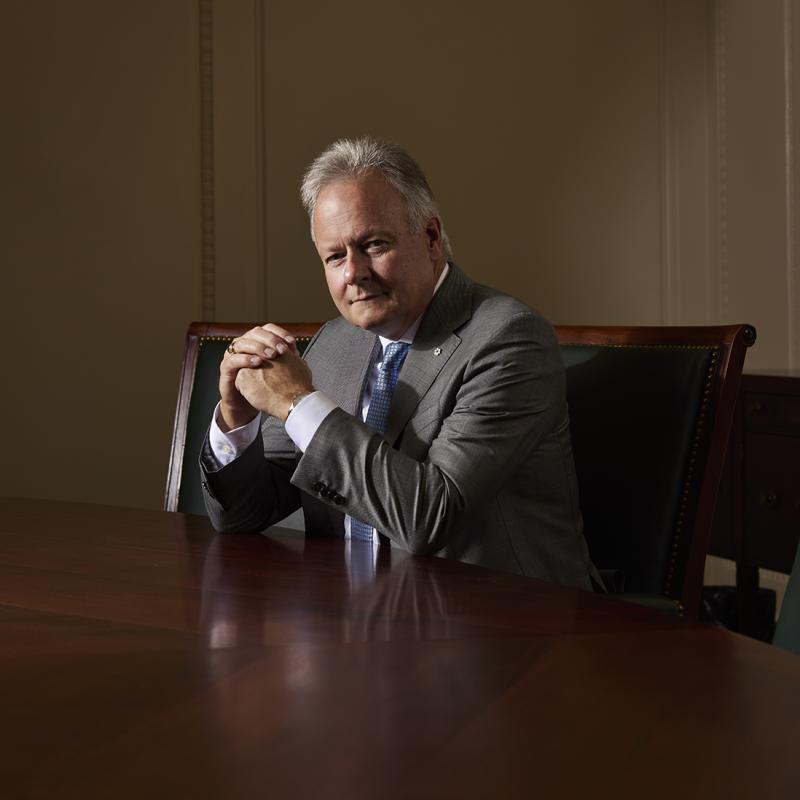
Stephen Poloz, Artsci’78

Say what you will about the 21st century’s milestones – smartphones and social media, Taylor Swift and Spotify – but one defining feature has been a string of economic shocks.
Recall 2001’s trifecta: the dot-com meltdown, 9/11, and Enron-era accounting scandals. Boom!
Then came the 2008–09 financial crisis and Great Recession.
Ka-boom!
Next, the pandemic and its aftermath (inflation, anyone?).
Earth-shattering ka-boom!
These events, plus smaller tremors, have elevated the role central bankers in Canada and elsewhere are expected to play in calming chaos and restoring order.
And for all but five of this century’s first 25 years, a Queen’s economics grad has led the Bank of Canada: David Dodge, Arts’65, LLD’02, governor from 2001–2008; Mr. Poloz, 2013–2020; and current governor Tiff Macklem, Artsci’83, since 2020.
Only current Prime Minister Carney’s tenure (2008–2013) broke the streak.
That three of the last four governors have been Queen’s graduates raises a few questions: What is it about Queen’s economics that produced three governors in quick succession? What lessons did Mr. Dodge, Mr. Poloz, and Mr. Macklem take from the classroom to the governor’s chair? And how do they view their tenures managing crises while coping with the pressures of the job?
The answers lie partly in the intellectual culture they absorbed at Queen’s. What links them isn’t just their office in Ottawa but a Queen’s imprint. Each came with different ambitions, yet all were shaped by an economics department that prizes curiosity, debate, and public service. (The three governors aren’t just connected by Queen’s; they know each other personally, too. Overlapping at the Bank of Canada at different times, they have worked together and built an easy rapport that continues today.)
-

David Dodge, Arts’65, LLD’02

Few high schoolers wake up one morning and decide to become an economist – future governors included.
David Dodge, the first of the trio to attend Queen’s, grew up in Toronto, where his father ran a manufacturing plant. He considered chemistry but economics grabbed his attention because, he says, “it helped you to understand the world and how it worked. It seemed very relevant.”
At Queen’s in the 1960s, economics was more than data points. The university had strong ties to Ottawa – just a couple of hours away – and its faculty included professors steeped in public policy.
There was also a lineage to the Bank of Canada. In 1934, Queen’s professor and alumnus Clifford Clark, then deputy finance minister, had helped establish the bank. By the time Mr. Dodge arrived on campus, Gerald Bouey, BA’48, LLD’81, was already climbing the bank’s ranks, becoming Queen’s first graduate to serve as governor (1973–1987).
But what riveted Mr. Dodge and classmates was the “Coyne Affair” of 1961, a clash between Governor James Coyne and Prime Minister John Diefenbaker over monetary and fiscal policy. Prime Minister Diefenbaker tried, and failed, to oust Governor Coyne, who eventually resigned. With professors like David Slater, BA’47, LLD’89, leading discussions, Mr. Dodge says students had a front-row seat. “I remember coming into class and we were all consumed by what was going on. There were ferocious debates as to who was right, the prime minister or Coyne,” he says.
No such drama marked Mr. Dodge’s own tenure with three prime ministers – Jean Chrétien, Paul Martin, and Stephen Harper – which began in January 2001, after a career in academia (including teaching at Queen's, where he also served as chancellor from 2008–2014) and the civil service. But other forces intervened. His first year as governor saw the 9/11 terrorist attacks, the collapse of the dot-com bubble, and accounting scandals that pushed the United States into recession. Yet Canada, unusually, did not follow.
Mr. Dodge credits that to several factors: booming investment in Alberta’s oil sands, a Canadian stock market less dependent on tech, plus an already buoyant economy. But his role shouldn’t be understated. To stave off a downturn, the bank slashed its key interest rate by 3.5 percentage points between January and November 2001.
As for his point that the economy was already resilient, well … Mr. Dodge had a hand in that, too. Before leading the bank, he had been deputy finance minister under Brian Mulroney and Mr. Chrétien, from 1992 to 1997. Alongside Mr. Martin, then finance minister, he led the way turning Canada’s long-standing deficits into a decade of surpluses.
His reputation as governor grew quickly. Before Mr. Carney earned “rock star” central banker status, the Toronto Star, in 2007, dubbed Mr. Dodge the “world’s most admired central banker.” That same year, Reuters named him one of its top newsmakers, praising him as “a skilled bureaucrat credited with helping Canada out of an economic morass in the 1990s” and a governor whose unusually direct talk “gained the admiration of market players.”
That candour extended to fellow central bankers. Mr. Dodge recalls that in the mid-2000s he and the governor of the Bank of England became alarmed at America’s widening current account deficit, unsustainable borrowing, and credit-fuelled housing boom. Together they warned U.S. Fed chair Alan Greenspan, but he would have none of it. “He thought the economy in the U.S. was red hot and it should be kept that way,” Mr. Dodge remembers.
Yet their concern was prescient. Soon, the U.S. housing market collapsed, triggering the global financial crisis.
-

Tiff Macklem, Artsci’83

The Bank of Canada governor is sometimes dubbed Ottawa’s third most powerful figure, after the prime minister and finance minister. But the role’s influence can appear limited. Of the bank’s four main duties – designing and issuing bank notes, serving as the federal government’s banker, safeguarding the financial system, and steering monetary policy – only the last has a big button that directly moves markets: setting the benchmark overnight interest rate.
In recent decades, however, governors have extended their reach by weighing in on broader issues.
Take Mr. Poloz’s 2018 speech at Queen’s. He argued Canada’s economy had “untapped potential” in five under-represented groups: youth, women, Indigenous Peoples, Canadians with disabilities, and recent immigrants. Bringing more of them into the workforce, he said, could add 500,000 workers, lift output by 1.5 per cent (about $30 billion annually), and raise incomes. He pointed to Quebec’s child-care and parental leave provisions, which pushed female workforce participation to 87 per cent, as proof that supportive policies can unlock growth.
It was the kind of speech Mr. Poloz became known for: direct, pragmatic, and firmly rooted in main-street economics.
Mr. Poloz grew up in car-manufacturing Oshawa, Ont., the son of a tradesman. He came to Queen’s planning to study medicine, but an economics class caught his interest.
Looking back, he first recalls that Queen’s took a broad “mainstream” approach to economics. “You were going to get everything for your toolkit.” Classes “were vigorous, challenging, yet civilized. It set the tone you hoped for.”
Second, the department was populated by luminaries. “When you got your economics textbook and looked at the cover, it was written by Lipsey, Sparks, and Steiner. Well, [Professors] Richard Lipsey and Gordon Sparks were at Queen’s,” he says.
But it was Doug Purvis, another professor, who left an especially memorable impression. He taught that economics wasn’t about memorization but about a disciplined way of thinking. That philosophy guided Mr. Poloz’s time as governor. “I’ve always been impatient with those who only focus on the math,” he says. “If it’s not in the math, it’s not correct. They almost don’t care how it applies in the real world.”
That mindset shaped his response to the 2014 oil shock. Though largely forgotten outside Alberta, the collapse in oil prices threatened to derail Canada’s brittle post-recession recovery. After peaking at US$107 a barrel in June, prices plunged by more than half.
At the bank’s granite-faced headquarters in Ottawa, Mr. Poloz was concerned. Official data showed no looming slowdown, but he had the bank poll oil executives to see how much they would cut investment. The answers pointed to billions in losses to the economy.
“We felt this was going to have a big impact six months from now,” he recalls.
“What I loved was that it wasn’t just theory. You could test ideas against data, reject them, and come up with better ones…”
Acting pre-emptively, the bank cut interest rates for the first time in four years. Again, some thought Mr. Poloz needn’t have bothered. But in the end, the bank was proven right. The economy contracted briefly, but a recession was avoided.
While the Bank of Canada’s core mandate hasn’t changed much for decades, its challenges can feel more urgent. The 2008 financial crisis was billed as a once-in-a-generation shock – until COVID-19 hit just 12 years later and proved more disruptive.
David Longworth, a retired Queen’s economics term adjunct professor and former bank deputy governor, says risk planning is becoming tougher for central bankers. “You can plan for (U.S.) President (Donald) Trump charging tariffs, but you can’t say what the probability is of how much they will be, or whether they’ll go up or down or how long they’ll be imposed,” he says.
“A lot of things we once accepted in the international order don’t seem to hold anymore,” he adds, making it harder for central banks to gauge how shifting trade alliances, supply chain shocks, wars such as the one in Ukraine, or pandemics will ripple through the Canadian economy.
All these issues and more have landed on the desk of the current governor, Tiff Macklem.
Mr. Macklem grew up in Montreal, where his father worked as an executive at Birks Jewellery. Like Mr. Dodge and Mr. Poloz, he considered another path (geography), but economics quickly won him over.
“What I loved was that it wasn’t just theory,” he says. “You could test ideas against data, reject them, and come up with better ones … Nothing compared to sitting in a classroom, having a professor explain something, and suddenly having the light bulb go on.”
The subject of inflation, in particular, left a deep mark. In the 1970s and ’80s, prices surged across the industrialized world. By the early ’80s, when Mr. Macklem was at Queen’s, inflation topped 12 per cent in Canada and mortgage rates soared above 20.
“As a teenager, my impression was that people were angry about inflation,” he says. “They felt cheated. They worked hard, but everything cost more. It seemed like a virus that spread through the entire economy, and nobody knew how to cure it.” His view shifted in university: “I realized inflation came from poor economic policies. It could be difficult to fix, but we didn’t have to live with inflation.”
By the early 1990s, the bank succeeded in pushing inflation down. Mr. Macklem was then part of a team (with Mr. Poloz) that designed the bank’s inflation-targeting framework. Canada’s central bank became among the first in the world to adopt such a policy, committing to keep inflation near two per cent. As a result, a generation of Canadians grew up without experiencing its damaging effects.
That changed early in Mr. Macklem’s tenure as governor. As the economy reopened in 2021–22, surging demand, product shortages, and supply chain disruptions pushed inflation above eight per cent. Central banks around the world, including Canada, didn’t immediately raise interest rates, thinking at first that the inflation spike would be temporary and that raising rates immediately would undermine the fragile recovery.
But as inflation kept soaring, “our thinking changed,” Mr. Macklem says. “We decided we needed to act forcefully.” Higher interest rates slowed growth and drove up mortgages and credit costs, but the strategy worked: inflation came down, and, importantly, it did so without pushing Canada into recession.
Mr. Macklem’s first term as governor ends in June 2027. By then, he will have steered the bank through the litany of obstacles cited above. Next up: Canada will attempt the tough task of expanding trade beyond the U.S. amid Donald Trump’s tariffs – which inevitably will affect economic growth one way or the other.
“Being governor is a difficult job at any time, but the last five years have had a lot more uncertainty than we’ve had in a long time,” says Jeremy Kronick, Artsci’06, who keeps tabs on Canada’s monetary policy as vice-president of economic analysis and strategy at the C.D. Howe Institute.
That uncertainty isn’t going away. More supply shocks – like those seen during the pandemic in 2021–22 – could return, driven by geopolitical tensions, trade wars, or climate change. These kinds of shocks, notes Mr. Kronick, are harder for central banks to manage than demand shocks, which cause consumer and business spending to rise and fall and can be smoothed with interest rate moves. “Things could become even more challenging for central banks,” he says.
How will Mr. Macklem tackle what-ever comes next? To answer that question, he recalls a formative moment from his undergraduate days. While working on a thesis about exchange rates, he spent weeks unsuccessfully trying to solve a problem with a method provided by his professor, David Backus. When he finally gave up and sheepishly returned to ask for help, he remembers Prof. Backus glanced at the problem and said, “Yeah, that method I gave you isn’t going to work,” before suggesting another approach.
“What I learned from that,” Mr. Macklem says, “is that real economics isn’t like a textbook where you can just go to the back and find the answer. So, as governor, I ask a lot of questions. Because it’s important that we get it right. Canadians are counting on us to get it right.”