

Of all the overlooked corners, crannies, and nooks at Queen’s, only one truly qualifies as a “hidden gem” – the Miller Museum of Geology. That’s because it’s filled with gems … and minerals, rocks, and a few dinosaur fossils, too.
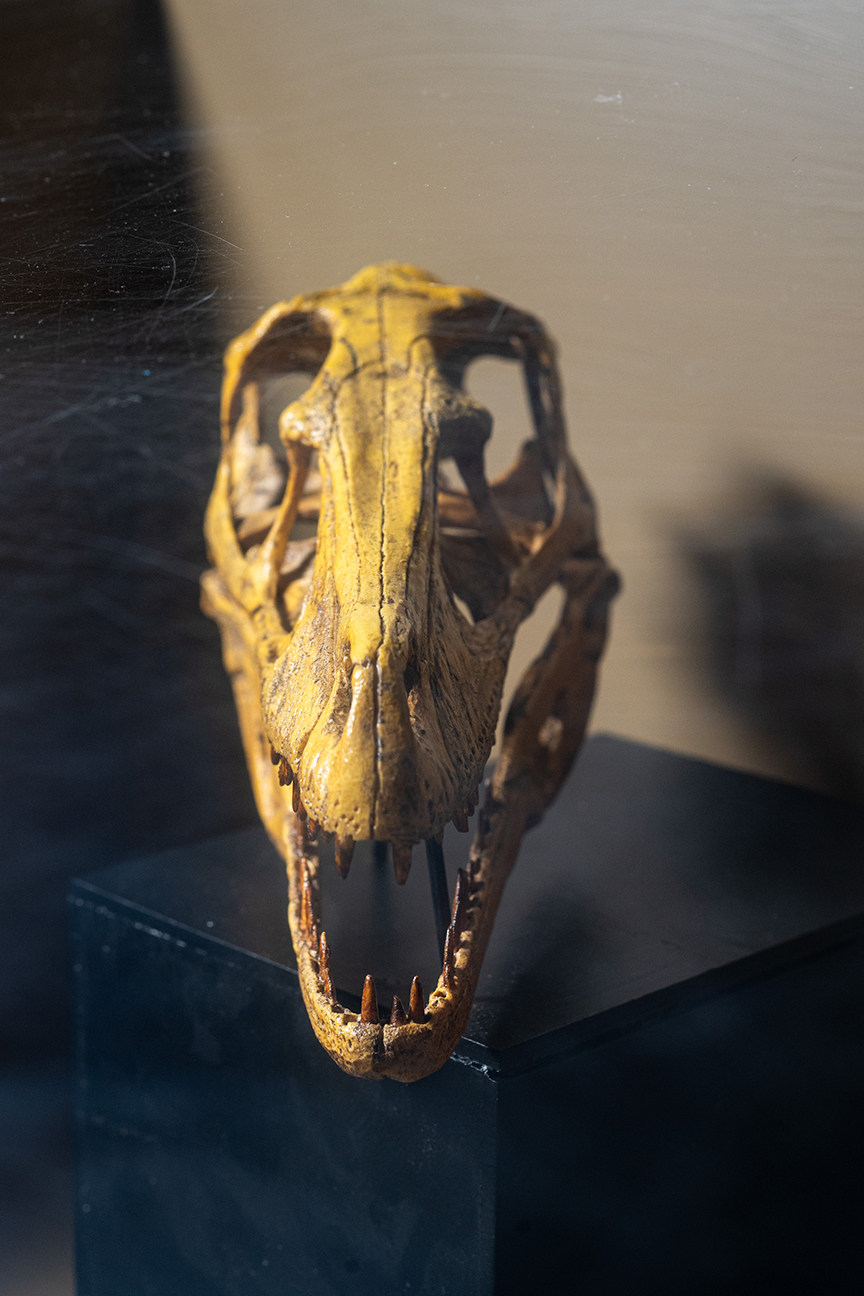
The museum spans several rooms in Miller Hall. About 50,000 items from around the world are in the collection, says Linda Tsuji, the Miller’s curator and adjunct assistant professor in the Department of Geological Sciences and Geological Engineering.
Here, rocks burst with colour: deep blue covellite mined in Montana for copper; bright yellow sulphur from Italy; a shimmering violet slice of charoite from Russia; and a stunning rhodochrosite from Argentina, its rose-pink swirls like lines in a tree trunk.


Some chronicle Canada’s mining past. A native silver piece from the Temiskaming Mine near Cobalt, Ont., connects to the museum’s namesake. Willet Green Miller came to Queen’s in 1893 as a geology professor. Later, as Ontario’s first provincial geologist, he identified silver discoveries that turned tiny Cobalt into a boom town, complete with an opera house and hockey team that vied for the Stanley Cup.
Local museum visitors often share the same reaction, Dr. Tsuji says. “I hear a lot of ‘I’ve lived in Kingston all my life and didn’t know this was here.’” Rock aficionados from afar add it to their itinerary when passing through. “Some people will spend two hours here and read everything.”
Queen’s distant history makes it the perfect spot for a geology museum. A billion years ago, the land was covered by a mountain range rivalling the Himalayas. Hundreds of millions of years later, it lay beneath a warm, shallow ocean that formed the limestone for which Kingston is famous. Visitors can touch these tectonic transformations: one boulder’s layers fold over one another, moulded as if made of soft dough; another bears a smooth, concave bite from a glacier.
The past may be set in stone. But at the Miller, it feels alive.