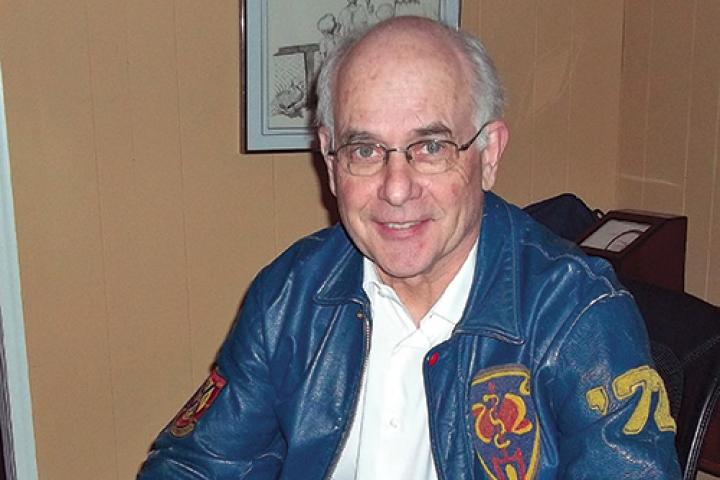
In 1980, if you had caught a young Ian Spooner between geology classes in Miller Hall and asked him where his future lay, he might have answered gigging with his guitar in folk clubs, sailing a yacht to the Bahamas, or being a ski bum in the Rockies – all of which he’s done.
He would not have said, “A reality TV star searching for long-lost pirate treasure.”
And yet for the past six seasons, Dr. Spooner, Artsci’83, MSc’88, has been a regular on The Curse of Oak Island, the History Channel show that has amassed a global audience while following a quirky, quixotic quest for pirate gold.
For Dr. Spooner, now a geoscientist at Acadia University in Wolfville, N.S., it’s been an adventurous career that might never have launched if not for Queen’s and an understanding professor.
“My connection with Queen’s runs deep,” he says.
Queen’s was the hometown university for the Kingston native. After completing his first year in general science, he settled on geology as his major. But, as for many young students struggling through their first years of higher education, it was a tough slog. By the end of second year, the future Dr. Spooner found himself on academic probation and at risk of suspension.
“I was just young for my age,” Dr. Spooner says. “It’s a real transition to go into university. I see it all the time here with my students. And it happened to me, too.”
Second-year geology field school and a summer job as a junior geologist in the Yukon helped Dr. Spooner get his bearings. He wrote a letter to Dr. Mabel Corlett, then head of undergraduate students. She wrote back, in all caps: “YOU’VE GOT ONE MORE CHANCE!” he recalls.
Years later, Dr. Spooner, now a geology professor himself, ran into Dr. Corlett at the Kingston Yacht Club.
“I told her that story and she got very emotional,” he says. “I was emotional, too, because I don’t know what I would have done otherwise. That was probably one of the most pivotal events in my life, outside of getting married – her letting me back in. Then everything changed for me.”
Dr. Spooner found his footing in Miller Hall.
“I felt it was a department that really took care of its people,” he says. “I found a home there. And I found a cohort – the class of ’83 – that were just a great bunch of people.”

He took geography courses that further expanded his horizons. He cites Dr. Robert Gilbert, Dr. John Shaw, and Dr. Gerald McGrath among his mentors.
“They made me feel, maybe unwittingly, that I had some potential,” he says.
But Dr. Spooner’s path to Oak Island was far from direct. After finishing his master’s degree at Queen’s and working several years as a geoscientist with a construction firm, he followed another passion – skiing – and moved to Lake Louise, where he helped manage a ski shop. While there, he also started a landscaping company with a friend until a professor at the University of Calgary invited him to pursue a PhD. Doctorate in hand, he was soon hired by Acadia, where he has been ever since.
He was head of the Earth and Environmental Science department from 2014 until 2019 and was also director of the K.C. Irving Environmental Science Centre.
Dr. Spooner, who turns 65 this year, will retire this summer.
Primarily, his research has dealt with measuring for the presence of metals in soil and groundwater, a key component of environmental remediation. It was that expertise that caught the attention of Oak Island’s treasure-hunting brothers, Rick and Marty Lagina, and their business partner, Craig Tester.
Initially, Dr. Spooner was skeptical. He’d heard the legends about the Oak Money Pit and the lost treasure of Captain Kidd – what Nova Scotian hasn’t? – but dismissed them as romantic folk tales.
“I have a sailboat I keep in Mahone Bay and have sailed past Oak Island hundreds of times,” Dr. Spooner says. “Sometimes I’d yell out: ‘It’s just a sinkhole!’”
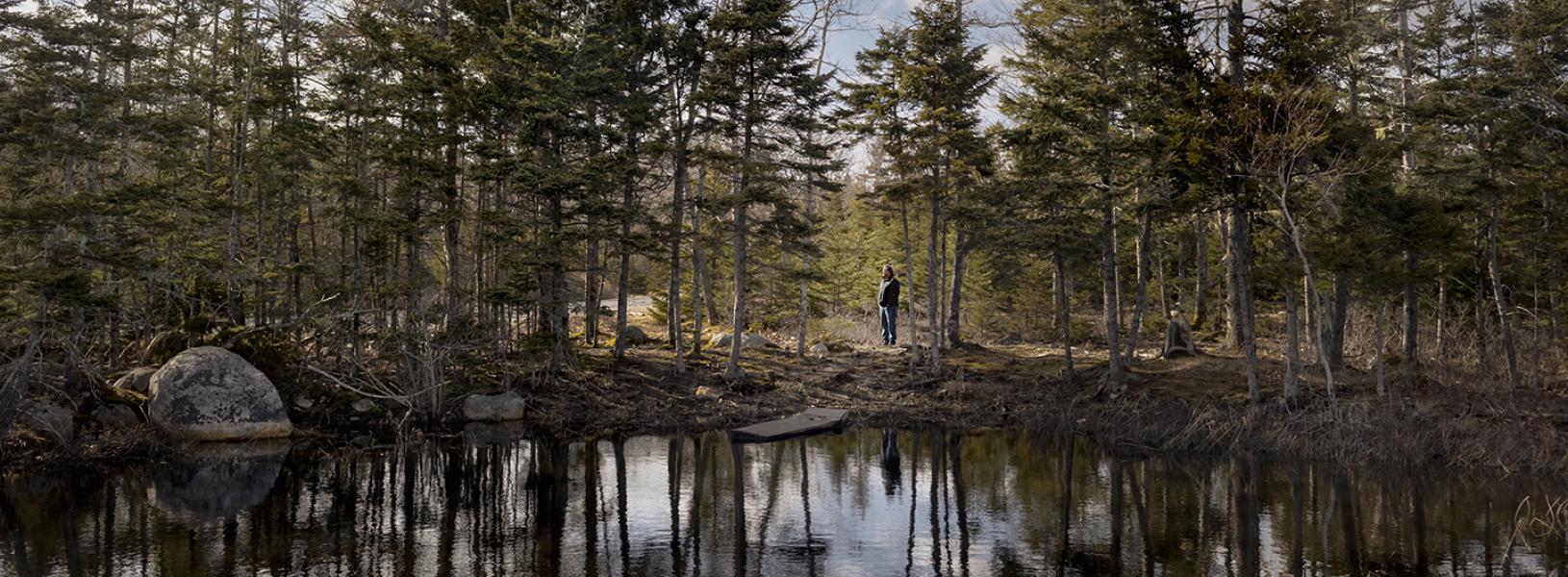
The Laginas and Mr. Tester were confounded by a mysterious triangle-shaped swamp on Oak Island and had been told that Dr. Spooner was an expert on the matter.
“They asked a few times and I always said, ‘No way. I’m busy. I’ve got my own lab to manage,’” he says. “I’d done a little bit of TV before,
but it just didn’t seem to be my kind of thing.”
He credits his sister, Karen Lee McKay, with changing his mind. They were skiing together in Whistler, B.C., when Karen Lee asked about the Oak Island offer.
“She watched the show and said, ‘So, when are you going to tell them that you can help?’ And I told her I wasn’t going to do it,” he says. “She got really mad. She said, ‘There’s an informed opinion, an uninformed opinion, and no opinion. And you always said that the worst thing is an uninformed opinion, and that’s exactly what you have.’ Then she stomped out of the bar! It was very awkward.
“Later, when we made up, I said, ‘You are absolutely right. I really don’t know what I’m talking about. If they ask me to do it, I will listen.’”
The next time Prometheus Entertainment, the company that produces The Curse of Oak Island, called on behalf of the Laginas and Craig Tester, Dr. Spooner said yes.
“I asked if I could involve my students and they said ‘Absolutely!’ Initially, it was only going to be for five days, myself and three students. We did some testing, and I realized that they were really, really good people. The students were excited. Their parents were excited. And I thought to myself, ‘OK, what’s this all about?’ I realized that there are a lot of people who were really invested in this.”
And, as it turns out, the show became very invested in him.
“With any kind of thesis, the challenge is limited by the information in front of you. Then it’s expanded by your imagination. And a lot of science doesn’t pay enough attention to the imagination side. But I think curiosity and imagination have been a huge part of my career.”
“When Dr. Spooner first came, it was because his expertise was swamp morphology,” says Jon Levy, who runs the Oak Island operation on site for Prometheus. “Then the Laginas and Craig Tester realized that Ian was such a great asset to the show. And we started asking, ‘Hey, can you look into different metals in the water in the Money Pit? Can you look into all these other complex scientific issues that they have?’ He’s been with us ever since and gives us great advice every year on how to solve the mystery.”
Dr. Spooner has now appeared in more than 100 episodes and is a valued member of what the Lagina brothers call their “Fellowship of the Dig.”
While the Laginas and Mr. Tester suspected the swamp was created by humans, it was Dr. Spooner who offered the scientific proof of their theory. Based on his advice, the team uncovered a mysterious stone pathway buried in the muck. Dr. Spooner also sent water samples from the Money Pit for analysis by another Queen’s geologist, Dr. Peir Pufahl at the Queen’s Facility for Isotope Research (QFIR) lab.
“Peir sent me the results and said, ‘You know, there’s a couple of your wells that are anomalous in gold,’” Dr. Spooner says. “That was a big moment. They even came to my house to film. Peir was on the show, too, and he was great.”
But from a production standpoint, Dr. Spooner has skills beyond swamp morphology that make him an asset to the show.
“Ian is an incredibly intelligent man,” Mr. Levy says. “He thinks about things in a way that none of the other members of the team do. One of the great skills he brings is that he takes very, very complex scientific jargon and digests it so that the audience can understand, too.”
As it turns out, bringing science to the people was something that came quite naturally to Dr. Spooner.
“They’ve let me do the science,” he says. “They were respectful of that. And I seemed to have what they needed for TV; talking in plain language, being engaged, having fun with other cast members on camera, being comfortable in that environment. I think that comes from being a teacher. It comes from being curious.”
For Dr. Spooner, one of the true values of the show is how it makes science accessible.
“I’ve learned that stories matter as much as science. Science without stories is a lesser thing,” he says.
During the field season, Oak Island can be crawling with between 40 and 60 people, including the Lagina brothers and their associates, scientists, historians, archeologists, and heavy equipment operators, as well as the TV crew from Prometheus. The cameras are always rolling. Nothing is staged.
“It’s not easy doing science in front of cameras,” Dr. Spooner says. “Science can be very boring at times, very tedious, especially for those observing it. Sometimes I feel like I have to rush so the poor cameraman’s not staring at me for three hours. But they’re very, very professional. As one cameraman said to me: ‘Don’t worry, Ian, we’re making TV. You do your thing.’”
Dr. Spooner regularly receives emails about the show and is often asked to pose for selfies with scientists at conferences he attends. Whenever the team is filming, a crowd of fans clusters at the causeway leading to Oak Island – a sort of Beatlemania for treasure hunters.
Dr. Spooner has taken the experience in stride. He does his science and allows the producers to do their thing, distilling hundreds of hours of video into each one-hour episode.
“If you’re going to do this work, you have to accept that you don’t have a lot of control,” Dr. Spooner says. “You have to trust in the audience.”
In fact, he rarely watches the show. Once, he and his wife checked in to a motel during a long road trip and, exhausted, flipped on the TV.
“And there it was,” he says. “We had a good laugh. You never quite look like you think you do. But after being on more than 100 episodes, you get to the point where it doesn’t really matter. You are who you are.”
Will the Laginas and Craig Tester ever find their gold? Dr. Spooner is coy. The water chemistry does indicate that there are precious metals in the Money Pit. And he points out that treasure hunters really did find a trove of coins and jewels belonging to Captain Kidd on an island off the shores of Long Island, N.Y.
“I mean, people have their stories and their theories, right? Some of those are interesting, and I’m curious about them. Others are less so, but again, you have to be respectful of that stuff.
“With any kind of thesis, the challenge is limited by the information in front of you. Then it’s expanded by your imagination. And a lot of science doesn’t pay enough attention to the imagination side. But I think curiosity and imagination have been a huge part of my career.
“I’ve been very fortunate with the opportunities I’ve had. And the Queen’s story is part of that. And I’m very, very grateful to Dr. Corlett and people like her who have given me that second chance.”

The Oak Island Legend
“Just off the rugged southeast shore of Nova Scotia lies a tiny island fashioned somewhat like a question mark.”
So begins David MacDonald’s 1965 Reader’s Digest story about the enduring mystery of Nova Scotia’s Oak Island. It’s a thrilling tale of “glittering legends of buried gold” and the long-lost treasure of Captain Kidd. Or was it Blackbeard? Or Captain Morgan? Could it be Shakespeare’s lost manuscripts or King Louis XVI’s crown jewels buried in Oak Island’s seemingly impregnable “Money Pit?”
The story of Oak Island has been told and retold for generations ever since the summer of 1795 when, legend has it, a young teen named Daniel McGinnis was hunting on the island and stumbled across an unusual depression in the ground. Suspended overhead from a tree branch was an aged ship’s block and tackle.
McGinnis returned the next day with two friends and the boys began to dig. At two metres’ depth, they reached a platform of oak logs. Three metres below that they reached another platform. Three metres below that, a third. McGinnis and his friends found no treasure, but in the more than two centuries since, other star-struck treasure seekers have continued the search, digging deeper and ever deeper. The Money Pit, with its devilish and sometimes deadly design, has held its secrets tight.
Among MacDonald’s mesmerized readers in 1965 were two young brothers from Michigan, Marty and Rick Lagina. Thirty years later, their imaginations still burning with dreams of gold, Marty, a successful businessman, and Rick, a former postal worker, visited Oak Island themselves. Along with their business partner, Craig Tester, they began a search of their own, first in partnership with the island’s owner and, later, as sole owners of the island themselves.
Their search had been underway for years before Prometheus Entertainment approached them to do a TV show. The Curse of Oak Island first aired in 2014. Twelve years and more than 266 episodes later, it’s still going strong. And the Lagina brothers and Mr. Tester are still digging for gold.