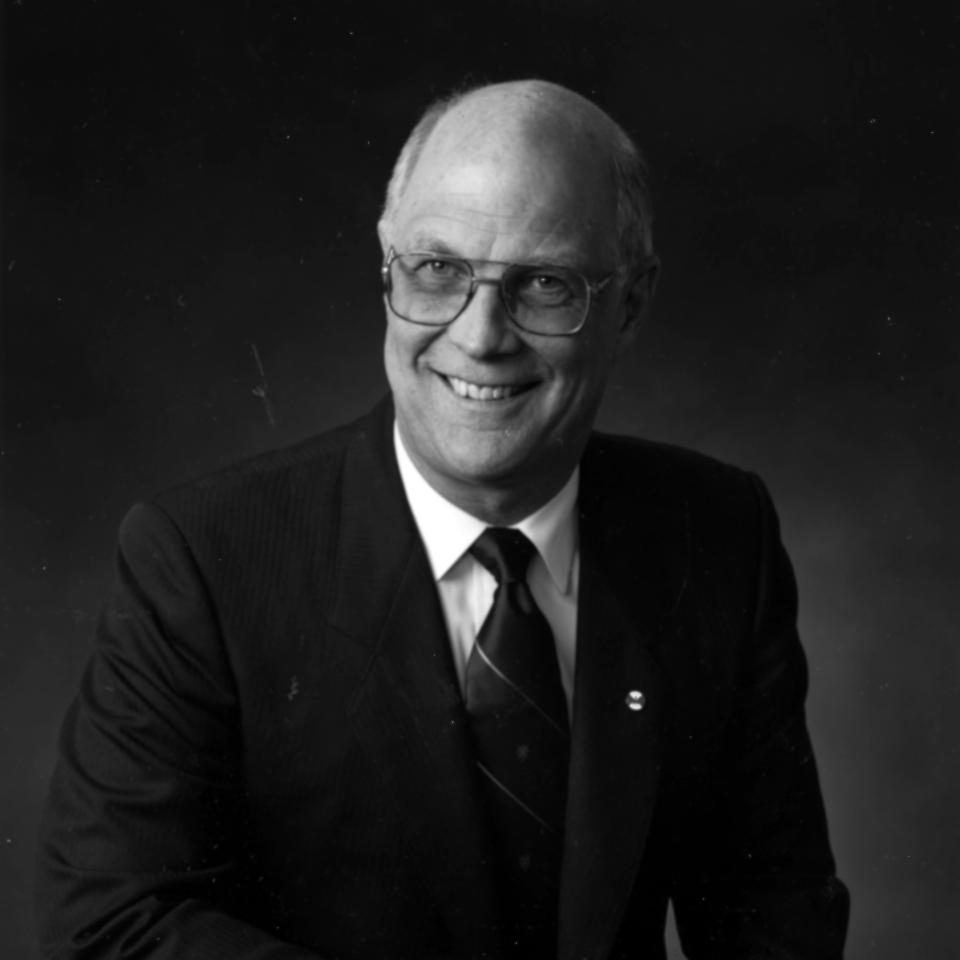
When four Queen’s students took over the university principal’s office one day in early 2002, William “Bill” Leggett, LLD’04, greeted them, gave up his space, and left them to proceed with their demonstration.
The students decided to occupy the principal’s office to protest Dr. Leggett’s proposal to the provincial government to scrap a tuition increase limit tied to inflation in favour of allowing the university to up it by 10 per cent annually over four years.
Although he steadfastly refused to withdraw his request, Dr. Leggett also fully supported the students who locked themselves in his office to express their opposition. He and his spouse, Claire, even arranged for a pizza delivery.
“The pizzas were hoisted onto the second floor of Richardson Hall, or so the story goes – it’s one that Bill would recount many times,” says Dr. David Walker, Meds’71, a professor in the Department of Emergency Medicine and School of Policy Studies.
“Interestingly, the student leader who led that occupation became a friend of Bill’s. Bill followed this young man’s career for years, which gives you an idea of the sort of man he was.”
Born in Orangeville, Ont., on June 25, 1939, Dr. Leggett became a globally prominent academic by happenstance, discovering a love of biology after taking an elective at Waterloo University College, now Wilfrid Laurier University. Dr. Leggett went to the university intending to be a physical education teacher.
That biology class set him on a course to be a world-renowned researcher in the dynamics of fish populations, with his contributions to the field seeing him invested into the Order of Canada, as well as being made a Royal Society of Canada fellow, among many other academic honours.
After graduating with a Bachelor of Arts from Waterloo, he completed a master’s program in zoology before heading to McGill University for doctoral studies. Dr. Leggett joined the McGill faculty after obtaining his doctorate in 1969 and quickly rose through the academic ranks, culminating with the post of vice-principal of academics, which he held before departing for Queen’s.
He became the university’s 17th principal and vice-chancellor in 1994, serving in those roles for a decade. After he retired, Dr. Leggett held the titles of Queen’s professor emeritus and principal emeritus.
Although Dr. Leggett oversaw Queen’s in a difficult time as governments looked to cut and universities found themselves in the crosshairs, he also found a way to deliver an impressive expansion of the campus that included adding several new buildings and student residences. One even bears his name, Leggett Hall. Along the way, he also raised the university’s profile and worked to attract external research funding.
On the other hand, former Queen’s Board of Trustees member Gordon Dowsley, Arts’66, recalls that Dr. Leggett always worried about the university growing too much, because he saw Queen’s as one big family and never wanted to lose that feeling. And no matter what role someone filled on campus, Dr. Leggett made sure each person felt that family vibe.
Queen’s Board of Trustees member Gordon Dowsley, Arts’66, recalls that Dr. Leggett always worried about the university growing too much, because he saw Queen’s as one big family and never wanted to lose that feeling.
“At graduations, there are a set of VIP seats up in front of the stage, and then the parents, they fill the galleries, or any corners that are open,” Mr. Dowsley says. “But Bill put out the word: ‘Look, if anybody here at Queen’s, any employee, a groundskeeper or a professor or anybody else, has a child graduating, by all means get them in that VIP section.’ I thought that was neat.”
Dr. Walker first met Dr. Leggett when he became principal. The pair and their spouses quickly formed a bond and soon began taking holidays together.
“You could hear Bill coming, because there was always a laugh in the hall,” Dr. Walker says. “When we would have budget meetings in the faculty each year and Bill would come to us, you’d hear him coming down the hall chatting and laughing. You just couldn’t help but love the guy as he was giving you gloom and doom news that our budget was going to be cut by 10 per cent, but then he’d say we’ll work together and we’ll work it through – he was disarmingly effective.”
He also enjoyed flying, although he didn’t own a plane and would rent one at a nearby flying club. And he loved working with his hands – perhaps a carryover from his father, who ran an automotive shop.
“He kept a full workshop in his cottage in the Ottawa Valley and took great pride in recounting the process of cutting down a tree on his bush land and making a table or something from it,” Mr. Dowsley says. “To be able to make something from a tree on his own land made him quite happy.”
No matter where work and hobbies took him, Dr. Leggett always had his high-school sweetheart, Claire (nee Holman), near his side.
“Claire was a perfect mate for a principal of his nature who was always being friendly with people and welcoming everyone to the event,” Mr. Dowsley says. “Of course, he missed her dreadfully after she died.”
Queen’s recognized the pair’s contributions to the university over the years with the Claire and Bill Leggett Seminar Room at the Isabel Bader Centre for the Performing Arts.
While Dr. Walker quickly admits he doesn’t know much about fish research, he certainly remembers a particular moment that stood out in Dr. Leggett’s academic career. When Dr. Walker served as dean of Queen’s Health Sciences, he oversaw the process to ensure that researchers met required standards, and at one point an Ontario government veterinarian inspected the research in the biology department.
“The veterinarian identified one of the shortfalls: A faculty member in biology failed to report the number of fish in the tanks in the research facility in biosciences, so I asked my administrative assistant to arrange a meeting with this recalcitrant professor in biology,” Dr. Walker recalls.
“It turned out it was Bill Leggett – we had a laugh about it, and then he went off to count his minnows.”
Dr. Leggett died Feb. 13, 2026. He was 86.