The Balloon-borne Very Long Baseline Interferometry Experiment (BVEX) is a new project, led by astrophysicists at Queen's University, with the goal of showing that radio telescopes suspended from helium balloons can join with ground-based telescopes to create an Earth-spanning radio observatory!
Very Long Baseline Interferometry (VLBI) uses many telescopes at different locations on Earth to observe the same object simultaneously. By carefully correlating the observations later on powerful computers it is possible to make extremely high-resolution images. For example, VLBI has been used by the Event Horizon Telescope Collaboration to image the shadows of the supermassive black holes. These maps are the highest resolution images ever made in astronomy.
Our team is aiming to show that adding balloon telescopes to global VLBI networks can improve the quality of these high resolution radio images. It may also be possible to use balloon telescopes to create even higher resolution maps of the regions around supermassive black holes by observing higher frequency light not accessible to most ground based telescopes.
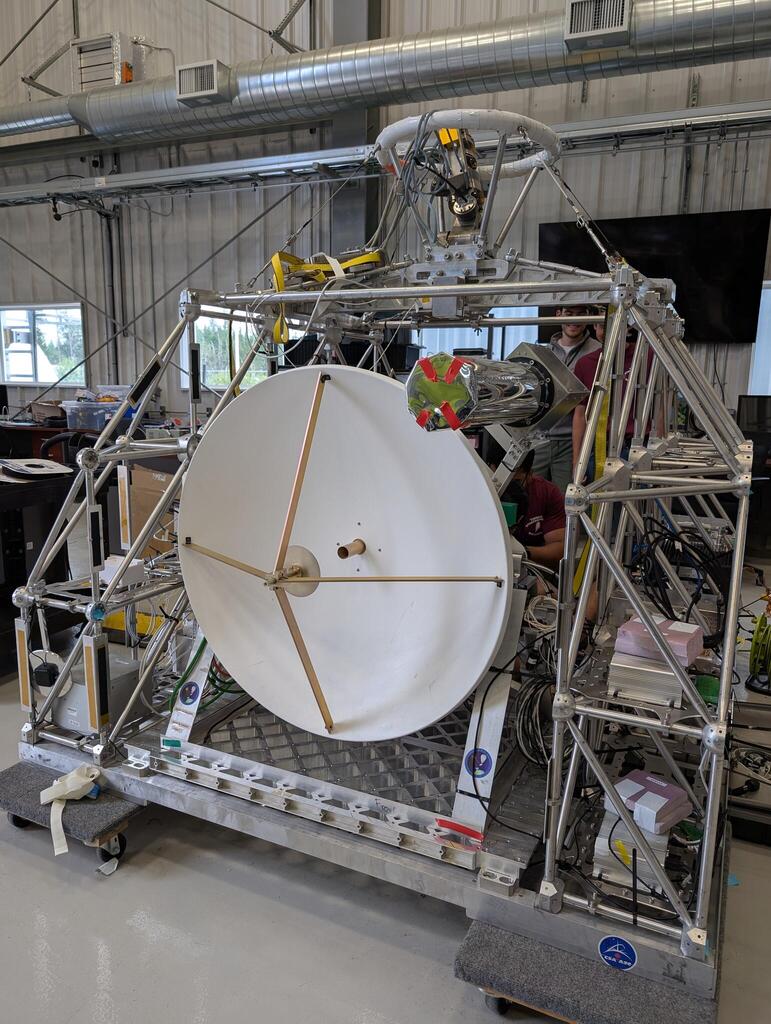
BVEX is the first step in adding balloon-borne radio telescopes to VLBI observatories. In the last week of August 2025 we will be launching a specially designed 0.9-meter radio telescope on a balloon gondola from the Canadian Space Agency's Timmins, Ontario Stratospheric Balloon Base. During the overnight balloon flight BVEX will rise up to 33 km above sea level, and will make observations of bright radio galaxies simultaneously with radio telescopes in North America and in Europe.