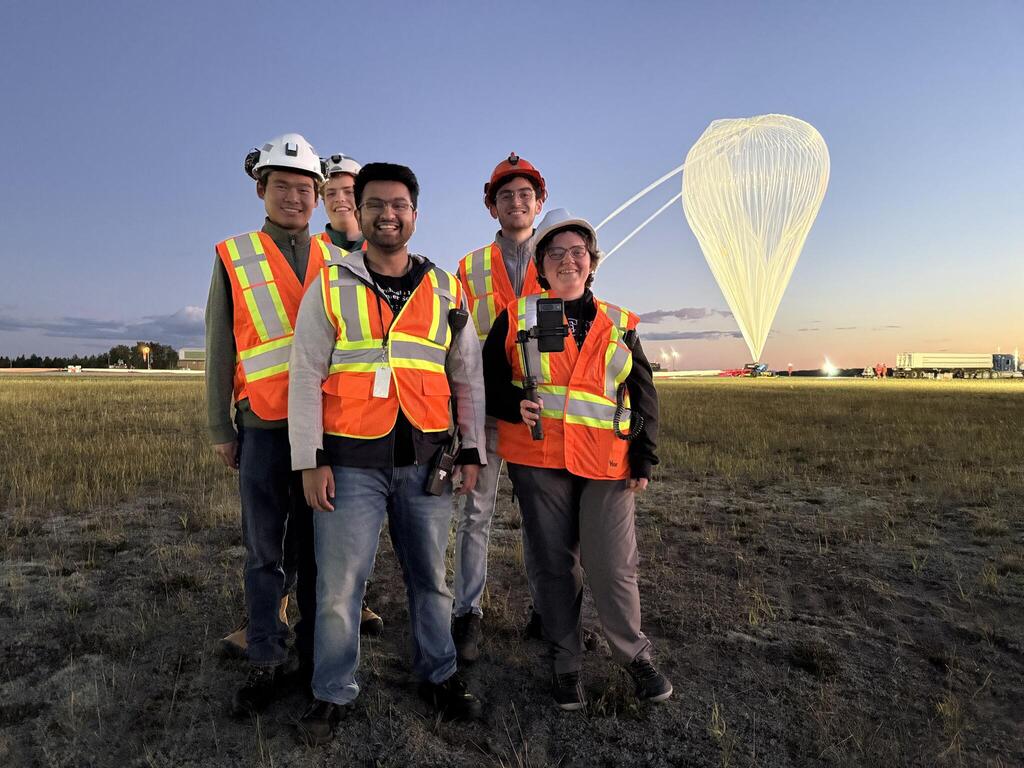
Well this post is quite a few weeks after the conclusion of our campaign... but as you will hear it was a bit of an adventure and I, at least, needed a bit of time to process all that happened.
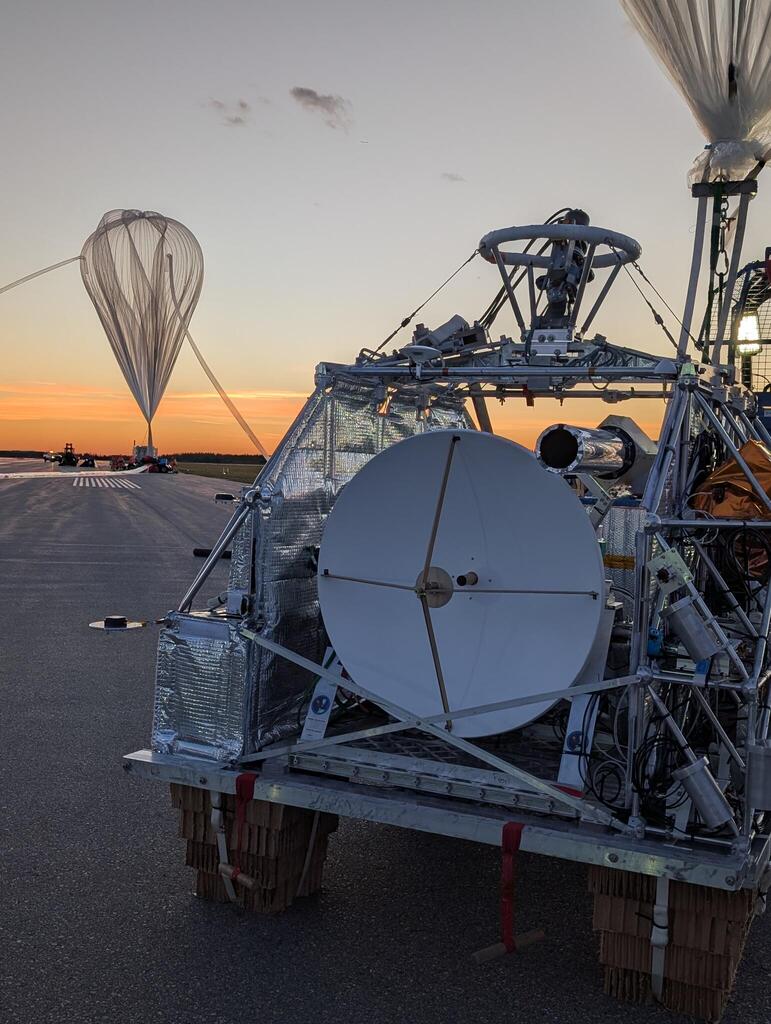
We launched BVEX on Friday August 29th at 9:45pm EDT. I've included a launch video below and you can see that it was very exciting! As the principal investigator (PI) of the largest experiment on the balloon gondola I got to give the go ahead to launch on behalf of the science teams over the radio. We also had a launch Zoom call going with the students who had to leave Timmins before the launch, as well as our family and friends.
After the launch we raced back to the payload integration building, where our computers were set up, to monitor how our instrument was performing and make sure that nothing was getting too cold. Everything seemed to be working quite well.
Once the balloon was at 12 km though we noticed that it had stopped rising. This isn't too unusual as this is about the height of the tropopause, which is the boundary between the troposphere (the lowest layer of Earth's atmosphere which is heated by the ground), and the stratosphere (where the atmosphere is heated by the ozone layer). It's the coldest part of the atmosphere and that means that the helium inside the balloon tends to be colder and denser and therefore it doesn't give as much lift. The CNES team tried dropping some ballast (tiny metal balls about the size of sprinkles that you would see on Christmas cookies) to lighten the weight carried by the balloon. That caused the balloon to rise about another km... and then it stopped rising again. They kept dropping more ballast and the balloon would rise a bit and then get stuck again. Eventually at about 16 km they had dropped almost all the ballast and we were still very far from our target altitude (32 km).
Meanwhile, at the altitude where our balloon was stuck the winds were moving fast coming from the north and pushing us towards... Sudbury. Now for safety reasons you never want to fly a giant balloon experiment over a densely populated area (would you want a 1000 kg balloon gondola landing in your backyard? or worse, on your house?), so at about 12:30am they had to terminate the flight before we got too close to Sudbury. This means that they separated the balloon from the parachute, with our balloon gondola suspended from the parachute, and our experiment slowly descended to the ground.
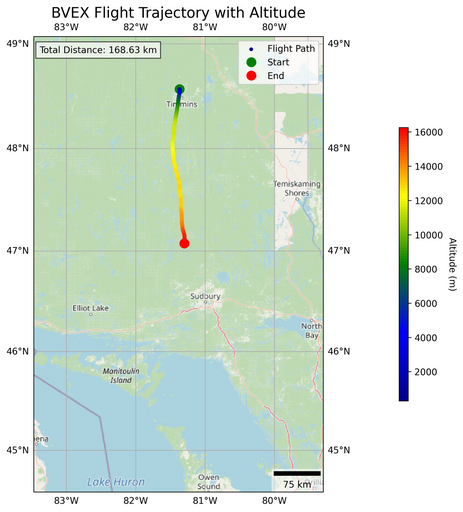
So we never got to a high enough altitude that we could point the gondola, and therefore we couldn't point our telescope at the sky and take science observations. We'll hopefully learn more about what happened to the balloon that caused it to get stuck, but the most likely explanation is that it had a severe leak.
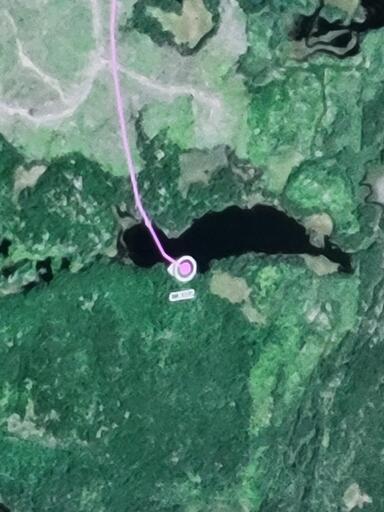
When the Canadian Space Agency (CSA)'s recovery team went out the next day to locate the gondola and all the flight electronics they found that the gondola had landed in a small lake and was fully submerged in the water. Amazingly, they still managed to recover the gondola and return it to Timmins that same night! Everything was wet and muddy but it was all recovered.
We cleaned all our electronics boxes and gave them several baths in rubbing alcohol (to try to get rid of the water), then packed everything up in our rental van and drove BVEX back to Queen's University in Kingston.
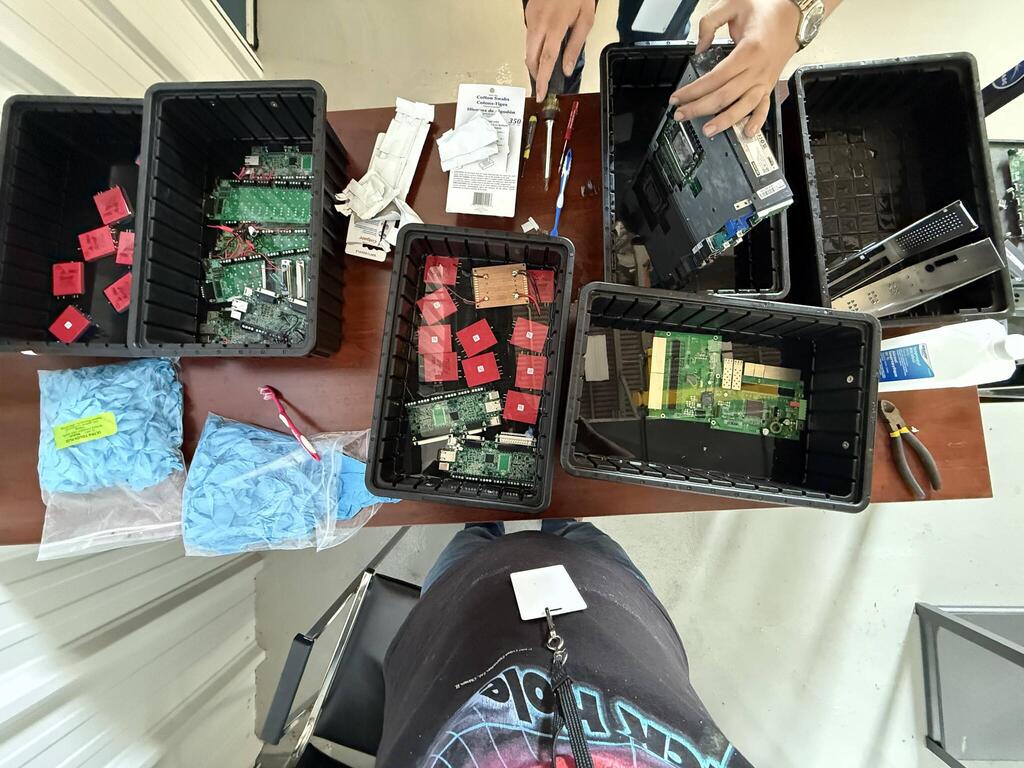
So we were all extremely disappointed, but in scientific ballooning there are extra risks compared to operating telescopes from the ground and we all knew that there was a small chance that either a balloon leak or a landing in water could happen. (Having both occur does seem especially unlucky).
There were some pieces of good news though.
The first is that, as far as we could test, our telescope, computers, heaters, electronics all worked... which is pretty amazing given that we spent two hours stuck in the coldest part of the atmosphere where the temperature was less than minus 50 degrees Celsius!
Also, most of the expensive components of our radio telescope (our system clock and the part of the receiver chain that mixes and converts the electromagnetic waves that we record to lower frequencies) was inside a sealed pressure vessel with the goal of keeping it at ground level pressure throughout the balloon flight. This pressure vessel turned out to be waterproof so all of the most expensive components of our experiment stayed dry and clean and we can reuse them for a second flight.
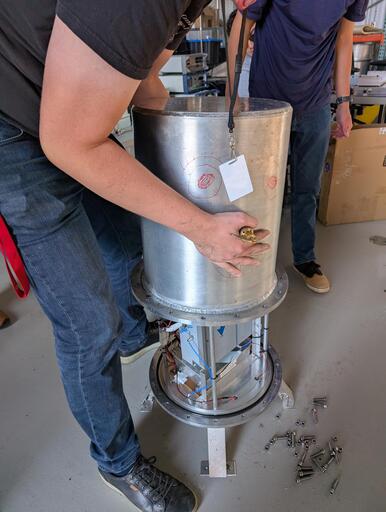
We are still testing our electronics but many of our systems seem to work, probably because they were powered off when BVEX landed in the lake and we did a very careful job of cleaning everything.
So our plan is to clean everything up, replace what needs to be replaced and hopefully try to fly an improved version of BVEX in a year or two. In the meantime, even through the outcome was not what we hoped, the campaign was still an amazing experience. I would like to thank the CSA and CNES for giving us the opportunity and support to fly our experiment. And I want to say a huge thank you to the BVEX students who designed, built and flew this experiment: graduate students Mayukh Bagchi, Felix Thiel and Maggie Oxford who have been working on this experiment for years, and the amazing undergraduate students who helped us get the experiment ready for launch: Rafael Costa, Aarchi Shah, Stephanie St-Jean, and Terry Yang.
We'll be back soon for a second try!