After unpacking and getting set up last week we have been spending a lot of time testing the BVEX telescope.
Our radio telescope observes in what is called the K-band (21-23 GHz frequency radio waves, which corresponds to a wavelength of about 1.3cm). BVEX is extremely small as far as radio telescopes go (our dish is 36 inches in diameter or 0.9 meters). So that means that by itself the radio telescope is not very sensitive and we need to obsere bright objects in the sky, such as the Sun and the Moon or the very brightest radio galaxies. The VLBI observations during our stratospheric flight will be much more sensitive because we will be pairing our small telescope with much large ground-based radio telescopes, such as the 100-meter diameter Effelsberg telescope in Germany.
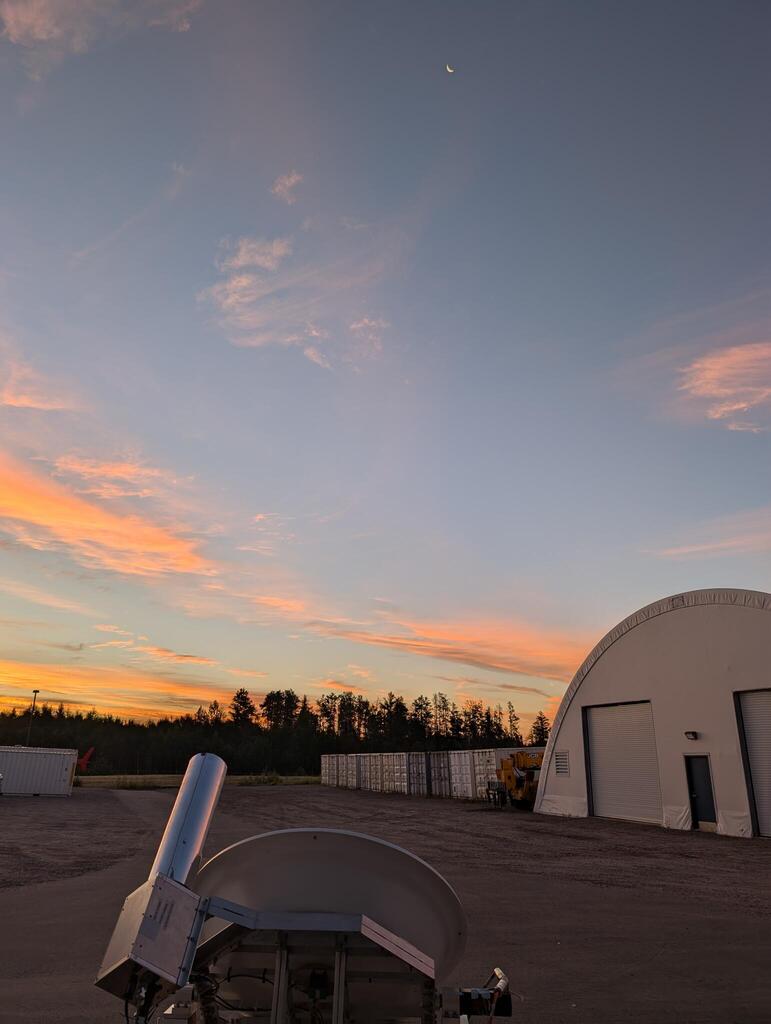
This big thing that we want to measure is where our radio telescope points to on the sky compared to our star tracking camera. The star tracking camera is a regular optical camera with a telephoto lens (the metal box on the left of the image above with a cylindrical tube attached to keep our stray light). It takes pictures of stars in the night sky and then compares them with a catalog, telling us where the telescope is pointing on the sky. However it is likely that the star camera won't be pointed at exactly the same location as the radio telescope and we need adjust for that when we use our motors to orient the radio telescope.
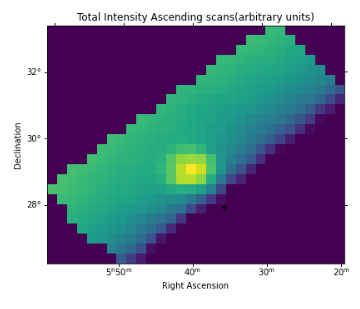
We had an excellent set of observations this morning, starting at 5AM, where we observed the Moon, Venus, and later the Sun. I've put a BVEX image of the Moon made by our undergraduate research student Aarchi Shah below.
The BVEX telescope is mounted on an aluminum frame and can be moved up or down (changing the elevation of the telescope). We can't easily control the left-right (azimuth) pointing so for now we are observing by moving the telescope up and down and waiting for the target to drift past as the Earth rotates (this is called drift scanning). Once we integrate our telescope on the gondola the Canadian Space Agency team will be able to point the gondola in azimuth for us. Then we will be able to test our ability to track radio galaxies and star forming regions with BVEX as they drift across the sky.