
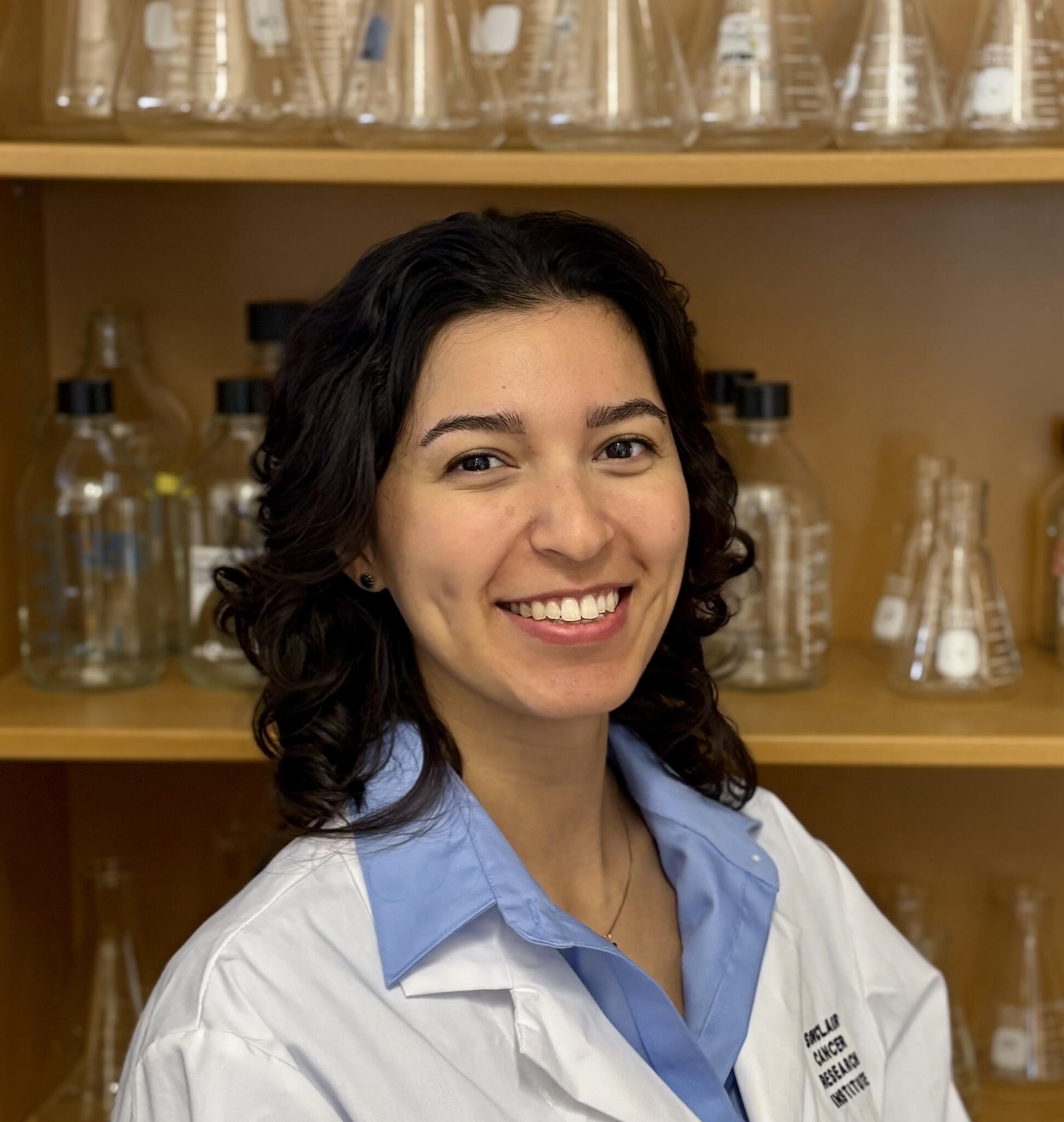
 Gabby Torretto came to cancer research with a personal stake in the work. "I think everyone has some sort of connection to cancer, be it through themselves or through family members," she says. A recent graduate of the Collaborative Graduate Program in Cancer Research at Queen's, Gabby completed her Master's in Pathology and Molecular Medicine under the supervision of Drs. Scott Davey and Harriet Feilotter — taking on one of the most frustrating problems in hereditary breast and ovarian cancer genetics.
The Research
BRCA1 — Breast Cancer Gene 1 — is a tumour suppressor gene whose protein helps maintain genomic stability through coordinating various DNA repair processes, including homologous recombination. When it functions normally, it keeps cells healthy. When it doesn't, the risk of developing breast and ovarian cancers rise significantly. Around 5 to 10% of breast cancers and 20 to 25% of ovarian cancers are linked to inherited variants in BRCA1 and BRCA2. Genetic testing is used to detect pathogenic variants in at-risk individuals, informing clinical decision-making for personalized care including enhanced screening, preventative strategies, targeted therapies and cascade testing for at- risk family members. However, genetic testing results are not always conclusive.
That's where Gabby's work comes in. As genetic testing has become more accessible, clinicians are increasingly encountering variants of uncertain significance, or VUSs — variants in BRCA1 whose effect on cancer risk is unknown. "This leads to a lot of ambiguity in the results," Gabby explains, "Clinicians are unable to effectively interpret these results, and subsequently are unable to provide appropriate management steps. And obviously this is a very distressing situation for women who don't know their level of risk."
Gabby's Master's project approached the problem from two angles. On the computational side, she built a classifier tailored to BRCA1’s BRCT domain to predict whether VUSs in the region are pathogenic or benign. The classifier incorporated a suite of in silico prediction tools selected using MolecularFeaST, a machine learning-based feature selection application developed at Queen's by Dr. Kathrin Tyryshkin and Dr. Neil Renwick. On the functional side, she tested those predictions in the lab by measuring how the variants affect the BRCT domain's ability to bind with the proteins it needs to carry out DNA repair. The results, she says, are aligning with the computational predictions, a promising sign for the classifier's accuracy.
The ultimate goal is to give clinicians clearer answers. "If we are able to concretely identify a pathogenic variant that was previously classified as a VUS," Gabby says, "clinicians are now able to effectively determine whether a woman is actually at an increased risk."
The Experience
Gabby's time in the program reflects what the Cancer Research Program at Queen's is designed to offer: an environment where students can immerse themselves in a meaningful problem, supported by dedicated faculty and a collaborative research community. She took CANC 380 [Evolutionary Biology of Cancer] in her third year as an undergraduate in Life Sciences at Queen's before going on to complete a fourth-year research project with Dr. Feilotter — a through-line that led naturally into her Master's work.
Outside the lab, Gabby volunteered weekly in the pediatric unit at Kingston General Hospital and took up bouldering — finding, as many researchers do, that stepping away from the bench is just as important as the hours spent at it. After completing her Master's, she stayed on at Queen's as a research associate to continue validating her classifier's predictions and publishing her lab’s findings.
Want to hear more from Gabby in her own words? She was a guest on the Queen's Grad Chat podcast — available on iTunes, Spotify, and Google Podcasts. Grad Chat is a great way to stay up to date on research happening across Queen's graduate programs — and if you're a current student interested in sharing your own work, learn how to sign up on the SGSPA Grad Chat webpage.
Queen’s researchers mentioned in this article: Dr. Harriet Feilotter, Dr. Scott Davey, Dr. Kathrin Tyryshkin, and Dr. Neil Renwick