Looking back at the 2024 Symposium
The second biennial Queen’s – BSIA International Migration and Mobilities Graduate Student Symposium was held in person on Friday, 22 March 2024 from 9:00 am – 3:40 pm. The symposium themed Borders, and (Un) Bordering: Analysing Migration and Mobility Through Contestation and Conflict was organized by Dr. Reena Kukreja, Associate Professor in Global Development Studies, Dr. Kim Rygiel, Professor in Political Science & Balsillie School of International Affairs, Wilfrid Laurier University, and Fatmanur Delioğlu, a PhD student at the Balsillie School of International Affairs at Wilfrid Laurier University.
Attendees
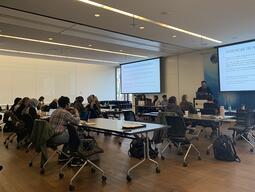
This symposium was an opportunity for graduate students, from various disciplines and faculties (development studies, political studies, international affairs, rehabilitation science, religious studies, cultural studies, geography and environmental studies, gender studies, and English), working on migration issues or related themes to showcase their work, and to promote their professionalization and academic career training, through the sharing of their work in a more formal setting, and receiving feedback from the peers and faculty members. The symposium also served as a platform for the graduate students to initiate and develop a network for future collaboration. Moreover, it created an opportunity to foster greater collaboration and inclusive community building between the BSIA and Queen’s University on migration studies. The Symposium was open to the general public and we extended the invitation through our BSIA Bulletin and IMRC community list serve and had a total of 37 registered participants.
The symposium hosted 14 graduate students on two panels and two roundtable discussions. The two themes addressed by the panels were – 1) Border Controls and the Politics of Migrant Governance, and 2) B/Ordering, (im)mobility, and (re)shaping of identity formation. Each panel and roundtable discussion also had invited discussants, who provided valuable feedback to the panelists and the presenters of the roundtable discussion. Find details about the 2024 Symposium schedule here.
Discussions
Some titles of the accepted papers include: “Transnational Lives Interrupted: The Canadian State and Indian International Student Experiences during the COVID-19 Pandemic”; “Enduring Empire: Colonialism and the UK’s Migration Policies”; “Indigenous Self-determination in Canada: Overlapping Sovereignties and Jurisdiction”; “Pothi Visa”: Cross-border Marriage, Citizenship, and Nepali Brides in South Korea”; “Impacts of Language Barriers on Healthcare Access Among Afghan Refugee Women”; and “Exploring the Sociocultural needs of Older Canadians of Japanese descent living in Toronto” to list a few. Find details of presenters and their bios here.
Following the success of a roundtable discussion in the first symposium held in 2021, the organization committee decided to include the roundtable discussion for this year too, as it was clear that several students, who were keen on participating in the Symposium, were at more preliminary stages of their research. Believing that student training and mentorship are invaluable at this early stage of research, the committee decided that graduate students at the start of their degree would benefit from a more collaborative discussion on their research ideas or aspects with which they are struggling. As a result, the panel discussions were reserved for students who were farther along in their research and were able to share initial findings or ideas, while the two roundtables were dedicated to students who were still in the planning phases of their research.
This year’s symposium had discussants provide feedback on specific papers and panel presentations that aligned with their own area of expertise and/or research interests. Consequently, the student participants benefitted from rich, detailed, and constructive feedback enabling them to strengthen their ideas and/or papers for publication.
Faculty discussants came from both Queen’s University and Wilfrid Laurier University and the Balsillie School but as organizers we drew significantly on the expertise of our faculty at Laurier and faculty associated with the International Migration Research Centre (IMRC) and the BSIA’s Migration, Mobilities and Social Politics (MMSP) Research Cluster. Important to note also is that as we seek to build networks, we are committed for each Symposium to inviting former students, who are now professors, to serve as discussants. This year’s discussants were (find discussant bios here):
-
Dr. Sarah Turnbull, Assistant Professor in the Department of Sociology and Legal Studies at the University of Waterloo;
-
Dr. Bree Akesson, Canada Research Chair (Tier II) in Global Adversity and Wellbeing, Associate Director of the Centre for Research on Security Practices, and Associate Professor of Social Work at Wilfrid Laurier University;
-
Dr. Jenna Hennebry, Professor at the Balsillie School of International Affairs;
-
Dr. Michael Gordon, Postdoctoral Fellow, International Migration Research Centre;
-
Dr. Hari KC, Research fellow with the Canada Excellence Research (CERC) in Migration and Integration program at Toronto Metropolitan university and Teaching Faculty at Wilfrid Laurier University;
-
Dr. Maissaa Almustafa, Lecturer at the Department of Political Science at the University of Waterloo;
-
Dr. Susan Ilcan Professor; University Research Chair at the Department of Sociology and Legal Studies, and the Balsillie School of International Affairs, University of Waterloo,
-
Dr. Setareh Ghahari, Associate Professor in the School of Rehabilitation Therapy and Associate Director (Occupational Therapy Program) at Queen’s University, and
-
Dr. Reena Kukreja, Associate Professor, Global Development Studies, Queen’s University.
It was heartening to note that many of the discussants carved time out of their busy schedules to attend the entire symposium and to hear all presentations. They did so because they saw immense value in the collegiality being fostered there and the mentorship offered to students. To quote one of the discussants, Dr. Michael Gordon, a postdoctoral fellow at the International Migration Research Centre (IMRC) who wrote back to the committee stating that:
As a recent graduate, I wish I had an opportunity like this when I was in graduate school. This is such a fantastic venue for students to present their work in progress and receive valuable feedback from discussants in the development of their papers for publication. The event promotes a supportive and collegial interdisciplinary environment for students engaging in border and migration research to develop their networks, gain experience presenting at conferences, and hear from other junior scholars engaged in innovative research projects. The opportunity to participate in this symposium should not be missed!
Dr. Michael Gordon
Similarly, Dr. Bree Akesson, Canada Research Chair (Tier II) in Global Adversity and Wellbeing, Associate Director of the Centre for Research on Security Practices, and Associate Professor of Social Work at Wilfrid Laurier University stated:
I truly enjoyed reading the papers and hearing from the students. I really like the process, and I hope to participate in future years.
Dr. Bree Akesson
Outcomes
As part of the Symposium’s objective to aid in student professionalization and provide academic and career-development skills, this time also the organizing committee hired one graduate student to act as the Program Coordinator. Fatmanur Delioğlu, a PhD student at the Balsillie School of International Affairs at Wilfrid Laurier University, not only served as Program Coordinator, but she also presented a co-authored paper at the Symposium. In her role as Program Coordinator, she was responsible for administrative work including collecting and organizing all submitted abstracts and draft papers, responding to student inquiries, and setting meetings for the organizing team, recording notes and tasks at said meetings, acting as a Symposium Chair for one of the Roundtables on the day of the Symposium. In addition, the Symposium was also supported by two graduate students in the BSIA’s Master of International Public Policy who were hired by the IMRC as interns, Varinia Salazar Barrientos and Khai Phan, who helped with logistics the day of the Symposium including with set up and clean up, and a high school student, Sarah Li who assisted with designing the poster and Symposium agenda.
Following the Symposium, a short follow-up survey was conducted among the participants. The feedback received was overwhelmingly positive that added value to the Symposium. The survey had a response rate of more than 57% with 8 out of 14 students (panelist and roundtable discussion participants). On a scale of 1-10 (1 being very poor and 10 being excellent), 7 out of 8 students rated the overall success of the Symposium as 10, with one student rating it a 9. The same rate of responses was obtained for the question, ‘how they would rate the overall organization of the event’. When asked what they liked most about the Symposium, participants responded that they got an opportunity for detailed engagement with their work, rich feedback from the discussants, an encouraging environment to share ideas, a platform to initiate networking with professors/faculties from different disciplines, and a fostered partnership between Queen’s University and the Balsillie School of International Affairs, Wilfrid Laurier University.
Further, when asked what could be improved for next year’s Symposium, the participants indicated that the Symposium could be split over two days with longer breaks in between as they felt rushed and got tired at the end of the sessions, open the symposium for post-docs at the University of Waterloo and its affiliate institutions, and expand the reach by including other universities within Ontario. On a scale of 1-5, 7 out of 8 students rated 5, and 1 rated 4 when they were asked how likely they are to return to the Symposium next year. However, 100% of the participants responded ‘yes’ to the questions on whether they would encourage others to attend the Symposium next year. When asked whether the Symposium met their expectations, the participants responded, that it exceeded their expectations, however, it would be useful if they could receive a follow-up email with the summary of their feedback from the discussant. The participants also listed potential themes for next year’s symposium such as border, gender, and solidarity, migration and diaspora, the role of social media in diaspora studies, and migration through decolonial perspectives.
When they were asked if they have any comments or suggestions that they might want to share on the website for potential participants in future Symposiums, two participants responded,
The Symposium offers a great opportunity to join a supportive and productive network of migration and mobility scholars across Queen’s and the Balsillie School of International Affairs.
Great opportunity to present your research, get valuable feedback, learn about research on migration from various fields of study, and make great connections with other migration scholars.
Participants
The results show support for the Symposium objectives and deliverables. These include providing HQP training and meaningful academic experiences to help students network and develop professional presentation and networking skills and intellectual engagement as scholars.
The annual Symposium is also designed to build an inclusive community across the two universities. The Symposium brings together a diverse group of faculty members and students interested in migration issues, which due to the nature of the field, includes many from equity-deserving groups that have historically been marginalized in the academy. Further, through the invitation of invited discussants, who are experts in the field, the Symposium showcases and promotes the work of our graduate students, connecting graduate students to internationally renowned expert academics within their fields. Furthermore, the Symposium supported the participating students with the knowledge dissemination of their research, both through providing presentations of their research as well as assisting with the development of their papers. This included assisting students early on in their research to refine their projects as well as helping students who were more advanced in their research to turn their Symposium papers into potential publications. Thus, the Symposium was able to provide guidance and meaningful support to students at a variety of stages in their research. One of the students was solicited for the submission of her work for Citizenship Studies, and others intended to submit their work on various platforms such as The Conversation.
For several students, the Symposium was the first opportunity that they had to present their work in a professional, academic setting. Participants’ feedback regarding the welcoming and friendly environment of the Symposium, and the usefulness of the feedback received indicates that the Symposium was successful in providing a space where students were able to practice and develop their presentation skills in a collaborative setting to prepare for future conference presentations.
EDII Outcomes
The Symposium set out to create an accessible and inclusive space where students belonging to a large diversity – Global South, racialized, and Queer-Muslim – felt included, welcomed, and offered a space and platform to share their work. Moreover, the Symposium acted as a forum for a diverse range of perspectives. While there were three key themes called for, the Symposium did not restrict the types of perspectives that could be taken on these themes. Indeed, the Symposium welcomed papers that challenged normative frames on the topic of migration studies, questioned the status quo, and made space for marginalized voices. A variety of geographic settings were addressed in the Symposium, reflecting the openness to research across a wide range of global foci. Some of the key areas addressed by the participants include colonialism and migration policies, Indigenous self-determination in Canada, border enforcement, impacts of technology on EU’s border governance, cross-border marriage and citizenship of Nepali brides in South Korea, experiences of the international student during COVID-19 pandemic, diaspora, and identity, coloniality, bordering regimes, use of arts among the Rohingya Refugees in Bangladesh, language barriers on health care access among Afghan Refugee Women, sociocultural needs of older Canadians of Japanese descent, and open borders and Rohingya Refugees.