
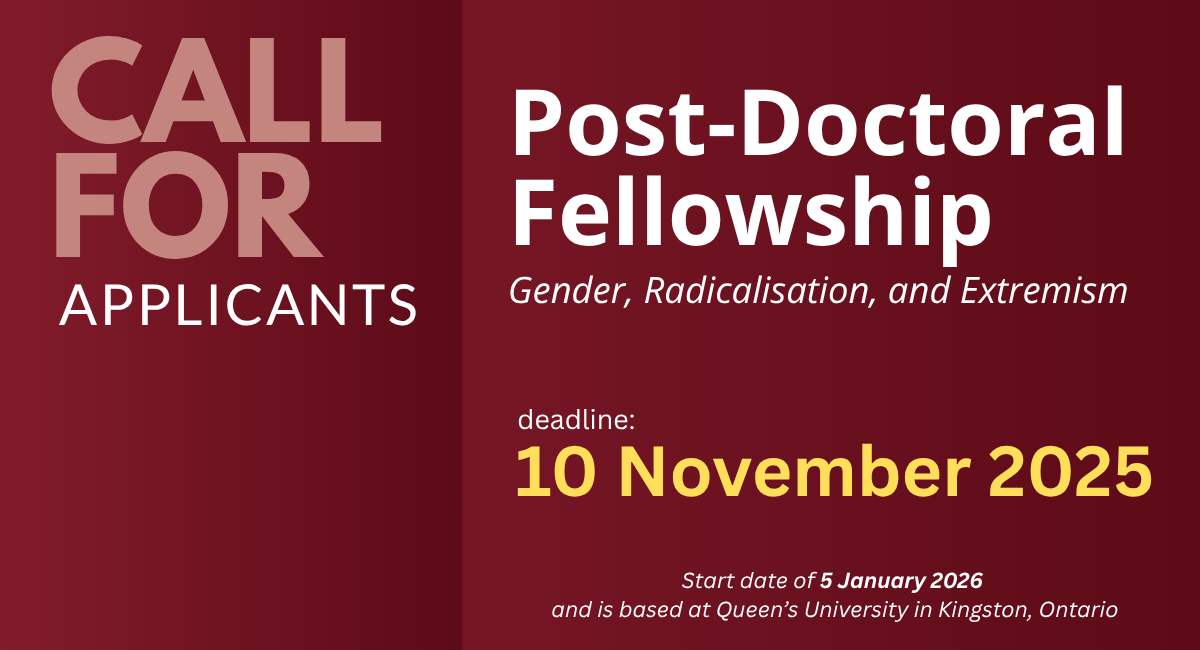
The Centre for International and Defence Policy at Queen’s University invites applications for a postdoctoral fellowship focused on gender, radicalisation, and extremism. This fellowship is part of “enAbling a Model driven deep understAnding of the roLe of gender Towards a Holistic solution against Extremism and radicalisation Activities” (AMALTHEA), a major Horizon Europe research initiative that seeks to better understand the causes, manifestations, and mitigation practices of violent extremism. The project critically examines the relationship between gender and extremism, investigating gender specific factors for radicalisation such as community belonging, social connections, trauma, and empowerment narratives. AMALTHEA addresses the challenge of limited access to knowledge, collaboration, and unified approaches against gender related radicalisation through in depth research and innovation in three complementary areas. Knowledge creation for law enforcement agencies, civil society organisations, educators, and prevention practitioners.
- Capacity building through training materials and resources tailored to practitioner needs.
- Policy and practice innovation by integrating gender sensitive perspectives into counter radicalisation strategies.
The project runs for thirty-six months beginning on October 1, 2025. The EU grant number is 101225661. The fellowship will be supervised by Dr. Yannick Veilleux Lepage. The position start date is 5 January 2026 and is based at Queen’s University in Kingston, Ontario.
Role of the Postdoctoral Fellow
The successful candidate will advance AMALTHEA’s research and engagement agenda in collaboration with project partners.
- Conduct qualitative research, including interviews, focus groups, and content or discourse analysis, to examine how gender shapes processes of radicalisation.
- Engage with law enforcement agencies, non governmental organisations, and community partners in order to capture evolving challenges and needs.
- Develop and refine case studies and scenarios for testing prevention and intervention strategies.
- Ensure that diverse societal perspectives are represented in findings and outputs.
- Publish results in peer reviewed journals and contribute to policy oriented publications and practitioner guidance.
- Contribute to seminars, workshops, and knowledge mobilisation activities across the project network.
Required Qualifications and Skills
- PhD in political science, sociology, criminology, anthropology, gender studies, or a closely related discipline. The PhD must be completed by the start date.
- Demonstrated expertise related to radicalisation, extremism, or closely related areas.
- Strong background in gender analysis, including familiarity with feminist or intersectional approaches.
- Proven experience with qualitative research methods, for example interviews, focus groups, and content or discourse analysis.
- Ability to work with sensitive topics and populations under strict ethical standards.
- Excellent communication skills for academic, policy, and practitioner audiences.
- Capacity to work independently and collaboratively in international and interdisciplinary teams.
Desirable Assets
- Research experience on gender and radicalisation or extremist movements in Canadian and or European contexts.
- Mixed methods research experience.
- Proficiency in additional languages, especially French, German, Italian, or Dutch.
- Prior experience engaging with practitioners, for example law enforcement, non-governmental organisations, and policymakers.
Salary and Benefits
- Salary of 53,000 Canadian dollars per year, plus benefits in accordance with the Postdoctoral Fellow Collective Agreement at Queen’s University.
- Initial term of one year, renewable on a yearly basis for up to an addition 18 months, subject to performance.
- Workspace and standard research support are provided. Modest research and travel funds may be available. The fellow will mentor and manage graduate research assistants as part of the project team.
Application materials
Please combine the following items into a single PDF in this order.
- Curriculum vitae
- A cover letter including one of the two statements regarding Canadian citizenship/Permanent Resident status specified in the Equity, diversity, inclusion, and accessibility sec-on
- A writing sample
- Names and contact details of two confidential referees, one should be the PhD supervisor. Letters are not required at this stage. Referees may be contacted if the candidate is shortlisted.
- Graduate transcripts. Copies or scans are acceptable.
How to apply
Email one PDF named “Surname_Firstname_SPS_Postdoctoral_Application.pdf to Yannick.veilleuxlepage@queensu.ca with a copy to cidpmanager@queensu.ca. Use the subject line SPS Postdoctoral Fellowship Application. The deadline is 10 November 2025 at 23:59 Eastern. Late or incomplete applications will not be considered.
Selection criteria
Applications will be evaluated for fit with the project and themes, depth of prior research on extremism and gender, ability to work independently within a large grant environment, strength of partner engagement experience, expected scholarly and practical contribution, methodological clarity and feasibility within the fellowship period, and the potential to engage partners and diverse
communities.
Equity and Inclusion
Queen’s University is committed to employment equity and to fostering a diverse and inclusive research environment. We welcome applications from women, Indigenous Peoples, racialised persons, persons with disabilities, and persons of any sexual orientation or gender identity. Applicants from outside of Canada are eligible to apply. Consistent with applicable guidance, Canadian citizens and permanent residents may be given priority. Candidates who wish to do so may provide information about career interruptions or other factors that have shaped their record of research and engagement. Queen’s provides support to applicants with disabilities, including accommodation that
takes into account accessibility needs during recruitment. Candidates requiring accommodation can contact cidpmanager@queensu.ca.
The University invites applications from all qualified individuals. Queen’s is committed to employment equity and diversity in the workplace and welcomes applications from women, visible minorities, Aboriginal Peoples, persons with disabilities, and persons of any sexual orientation or gender identity. In accordance with Canadian immigration requirements, priority will be given to Canadian citizens and permanent residents. To comply with federal laws, the University is obliged to gather statistical information as to how many applicants for each job vacancy are Canadian citizens or permanent residents of Canada. Applicants need not identify their country of origin or citizenship. However, all applications must include one of the following statements. “I am a Canadian citizen / Permanent Resident of Canada.” or “I am not a Canadian citizen / Permanent Resident of Canada.” Applications that do not include this information will be deemed incomplete.
Postdoctoral fellows at Queen’s University are governed by the Postdoctoral Fellow Collective Agreement, which outlines the terms of appointment, salary, and benefits.