

Data, Apps, and Failure in Border Security
Date
Tuesday November 24, 202612:00 pm - 1:00 pm
Location
Online Zoom Webinar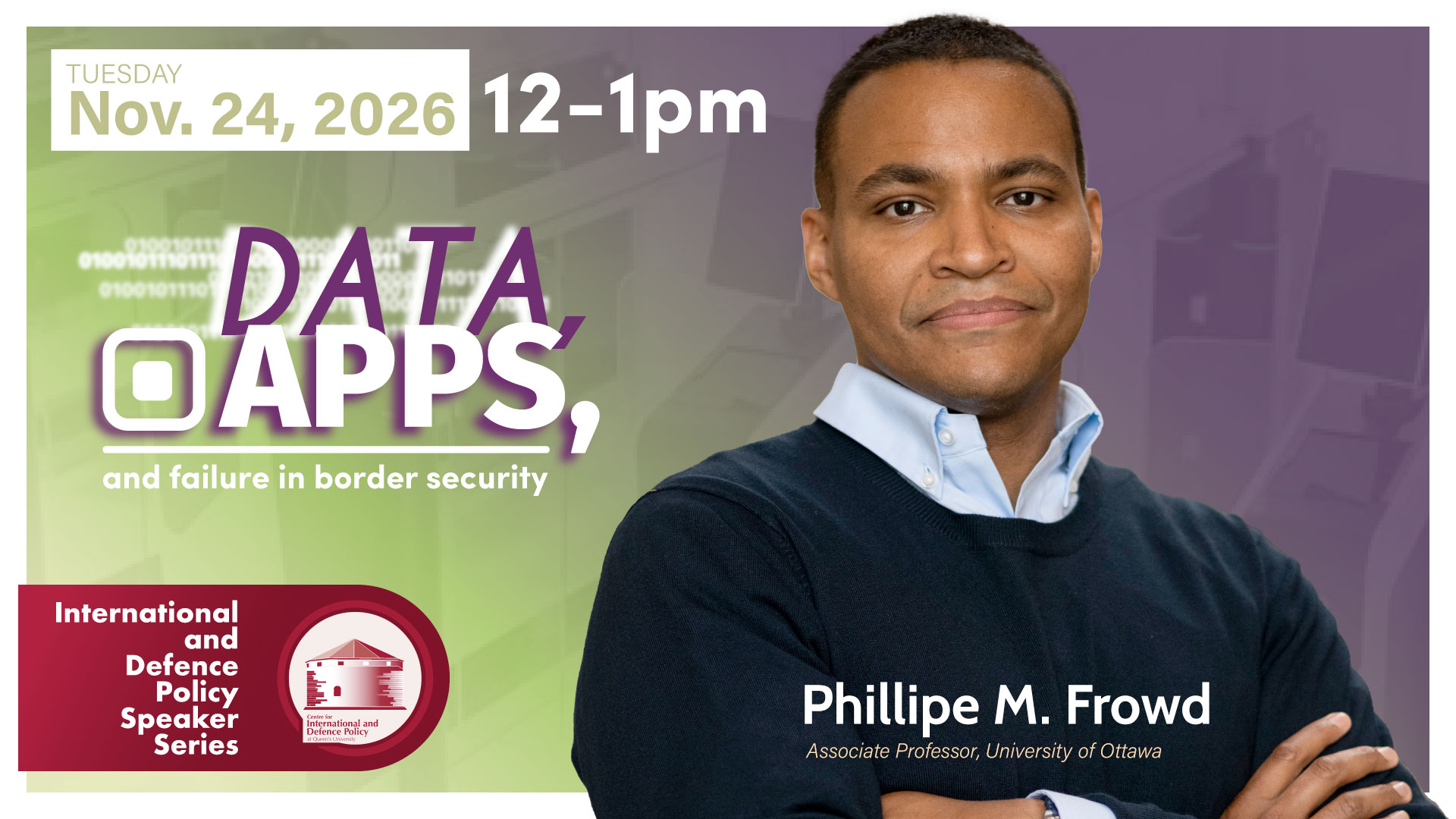
The datafication of international borders is a key site for the analysis of failure in security technologies. This presentation draws on existing work in critical security studies on the turn towards digitally mediated forms of bordering, identifying existing modes of critique around the (non-)functioning, peripheral impacts, and ethical lapses of technology. It advances these critiques through an engagement with science and technology studies (STS), arguing that failure is a socio-technical phenomenon that goes beyond technical or ethical lapses alone. Instead, failure is shaped by dynamics of visibility and exposure which take multiple forms. Three cases are used to illustrate this argument: the use of Covid-19 case counts in the governance of temporary foreign workers in Canada; glitches in the biometrics and mobile applications by US Customs and Border Protection; and the political and technological controversies around the ArriveCan app. This presentation is based on a work in progress with Dr. Ben Muller.
Register for In-Person Attendance Register for Online Attendance
Bios:
Philippe M. Frowd is an Associate Professor in the School of Political Studies at the University of Ottawa, Canada. His research draws on critical security studies and focuses on emerging transnational forms of governance of security in the Sahel region of West Africa. His research has primarily focused on irregular migration and border control in the region and has been the focus of his latest book Security at the Borders: Transnational Practices and Technologies in West Africa (2018, Cambridge University Press). Philippe also works on the politics of non-state security provision and dynamics of militarization and intervention in the Sahel more broadly. His work has appeared in Third World Quarterly, Geopolitics, and African Affairs. He is an associate editor of Security Dialogue.