

A seminar on Defence Procurement Adoption and Marketing of Dual-use Technologies
Date
Friday January 16, 202612:00 pm - 1:30 pm
Location
Law Building (128 Union St.) - Room 2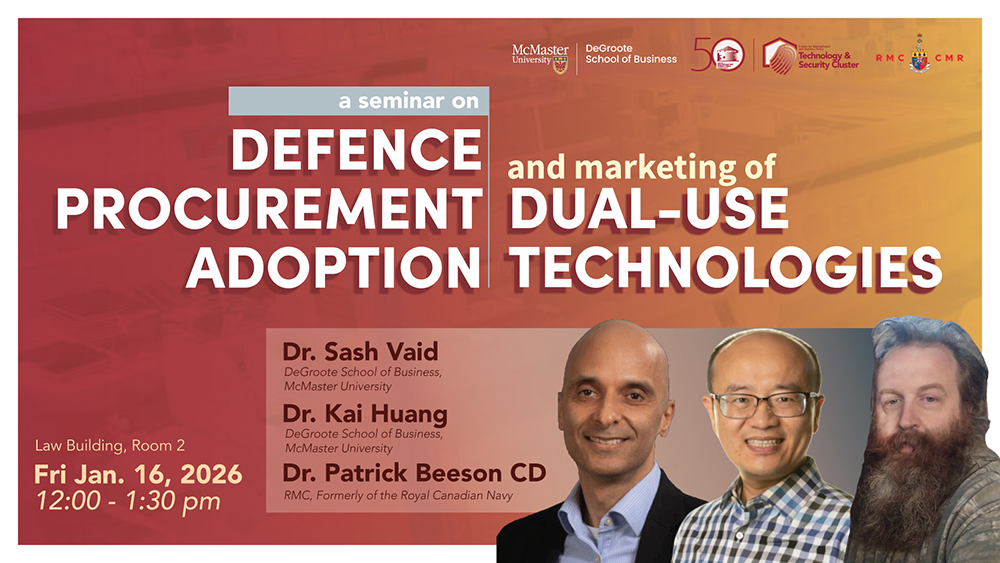
This seminar leverages the Capability-Intent Matrix (Singer, 1958) and Agency Theory (Jensen & Meckling, 1976) to examine conditions under which misalignment between principals (governments) and agents (3D printing firms) leads to opportunistic behavior, such as sanctions evasion. We test our proposition through three interrelated studies:
- Capability study: Closed-loop supply chain design for spare parts with remanufacturing and 3D printing. - Dr. Kai Huang
- Intent study: Predicting sanctions evasion modes via a combination of graph and game theory. - Dr. Patrick Beeson
- Matrix study: Defence procurement adoption—aka marketing: A persuasion experiment. - Dr. Sash Vaid
This event is free to attend, and open to all. Registration is required.
*Snacks and refreshments will be offered.
Speaker Bios:
Dr. Sash Vaid is a tenured Associate Professor of Marketing at the DeGroote School of Business and an Affiliate Faculty with the School of Computational Science and Engineering at McMaster University. He is also a Research Affiliate at the University of Michigan. Dr. Vaid has extensive expertise in econometrics and quantitative marketing of ubiquitous industrial and cyber technologies, many with dual-use applications. His research interest in marketing interfaces can be visualized as a “Vaid Venn Diagram” with three circles intersecting across: (1) Political economy of marketing – Attending to the regulatory and institutional contexts impacting firms, as well as dual-use industrial and cyber technology supply and acceptance. (2) Dual-use industrial and cyber technologies – Investigating marketing’s interfaces with a range of ubiquitous technologies originally developed for defense applications (e.g., AI, cybersecurity, imaging, and geodata) and related industrial markets (e.g., sales lead nurturing, sales lead generation, marketing automation systems) that are now used for commercial use and consumer engagement. (3) Exogenous shocks at macro (regulatory) and micro (firm) levels – Exploring how these shocks influence marketing interfaces, which often lie along two dimensions that are somewhat intrinsic and extrinsic to the firm, specifically – functional and technological.
Dr. Kai Huang specializes in the optimization under uncertainty and data-driven optimization techniques with applications in business analytics and supply chain management. His recent research interests include data-driven inventory management, electric/autonomous vehicles, humanitarian logistics, and food supply chain safety. He teaches courses in operations management and supply chain management.
Dr. Patrick Beeson began his military career as a naval reservist at His Majesty's Canadian Ship (HMCS) PREVOST in London Ontario before enrolling in the Regular Officer Training Plan (ROTP) at the Royal Military College of Canada (RMCC). After graduation, Patrick served for several years in the Royal Canadian Navy (RCN) aboard multiple ships including HMCS GLACE BAY, HMCS WINNIPEG, HMCS OTTAWA, HMCS MONTREAL and HMCS VILLE DE QUÉBEC. In the RCN, Patrick served as a bridge watchkeeping officer and later as an above water warfare director/officer. In the latter capacity, Patrick planned and oversaw the execution of various events such as live gunnery and air defence exercises. Patrick also participated in counter-narcotics/terrorism patrols in the Caribbean theater, supervising the fusion of Electronic Warfare (EW) and other sensor data with a view to detecting cartel surface vessels and aircraft. Patrick subsequently transitioned into the pharmacy officer occupation, ultimately becoming the pharmacy team leader at Canadian Forces Base (CFB) KINGSTON. Notably, Patrick oversaw the local coordination of medical logistics at CFB KINGSTON in support of Canada's deployment of personnel participating in the evacuation of Syrian civil war refugees. Patrick's military career was cut short in 2016 by a Post Traumatic Stress Disorder (PTSD) related medical release. Educationally, Patrick holds bachelor's degrees in mechanical engineering and pharmacy. Patrick also possesses a Masters of Business Administration and a doctorate in Operations Research (OR). Patrick's doctoral thesis focused on flight path optimization for military, medical evacuation helicopters in anti-aircraft threat environments as well as the determination of optimal deployment locations for helicopters and field hospitals. Patrick is currently working with Dr. Sash Vaid and Dr. Kai Huang applying OR as well as graph and game theoretic concepts to the study of dual-use technology procurement chains. Patrick's work focuses on predicting sanctions evasion behaviour via a game on a network approach. Outside of his OR work on dual-use technologies, Patrick has launched an independent Autonomous Underwater Vehicle (AUV) development project. Should this project be successful, the resulting AUV will be capable of entering enclosed underwater spaces (e.g. shipwrecks, flooded caves, flow channels in hydroelectric plants...) and generating high resolution, 3D models of these internal environments for scientific, archeological, repair and maintenance, salvage, and defence purposes. Incidentally, this project relies heavily on dual-use technologies. Patrick now lives on the windswept north shore of New Brunswick with his wife and teenage child on a small hobby farm. The peace and quiet of this lifestyle is conducive to the clear thinking and mental well-being Patrick relies upon to work on his research