
News about the Strathy Language Unit and Canadian English studies
Inclusive Standards in the CED
Date: September 15, 2026 | Category: In the Media
"The point of this project is not to prioritize one way of speaking Canadian English or even to signify one way as proper and some other way as non-standard. It’s to produce a contemporary, comprehensive resource that captures and thus catalyzes our patchwork identity."
- Scrabble players, gird your loins (The Tyee, Sept. 7, 2026)
Embracing my Cape Breton Accent
Date: August 31, 2026 | Category: Guest Column
Author: Ryan Martin
In this series for the blog, Ryan Martin explores the English of Cape Breton.
Last December, when I was visiting Cape Breton over the holiday break, I made plans to see a few of my old friends. One day, a friend came to pick me up in his car, and upon getting in and seeing him, I instinctually said, “How’s she goin’ there, b’y?” Over the course of that car ride, I continued to employ such Cape Bretonisms liberally: “Oh, Godjeah!” and “Hyeah” (or, the Gaelic Gasp), and “Go ‘way witcha!” Beyond these common expressions, I also spoke with a high inflection that is a staple of the Cape Breton accent; it is as though each word must be accented and emphasized. This was not an isolated incident with this one specific person, however; at a family holiday party, I asked a longtime friend about her boyfriend and said, “How’s your man?”
In my daily life in Ontario, where I’m a student, I don’t use Cape Bretonisms very often, nor do I have a particularly strong accent. Yet upon returning home to Cape Breton, I spoke completely differently. This was not a new phenomenon; in fact, even when I lived in Cape Breton, I would find my accent changing depending on who I was with and where I was. Yet it is only now that I find myself reflecting upon why exactly it is that I don’t speak with the Cape Breton accent in everyday life, despite the fact that many of the friends with whom I grew up have all managed to maintain their accents. I feel I should have a stronger (and more consistent) accent than I do. So why don’t I?
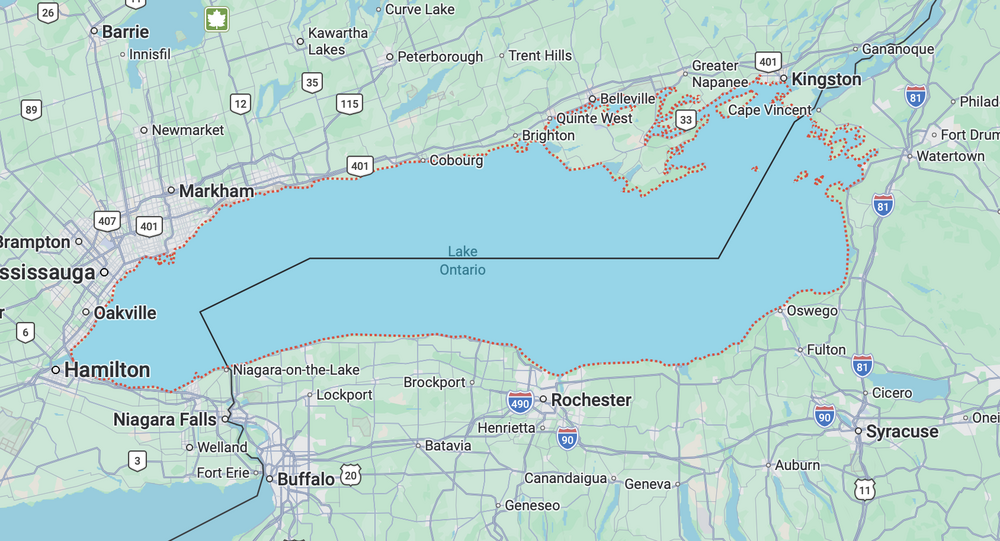
Lake Ontario
Date: August 30, 2026 | Category: In the Media
Stanstead
Date: August 26, 2026 | Category: Guest Column
Author: Jade Lemieux
In this new series for the blog, Jade Lemieux introduces us to English-speaking communities in Québec.
If you are visiting southern Québec and find your way to Stanstead, at first glance, it will seem like any other completely ordinary small town. However, if you drive down CANUSA Street to enter Stanstead, you would be driving, for a short distance, directly along the Canada-United States border (as the name of the street implies). Although it is not the only English-speaking community in the Eastern Township, as I’ve explored in a previous blog post on Lennoxville, Stanstead is unique due to its geographical location on the border between Québec and Vermont, directly south of the community of Derby Line. Looking at a map, you can see that if it weren’t for the border, Stanstead and Derby Line would be the same town.
First founded by settlers from New England in the 1790s, Stanstead is now formed of what was formerly known as the “Three Villages”: Stanstead Plain, Rock Island, and Beebe Plain. In its beginnings, Stanstead was a haven for smugglers and bootleggers; that is, until the establishment of a customs station in 1821. In the 19th century, Stanstead began to flourish as it established itself within Canada-United States relations, becoming the first Canadian stop on the stagecoach route linking Québec City and Montreal to Boston. This role as a transportation centre is one that gave Stanstead major economic prosperity, and it is a role the town maintains to this day, although the original stagecoach is long gone. Stanstead’s identity as a community is intimately tied to Canada’s relationship to the United States, both on a local level and a national level. Locally, its proximity to Derby Line and the two towns’ history of collaboration directly contributes to Stanstead’s ability to maintain its English-speaking identity in the Francophone province. On a wider national level, its position on the border means it is more directly affected by the politics of both countries.
Introducing Q
Date: August 20, 2026 | Category: News
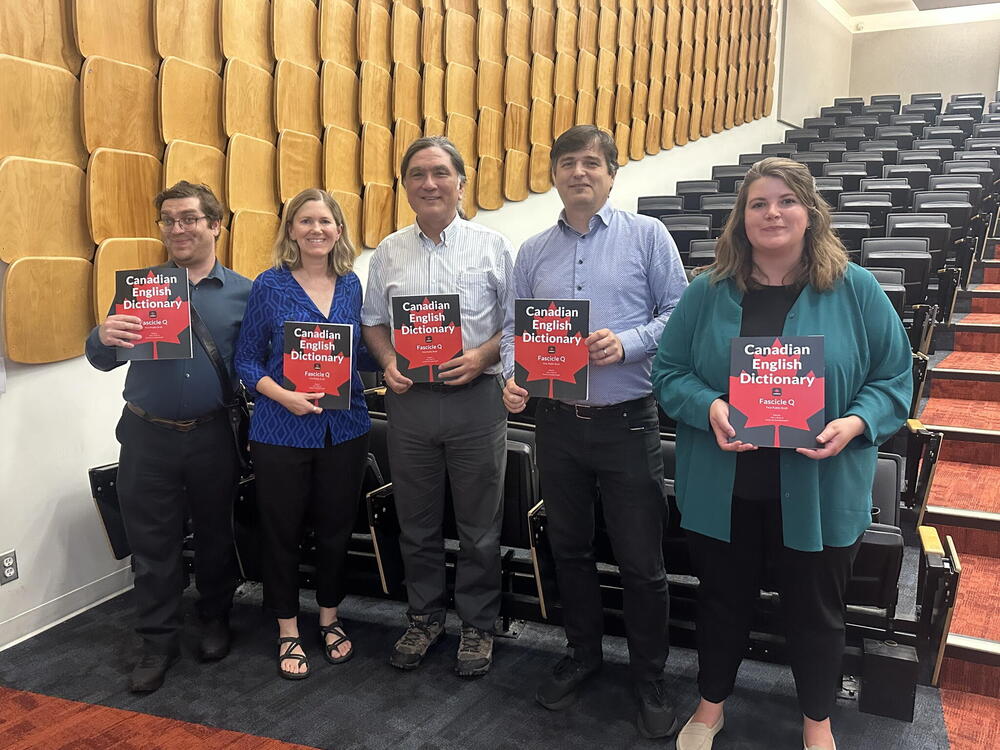
The team behind the new Canadian English Dictionary (CED) has released their first public draft – a full edition of the letter Q entries. Print copies are now available to order.
Cape Breton English in Literature: A Case Study
Date: August 17, 2026 | Category: Guest Column
Author: Ryan Martin
In this new series for the blog, Ryan Martin explores the English of Cape Breton.
Like many Maritimers, I adored the 2017 musical Come From Away (book, music, and lyrics by Irene Sankoff and David Hein). I cannot understate how exciting it was to see a part of the Maritimes represented on a Broadway stage. So, when the musical’s libretto was published in 2019, I flocked to the bookstore to purchase it and read it in its entirety the very same day. The experience turned out to be eye-opening, because what struck me most about the script was seeing the word “b’y” for the very first time in print. I am not sure how I conceived of the word – which means 'boy' or 'friend' and has a comfortable place in Cape Breton and Newfoundland English – before that moment; I am not sure how I would have spelled it, or, indeed, if I would have spelled it at all. But here, for the first time, I was seeing something I’d heard for my entire life in print. It is one thing to have heard a particular kind of English your entire life; it is still another to see that English be addressed in scholarly writing; but to see one’s accent and vocabulary reflected in art can only be described as cathartic.
I have selected the short story “The Glace Bay Miner’s Museum” by Sheldon Currie – later adapted into a movie starring Helena Bonham Carter – to use as a case study in how Cape Breton English appears in print. I chose Currie’s story in particular because of its modern-day, urban (1970s Glace Bay) setting, as well as its explicitly Cape Breton narrative voice. I will refrain from summarizing or analyzing the story in much detail; although this is quite contrary to my training in literary studies, I want to aim this discussion purely on the features of the language.
Inclusive Standards
Date: August 7, 2026 | Category: News
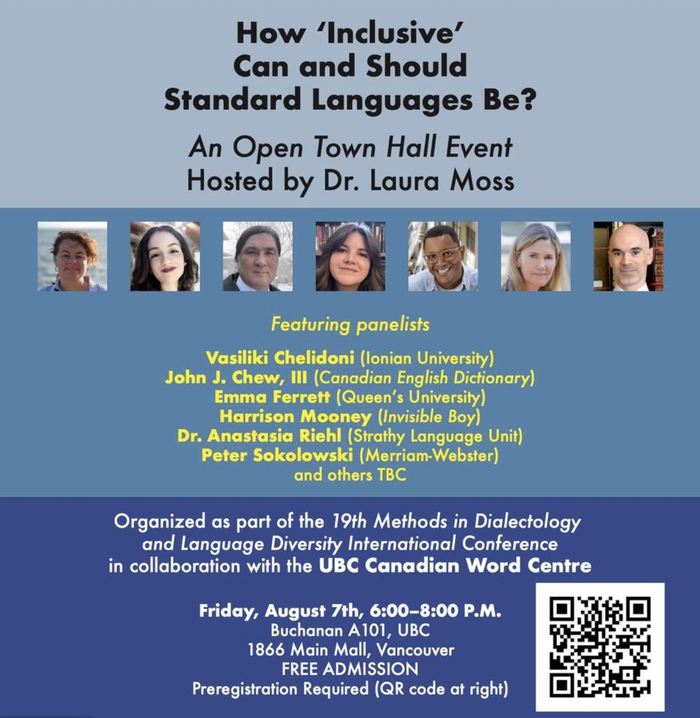
How 'inclusive' can and should standard languages be? This will be the question under consideration at tonight's Town Hall in Vancouver, featuring members of the Canadian English Dictionary team.
Grosse Île
Date: July 20, 2026 | Category: Guest Column
Author: Jade Lemieux
In this new series for the blog, Jade Lemieux introduces us to English-speaking communities in Québec.
I have always known the Magdalen Islands archipelago as a popular tourist destination and summer vacation spot for people both within and outside Québec. While I have not had the chance to visit myself yet, I have seen countless trip photos and can almost picture myself in the hilly, green landscape, looking down steep, red, rocky cliffs getting hit by wave after wave from the Gulf of St Lawrence. Situated off the continent, southeast of the Gaspé Peninsula and just north of Prince Edward Island and Cape Breton, the Magdalen Islands are home to a culturally mixed population of Francophone, Anglophone, and Acadian people.
First land of the Mi’kmaq tribe, then taken by French settlers, the archipelago became home to several Acadian families until 1755, when many were deported by English settlers. With even more French families coming to the Magdalen Islands from Miquelon in 1793, the archipelago was already becoming home to a culturally varied population. It is not until 1822, however, that the English-speaking communities of the archipelago firmly established themselves when the Islands were handed to an English admiral. Today, certain islands in the archipelago—namely Entry Island and Grosse Île—persist as English-speaking enclaves even in a predominantly French region. Both Entry Island and Grosse Île’s communities were formed predominantly by individuals originally from the Scottish Highlands, as well as some families who moved from Nova Scotia and New Brunswick.
Cape Breton Placenames
Date: July 6, 2026 | Category: Guest Column
Author: Ryan Martin
In this new series for the blog, Ryan Martin explores the English of Cape Breton.
When I was in high school, I was a cashier at a grocery store in North Sydney, Nova Scotia. In the summer, we would often have customers from the Mainland (that is, the rest of Nova Scotia) who wanted directions. One night, a couple asked me how to get to the Highland Motel. I instinctually responded, “You know where the Old Highway is?” Needless to say, they did not, in fact, know where the Old Highway was; they had no idea there was a new highway to begin with. But I knew no other way to convey directions other than with Cape Breton-specific landmarks. (Thank goodness they didn’t ask for directions to the Cabot Trail, which almost certainly would have led to my using the utterly perplexing phrase, “Down north.”)
As with any community, the Cape Bretoners have specific names for places that are not reflected on any map but instead entirely localized. Today, I want to share a few of the nicknames I heard growing up. I emphasize my own personal experience here because, as of yet, there has been little scholarly literature on Cape Breton’s endonymic placenames, and what has been written often focuses on Sydney or Glace Bay. While the names and the stories behind those two locales are very interesting, I want to bring attention to the names I myself know, many of which (but not all) are specific to North Sydney and Sydney Mines. As William Davey writes in the Dictionary of Cape Breton English, “learning the informal names for the local places is often part of the initiation into a new community or group and a sign of membership” (72). Consider this, then, an initiation of sorts, a brief guide to endonymic placenames.
Point Form
Date: July 2, 2026 | Category: In the Media
'Point form', 'cashspeil' and 'kitty-corner' are among the Canadianisms recently added to the Oxford English Dictionary.
Canada Day
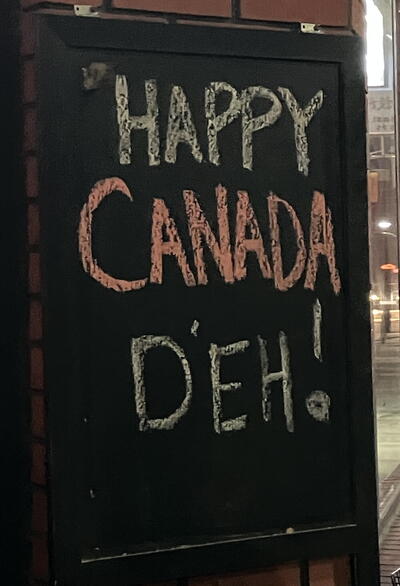
Date: July 1, 2026 | Category: News
Lennoxville
Date: June 23, 2026 | Category: Guest Column
Author: Jade Lemieux
In this new series for the blog, Jade Lemieux introduces us to English-speaking communities in Québec.
If you ever find yourself in Sherbrooke, two hours east of Montreal, you might want to make a short detour through its English-speaking borough, Lennoxville. For nine months out of the year, you will find it buzzing with students from its two higher education institutions, Champlain College and Bishop’s University. Walking down College Street from the university’s campus toward Lennoxville’s main street (Queen’s St.), you will cross The Golden Lion—or just The Lion for locals and students—Québec’s oldest microbrewery. It will most likely be filled with students hanging out after class, exceeding their student budget. Continuing down Queen’s Street, you will find yourself next to Faro, a Sherbrooke-owned coffee shop and roaster where I personally spent countless hours working on final papers while drinking lattes. Entering either of those local shops, you will be welcomed with the “bonjour-hi” language filter greeting, a trademark of bilingual areas that you would not hear in the rest of the city.
With nearly half of its residents recording English as their mother tongue, Lennoxville is one of the last remaining anglophone strongholds in the Eastern Townships. The Eastern Townships refers to a region on the southernmost part of Québec, adjacent to the United States’ border along both Vermont and Maine. Originally Abenaki territory, the region was mostly left alone during the first wave of French colonization, with only one settlement established: Grande-Fourche (now Sherbrooke). Following the American Revolutionary War, groups of British Loyalists flocked to the area despite the Québec governors’ encouragement for them to move west. Therefore, in 1791, the land was divided among 95 townships. Due to its rapid industrial growth and system of roads and railways, the region attracted a large population, including waves of French settlers in the 1840s. By 1881, those French settlers had become a majority over the Anglophone residents of the Eastern Townships. Today, only 10 percent of the population of the Eastern Townships is anglophone, with Lennoxville remaining one of the last English centers.
Gaelic features in Cape Breton English
Date: June 10, 2026 | Category: Guest Column
Author: Ryan Martin
In this new series for the blog, Ryan Martin explores the English of Cape Breton.
Growing up in Cape Breton, also known by its Mi’kmaq name Unama’ki, my elementary school’s music classes often tasked us with singing traditional Gaelic songs. Though my classmates and I were more or less oblivious to the meaning of the words, such comprehension had little or no bearing on our ability to memorize the Gaelic lyrics, and to this day I can still sing “Calum Crùbach” in its entirety. At the time, I understood this to be a kind of gesture towards a language and a culture that, for all intents and purposes, were inaccessible to me. After all, I lived and attended school where English was the only language spoken; the Gaelic speakers of Cape Breton felt as though they were worlds apart from me. Now, however, I realize that the Gaelic language is inextricable from the particular manner of speaking English that is found on Cape Breton Island, regardless of whether or not myself and my classmates were aware of it. It is for this reason that I want to take the time to outline a few of the Gaelic influences on Cape Breton English.
First, a point of clarification. “Gaelic” typically refers to the language Scots Gaelic. It also sometimes refers to the separate but related language Irish Gaelic, more commonly called “Irish”. Both Scots and Irish Gaelic have an influence on Cape Breton English, although the strongest influence is from Scots Gaelic, and I use “Gaelic” to refer to Scots Gaelic unless otherwise specified.
Accentism for Profit
Date: May 25, 2026 | Category: News
"Any human interaction is a two-way street, and the success of that communication comes, in large part, from an implicit collaborative building of understanding — an establishment of a common ground."
- Accentism for profit? What Telus is getting wrong about accents (The Conversation, May 20, 2026)
Westmount
Date: May 11, 2026 | Category: Guest Column
Author: Jade Lemieux
In this new series for the blog, Jade Lemieux introduces us to English-speaking communities in Québec.
While Montreal is well-known as the largest Francophone city in the Americas, most people do not know that the Island of Montreal is not actually a single city but contains a few different enclaved municipalities. Therefore, if you find yourself driving across the island and notice a specific shift in the style and architecture of the environment, you might have just crossed into a different municipality. Furthermore, if you look at road signage and start seeing English “Stop” signs, instead of the usual “Arrêt” signs used throughout the rest of Québec, then you know you are now in Westmount.
As its name suggests, Westmount lies on the western flank of Mount Royal (the largest mountain on the island and important landmark), and it is recognized as an independent municipality with its own city council and government. Just like the wider region of Montreal, ascribed as one of the “bilingual capitals of the world,” a large portion of Westmount’s population speaks both French and English. More interestingly, however, 67.8% of its 20,350 residents record English as their main language spoken, with 48.7% of the population noting English as their mother tongue. Westmount, therefore, has been known for most of its history as the “Anglophone enclave” of Montreal.
Literary Map of Toronto
Date: April 21, 2026 | Category: News
Explore Toronto through literature with our new map plotting literary references to the city. Click on a pin to read a quote related to the area. Thanks to former Strathy intern Josh Bernier-Taylor for initiating the project. Do you have a quotation from a fictional work set in Toronto that you would like to suggest? Send it to strathy@queensu.ca.
Nigerian Canadian English
Date: April 20, 2026 | Category: In the Media
"Dialects ... shape identity – it's a marker of who you are and what community you're from."
- Chips vs. fries: I speak English fluently and yet I am always translating (CBC, April 19, 2026)
EPIP 9 Conference
Date: April 16, 2026 | Category: News
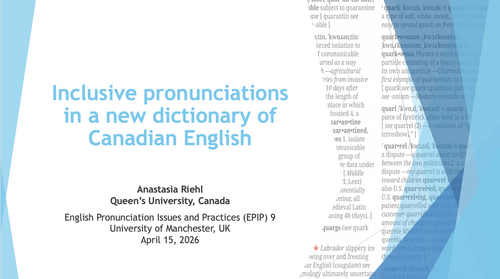
Strathy Director Anastasia Riehl presented a talk about pronunciations in the new Canadian English Dictionary at the conference English Pronunciation Issues and Practices in Manchester, England.
Toronto Slang?
Date: March 29, 2026 | Category: In the Media
What was intended to be a light-hearted conversation about Toronto slang on late-night television has turned into a controversy over authenticity and appropriation.
- Jimmy Fallon got quizzed on Toronto slang (Toronto Life, March 26)
- Actress faces backlash over 'Toronto slang' segment (HOLR, March 27)
Jack Chambers (1938-2026)
Date: March 10, 2026 | Category: News
With sadness for his loss and appreciation for his groundbreaking contributions to the field of Canadian English, we honour the memory of Jack Chambers.
Defining Identity
Date: Feb. 5, 2026 | Category: In the Media
"The development of a new Canadian English dictionary is consistent with our persistent yearning to convince ourselves we are distinct as a nation ..."
- We must recalibrate, give'r and be wary of those who would "maplewash" (Seaway News, Feb. 19, 2026)
Hockey Jargon
Date: Feb. 5, 2026 | Category: In the Media
Don't take your eyes off the biscuit! With the winter Olympics underway, it's a great opportunity to brush up on your hockey terminology.
- Apple, biscuit and twig: Explaining hockey's unique jargon you'll hear at Milan Cortina (CNN, Feb. 5, 2026)
Spelling as Identity
Date: Jan. 23, 2026 | Category: In the Media
"Much of our Canadian newspaper spelling style can be explained by a tendency to adopt British spelling instead of American, but it’s not quite as simple as that ... There is such a thing as Canadian English, and it’s not merely an adoption of British over American spelling."
- Ottawa strays from Canadian English at its own peril (The Western Producer, Jan. 20, 2026)
Canadian AI
Date: Jan. 18, 2026 | Category: In the Media
"Today’s most powerful LLMs are built by American companies, trained largely on material that’s weighted toward American English, and fed giant snapshots of the public web that are also dominated by American interests ... Canada’s national voice could begin to disappear from the machines that will increasingly mediate everyday life. That will reduce and drain linguistic variety and other uniquely Canadian cultural elements."
- Why we need an AI model that speaks Canadian (Calgary Herald, Jan. 17, 2026)
North Words
Date: Jan. 16, 2026 | Category: In the Media
Strathy Director Anastasia Riehl discusses the Canadian English Dictionary, linguistics and endangered languages on an episode of the podcast North Words.
Defining Canada with Canadianisms
Date: Jan. 12, 2026 | Category: In the Media
"During these times when we need to hang on tight to our identity like a tuque during a soaker, there are real linguistic warriors hard at work to scientifically determine what makes a word Canadian."
- What makes a word Canadian? These linguistic warriors are hard at work to find out (Globe and Mail, Jan. 12, 2026)
Slopification
Date: Jan. 10, 2026 | Category: In the Media
We are clearly overrun by "low-quality, high-quantity content, most typically produced by generative AI", given that 'slop' has been selected yet again for 2025 Word of the Year, this time by the American Dialect Society. “Slop isn’t a new word. It has moved from the pig sty, to the algorithm, and now forms new compounds such as sloppunk, slopification, and friend slop ... This productivity has no end in sight.”
More on Maplewashing
Date: Jan. 1, 2026 | Category: In the Media
Updated: Jan. 10, 2026
Strathy researcher Emma Ferrett talks with CBC's Ontario Morning and Kingston Daily about Canada's Word of the Year and the Canadian English Dictionary.