

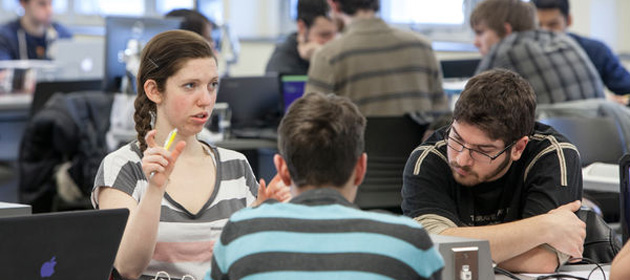
Blended learning integrates in-class, face-to-face learning with online learning in a purposeful, thoughtful and complementary way to enhance student engagement. (Garrison and Vaughn 2008).
Blended Learning for Students [PDF] describes blended learning from a student's perspective.
Improved student engagement is achieved by focusing on in-class interaction to promote active and collaborative learning, and minimizing or eliminating the passive transmission of information.
In Arts and Science a blended model generally involves moving fundamental knowledge acquisition out of the classroom—using interactive online materials to deliver enriched content, to guide students through the textbook, to verify comprehension—and devoting classroom time to applying, integrating and synthesizing the knowledge. This model is sometimes referred to as the “flipped classroom.” While blended courses have the same number of student learning hours as traditional lecture courses, the nature of the learning hours is different and fewer contact hours are involved.
In addition to enhancing student engagement, several benefits are associated with blended models. Flexibility is increased for students through the learner-centred approach, which allows students to progress at their own pace online and to review complex concepts as needed. For instructors, the blended approach frees up class time and offers opportunities to integrate teaching and research—to explore a research perspective, discuss case studies, or to pose a provocative question.
Redesigning a course as a blended model is not seen as a cost-saving model, but can be an effective way of increasing enrolment in high-demand courses using existing resources.
Blended models are particularly effective for large classes, where it is more challenging to engage students. The Faculty’s first innovations in blended learning were initiated in 2011 by instructors in two high-enrolment Arts and Science courses: Human Geography (GPHY 101) and Principles of Psychology (PSYC 100).
The Faculty is promoting the development of blended learning models for large introductory classes through a strategic Course Redesign project. Starting in 2012/13, Introduction to Sociology (SOCY 122), Women, Gender, Difference (GNDS 120) and Ancient Humour (CLST 205) are being delivered as blended courses. In an independent initiative, the Department of Film and Media is offering Film, Culture and Communication (FILM 110) in a blended format as well.
The next phase of the Course Redesign project (2013/14) includes the following courses: Differential and Integral Calculus (MATH 121), Introductory Biology of Cells (BIOL 102), General Chemistry (CHEM 112), Gender, Race and Popular Culture (GNDS 125) and Theatre in the Age of Film and Television (DRAM 205).
All blended courses, including those initiated outside of the Course Redesign project, are being assessed to evaluate their effectiveness in terms of student engagement and learning; the results of these assessments will be reported to the university community.
Read more about the Faculty's blended learning initiative.
View Resources for blended learning.