|
PEARLPaleoecologicalEnvironmentalAssessment andResearchLaboratory |
|
- Home
- People
- Research
- Outreach
- Blog
|
|
PEARLPaleoecologicalEnvironmentalAssessment andResearchLaboratory |
|
|
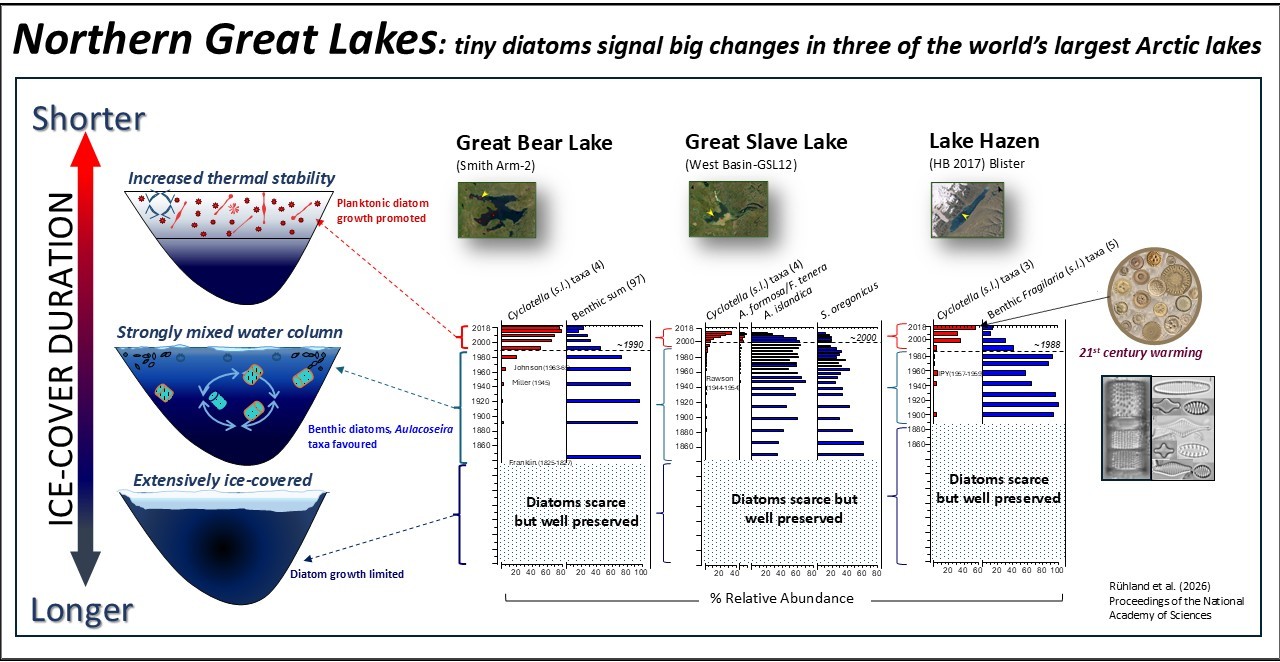
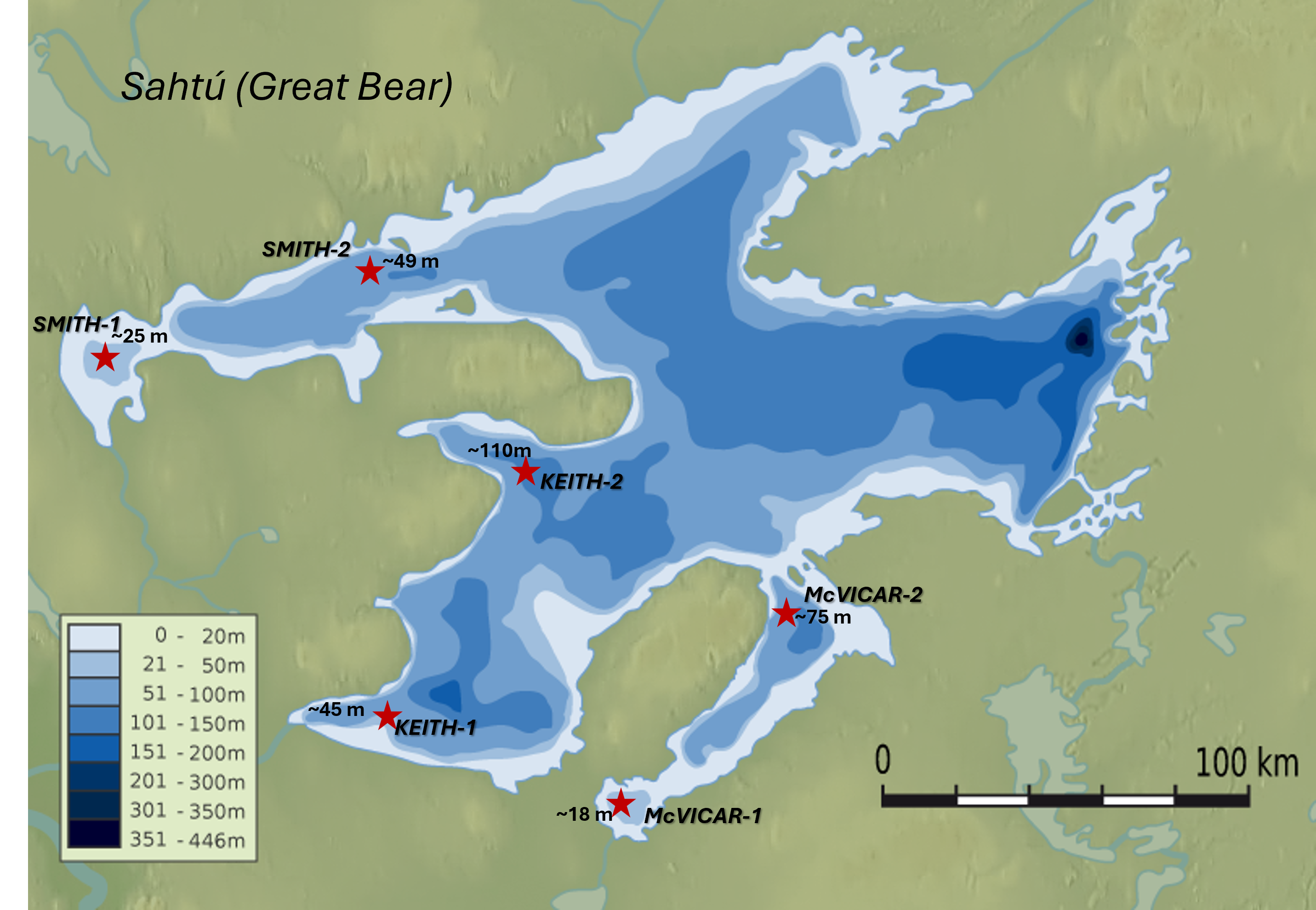
Summary: The rapid re-structuring of algal communities archived in dated sediment records from Great Bear Lake, Great Slave Lake and Lake Hazen, three of the world’s largest and deepest Arctic lakes, is a clear sign that these once climate-resistant freshwater bodies have now succumbed to recent accelerated warming and have diverged from their 20th century conditions. Changes in the quantity and composition of algae at the base of the food chain of these ‘Northern Great Lakes’ signal a threshold response that will likely cascade to higher trophic levels. Kingston, ON – A new study led by Queen’s University in collaboration with researchers from Environment and Climate Change Canada (ECCC) and Fisheries and Oceans Canada (DFO), published in the Proceedings of the National Academy of Sciences, shows that accelerated 21st century warming is markedly altering Great Bear Lake, Great Slave Lake, and Lake Hazen, three of world’s largest and deepest Arctic lakes. The study identified striking changes in diatoms (microscopic algae with glass cell walls) preserved in dated lake sediment records that provided the team with a window into past ecological conditions for these remote Arctic regions. They found that, despite differences in latitude and setting, the three lakes registered remarkably similar and near-synchronous shifts in diatom composition that corresponded to longer and warmer ice-free periods and changes in lake thermal conditions. “A big change in the community structure of these tiny algae at the bottom of the food web is an early warning that the rest of the lake is changing” says Dr. Kathleen Rühland, lead author and senior research scientist at Queen’s University’s Paleoecological Environmental Assessment and Research Lab (PEARL). “Diatoms may be very small, but they have a big influence on the ecological functioning of these lakes, as they are a critical food source that supports the rest of food web.” Until recently, Great Bear Lake, Great Slave Lake and Lake Hazen have maintained extensive ice covers that have helped buffer the effects of recent anthropogenic warming, in contrast to small and mid-sized Arctic lakes and ponds where pronounced lake-ice responses to climate change are now well documented. “These iconic large, deep Arctic lakes have remained relatively stable for centuries, but the exceptional pace of Arctic warming in recent decades is pushing these ‘Northern Great Lakes’ into new ecological states” says PEARL research scientist and co-author Dr. Neal Michelutti. Direct monitoring data are scarce and much of the baseline information for these remote lakes comes from early surveys or from Indigenous knowledge. A compilation of rare historical data from the 1940s to 1970s, that included phytoplankton data, provided a wealth of information that gave the researchers a means to “ground-truth” their paleolimnological interpretations. “The lack of direct long-term monitoring data is a major challenge for environmental assessments. Fortunately, lake sediments are like the so-called black boxes in aircraft, faithfully recording changes that happened in and outside the lake” adds co-author Professor John P. Smol, co-director of PEARL. “Although Great Bear Lake is often considered to be the world’s largest unpolluted lake, our sediment profiles track striking ecosystem changes, linked to climate warming, showing that these large northern lakes are fundamentally different than they were just a few decades ago”. The research, however, also raises new questions. “The long-term consequences on Arctic food webs remain poorly understood but will likely be significant and ultimately affect fish populations and the people who depend on these resources” says co-author Dr. Marlene Evans, Research Scientist with the Watershed, Hydrology and Ecology Research Division, ECCC, and based in Saskatoon. “Community-based water quality and biological data collection over the past two decades on Great Bear and Great Slave lakes have provided important baseline aquatic ecosystem information. However, to better understand how climate-mediated changes are impacting fish populations on these lakes will require continued strong Indigenous involvement in community-led monitoring” notes Dr. Kimberly Howland, a DFO research scientist based in Winnipeg. “One certainty is that the Arctic is changing fast under this new climate regime” concludes Dr. Rühland. For high resolution images related to this paper, click Here Contact Information for Authors:Kathleen M. Rühland Paleoecological Environmental Assessment and Research Lab (PEARL), Department of Biology, Queen's University, Kingston, ON, Canada ruhlandk@queensu.ca Neal Michelutti Paleoecological Environmental Assessment and Research Lab (PEARL), Department of Biology, Queen's University, Kingston, ON, Canada nm37@queensu.ca Marlene S. Evans Environment and Climate Change Canada 11 Innovation Boulevard, Saskatoon, SK, S7N 3H5, Canada marlene.evans@ec.gc.ca Kimberly L. Howland Arctic Fisheries and Marine Mammal Science Division, Freshwater Institute, Fisheries and Oceans Canada, Winnipeg, MB, Canada kimberly.howland@dfo-mpo.gc.ca John P. Smol Paleoecological Environmental Assessment and Research Lab (PEARL), Department of Biology, Queen's University, Kingston, ON, Canada smolj@queensu.ca |
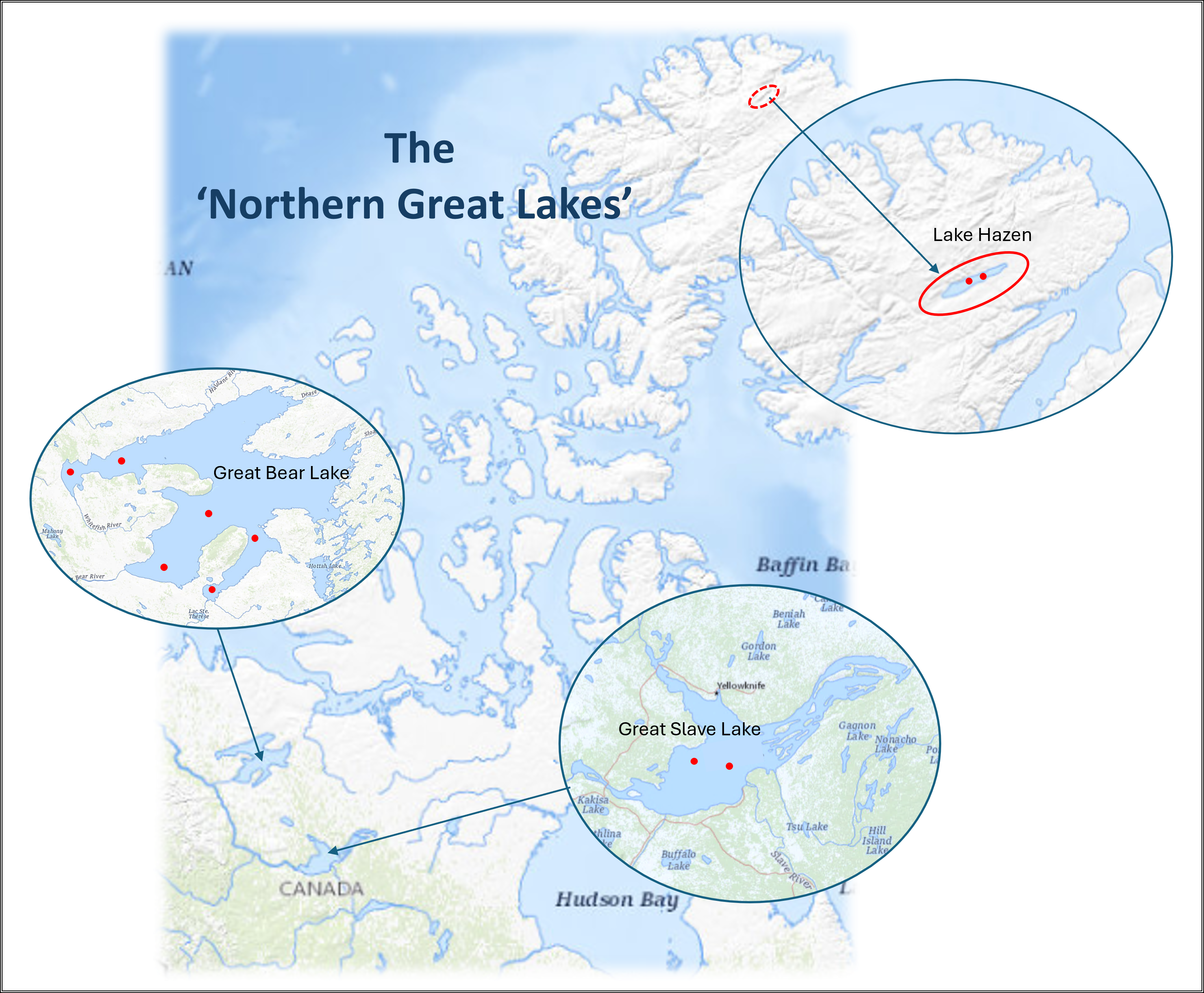 Map showing relative locations of Lake Hazen in Nunavut and Great Bear Lake and Great Slave Lake in the Northwest Territories, Canada. The red dots indicate the locations of the sediment cores analysed in this study. |
|
|
|
|
|
To request a PDF of the original artical, email John Smol |
Media coverage for this article:
The Globe and Mail,
CBC North's The Trailbreaker,
730 CKNW Weekends with Rob Fai,
CBC News North,
The Kingston Whig Standard,
The Rundown on TVO,
Queen's Gazette ,
Education News Canada,
|
|