
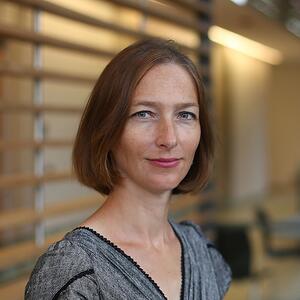
Kathrin Tyryshkin
Biomedical Data Scientist, Department of Pathology and Molecular Medicine, Queen’s University
Dr. Kathrin Tyryshkin is a Biomedical Data Scientist at the Department of Pathology and Molecular Medicine at Queen’s University. She holds a PhD and an MSc in biomedical computing from Queen’s University and a BA Hons degree in computer science from York University. Dr. Tyryshkin has an excellent track record of discovery and innovative research and is extensively involved in multidisciplinary, collaborative research teams. Her teaching and research bring together data science, computing, and translational biomedical research. She is particularly interested in identifying patterns in biomedical data that facilitate the search for biomarkers. She designs novel and advanced algorithms and develops classification models for diagnosis, assessment, and prognosis of a medical condition or disease.
Past Members
-
2023/24 Chenshuo (Aurora) Zhang, MSc in Biomedical Informatics, Sex differences in immune response in bladder cancer
-
2016/18 Tal Shapira, MSc project in Computer Science, Validation of diagnostic gene sets to identify critically ill patients with sepsis. Current position: Software developer
-
2016/18 Blake Pyman, MSc in Computer Science, Context-Aware Deep Cancer Classifier: Exploring microRNA Regulation of Cancer with Deep Learning. Current position: Machine Learning Developer, Ontario Power Generation
-
2020/21 Taylor Fountain, MSc in Biomedical Informatics, microRNA-based classification of diffuse large B-cell lymphoma.
-
2020/21 Greg Eriksen, MSc in Biomedical Informatics, microRNA-based classification of typical and atypical lung carcinoids.
-
2021/22 Melani Maheswaran, MSc Candidate in Biomedical Informatics, Classification of Diffuse Large B-Cell Lymphoma Patient Response to R- CHOP Therapy using mRNA Expression Profiles
-
2021/22 Ningyou Li, MSc in Biomedical Informatics, Classification of Neuroendocrine Neoplasms using Graph Neural Network
Computing Undergraduate Students (CISC-499/500)
-
2023 Yuqi Yang, Dashboard for Pathology Reporting
-
2023 Raymond Jing, Feature Selection in Graph Neural Networks
-
2023 Samantha Tapping, Expanding on the Computation Pipeline for Accurate microRNA Curation
-
2023 Roy Li, Parallelization of the MFeaST Application
-
2022 Molly Fleming and Chloe Talman Developing a Broadly Enabling Computation Pipeline for Accurate microRNA Curation
-
2022 Ben Minor, Preprocessing GUI for Genomic Data
-
2021 Ricky Zhang, Genomic Data Analysis and Visualization GUI
-
2020 Allesia Morin, Differential analysis of miRNA expression in plasma and serum
-
2020 Tong Cheng, Extension of the genomic data analysis and visualization GUI
-
2020 Yuxin Cheng, REDCAP database for clinical and pathological data
-
2019 Miranda Smith, Genomic data analysis and visualization GUI
-
2019 Linke Li, Recurrence and survival prediction for ACC Cancer
-
2019 Yiwen Feng, Pre-processing and analysis of miRNA data
-
2017/18 Justin Gerolami, Predicting cases of recurrent Clostridium difficile infection through machine learning, (CISC500)
-
2018 Danielle Tremblay, miRNA-mRNA targeting algorithm for understanding miRNA-mediated gene regulation. Current position: Law student, U of Sydney
-
2018 Sabrina Quazi, Analyzing the effects of enhancers on nearby miRNAs in cases of Diffuse Large-B-cell Lymphoma
-
2017 Mareena Malory, Mapping, curation, and evolutionary conservation of macaque miRNA, Current position: Data manager, Memotext
-
2021 Raymond Jing, Graph Neural Network model for prediction of treatment response in DLBCL
-
2019 Val Kobilaski, Understanding the relationship between mutation and methylation patterns
-
2017 Justin Gerolami, Role of somatic mutations in Diffuse Large B-cell Lymphoma (DLBCL)
-
2015 Katherine Beaulieu, microRNA for Cancer Diagnosis
Mitacs Summer Global Research Internship (GRI)
- 2023 Nishant Rajadhyaksha, Graph Neural Network model for prediction of cancer
Life-science Undergraduate Students
-
2024/25 Taylor Zhang, Using Outlier Detection Methods to Discriminate Recurrence Risk of Who 1973 Grade 2 and Grade 3 in Non-Muscle Invasive Bladder Cancer
-
2021/22 Emmanuelle Rousselle, Application of Gene Set Enrichment Analysis to Identify Signaling Pathways Driving DLBCL Response to R-CHOP Treatment
-
2019/20 Yossra Zaza, miRNA-based prediction of therapy response in DLBCL.
Undergraduate Volunteer Students
-
2024/25 Ana Maria Vera Rodriguez, Research Volunteer. Project: Discriminating Recurrence Risk of Who 1973 Grade 2 and Grade 3 in Non-Muscle Invasive Bladder Cancer
-
2019/22 Tashifa Imtiaz, Research Volunteer. Project: Identifying miRNA biomarkers in patients with Multiple Sclerosis.
-
2017/20 Zier Zhou, Research Volunteer and Craig Jury Memorial Summer Student. Project: Statistical analyses of miRNA expression data sets.