
Accent refers to pronunciation features shared by a group of speakers that do not alter the meaning of words. Accent is shaped by how listeners perceive speech in relation to an assumed phonetic “norm,” often associated with an imagined native speaker of English1. Because accent is understood in comparison to these expectations, it is always filtered through social assumptions and power relations and is therefore never neutral2.
Accent discrimination, also known as accentism, describes a set of beliefs and practices that position the accent of a presumed native English speaker as linguistically superior. This ideology justifies the profiling, marginalization, and mistreatment of speakers whose accents are perceived as deficient3. Rooted in the colonial history of English, accent discrimination in the Canadian context functions as an auditory form of oppression that reflects broader systems of inequity4. While it is often framed as individual bias against accented speakers5, accent discrimination operates far beyond isolated interpersonal encounters.
As universities continue to internationalize, students, faculty, and staff from diverse linguistic backgrounds interact daily. However, linguistic diversity alone does not ensure auditory acceptance. Instead, these environments frequently reproduce hierarchies of accent, where certain ways of speaking are perceived as authoritative and credible while others are devalued6. Accent thus becomes a marker through which belonging, intelligence, and professionalism are assessed and judged.
Accent Discrimination at Queen’s University
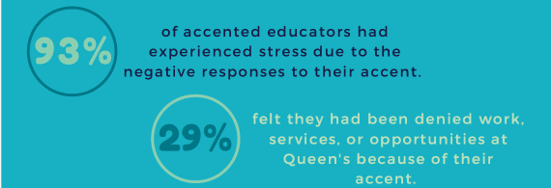
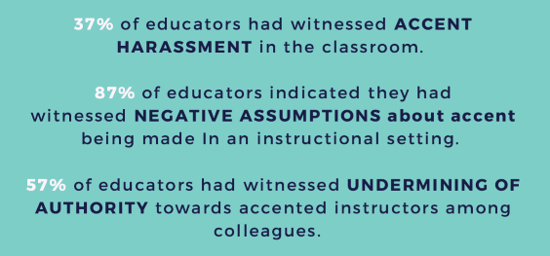 At Queen’s University, an online survey was conducted to examine perceptions of accent and authority among educators. This research culminated in the public report Understanding Each Other: Perceptions of Accent and Authority among Classroom Instructors at Queen’s University (2017). The findings revealed that nearly 37% of the 128 respondents had witnessed accent harassment or discrimination on campus. Among the 32 respondents who reported speaking English with an accent, almost half indicated that they had personally experienced harassment or discrimination in their professional roles. These findings provide institution-specific evidence of how accent discrimination manifests within everyday academic interactions, reflecting patterns that have been documented across higher education more broadly.
 The report further demonstrates how listener prejudice amplifies perceptions of authority for speakers whose accents are associated with whiteness or intellectual prestige. As the authors note, “prejudice on [the] hearers' part [is] likely to inflate the credibility of someone who ‘speaks white’ with an accent heard as coming from somewhere intellectually prestigious, authoritative, or trustworthy. [This is] connected to a prejudice in favor of ‘really white’ Euro-speech”7 (p. 17). Rather than reflecting isolated attitudes, these patterns reveal how institutional norms of credibility and professionalism are racialized and audibly encoded. These findings support existing literature demonstrating that accent discrimination intersects with racism and other forms of oppression, including sexism, classism, ableism, and homophobia, to structure power, privilege, and exclusion within academic spaces8.
Accent Discrimination as a Systemic Issue
As the findings from the Queen’s University report show, accent discrimination is not simply a matter of individual misunderstanding or personal prejudice; it is embedded within broader systems of inequity. Research suggests that when listeners hold negative attitudes toward a speaker’s accent, their comprehension of the speaker’s message is significantly reduced, even if the speech itself is clear9, 10, 11, 12, 13. At its core, accent discrimination is closely tied to racism, with language—particularly accent—serving as a primary site where racialized bias surfaces14.
A substantial body of research demonstrates that speakers with so called nonstandard accents, including foreign or regional accents, are often evaluated less positively than speakers with standard accents. These evaluations affect perceptions of comprehension15, speaker status, solidarity, and dynamism16, as well as perceived hireability17. Importantly, however, research consistently shows that nonstandard accents do not inherently reduce intelligibility18; rather it is the preconceived expectations of the listener that interfere with comprehension. Taken together, both the Queen’s findings and the broader literature suggest that negative evaluations stem not from linguistic deficiency but from listener bias embedded within social and institutional hierarchies.
Listening as a Site of Change
Although speaker-initiated strategies, such as adjusting speaking speed, may sometimes improve evaluations of accented speech, research cautions against placing responsibility for addressing accent discrimination on speakers alone19, 20, 21. Framing accent bias as a problem to be corrected by speakers reinforces deficit-oriented assumptions and obscures the active role listeners play in producing and sustaining discriminatory judgments. Consequently, scholarly attention has increasingly shifted toward listener-focused approaches that examine how accents are perceived, interpreted, and socially valued22.
Improving listening, however, extends beyond individual effort or attitudinal changes. Listening is also a collective practice shaped by broader social and institutional conditions6. Listening is influenced by “the social and organizational influences on listening”23, including institutional norms, expectations, and power relations. Addressing accent discrimination therefore requires transforming the listening structures that normalize certain accents while stigmatizing others. From this perspective, advancing linguistic justice in higher education involves challenging the institutional conditions that devalue accented speakers and reorienting listening practices toward equity, inclusion, and shared responsibility6.
Queen’s Harassment and Discrimination Policy and Language-related Discrimination
The following section, along with the section that follows, was developed by Queen’s Human Rights and Equity Office (HREO) to ensure alignment with Queen’s institutional policies, provincial human rights frameworks, and existing university resources related to harassment, discrimination, and equity.
In some cases, accent-based discrimination may violate the Ontario Human Rights Code. The Ontario Human Rights Code prohibits actions that discriminate against people based on a protected ground in a protected social area. While accent is not directly labelled as one of these protected grounds, it may be connected to discrimination based on ancestry, place of origin, ethnic origin, and/or race. As such, differential treatment based on accent may fall within the scope of prohibited discrimination under both provincial legislation and Queen’s policies.
The Ontario Human Rights Commission Policy on Language-related Discrimination says:
“A person's accent is also often associated with her or his "mother tongue" or place of origin. Because a person's accent is usually related to her or his ancestry, ethnic origin or place of origin, the Code can be infringed when someone is denied employment, service, housing, or is otherwise discriminated against because of an accent. In these kinds of situations, the underlying discrimination is often actually based on ancestry, place of origin and, or ethnic origin.”
If you have concerns around accent-based discrimination and/or the Harassment and Discrimination policy the Human Rights Advisory services are available to discuss options and next steps.
To learn more about Harassment and Discrimination policy and procedure at Queen’s check out:
Queen’s Resources for Further Learning
Continue your learning with the following resources:
1 Flege, J. E. (1988). Factors affecting degree of perceived foreign accent in English sentences. The Journal of the Acoustical Society of America, 84(1), 70-79.
2 Rangan, P., Saxena, A., Srinivasan, R.T., & Sundar, P. (Eds.). (2023). Thinking with an accent: Toward a new object, method, and practice. University of California Press.
3 Dovchin, S., & Dryden, S. (2022). Unequal English accents, covert accentism and EAL migrants in Australia. International Journal of the Sociology of Language, 2022(2), 33-46.
4 Ramjattan, V.A. (2024). Accent modification and workplace accentism: The institutionalization of linguistic profiling and its career implications. Career Development International, 29(3), 311-322.
5 Telo, C., Trofimovich, P. and Grantham O’Brien, M. (2022), “Disentangling professional competence and foreign accent”, Journal of Second Language Pronunciation, 8(3), 413-443.
6 Ramjattan, V. (2025, January). Accent Discrimination and (Re)Institutionalized Listening. Queen’s University.
7 Simpson, S., Clow, E., & Yzaguirre, V. (2017). Understanding Each Other: Perceptions of Accent and Authority among Classroom Instructors at Queen’s University. Queen’s University.
8 Lindemann, S. (2019). Other people's English accents matter: Sociolinguistic testimonios from bilingual faculty and students. International Multilingual Research Journal, 13(4), 249–262. https://doi.org/10.1080/19313152.2019.1653993
9 Ahn, J., & Moore, D. (2011). The relationship between students’ accent perception and accented voice instructions and its effect on students’ achievement in an interactive multimedia environment. Journal of Educational Multimedia and Hypermedia, 20(4), 319-335.
10 Kang, O., & Rubin, D. L. (2009). Reverse linguistic stereotyping: Measuring the effect of listener expectations on speech evaluation. Journal of language and social psychology, 28(4), 441-456.
11 Mayer, R. E., Dow, G. T., & Mayer, S. (2003). Multimedia learning in an interactive self-explaining environment: What works in the design of agent-based microworlds?. Journal of educational psychology, 95(4), 806-812.
12 Rubin, D. L. (1992). Nonlanguage factors affecting undergraduates' judgments of nonnative English-speaking teaching assistants. Research in Higher education, 33(4), 511-531.
13 Kang, O., and Moran, M. (2019) ‘Enhancing Communication Between ITAs and US Undergraduate Students’, In S. D. Looney and S. Bhalla (eds.) A Transdisciplinary Approach to International Teaching Assistants: Perspectives from Applied Linguistics, (pp. 82–9. Blue Ridge Summit, PA: Multilingual Matters.
14 Lee, J. J., & Rice, C. (2007). Welcome to America? International student perceptions of discrimination. Higher education, 53(3), 381-409.
15 Munro, M. J., Derwing, T. M., & Morton, S. L. (2006). The mutual intelligibility of L2 speech. Studies in second language acquisition, 28(1), 111-131.
16 Fuertes, J. N., Gottdiener, W. H., Martin, H., Gilbert, T. C., & Giles, H. (2012). A meta‐analysis of the effects of speakers' accents on interpersonal evaluations. European journal of social psychology, 42(1), 120-133.
17 Spence, J. L., Hornsey, M. J., Stephenson, E. M., & Imuta, K. (2024). Is your accent right for the job? A meta-analysis on accent bias in hiring decisions. Personality and Social Psychology Bulletin, 50(3), 371-386.
18 Derwing, T. M., & Munro, M. J. (1997). Accent, intelligibility, and comprehensibility: Evidence from four L1s. Studies in second language acquisition, 19(1), 1-16.
19 Rubin, D. L. (2012) ‘The Power of Prejudice in Accent Perception: Reverse Linguistic Stereotyping and its Impact on Listener Judgments and Decisions’, in J. Levis and K. LeVelle (eds.) Proceedings of the 3rd Pronunciation in Second Language Learning and Teaching Conference, (pp. 11–7). Iowa State University.
20 Lindemann, S., Litzenberg, J., and Subtirelu, N. (2014) ‘Problematizing the Dependence on L1 Norms in Pronunciation Teaching: Attitudes Toward Second-Language Accents’, In J. M. Levis and A. Moyer (eds.) Social Dynamics in Second Language Accent, (pp. 171–94). De Gruyter.
21 Subtirelu, N. C., & Lindemann, S. (2016). Teaching first language speakers to communicate across linguistic difference: Addressing attitudes, comprehension, and strategies. Applied Linguistics, 37(6), 765-783.
22 Hendriks, B., van Meurs, F., & Wolf, L. (2025). Reducing the impact of foreign accentedness in English Medium Instruction. Applied Linguistics, 1-32.
23 Yip, J., & Fisher, C. M. (2022). Listening in organizations: A synthesis and future agenda. Academy of Management Annals, 16, 657–679.
 This Creative Commons license lets others remix, tweak, and build upon our work non-commercially, as long as they credit us and indicate if changes were made. Use this citation format: Accent Discrimination in Higher Education. Centre for Teaching and Learning, Queen’s University