
Instructional design frameworks, as models that guide and organize how we plan (and sometimes implement) teaching and evaluation, are useful whenever we start to think about a particular learning activity or assessment, including group work. There are many different structured frameworks; the following are just a few and are not exhaustive, nor are they mutually exclusive. They can complement one another well through macro- and micro-design phases.
Backward Design
(Wiggins and McTighe, 1998)
Start with desired results (i.e., the learning goals or outcomes) of unit/course:
- e.g., What concepts and competencies should learners retain?
Determine the acceptable evidence, considering what can be assessed to meet these goals/outcomes and criteria – performance tasks and/or learning objects:
- e.g., What will I accept as evidence of student understanding and proficiency?
Develop a learning plan, reflecting on the scaffolding (learning activities, instructional strategies, resources and other supports) students will need along the way to produce this evidence
- e.g., What do I need to teach and how will I teach it to enable learners to produce this evidence and achieve these results?
ADDIE
(Branch, 2009)
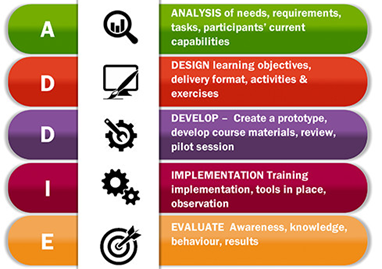
The ADDIE model is a robust framework and likely the most well-known and commonly used in online learning. It incorporates the entire spectrum of design, from problem identification (analysis) to continuous improvement (evaluation). There are different variations on the ADDIE model, including the more agile Rapid Instructional Design (Piskurich, 2015). However, the basic phases are:
- A: Analysis of needs, requirements, tasks, participants' current capabilities
- D: Design learning objectives, delivery format, activities & exercises
- D: Develop - Create a prototype, develop course materials, review, pilot session
- I: Implementation - Training implementation, tools in place, observation
- E: Evaluate - Awareness, knowledge, behaviour, results
Source: Linda Lorenzetti
Journey Mapping
Commonly used in other sectors (e.g., marketing), journey mapping has made its way into education and provides an innovative way of thinking about instructional design by encouraging us to visualize the process that students go through to achieve learning goals or outcomes.
Journey maps can provide a uniquely empathetic lens into the student experience and allow us to think about how to sequence touch points, or micro-experiences, to create rich opportunities for learners. That is, by mapping out the way a student may experience their learning, we can reveal various hidden opportunities to improve groupwork design: gaps in our assumptions, places where additional supports may be needed, and what specifically engages the learner. When mapping, consider three phases of the learning journey: before (planning, anticipation), during (sequence touch points), after (reflection, evaluation).
More specifically, journey mapping offers a student-centred approach to design. It allows us to
- understand students’ needs and perspectives (empathize, define);
- explore options (ideate, prototype); and
- materialize solutions (test, implement).
When we empathize with the student, we can try to account for friction – barriers that may prevent learners from accomplishing activity goals and learning outcomes. By providing proactive and/or reactive supports and interventions for students, friction can be either reduced at various touchpoints throughout the process or be transformed into a positive learning experience. Designers can even use this information at the foundation of their design, for example to sequence touchpoints in a way that is meaningful and accessible to various students.
 This resource was remixed from the ‘Instructional Design Guide to Group Work’ licensed by Arts & Science Online at Queen's University under a Creative Commons Attribution-NonCommercial-ShareAlike 4.0 International License.