Lies in the Skies: Limits of the Drone Warfare Evolution and the Rise of Countermeasures

Date

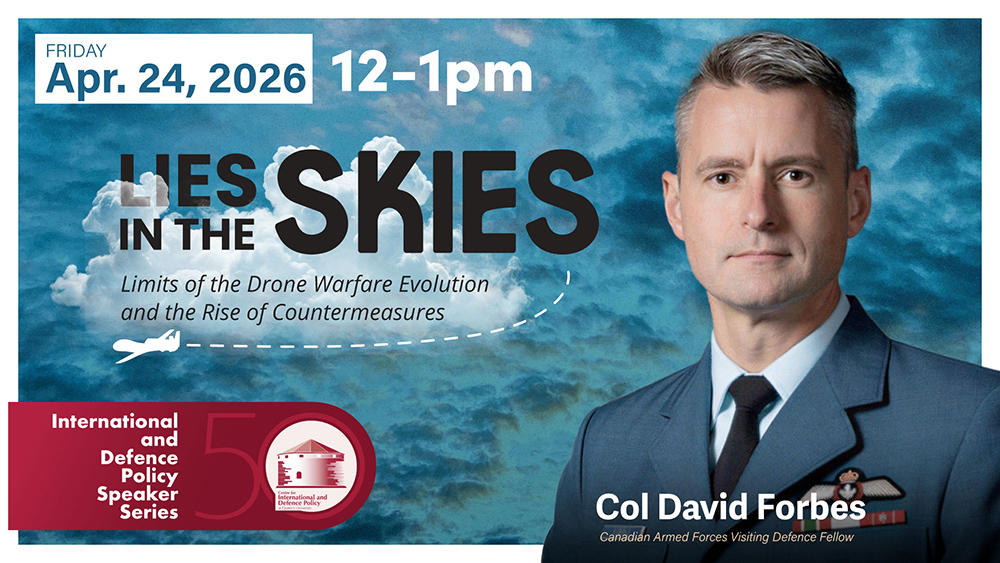
Friday April 24, 2026
12:00 pm - 1:00 pm

Location

Robert Sutherland Hall Room 448

Lies in the Skies: Limits of the Drone Warfare Evolution and the Rise of Countermeasures

Drones represent an evolution in warfare, not a revolution, and the full implications of drone warfare have not yet been felt. The ability to operate effectively despite drone threats is the necessary precondition for success and the reason counter-drone capability deserves even greater attention than drone capability itself. Battle-winning operations will continue to require modern, specialized platforms operated by increasingly informed, connected, protected, and adaptive personnel. Drones will be an important part of that future, but they will not fundamentally replace it.


Register for In-Person Attendance  Register for Online Attendance


Bio:

Col David Forbes graduated from the Royal Military College in 2001. Owing to a training delay, he traveled to Australia to complete a master’s degree. Following training, he piloted Griffon helicopters with 427 Special Operations Aviation Squadron. In 2010, he deployed as part of Canada’s Special Operations Task Force to Kandahar, Afghanistan flying Russian-built Mi-17 helicopters. Col Forbes was then posted to 408 Tactical Helicopter Squadron where he deployed as a detachment commander to the Philippines as part of Canada’s humanitarian response to Typhoon HAIYAN. Following Staff College, Col Forbes worked on national defence policy in Ottawa. He later served as the Commanding Officer of 408 THS.  He was assigned as the Executive Assistant to the Commander of Canadian Joint Operations Command and, once promoted to his current rank, as Director of Continental Operations. Most Recently, Col Forbes proudly served as Commander 1 Wing. Col Forbes holds a BA in History from the RMC, a Masters in International Relations from Bond University, and another in Defence Studies from the Canadian Forces College. Col Forbes is a graduate of the Canadian Army Staff College and of the Canadian Armed Forces’ Joint Command and Staff Program.


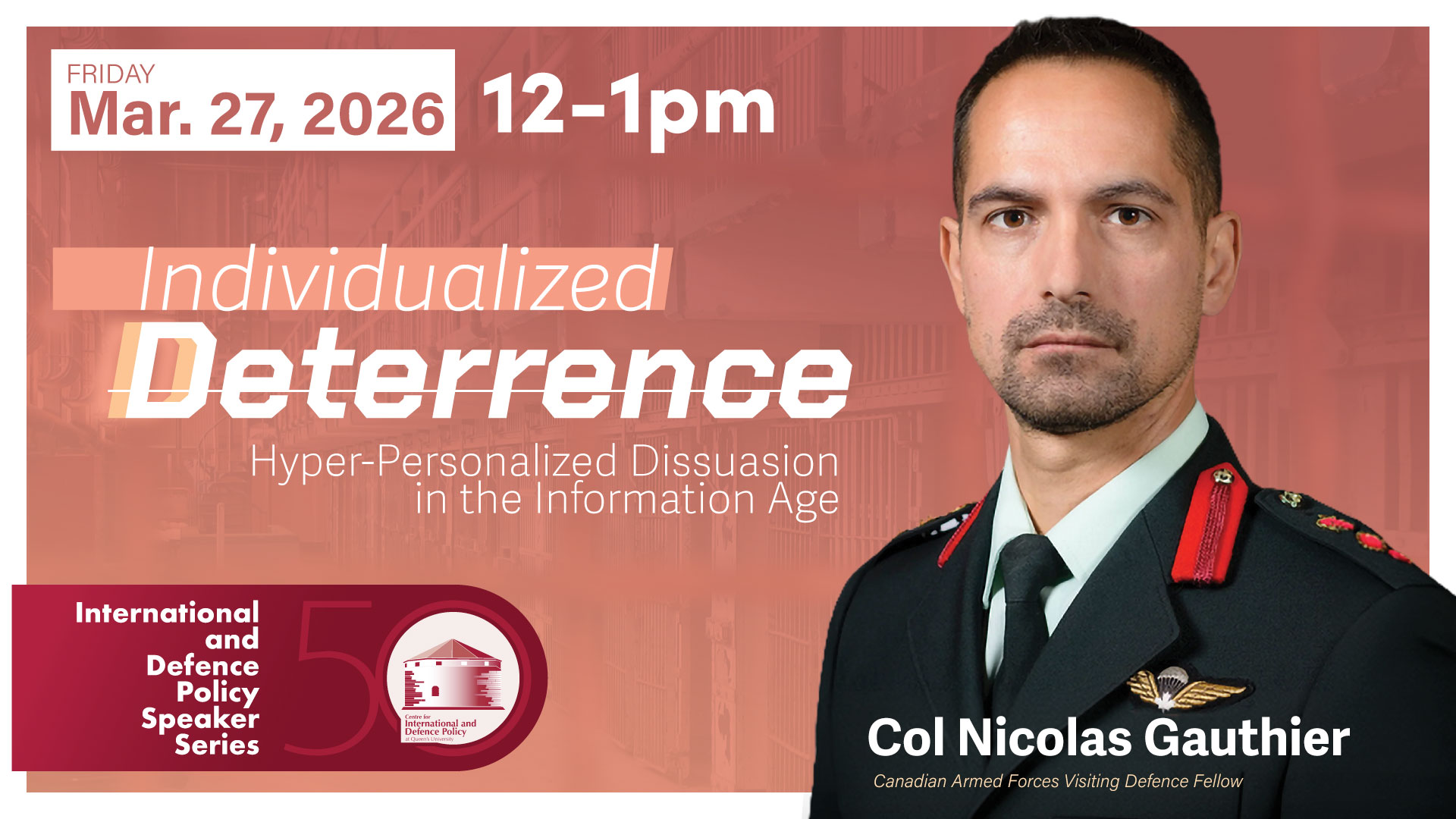
Individualized Deterrence: Hyper‑Personalized Dissuasion in the Information Age

Date

Friday March 27, 2026
12:00 pm - 1:00 pm

Location

Law Building - Room 2 (128 Union St.)

IDPS Nicolas Gauthier


Traditional deterrence assumes countries act like calm, rational players pursuing clear national interests. But in many authoritarian systems, that’s not how decisions are really made. Power often rests in the hands of one individual — and that individual may care less about abstract national goals and more about staying in power, protecting loyal elites, building personal wealth, or shaping their legacy in history. If we want deterrence to work in those contexts, is it possible to think less about “what does the other country needs?” and more about “what does the leader want?”


Bio:

Colonel Nicolas (Nic) Gauthier joined the Canadian Armed Forces in 1999 and was commissioned as an infantry officer into The Royal Montreal Regiment. Following his graduation, he transferred to the regular component and has since served with all three battalions of the Royal 22e Régiment. Colonel Gauthier has most recently served as Director of Expeditionary Operations at the Canadian Joint Operations Command headquarter, his previous practical policy experience include service as Canada’s Defence Attaché to Ukraine in Kyiv during Russia’s full-scale invasion, serving as a Senior Analyst within the Privy Council Office’s Foreign and Defence Policy Secretariat, and as Senior Staff Officer for Operations and Plans at NATO Headquarter in Brussels. Additional command and staff experiences include serving as the Deputy Commander of the Combat Training Center, command of the Infantry School, and as Executive Assistant to the permanent military representative of Canada to the Military Committee. He holds a Bachelor of Science from Université de Montréal, a Master of Public Administration from the Royal Military College of Canada, and a Master of Business Administration from the Quantic School of Business and Technology. Colonel Gauthier has two daughters, Amalia and Clara. He enjoys running, skiing, caving and rock climbing.


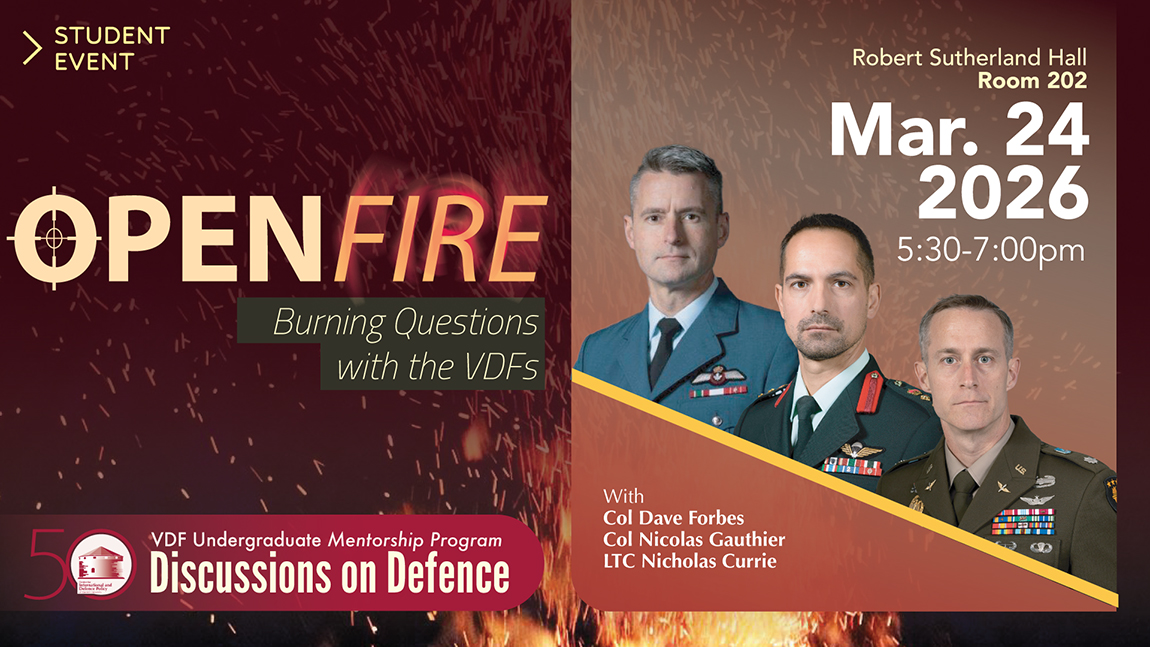
Open Fire: Burning Questions with the VDFs

Date

Tuesday March 24, 2026
5:30 pm - 7:00 pm

Location

Robert Sutherland Hall Room 448

Discussions on Defence

The CIDP is pleased to present its final Discussion on Defence for 2025-2026 year with a Q&A panel led by our Visiting Defence Fellows, Col Nicolas Gauthier, LTC Nicholas Currie, and Col Dave Forbes.

As Canada commits to spending 5% of GDP on defence in the coming decade, building defence literacy has never been more vital for students and Canadian society. This event offers undergraduate students the opportunity to learn from fellows as part of our mentorship program, engaging them in the defence and security community.


A light meal will also be provided with event registration.


Register Here

SITREP-Q: Quantum Readiness in a Changing Global Security Environment

Date

Tuesday February 10, 2026
9:00 am - 5:00 pm

Location

Donald Gordon Centre, Queen's University

SITREP-Q


Conference Outputs


Conference Agenda

9:00am - Welcome

  • Michael Murphy, Director, Centre for International and Defence Policy

9:10am - Briefing (ISED)

  • Michael Rosenblatt, Director, National Quantum Strategy Secretariat (ISED)

9:50am - Briefing (DND)

  • Joseph Waugh, Defence Industrial Strategy Team, DND-ADM(Pol)

10:30am - Break

10:45 - Policy Panel

  • Kristen Csenkey, St. Francis Xavier University (Chair)
  • Tracey Forrest, Research Director, CIGI
  • Kyle Briggs, Entrepreneur-in-Residence, University of Ottawa
  • Matthew da Mota, Senior Policy Researcher, Canadian Shield Institute

12:00pm - Lunch

1:00pm - Briefing (Industry)

  • Lisa Lambert, CEO, Quantum Industry Canada

2:00pm - Industry Panel

  • David Yiptong, Quantum City (Chair)
  • Alex Maierean, CEO, Phantom Photonics
  • Rafal Janik, COO, Xanadu
  • Kyung Soo Choi, CEO, Q-Block
  • David Roy-Guay, CEO, SBQuantum

3:15pm - Break

3:45pm - Briefing (Cyber)

  • Peter Haighton, Cryptography Engagement Team, Canadian Centre for Cyber Security

4:45pm - Closing

  • Michael Murphy, Director, Centre for International and Defence Policy


Adapt or be Outflown: Translating Russo-Ukrainian sUAS Lessons Learned for Military Readiness

Date

Friday February 27, 2026
12:00 pm - 1:00 pm

Location

Law Building - Room 2 (128 Union St.)

IDPS Nicholas Currie


The proliferation of small Unmanned Aerial Systems (sUAS) witnessed during the Russo-Ukraine war is transforming how nations view readiness for Large-Scale Combat Operations.  In one year, production goals in Ukraine more than doubled, with 2025 projections aiming to field over 4.5 million sUAS on the battlefield.  While the long-term effects of sUAS proliferation on military operations remain unknown, the immediate impacts on combat operations are well-documented.  The presentation examines how militaries can leverage lessons from the war, as well as ongoing Transformation in Contact (TiC) efforts, to make meaningful changes in procurement to close technological gaps and in institutional training to secure the future professional growth of unmanned operations. 


Register for In-Person Attendance  Register for Online Attendance


Bio:

LTC Nicholas (Nick) Currie is the United States Army Visiting Defense Fellow to the Centre for International and Defence Policy, Queen’s University Kingston, Ontario. Nick has 18 years of service with the United States Armed Forces as an Army Aviator. Nick has three operational deployments to Afghanistan focusing on security and stability operations; and recently completed his command of 1st Battalion, 101st Aviation Regiment.

Nick served in various command and staff positions - including postings to US Special Operation Command, the 82nd Airborne, and the 101st Airborne. He is a graduate of the Australian Command and Staff College - earning a Master's of Defence Studies from Australia National University. Nick received a Master’s Degree in Aviation Safety from Florida Institute of Technology, and he received a Bachelor of Science Degree from Embry-Riddle Aeronautical University. He earned multiple awards during his career, to include the Senior Aviator badge, Bronze Star, Meritorious Service Medal, and Army Commendation Medal.

International and Defence Policy Speaker Series - Arctic Intelligence: Securing Our Great White North with Robert Martyn

Date

Friday January 30, 2026
12:00 pm - 1:00 pm

Location

Law Building - Room 2 (128 Union St.)

Roberty Martyn

While previously known as a region of low geopolitical tensions, security challenges in the Arctic are increasing.  The Canadian Arctic in particular sees climate change facilitating growing international interest for both transit and mineral exploitation. Our domain awareness in the north is inadequate mainly due to neglect and we have seen increasing incidents of foreign shipping in our waters of which we were completely unaware. After an overview of some Intelligence basics, we will look at the Arctic through the Intelligence process, concluding with how some evolution of our system may prove beneficial for Canada.


Bio:

Robert Martyn is a former member of the Canadian military, having divided service between the Air Force and Army. He served in Armour and Search & Rescue before being commissioned as an Intelligence officer, where he worked in NDHQ, Brigade HQ, and within Special Operations Forces Command. He has operational deployments to Cyprus (UN), Bosnia (NATO), Kosovo (NATO), and two tours in Afghanistan (Special Operations Command). He retired as a Reserve Infantry Officer.

After receiving a BA in Politics (Manitoba) and a MA in War Studies (RMC), Robert completed his PhD in Military History (Queen’s) in 2004, with a dissertation on Intelligence Support to Peacekeeping. This was followed by Post-Doctoral research in Terrorism (William & Mary) and Intelligence (Carleton/Norman Patterson School of International Relations).

A seminar on Defence Procurement Adoption and Marketing of Dual-use Technologies

Date

Friday January 16, 2026
12:00 pm - 1:30 pm

Location

Law Building (128 Union St.) - Room 2

Dual-use Technologies


This seminar leverages the Capability-Intent Matrix (Singer, 1958) and Agency Theory (Jensen & Meckling, 1976) to examine conditions under which misalignment between principals (governments) and agents (3D printing firms) leads to opportunistic behavior, such as sanctions evasion. We test our proposition through three interrelated studies:

  • Capability study: Closed-loop supply chain design for spare parts with remanufacturing and 3D printing. - Dr. Kai Huang
  • Intent study: Predicting sanctions evasion modes via a combination of graph and game theory. - Dr. Patrick Beeson
  • Matrix study: Defence procurement adoption—aka marketing: A persuasion experiment. - Dr. Sash Vaid

This event is free to attend, and open to all. Registration is required.


Register Here


*Snacks and refreshments will be offered.


Speaker Bios:

Dr. Sash Vaid is a tenured Associate Professor of Marketing at the DeGroote School of Business and an Affiliate Faculty with the School of Computational Science and Engineering at McMaster University. He is also a Research Affiliate at the University of Michigan. Dr. Vaid has extensive expertise in econometrics and quantitative marketing of ubiquitous industrial and cyber technologies, many with dual-use applications. His research interest in marketing interfaces can be visualized as a “Vaid Venn Diagram” with three circles intersecting across: (1) Political economy of marketing – Attending to the regulatory and institutional contexts impacting firms, as well as dual-use industrial and cyber technology supply and acceptance. (2) Dual-use industrial and cyber technologies – Investigating marketing’s interfaces with a range of ubiquitous technologies originally developed for defense applications (e.g., AI, cybersecurity, imaging, and geodata) and related industrial markets (e.g., sales lead nurturing, sales lead generation, marketing automation systems) that are now used for commercial use and consumer engagement. (3) Exogenous shocks at macro (regulatory) and micro (firm) levels – Exploring how these shocks influence marketing interfaces, which often lie along two dimensions that are somewhat intrinsic and extrinsic to the firm, specifically – functional and technological.

Dr. Kai Huang specializes in the optimization under uncertainty and data-driven optimization techniques with applications in business analytics and supply chain management. His recent research interests include data-driven inventory management, electric/autonomous vehicles, humanitarian logistics, and food supply chain safety. He teaches courses in operations management and supply chain management.

Dr. Patrick Beeson began his military career as a naval reservist at His Majesty's Canadian Ship (HMCS) PREVOST in London Ontario before enrolling in the Regular Officer Training Plan (ROTP) at the Royal Military College of Canada (RMCC). After graduation, Patrick served for several years in the Royal Canadian Navy (RCN) aboard multiple ships including HMCS GLACE BAY, HMCS WINNIPEG, HMCS OTTAWA, HMCS MONTREAL and HMCS VILLE DE QUÉBEC. In the RCN, Patrick served as a bridge watchkeeping officer and later as an above water warfare director/officer. In the latter capacity, Patrick planned and oversaw the execution of various events such as live gunnery and air defence exercises. Patrick also participated in counter-narcotics/terrorism patrols in the Caribbean theater, supervising the fusion of Electronic Warfare (EW) and other sensor data with a view to detecting cartel surface vessels and aircraft. Patrick subsequently transitioned into the pharmacy officer occupation, ultimately becoming the pharmacy team leader at Canadian Forces Base (CFB) KINGSTON. Notably, Patrick oversaw the local coordination of medical logistics at CFB KINGSTON in support of Canada's deployment of personnel participating in the evacuation of Syrian civil war refugees. Patrick's military career was cut short in 2016 by a Post Traumatic Stress Disorder (PTSD) related medical release. Educationally, Patrick holds bachelor's degrees in mechanical engineering and pharmacy. Patrick also possesses a Masters of Business Administration and a doctorate in Operations Research (OR). Patrick's doctoral thesis focused on flight path optimization for military, medical evacuation helicopters in anti-aircraft threat environments as well as the determination of optimal deployment locations for helicopters and field hospitals. Patrick is currently working with Dr. Sash Vaid and Dr. Kai Huang applying OR as well as graph and game theoretic concepts to the study of dual-use technology procurement chains. Patrick's work focuses on predicting sanctions evasion behaviour via a game on a network approach. Outside of his OR work on dual-use technologies, Patrick has launched an independent Autonomous Underwater Vehicle (AUV) development project. Should this project be successful, the resulting AUV will be capable of entering enclosed underwater spaces (e.g. shipwrecks, flooded caves, flow channels in hydroelectric plants...) and generating high resolution, 3D models of these internal environments for scientific, archeological, repair and maintenance, salvage, and defence purposes. Incidentally, this project relies heavily on dual-use technologies. Patrick now lives on the windswept north shore of New Brunswick with his wife and teenage child on a small hobby farm. The peace and quiet of this lifestyle is conducive to the clear thinking and mental well-being Patrick relies upon to work on his research