KCIS 2026 - Transformative Technologies: Reshaping Defence and Security

Start Date

Wednesday November 18, 2026

End Date

Friday November 20, 2026

Time

6:00 pm - 3:00 pm

Location

Holiday Inn Kingston Waterfront
Transformative Technologies


In an era where emerging technologies are disrupting societies and transforming the character of war, the security and defence sectors must adapt. Advances in artificial intelligence, quantum technologies, cyber capabilities, digital infrastructure, and algorithms are altering how states defend themselves and conduct operations. At the same times, these innovations represent major economic opportunities for rapid development of high-value industries. Transformative Technologies: Reshaping Defence and Security brings together defence leaders, policymakers, military practitioners, industry experts, and researchers to explore how technologies are transforming security and defence, and how our thinking must adapt to prepare for these new drivers of change. Through expert panels, keynote addresses, and engaging conversations, participants will gain insights into the challenge of dual-use policy, defence research and development, cyber operations, international scientific cooperation, and technological arms races in critical sectors


Visit the KCIS 2026 Homepage

Governing for Readiness: Health System Leadership in an Era of Sustained Conflict

Date

Tuesday May 12, 2026
12:00 pm - 1:00 pm

Location

Online Zoom Webinar

Ex-Paratus


Exercise Canada Paratus was a landmark, pan-Canadian health security exercise designed to test Canada’s readiness to sustain care during large-scale combat operations while continuing to serve the broader population. Framed through a national health defence lens, this presentation examines the governance architecture required to manage sustained mass-casualty repatriation across federal, provincial, territorial, and military systems.

Drawing on the exercise findings, Dr. Colleen Forestier, Brigadier-General (Ret’d) and Dr. David Pedlar will focus on the central insight that Canada’s greatest vulnerability is not clinical capability, but governance clarity. Exercise Canada Paratus surfaced critical governance questions related to leadership authority, command-and-control structures, intergovernmental coordination, and data integration, while demonstrating measurable gains in cross-sector understanding and coordination.

From a defence perspective, health system resilience is strategic infrastructure. Effective governance, clear decision rights, interoperable data systems, scalable health human resources, and integrated civilian–military planning, is essential to Canada’s capacity to protect its population during sustained crisis.

This session will outline a path toward a formalized pan-Canadian health emergency governance model capable of sustaining Canada through prolonged crisis while safeguarding public trust and access to care.

View the PowerPoint Presentation (PDF 2mb)


Biographies:

Dr. Colleen Forestier is the Registrar & CEO of the College of Physicians & Surgeons of Alberta (CPSA), the regulatory body responsible for licensing and regulating physicians and physician assistants in Alberta. Dr. Forestier began her medical career as a rural family physician in southern Alberta before joining the Canadian Armed Forces in 2003. During her more than two decades of military service, she led health care teams, planned, developed and executed strategic, operational and tactical level plans in a wide variety of health fields. Her military service included operational deployments to Afghanistan and West Africa, where she led healthcare teams in complex and demanding environments. She retired as the Deputy Surgeon General in 2025. She earned her MD from the University of Western Ontario in 1996 and completed her Family Medicine residency at the University of Calgary. She holds a Certificate of Special Competence in Emergency Medicine (CCFP-EM), as well as a Master of Public Health and a Master of Public Administration. As Registrar & CEO, Dr. Forestier is committed to advancing thoughtful, profession-led regulation that acts in the public interest and supports quality healthcare for Albertans.

Dr. David Pedlar is a Senior Scientist at The University of Ottawa Institute for Mental Health Research at the Royal. He has dedicated his career to advancing evidence-based care and improving the well-being of Canadian Armed Forces members, Veterans, and their families as a researcher and leader.  His published work focuses on mental health, transition to civilian life, and recovery after military service. After beginning his career in direct client care, Dr. Pedlar spent fifteen years as the National Director of Research for Veterans Affairs Canada. He later served as Scientific Director of the Canadian Institute for Military and Veteran Health Research (CIMVHR) where he helped build a national and international research network focused on military, Veteran, and family health. In 2015, Dr. Pedlar received his second Canadian Fulbright Award as visiting research chair in military social work at the University of Southern California. In 2018, he co-founded and continues to co-chair the Five Eyes Mental Health Research and Innovation Collaboration, where he advances multinational research on military and Veteran mental health. Dr. Pedlar also serves as Research Director for Superminds for Superhumans, a humanitarian mental health initiative supporting Ukrainian soldiers and civilians and their families with rehabilitation and return to civilian life following war-related amputation.


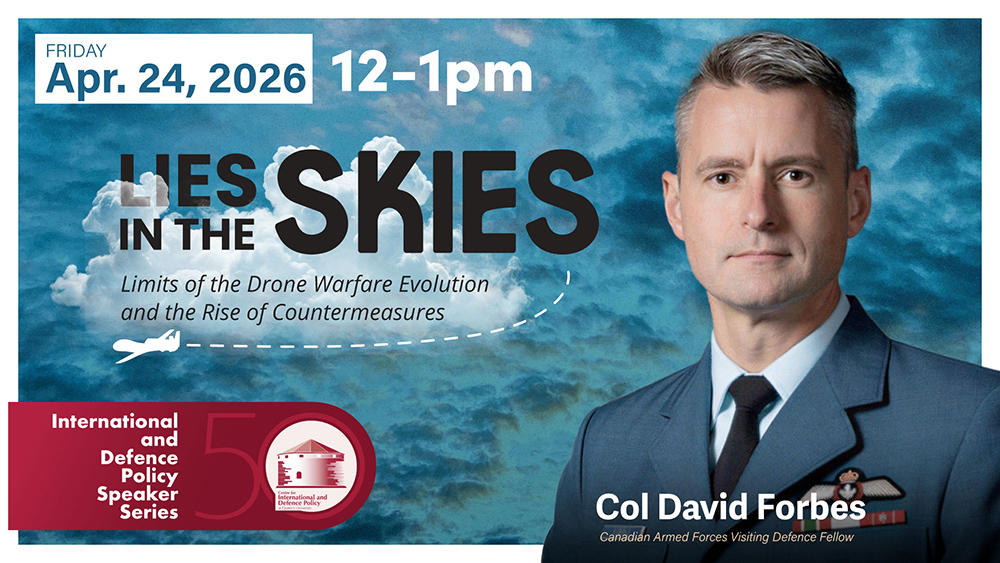
Lies in the Skies: Limits of the Drone Warfare Evolution and the Rise of Countermeasures

Date

Friday April 24, 2026
12:00 pm - 1:00 pm

Location

Robert Sutherland Hall Room 448

Lies in the Skies: Limits of the Drone Warfare Evolution and the Rise of Countermeasures

Drones represent an evolution in warfare, not a revolution, and the full implications of drone warfare have not yet been felt. The ability to operate effectively despite drone threats is the necessary precondition for success and the reason counter-drone capability deserves even greater attention than drone capability itself. Battle-winning operations will continue to require modern, specialized platforms operated by increasingly informed, connected, protected, and adaptive personnel. Drones will be an important part of that future, but they will not fundamentally replace it.


Bio:

Col David Forbes graduated from the Royal Military College in 2001. Owing to a training delay, he traveled to Australia to complete a master’s degree. Following training, he piloted Griffon helicopters with 427 Special Operations Aviation Squadron. In 2010, he deployed as part of Canada’s Special Operations Task Force to Kandahar, Afghanistan flying Russian-built Mi-17 helicopters. Col Forbes was then posted to 408 Tactical Helicopter Squadron where he deployed as a detachment commander to the Philippines as part of Canada’s humanitarian response to Typhoon HAIYAN. Following Staff College, Col Forbes worked on national defence policy in Ottawa. He later served as the Commanding Officer of 408 THS.  He was assigned as the Executive Assistant to the Commander of Canadian Joint Operations Command and, once promoted to his current rank, as Director of Continental Operations. Most Recently, Col Forbes proudly served as Commander 1 Wing. Col Forbes holds a BA in History from the RMC, a Masters in International Relations from Bond University, and another in Defence Studies from the Canadian Forces College. Col Forbes is a graduate of the Canadian Army Staff College and of the Canadian Armed Forces’ Joint Command and Staff Program.


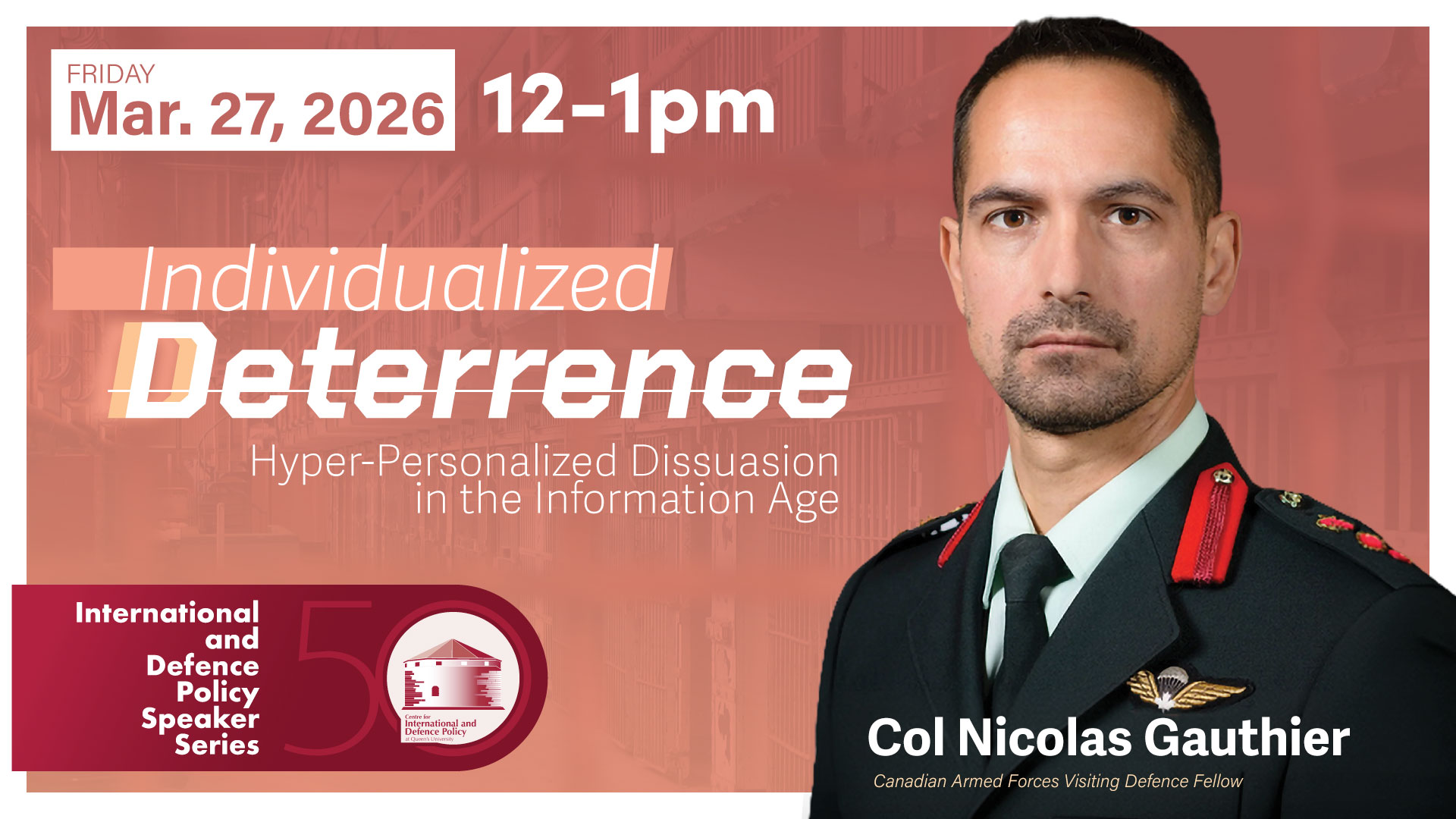
Individualized Deterrence: Hyper‑Personalized Dissuasion in the Information Age

Date

Friday March 27, 2026
12:00 pm - 1:00 pm

Location

Law Building - Room 2 (128 Union St.)

IDPS Nicolas Gauthier


Traditional deterrence assumes countries act like calm, rational players pursuing clear national interests. But in many authoritarian systems, that’s not how decisions are really made. Power often rests in the hands of one individual — and that individual may care less about abstract national goals and more about staying in power, protecting loyal elites, building personal wealth, or shaping their legacy in history. If we want deterrence to work in those contexts, is it possible to think less about “what does the other country needs?” and more about “what does the leader want?”


Bio:

Colonel Nicolas (Nic) Gauthier joined the Canadian Armed Forces in 1999 and was commissioned as an infantry officer into The Royal Montreal Regiment. Following his graduation, he transferred to the regular component and has since served with all three battalions of the Royal 22e Régiment. Colonel Gauthier has most recently served as Director of Expeditionary Operations at the Canadian Joint Operations Command headquarter, his previous practical policy experience include service as Canada’s Defence Attaché to Ukraine in Kyiv during Russia’s full-scale invasion, serving as a Senior Analyst within the Privy Council Office’s Foreign and Defence Policy Secretariat, and as Senior Staff Officer for Operations and Plans at NATO Headquarter in Brussels. Additional command and staff experiences include serving as the Deputy Commander of the Combat Training Center, command of the Infantry School, and as Executive Assistant to the permanent military representative of Canada to the Military Committee. He holds a Bachelor of Science from Université de Montréal, a Master of Public Administration from the Royal Military College of Canada, and a Master of Business Administration from the Quantic School of Business and Technology. Colonel Gauthier has two daughters, Amalia and Clara. He enjoys running, skiing, caving and rock climbing.


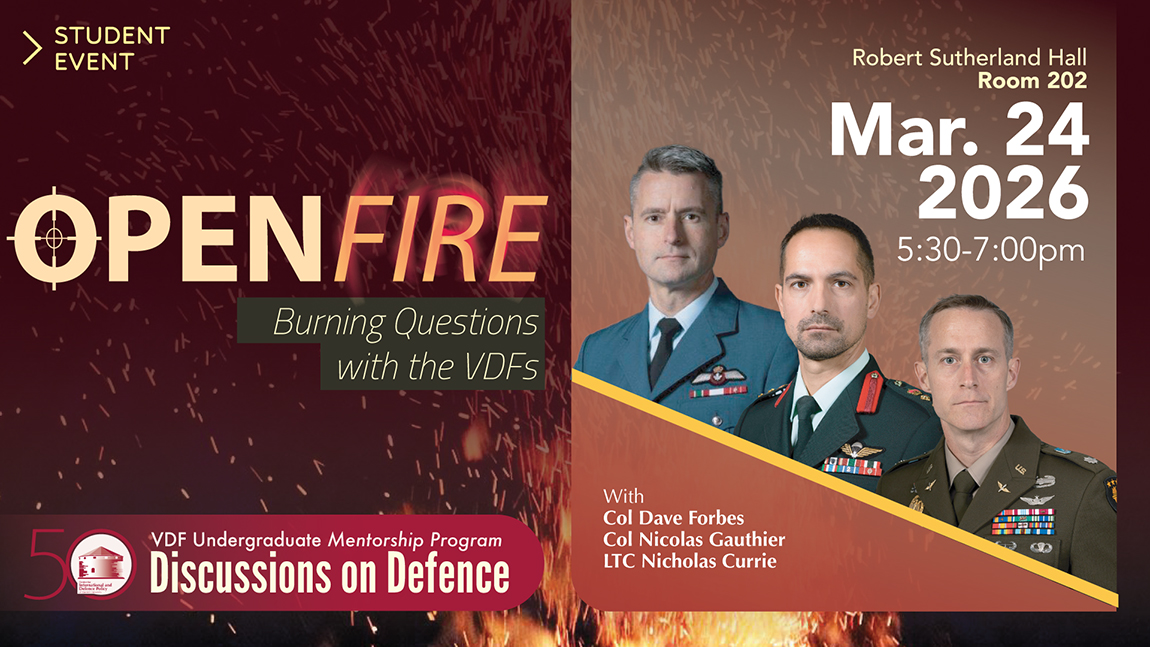
Open Fire: Burning Questions with the VDFs

Date

Tuesday March 24, 2026
5:30 pm - 7:00 pm

Location

Robert Sutherland Hall Room 448

Discussions on Defence

The CIDP is pleased to present its final Discussion on Defence for 2025-2026 year with a Q&A panel led by our Visiting Defence Fellows, Col Nicolas Gauthier, LTC Nicholas Currie, and Col Dave Forbes.

As Canada commits to spending 5% of GDP on defence in the coming decade, building defence literacy has never been more vital for students and Canadian society. This event offers undergraduate students the opportunity to learn from fellows as part of our mentorship program, engaging them in the defence and security community.


A light meal will also be provided with event registration.


Register Here

SITREP-Q: Quantum Readiness in a Changing Global Security Environment

Date

Tuesday February 10, 2026
9:00 am - 5:00 pm

Location

Donald Gordon Centre, Queen's University

SITREP-Q


Conference Outputs


Conference Agenda

9:00am - Welcome

  • Michael Murphy, Director, Centre for International and Defence Policy

9:10am - Briefing (ISED)

  • Michael Rosenblatt, Director, National Quantum Strategy Secretariat (ISED)

9:50am - Briefing (DND)

  • Joseph Waugh, Defence Industrial Strategy Team, DND-ADM(Pol)

10:30am - Break

10:45 - Policy Panel

  • Kristen Csenkey, St. Francis Xavier University (Chair)
  • Tracey Forrest, Research Director, CIGI
  • Kyle Briggs, Entrepreneur-in-Residence, University of Ottawa
  • Matthew da Mota, Senior Policy Researcher, Canadian Shield Institute

12:00pm - Lunch

1:00pm - Briefing (Industry)

  • Lisa Lambert, CEO, Quantum Industry Canada

2:00pm - Industry Panel

  • David Yiptong, Quantum City (Chair)
  • Alex Maierean, CEO, Phantom Photonics
  • Rafal Janik, COO, Xanadu
  • Kyung Soo Choi, CEO, Q-Block
  • David Roy-Guay, CEO, SBQuantum

3:15pm - Break

3:45pm - Briefing (Cyber)

  • Peter Haighton, Cryptography Engagement Team, Canadian Centre for Cyber Security

4:45pm - Closing

  • Michael Murphy, Director, Centre for International and Defence Policy