Speaker Presentation - Gender, Global Cyber Governance, and Risks of Carceralism with Katharine Millar

Date

Wednesday January 7, 2026
12:00 pm - 1:00 pm

Location

Queen’s University, Robert Sutherland Hall Rm. 554
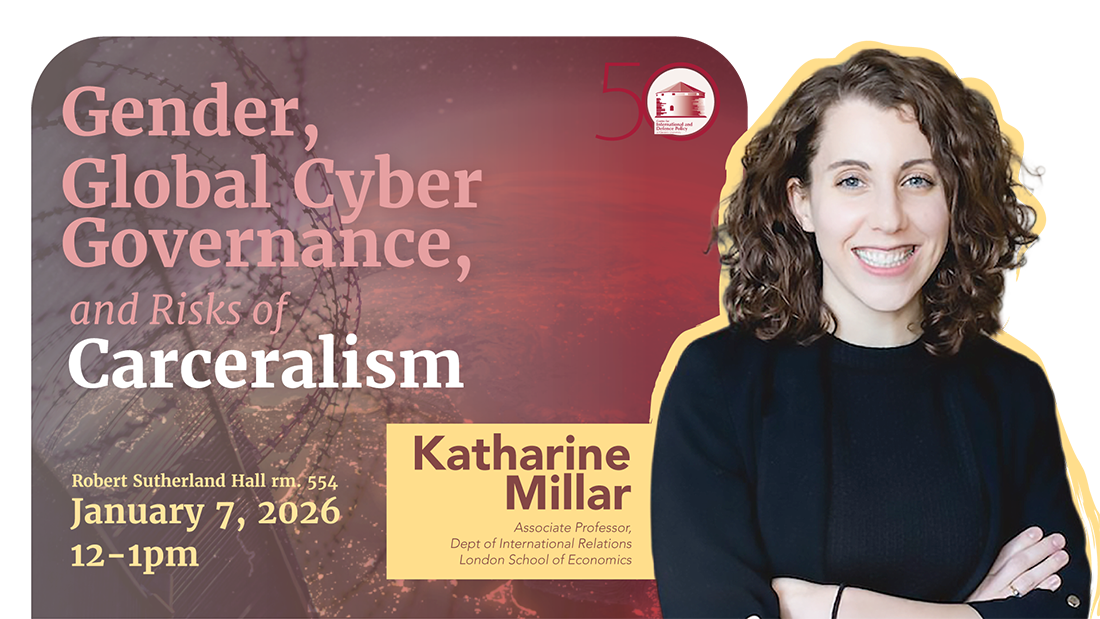
Katharine Millar Gender, Cyber Governance


 Gender, Global Cyber Governance, and Risks of Carceralism with guest speaker Katharine Millar.

Register Here


Bio:


Katharine Millar is an Associate Professor of International Relations in the Department of International Relations at the London School of Economics. Her research interests lie in examining the gendered cultural narratives underlying political violence and the modern collective use of force.  Her on-going research examines gender, race, sexuality and the transnational politics of death in the context of Covid-19; and gender, technology, and cybersecurity. Dr Millar has also published on female combatants, gendered representations of violent death, military and civilian masculinity, and critical conceptions of militarism.  Dr Millar's award-winning first book, Support the Troops: Military Obligation, Gender, and the Making of Political Community, was published in 2022 by Oxford University Press. Dr Millar is an Editor at the journal Security Dialogue and an associated researcher with the Centre for Women, Peace and Security at the London School of Economics. She has participated in consultation processes regarding the UN's Women, Peace, and Security Agenda and gender and cybersecurity for various state governments, armed forces international organisations and international non-governmental organisations.
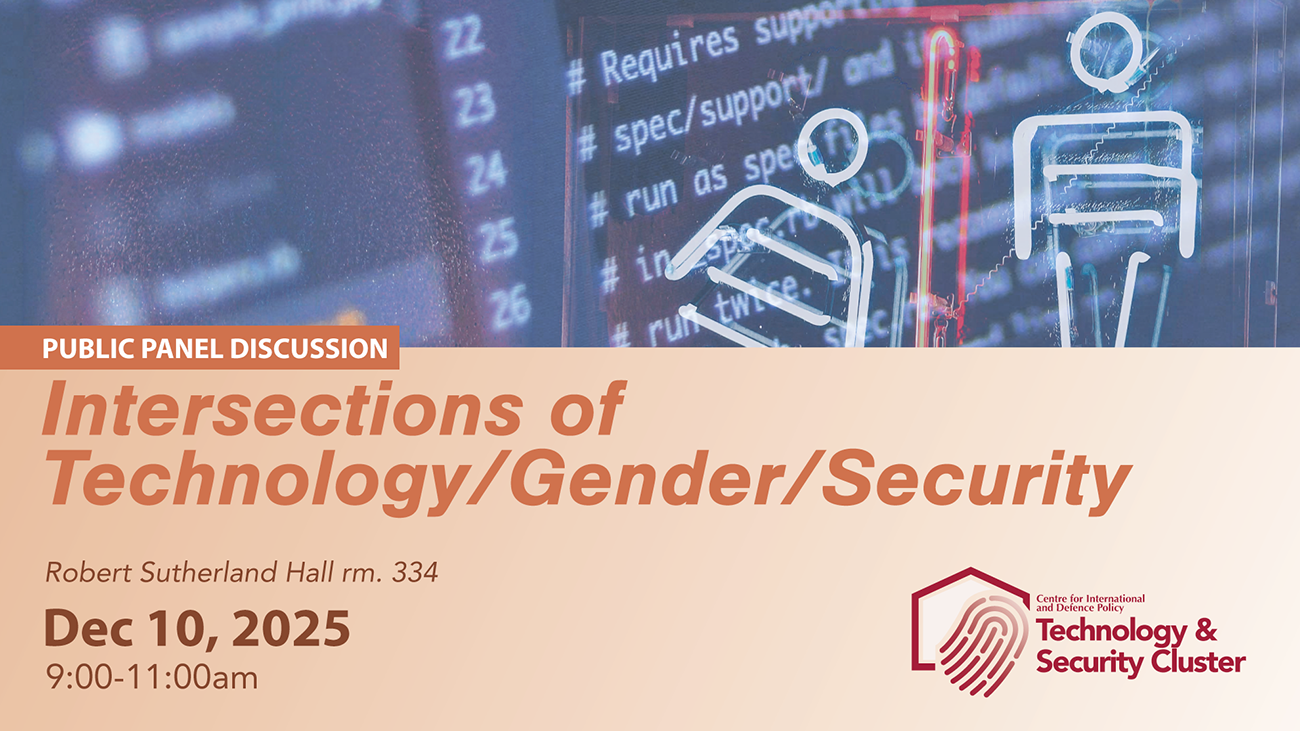
 

Public Panel Discussion - Intersections of Technology/Gender/Security

Date

Wednesday December 10, 2025
9:00 am - 11:00 am

Location

Queen’s University, Robert Sutherland Hall Rm. 334

Technology Gender Security Panel

*open to all, no registration required

This panel explores the critical intersections of the politics of gender, emerging technology, and international security. The discussion also highlights opportunities to align gender-responsive approaches with technology policy, ensuring that future security frameworks are inclusive, ethical, and resilient. Participants will gain insights into building more equitable and strategically sound governance systems for a rapidly evolving technological landscape. The panel is hosted by the CIDP's Technology and Security Cluster, and made possible by the MINDS project Q-WPS: Quantum Technology and the Women, Peace, and Security Agenda.

Speakers:

Veronica Kitchen

Veronica Kitchen

Veronica Kitchen

Associate Professor

Department of Political Science

University of Waterloo

About

Veronica Kitchen is Associate Professor of Political Science at the University of Waterloo and the Balsillie School of International Affairs, where she researches national security and teaches in the field of International Relations. She serves on the Balsillie School Board. Previously, she was co-director of the Canadian Network for Terrorism, Security, and Society (TSAS) and serves on the executive of its successor, the Canadian Network for the Study of Security, Extremism and Society (CANSES) where she is co-lead of the working group on early career researchers. She has published extensively on gender and national security, heroism and global politics, IR pedagogy, mega-event security, Canadian-American security relations, and transatlantic security relations.

Catherine Viens

Catherine Viens

Catherine Viens

Postdoctoral Fellow

About

Dr. Catherine Viens is a political scientist specializing in resource governance, environmental and social dimensions of extractivism, security studies, and gender analysis. Her research examines how large-scale projects shape local governance, security, and community resistance, drawing on fieldwork in India, South Africa, and Canada.

She holds a PhD in Political Science from the Université du Québec à Montréal (2023, distinction) and completed a postdoctoral fellowship (2023-2025) at the Institute of Development Studies (IDS), University of Sussex, funded by the Fonds de recherche du Québec.

At the CIDP, her work focuses on conflict prevention, risk analysis, and the security governance dimensions of natural resource projects, in collaboration with Stéfanie von Hlatky and Andrew Grant, as well as on updating the Conflict Prevention Tool (CPT) through a gender lens.

She also serves as Director of the Risk and Security Management Program at the Canadian Research Institute on Humanitarian Crisis and Action (OCCAH). She provides expertise to governments and NGOs on development, gender, humanitarian action, and security. She also offers media commentary on India’s domestic and foreign policy and is the Quebec director for the feminist NGO Fundación Lüvo.

Research Interests

  •  

Recent Publications

  •  

Online

  •  

War in Orbit? Satellites and the Next Battleground

Date

Friday December 12, 2025
12:00 pm - 1:00 pm

Location

Queen’s University, Robert Sutherland Hall Rm. 334 | Online via Zoom


Jessica West

From streaming your classes to guiding drones, satellites quietly run our world. But the line between civilian and military uses is blurring. As new technologies fuel competition in orbit, space is emerging as the next arena of conflict. Join us to explore the risks, and why they matter for the future of Earth.


Bio:

Dr. Jessica West is a Senior Researcher at Project Ploughshares and a leading voice on space security and global governance. She works at the intersection of emerging technologies, conflict, and peacebuilding, and is actively engaged in United Nations processes shaping the future of outer space security.


Wayne Eyre

Wayne Eyre

Wayne Eyre

frmr Chief of the Defence Staff

Canadian Armed Forces

About

General Wayne Eyre retired in 2024 as Canada’s Chief of the Defence Staff (CDS). As the commander of the Canadian Armed Forces and military advisor to the Prime Minister and Cabinet, he led Canada’s military through an unprecedented confluence of international and domestic crises and rapidly evolving security stressors. In his 40-year military career, he commanded at all levels, from an infantry rifle platoon to Commander of the Canadian Army before being serving as CDS. He led numerous domestic operations in Canada, and overseas he served in Cyprus, Croatia, Bosnia, Afghanistan (twice), and South Korea, where he was the most senior Canadian officer ever stationed in the Asia Pacific region. A graduate of the Royal Military College of Canada, the US Army War College, and the US Marine Corps School of Advanced Warfighting, he holds a BSc and three master’s degrees. Since retirement, he has been writing, teaching, speaking, and advising.

Lieutenant-General (Ret’d) B.F. Frawley, CMM, CD

Lieutenant-General (Ret’d) B.F. Frawley, CMM, CD

Blaise Frawly

frmr Deputy Commander

NORAD

About

Lieutenant-General (ret’d) Blaise Frawley joined the Canadian Armed Forces in 1985. He is an RCAF pilot with over 3000 hours on the F/A-18 Hornet including combat missions over the Federal Republic of Yugoslavia and Kosovo. He has held many staff, operational flying, command and overseas positions including an F/A-18 exchange tour with the USMC, Commanding Officer of 410 Sqn, Cold Lake AB, Commander of 17 Wing Winnipeg, the Combined Forces Air Component Commander for Exercise RIMPAC 16, the Director General of Space, Deputy Commander of the RCAF, the Deputy Vice Chief of the Defence Staff, and as the Deputy Commander of NORAD. LGen (ret’d) Frawley is a graduate of the Fighter Weapons Instructor course and the Fighter Electronic Warfare Advanced Radar course. Additionally, he is a graduate of the Canadian Forces Command and Staff College in Toronto and the USAF Air War College at Maxwell AFB, Alabama. He holds a Bachelor of Military Arts and Sciences from the Royal Military College of Canada, and a Master of Strategic Studies from the USAF Air University. With over 40 years of service to his country, he retired from active-duty service in October of 2025.

Paul Samson

Paul Samson

Paul Samson

President

Centre for International Governance Innovation (CIGI)

About

Paul Samson is President of the Centre for International Governance Innovation (CIGI), an independent Canadian think tank working on international governance with a focus on policy solutions in an era of transformative technologies. Paul served over 20 years with the Government of Canada, including at the deputy minister level. He worked in the Privy Council Office during the time of three different Prime Ministers. At Finance Canada, he served as Canada’s deputy for finance at the Asia-Pacific Economic Cooperation (APEC) forum, was co-chair of the G20 Framework Working Group on the global economy and served on the Board of Directors for the Asian Infrastructure Investment Bank (AIIB). Paul completed a doctorate in international relations at the Graduate Institute, Geneva, and his undergrad at the University of British Columbia. He completed post-doctoral studies at Harvard University and was a research associate at the Belfer Center for Science and International Affairs. He has published widely and appears regularly in national and global media on topics covering the global economy, emerging technologies and governance.

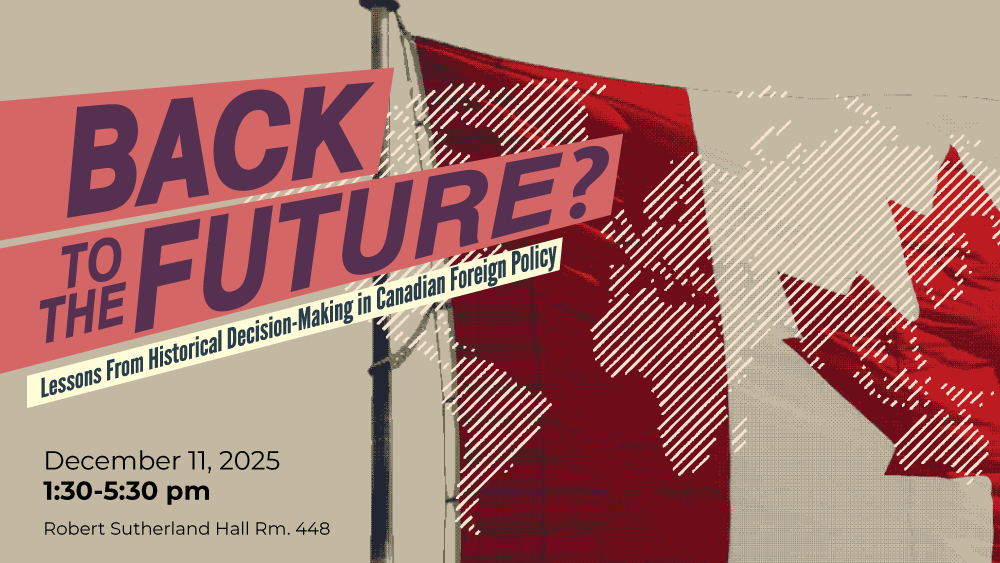
Back to the Future? Lessons From Historical Decision-Making in Canadian Foreign Policy

Date

Thursday December 11, 2025
1:30 pm - 5:30 pm

Location

Robert Sutherland Hall Room 448


Back to the future?

Open to all, no registration required.*


13:30 – Opening Remarks

  • Justin Massie (UQAM): Looking Back to Lead Forward: Canada’s Historical Playbook for a New Geopolitical Era

13:45-15:15 – Leadership, Bureaucracy, and Alliance Politics in Canadian Strategic Decisions

  • David Haglund (Queen’s University): From Farce to Tragedy? Canada, NATO, and the Trump ‘Greenland Conundrum’
  • Nicolas-François Perron (UQAM): Challenging the Pearsonian Consensus: Trudeau’s Defence Review and the Limits of Counter-Strategic Culture
  • Émile Lambert-Deslandes (Queen’s University): Death by Bureaucracy? The Mulroney Government, Nuclear Submarines, and the Art of Playing for Time
  • Stéfanie von Hlatky (Queen’s University) & Thomas Juneau (University of Ottawa): From friendship motive to absolute loyalty: Lessons from Canada’s participation in NATO’s campaign in Libya

15:15-15:30 – Break

15:30-17:00 – Crisis, Pressure, and Rearmament: Canada’s Recurring Defence Dilemmas

  • Stéphane Roussel (ENAP), David Albert (ENAP) and Alexane Dumoulin (ENAP): ReArmCanada: Lessons from 1914, 1939 and 1950
  • Joseph T. Jockel (St. Lawrence University): Canada Rearms under Allied Pressure: Lesson from 1950-51 for 2025-26
  • Justin Massie (UQAM): Canada’s Participation in the Korean War and Lessons for its Current Strategic Trilemma
  • Kim Richard Nossal (Queen’s University): The End of the Special Relationship? Canada-U.S. Relations in the Trump Era

17:00-17:30 – Closing Remarks

  • Philippe Beaulieu-Brossard (Canadian Forces College): Historical lessons for Strategy-Making


*note: Attendance to this event does not count towards the Emerging Leaders program.


Phillipe Lagassé

Phillipe Lagassé

Phillipe Lagassé

Associate Professor / Barton Chair

Norman Paterson School of International Affairs

Carleton University

About

Philippe Lagassé is associate professor and Barton Chair at the Norman Paterson School of International Affairs, Carleton University, Ottawa. His research focuses on defence policy and procurement, executive power, and the Westminster system. He is widely published in the fields of comparative politics, public law, and foreign and defence policy studies. Lagassé served as an independent reviewer of major Canadian defence procurements from 2012-2022. In 2025 he was awarded the Canadian Forces Medallion for his ‘exceptional contribution to Canadian defence policy’.