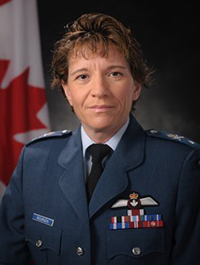
Maureen Bartram
Maureen Bartram
Manager / Administration
CIDP
Manager / Administration
CIDP
Start Date
Thursday May 6, 2021End Date
Friday May 7, 2021Time
9:00 am - 5:00 pmLocation
By Invitation Only - via ZoomDownload the Total Defence Force Workshop Programme (PDF 1.7MB)
Defence workforces are complex, comprising regular force military members, reservists, defence civil servants, and contractors working for private military and security companies. These groups of personnel are employed towards the same overarching goals related to national and international security, and are often highly integrated in the performance of their functions. At the same time, despite the often high levels of partnership and integration, different personnel management systems are in place. These cultural differences affect their integration, the nature and quality of their collaboration, and ultimately affect personnel outcomes such as performance and retention, as well as organisational and operational effectiveness.
Defence organizations around the world are increasingly recognizing the importance of optimizing the intragroup employment, as well as the intergroup integration, of defence personnel and many are adopting terminology to imply they form a cohesive whole [select examples include, the Defence Team (Canada), the Whole Force Concept (United Kingdom), One Defence Team (Sweden), Total Defence Workforce (New Zealand), Total Force Concept (United States), and the Adaptable Force (Netherlands)]. Since most research has traditionally focused on regular force military personnel, gaps in research on personnel in the other components – that is, research focused on reservists, defence civilians, and defence contractors, will be addressed in the context of this workshop.
Key questions include:
This workshop is being organized through a collaboration between the Canadian Defence and Security Network , the Total Defence Force working group of the European Research Group for Military and Society (ERGOMAS), and the Swedish Centre for Studies of Armed Forces and Society (CSMS).

Date
Tuesday March 30, 2021Location
ZoomThe current U.S. national security strategy characterizes China as a strategic competitor that is “attempting to erode American security and prosperity.” Never has it been more important for the U.S. to strengthen relationships with allies that will aid the U.S. in deterring such an adversary. Since the beginning of WWII, the U.S. has recognized that its security and prosperity are closely linked with the security of its allies around the world. Deterring China’s intimidation, coercion, and attacks on other countries to gain global influence is at the top of U.S. Foreign Policy priorities. However, if deterrence is to work, the U.S. must rebuild credibility with its allies and revive its understanding of extended deterrence and assurance. Washington must reexamine and replace policies that no longer serve allied interests to effectively contribute to a reliable U.S. defense strategy. There is no question, the future of U.S. security and prosperity will all depend on how effectively the U.S. adapts policies and strategies to assure its friends (and deter their enemies) in this long-term strategic competition with China.
Lieutenant Colonel(P) Thomas R. BolandU.S. Army Visiting Defence Fellow 2019-20
U.S. Army War College Senior Service
Lieutenant Colonel(P) Thomas R. Boland received his commission as a Quartermaster Officer in the U.S. Army in 2000 from Presbyterian College in Clinton, SC. He currently is assigned to the United States Army War College and serves as Visiting Defence Fellow at the Centre for International Defence and Policy at Queen’s University.
His leadership opportunities included command of Alpha Company, 626th Brigade Support Battalion (BSB) in August of 2006 while deployed to Tikrit, Iraq, in support of Operation Iraqi Freedom (OIF). After a year home, LTC(P) Boland deployed the same Company back to Iraq in support of OIF. Upon his return from Iraq in August 2008, he then commanded Headquarters and Headquarters Company, 626th BSB in Fort Campbell, KY. Later at the Battalion level, he commanded the Army Field Support Battalion in Alaska from June 2017 to June 2019.
Staff positions at the battalion and brigade level included Executive Officer, Support Operations Officer, and S4 in the 82nd Airborne Division. He served as the Joint Logistics and Distribution Branch Chief in the J4 at United States Indo - Pacific Command and served for a year as the Division G4 in the 10th Mountain Division at Fort Drum, NY.
LTC(P) Boland’s is a graduate of the Quartermaster Officer Basic Course, the Combined Logistics Officer Advanced Course, the Command and General Staff College, and the Joint Combined Warfighting School. He has earned a Bachelor of Science in Education from Presbyterian College and a Master’s in Business Management from Austin Peay State University. He is married to Liz Boland and they have four children.
Date
Tuesday March 23, 2021Location
ZoomIn the process of developing a gender-informed, culturally competent mentorship program, 28 interviews were conducted with individuals who identified themselves as experts in mentorship, mentors, mentees, or a combination of all three. The current presentation will provide a snapshot of those conversations about mentorship, gender, organizational culture, and whether or not there should be a place for women-specific mentorship should be provided in the CAF.
Linna Tam-Seto, Ph.D., O.T.Reg. (Ont)CDSN Post-Doctoral Fellow
Centre for International and Defence Policy
Dr. Linna Tam-Seto is the inaugural Canadian Defence and Security Network Postdoctoral Research Fellow completing her fellowship at the Centre for International and Defence Policy (CIDP) at Queen’s University with Dr. Stéfanie von Hlatky.
Linna holds a PhD in Rehabilitation Science and a registered occupational therapist with experiences working in the area of child, adolescent, and family mental health and supporting evidence-based professional practice. Linna’s research interests include understanding the health and well-being of Canada’s military members, veterans, public safety personnel, and their families with a focus on life transitions and changes. Linna’s current work at the CIDP involves the development of a gender-informed, culturally competent mentorship program to support servicewomen within the Canadian Armed Forces.
Linna has also received a MINDS grant to conduct a validation study of the mentorship program.

Date
Friday February 26, 2021Location
The Obama administration announced its strategic pivot to Asia in 2011. Over the last decade, the pivot has evolved, from strategic rebalancing under Obama, to the Trump administration’s “Free and Open Indo-Pacific” strategy. But has the centre of gravity of U.S. diplomacy and defence shifted to the Indo-Pacific as initially planned? By removing the U.S. from the Trans-Pacific Partnership and accelerating the American retreat from world affairs at a time when China was consolidating its position in the Indo-Pacific, did the Trump administration compromise the American strategy on Asia? How did America’s allies react to the U.S. pivot and what impact did it have on rival powers, such as China and Russia, and on the balance of power in the Middle East? Finally, what lessons should Canada learn from this strategy and what are the strategic and defensive implications for Ottawa?
This workshop is being organized by the Network for Strategic Analysis, created by the Mobilizing Insights in Defence and Security (MINDS) program of Canada’s Department of National Defence. The workshop will bring together academic and military experts to take stock of this strategic issue in the context of increased rivalry between major powers.
Download the Programme [PDF 2.7MB]
Programme:
9:30 Opening remarks by Jonathan Paquin (Université Laval)
9:35 – 11:15 The Evolution of the Strategic Pivot and the Response of Washington’s Allies
Moderator: Stéphanie Martel (Queen’s University)
11:15 – 12:00 Keynote Speaker - Commodore Angus Topshee, OMM, MSM, CD
12:00 – 13:00 Lunch
13:00 – 14:15 Reactions of Rival Powers to American Rebalancing
Moderator: Yann Breault (Royal Military College of St-Jean)
14:15 – 14:30 Closing Remarks
Date
Thursday January 28, 2021Location
ZoomThis lecture will examine the CAF/DND WPS agenda and the implementation of UNSCR 1325 focusing on CAF/DND strategy, including the institutional and the operational lines of effort. Furthermore, the presentation will look at the key achievements, the challenges remaining and will conclude with a few recommendations on the way-forward.
Brigadier-General M.H.L. (Lise) Bourgon, OMM, MSC, CDCanadian Forces Visiting Defence Fellow, 2020-21
CIDP
Brigadier-general Lise Bourgon joined the Canadian Armed Forces (CAF) in 1987 and received her pilot wing following graduation from College Militaire Royal de St-Jean in 1992.
As a helicopter pilot, she was assigned to 423 Maritime Helicopter Squadron in Shearwater, Nova Scotia where she deployed on numerous Royal Canadian Navy deployments. She also served as an instructor with 406 Maritime Operational Training Squadron (OTS). Operational tours included Detachment Commander on HMCS Montreal during a 6-month tour and the Joint Task Force (JTF) Commander for OP IMPACT, the first Canadian female to serve in that position.
Leadership opportunities included the command of 406 Maritime OTS, the Maritime Helicopter Wing in Shearwater and the Canadian Task Force assigned to OP INHERENT RESOLVE.
Staff positions have included project management, Executive Assistant to the Chief of the Air Staff, Air Liaison Officer at the NATO Air Headquarters in Ramstein, Germany, Director General Operations at the Canada Joint Operational Command and Director General Operations at the Strategic Joint Staff. She is currently assigned as the Defence Fellow at the Centre for International Defence and Policy at Queen’s University. She is also the Women, Peace, and Security Champion for the CAF.
BGen Bourgon is a graduate of Air Warfare College, holds a Master Certificate in Project Management from George Washington University and a Master's in Public Administration from Royal Military College of Canada
Date
Thursday January 14, 2021Location
ZoomThe response to Covid19 is often framed as a war: the virus is an enemy; medical workers are described as being on the frontlines; the effort to treat patients is a battle.
Looking at this issue through the lens of securitization theory and exploring the impact of metaphors, this presentation examines the implications of framing pandemic response in martial terms, using historical and contemporary examples from around the world--both positive (e.g. unity of effort, national mobilization of resources) and negative (e.g. militarization of response, abrogation of civil liberties in deference to 'national security', a 'sacrifice calculus' whereby lives are commodified, etc.). Special attention will be paid to the developing situation in Canada and the way in which securitization has lead to an increased role for the military.
The presentation concludes with a discussion of the longer-term implications for such an approach. Beyond the immediate crisis response we are currently in, how might this shift our understanding of security and the appropriate use of the military.
Christopher AnkersenClinical Associate Professor
The Center for Global Affairs, NYU
Dr. Christopher Ankersen is Clinical Associate Professor at the Center for Global Affairs, where he teaches in the Transnational Security concentration. He is the faculty lead for the Global Risk specialization.
Prior to joining NYU, Christopher worked for the United Nations. He held positions at the Economic and Social Commission for Asia and the Pacific in Bangkok; the UN Assistance to the Khmer Rouge Trials in Phnom Penh; the UN Offices in Geneva and Vienna; and with the Department of Safety and Security in New York, where he was Desk Officer for Iraq.
From 2002 to 2004, Dr. Ankersen was Ralf Dahrendorf Scholar at the London School of Economics and Political Science. He has taught at the LSE, the London Centre for International Relations, King’s College London, Carleton University, and the Royal Military College of Canada and has lectured at staff colleges in Canada, Australia, and Denmark. From 2000 to 2005, he acted as a strategy consultant to militaries, governments and private firms in the UK and Canada. From 1988 to 2000, Dr. Ankersen was an officer in the Canadian Forces, serving in Princess Patricia’s Canadian Light Infantry, including on overseas missions with the UN and NATO.
He has produced a number of publications on international relations and strategic studies, including The Politics of Civil-Military Cooperation and three edited volumes: The Future of Global Affairs, Understanding Global Terror, and Civil-Military Cooperation in Post-Conflict Operations.
Date
Wednesday October 21, 2020Location
ZoomFrom Tripoli to Baku, and several points in-between, Turkey finds itself today on the front-lines of many regional conflicts. Meanwhile, on the home front, alleged followers of Turkish Islamic cleric Fetullah Gülen, who Turkey blames for the 2016 attempted military coup, continue to be arrested, the threat of renewed attacks by the Kurdish PKK lingers and the Turkish Lira slides. How will Turkey’s Middle East end-game play out? Join us for a tour-de-force discussion that will include insights gleaned from the speakers last visit to Ankara and Istanbul in November 2019, and his recent research and upcoming book chapters on Canada-Turkey relations and Canada's strategic engagement in the Middle East and North Africa.
Chris Kilford
President
Canadian International Council,
Victoria Branch
Dr. Chris Kilford served as Canada’s military attaché in Ankara, Turkey from 2011-2014 with cross-accreditation to Azerbaijan, Georgia and Turkmenistan. He also served in Afghanistan from July 2009 to July 2010 as the deputy military attaché and is a former Commanding Officer of 4th Air Defence Regiment. Since retiring from the military in 2014, he has continued to keep a close eye on the region and become a respected commentator on historical and contemporary events. He holds a PhD in history from Queen’s University, is a graduate of the Advanced Military Studies Course and the National Security Program (equivalency granted). He is also a member of the Canadian International Council National Board and President of the Victoria branch.
Date
Wednesday November 25, 2020Location
ZoomThe NATO Defense College is not a well known organization. However, the professional education that it offers, along with engagement activities and ongoing research, provide effective knowledge mobilization in support of NATO initiatives. Dr Howard Coombs, a former NATO Defense College Research Fellow, will discuss the College and present an overview of the work that this institution conducts to support twenty-first century Alliance activities.
Howard G. Coombs
Associate Professor - Royal Military College of Canada
Howard G. Coombs is an Associate Professor and the Associate Chair of War Studies at the Royal Military College of Canada, in Kingston, Ontario. He is also a part-time Canadian Army reservist with the Office of the Chief of Reserves, located at the Canadian Armed Forces National Defence Headquarters. Coombs received his PhD in Military History from Queen’s University, in Kingston. His research interests are Canadian professional military education, in addition to post-Cold War Canadian military operations and training . In 2020 he was the first Canadian Mobilising Insights in Defence and Security Programme (MINDS) Fellow at the NATO Defence College in Rome, Italy.
Start Date
Thursday December 10, 2020End Date
Friday December 11, 2020Time
9:30 am - 1:00 pmLocation
Canada must adapt to an unpredictable international environment, defined by increased great power competition and the proliferation of regional conflicts to which it is often called upon to respond. The Network for Strategic Analysis’ annual colloquium will examine the theme of a fractured international order by considering the adaptation of different regions to this new international architecture, the viability of multilateralism as a model for interstate cooperation, and the more visible role of capacity building in conflict management.
09:30 - 09:45 Welcoming Remarks by Co-directors
09:45 - 10:45 The Fractured International Order
Moderator: Jonathan Paquin (Université Laval)
11:00 - 12:00 Keynote Speaker
12:00 - 13:00 Lunch
13:00 - 14:00 Capacity Building and Conflict Management
Moderator: Théo McLauchlin (Université de Montréal)
09:30 - 09:40 Welcoming Remarks by Co-directors
0940 - 10:40 Multilateralism in Free Fall?
Moderator: Sarah-Myriam Martin-Brûlé (Bishops University)
11:00 - 12:00 Keynote Speaker