IDPS - How Russia’s Hybrid Warfare is Changing? with Dr. Marzena Żakowska

Date

Wednesday November 16, 2022
12:00 pm - 1:00 pm

Location

Online Webinar over Zoom

How Russia’s Hybrid Warfare is Changing?

The study aims to examine Russia's hybrid tactics below the threshold of conventional war used against Georgia and Ukraine to secure the sphere of influence by destabilizing those states' internal security and territorial integrity. The research focus is on analyzing hybrid methods used by Russia, to include: (i) "borderization" policy; (ii) separatist movement and local unrest (iii) disinformation campaign. The study's methodological framework is based on the clash of interests approach and Gerasimov's doctrine of non-linear warfare. Evidence suggests that the Georgia War of 2008 and Ukraine War of 2014-2021 best demonstrate the reality of Russia’s approach to hybrid war. However, comparison with the Ukraine War since February 2022 suggest that some hybrid war measures may be changing.

The earlier wars suggest that Russia’s hybrid tactics are the first step to "opening the door" to Outimplement a military operation in other states' territories. Russia undermines the sovereignty of the targeted states through election meddling to establish pro-Russian local government and induces widespread disinformation to build pro-Russian sentiments in the targeted society. Gerasimov’s doctrine of non-linear warfare does accept the reality of conventional means of war being used, but the war since February 2022 suggests that hybrid war approaches as used in the earlier wars did not achieve Russian ends, thus leading to the use of traditional conventional means that call into question the utility of hybrid war. This allows for identifying determinants that show how Russia’s hybrid war is changing.

This study is part of the research project developed in cooperation with professor Larry P. Goodson from U.S. Army War College.


Keywords: hybrid warfare, hybrid tactics, Russia, Ukraine, Georgia, borderization policy, separatist movement, local unrest, disinformation


Speaker

Marzena Żakowska

Dr. Marzena Żakowska
War Studies University, FNSWSU

Marzena Żakowska is an assistant professor and lecturer at the National Security Faculty at the War Studies University, FNSWSU. She holds a Ph.D. in Security Science from the National Defence University, Warsaw, Poland. Currently, she is Director of the Global Affairs and Diplomacy Studies at FNSWSU and Chair of the War Studies Working Group at the International Society of Military Sciences. Professional associations include the Academy for International Conflict Management and Peacebuilding and the United States Institute of Peace in Washington, D.C. She is also a Research Fellow at the Royal Military College of Canada and the US Army War College. As editor and author, she has published books and articles on the subject of armed conflict, hybrid threats, security, and social security issues. Recently she worked on the project “Modern War and Grey Zones” with prof. David Last from the Royal Military College of Canada and project “How Russia’s Hybrid Warfare is Changing?” with prof. Larry Goodson from US Army War College.

Emma Fingler

Emma

Emma Fingler

PhD Candidate/Researcher

Political Studies

Queen's University

15ejf@queensu.ca

Mackintosh-Corry Hall, B304

About

Emma Fingler (she/her) is a SSHRC-funded doctoral candidate researching gender, disaster response operations, and regional governance in South and Southeast Asia. She is a Fellow with the Climate Security Association of Canada and is a Graduate Research Fellow with the Centre for International and Defence Policy (CIDP) at Queen’s University. Emma was the 2023 Graduate Scholarship recipient of Women in Defence and Security (WiDS). She was previously a Canada-Asia Young Professional Fellow with the Asia Pacific Foundation of Canada and 2022-2024 Graduate Fellow with the Research Network on Women, Peace and Security. Emma has experience working abroad on humanitarian, development, and coordination issues. Prior to joining Queen’s, she was the Special Assistant to the United Nations Resident Coordinator in Kathmandu Nepal, and a Junior Professional Consultant with the UN Resident Coordinator’s Office in Kathmandu. She holds an M.A. in Global Governance from the University of Waterloo’s Balsillie School of International Affairs and a B.A. Hons. in Political Studies from Bishop’s University.

Research Interests

  • Humanitarian and disaster governance
  • Women Peace and Security Agenda, with a focus on the Association of Southeast Asian Nations (ASEAN)
  • Global governance structures and norms

Recent Publications

  • 2024 Fingler, E. “Women, peace and security initiatives should matter to all Canadians.” The Conversation. April 14, 2024. https://theconversation.com/women-peace-and-security-initiatives-should-matter-to-all-canadians-226939
  • 2023 Fingler, E. “‘Get More Specific On Canada’s Women, Peace, and Security Agenda’ in Canada’s Indo-Pacific Strategy: Analysis From Our Young Professionals Fellows.” Asia Pacific Foundation of Canada. January 24, 2023. https://www.asiapacific.ca/publication/canadas-indo-pacific-strategy-analysis-young-professionals.
  • 2022 Fingler E. ‘Opportunities for Peace: Analysing the Intersection of Security and Disasters in Southeast Asia.’ Report, Defence and Security Foresight (DSF) Group, University of Waterloo. https://www.emmafingler.com/_files/ugd/e4e225_0c07b75be1354db88743290c77d734a0.pdf
  • 2021 Fingler, E. ‘Finding soldiers of peace: Three dilemmas for UN peacekeeping missions,’ International Affairs, Volume 97, Issue 5, September 2021, Pages 1631-1633, https://doi.org/10.1093/ia/iiab139

Dr. Meaghan Shoemaker

Meaghan

Meaghan Shoemaker

Special Advisor

Canadian Institute for Military and Veteran Health Research (CIMVHR)

About

Meaghan holds a PhD in Political Studies from Queen’s University and is the Special Advisor on Gender and Diversity for Canadian Institute for Military and Veteran Health Research (CIMVHR). Her research interests include defence policy, human security, and diversity and human rights. She has contributed to forums such as The Conversation Canada, The Globe and Mail, and the NATO Association of Canada.   

In her previous employment with Canada’s Department of National Defence, Meaghan led organization-wide initiatives for the Canadian Armed Forces related to employment equity, sexual misconduct, and culture change. Meaghan also provides training and education for national militaries, facilitating conversations with members across all ranks on the topics of emotional intelligence, mentorship, unconscious bias, micro-aggressions, and human rights.  

Research interests 

  • Women, Peace, and Security
  • International Security Organizations (NATO; UN)
  • Military and Defence Policy

Recent Publications

  • (Forthcoming, Winter 2026) Shoemaker, Meaghan. Mission Marginalized: Gender Bias in NATO Operations. DeGruyter Press.

  • (In progress) Shoemaker, Meaghan, and Tam-Seto, Linna (ed). The Gender Dimension of Veteran Transition: Best Practices and the Way Forward. University of British Columbia Press.

  • Shoemaker, Meaghan, “Power and Culture Change in the Military.” Canadian Military Journal (CMJ), vol 23 (3) (2023). Special Issue edited by Maya Eichler, Nancy Taber. 

  • Taber, Nancy and Meaghan Shoemaker, “A Force to Imagine: A Feminist Rethinking of Universality of Service,” Journal of Military, Veteran, and Family Health. (December, 2023). doi:10.3138/jmvfh-2023-0011. 

Online

  •  

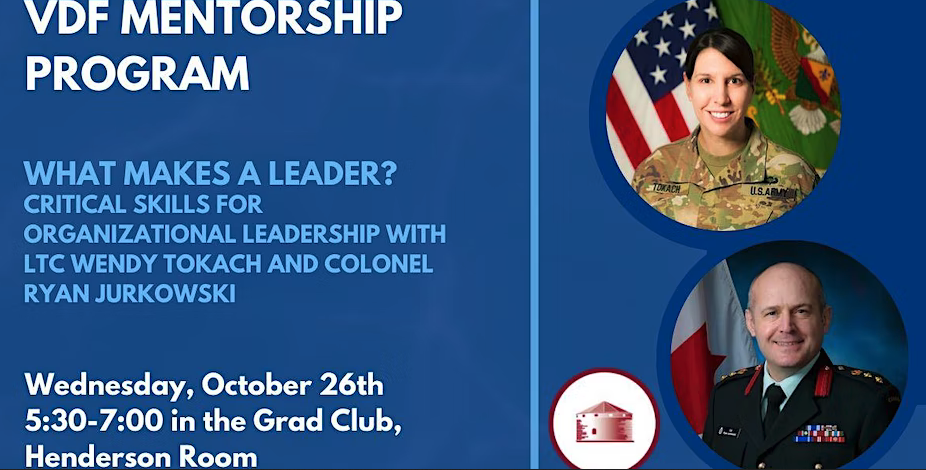
Critical Skills for Organizational Leadership

Date

Wednesday October 26, 2022
5:30 pm - 7:00 pm

Location

The Grad Club | 162 Barrie Street Kingston, ON K7L 3K1

VDF Mentorship - Oct 16

As part of the VDF mentorship program for undergraduate skill building.


VDF Mentorship Talk - What Makes a Leader? Critical Skills for Organizational Leadership

This meeting will begin with a short lecture on what it means to be a leader in organizations and the skills required, led by LTC Wendy Tokach. Following the initial talk, the floor will open up to discussions about leadership, or any other questions students may have relating to the field of international defence and security.

Register now to attend


One Korea – Two Nations

Date

Wednesday October 26, 2022
12:00 pm - 1:00 pm

Location

Online Webinar over Zoom

One Korea - Two Nations

Since the signing of the Armistice Agreement in 1953, the international community has pursued a range of talks, actions and initiatives aimed at achieving a final peace agreement for Korea. 70 years later a great deal has changed on the Korean peninsula, but the two nations are no closer to achieving an enduring peace. Is this due to the actions of the Democratic People’s Republic of Korea (North Korea), the Republic of Korea (South Korea), China or the USA? Examining the influences of the key players in the Korean Peninsula indicates that a solution is not likely in the near term, and why the Korean Peninsula could serve as a hinge point for a future conflict in the region.


Speaker

Acton Kilby

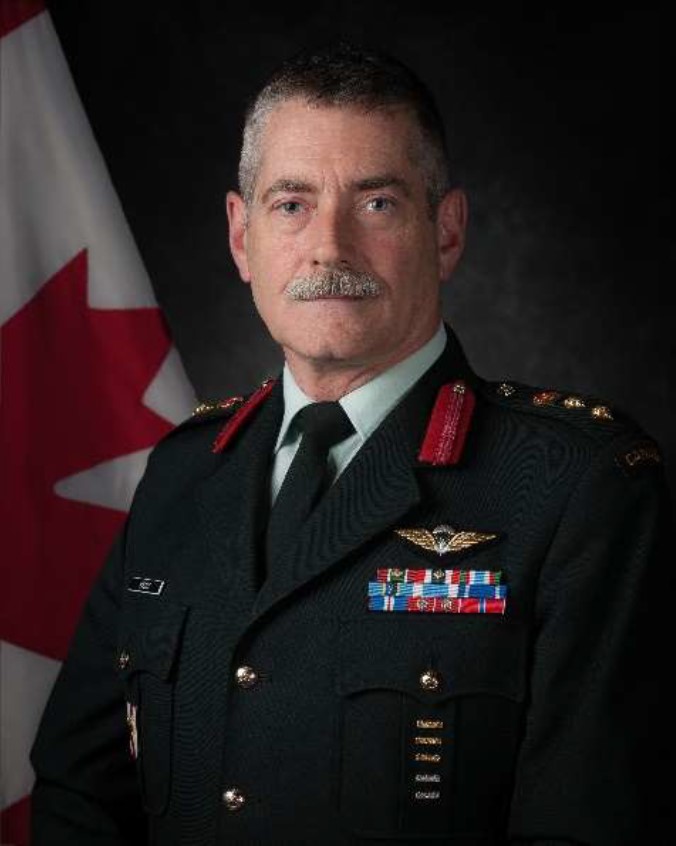
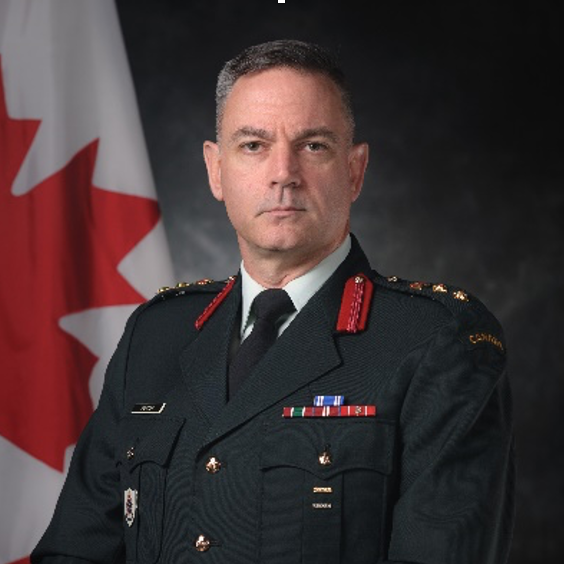
COLONEL ACTON KILBY, CD
Canadian Armed Forces

Colonel Acton Kilby joined the Canadian Armed Forces in 1979 as a Reservist and then entered the Regular Army in 1984 as an Infantry Officer. He is a member of the Royal Canadian Regiment and has served with 3rd Airborne Commando of the Canadian Airborne Regiment. He has commanded from Platoon to Battalion level and was acting Commander 2nd Canadian Mechanised Brigade Group while the Brigade deployed Canada’s last major rotation to Bosnia and Canada’s first ISAF Task Force to Kabul in 2005. 

He served on exchange with the British Army 1999-2002 deploying in support of British Forces in several theatres of operation. In 2007-2008 he deployed to the Democratic Republic of Congo as the Deputy Chief of Staff for the UN Mission in the Congo and subsequently as special advisor to the African Great Lakes Task Force responsible for disarmament and demobilization of Armed Militias. 

He served in the Canadian Army HQ as Director of the Land Staff and as Director Strategic Readiness with Canada’s Strategic Joint Staff. In 2010-2011, he deployed to Afghanistan as Director Stability with 10th (US) Mountain Division where he was responsible for Stability Operations in Regional Command South. 

Col Kilby was the Canadian Defence Attaché to Australia, New Zealand, and Papua New Guinea (2013-16). He was subsequently appointed Director Foreign Liaison for the Canadian Armed Forces, responsible for supporting Canadas Defence Diplomacy program with 138 countries and exercising command of Canada’s Defence Attaches deployed around the world (2016-19). 

In 2019, Col Kilby was selected as Director Senior Appointments responsible for the career management and support for all Senior Appointment Chief Warrant Officers, Colonels, General Officers and Flag Officers of the Canadian Armed Forces. 

In August 2020, Col Kilby was assigned to United Nations Command HQ, South Korea as the Deputy Chief of Staff (DCOS) and has just returned to Canada to commence his transition to post-service life. 

Col Kilby is a graduate of the Royal Military College of Canada, the Land Force Command and Staff College, the Canadian Forces Command and Staff College, and the National Strategic Studies Program. 

He is an avid outdoor sportsman and loves fishing. He is married with three adult children. 

Émile Lambert-Deslandes

Émile Lambert-Deslandes

Émile Lambert-Deslandes

Graduate Researcher

Political Studies

Queen's University

21eld6@queensu.ca

Robert Sutherland Hall #411

About

Émile is a doctoral student and Joseph-Armand Bombardier (CGS-D) Scholar in the Department of Political Studies at Queen’s University, studying International Relations and Security under the supervision of Dr. Stéfanie von Hlatky. He has been granted the Desjardins Scholarship, the G.G. Baron Van der Feltz Award for best master’s dissertation in International Relations, and the Ontario Graduate Scholarship (OGS; twice). Émile’s research is primarily focused on NATO deterrence, nuclear weapons, and nuclear latency. Additionally, he works on Canadian foreign and defence policy, as well as nuclear (non-)proliferation. 

Émile has authored or co-authored articles, book chapters, and book reviews that have been published in International Affairs, the Journal of Strategic and Military Studies, the Palgrave Handbook on Contemporary Geopolitics, and The Conversation, and regularly analyzes international events on the radio. He is also a Graduate Research Fellow at the Centre for International and Defence Policy, and a Coordinator for the Network for Strategic Analysis. Previously, Émile earned a B.A. in International Development Studies at McGill University in 2020, and a M.A. in Political Studies at Queen’s University in 2022.

Research Interests

  •  

Recent Publications

  •  

Online

The Need for Soft Skills in International Organizations: Experiences from NATO, UN and Coalition Headquarters

Date

Wednesday September 28, 2022
5:30 pm - 7:00 pm

Location

Queen's University


This Queen's undergraduate workshop is part of the CIDP's VDF Mentorship program series.

"To connect with the undergraduate body at Queen's and foster interest in international and defence policy, the CIDP is running a mentorship program with our Visiting Defence Fellows. Through workshops and small group discussions, students will facilitate a connection with experienced professionals in the field and develop critical skills. The program is designed to encourage interest in international and defence policy, as well as prepare undergraduate students with guidance regarding career development."

Our next event is "The Need for Soft Skills in International Organizations: Experiences from NATO, UN and Coalition Headquarters"

location: Robert Sutherland Hall Rm. 334 | 138 Union St.

Click here to register


Contact VDF mentorship program facilitator Sadie McIntosh for more information: 19sem17@queensu.ca