
In Memoriam: Hon. Hugh Segal
UPDATED - August 10, 2023 | In Memoriam - Former CIDP Director Hon. Hugh Segal
Fellow
Colonel Ryan Jurkowski is a PhD War Studies candidate at the Royal Military College. Ryan has 30 years of service with the Canadian Armed Forces as an infantry officer with operational experience throughout sub-Saharan Africa and Europe. Ryan has military deployments to Bosnia, twice to Afghanistan, Kuwait, and Iraq. He has held numerous staff positions in the Canadian Armed Forces to include being on the Joint Staff, the Director of Programmes at the Canadian Forces College, the Chief of Staff at the Canadian Defence Academy, and as the Canadian Armed Forces Visiting Defence Fellow to the Centre for International and Defence Policy at Queen’s University.
Ryan has a Masters of Defence Studies from the Royal Military College and has been awarded a Mention-in-Dispatches, the Meritorious Service Medal, the Queen’s Diamond Jubilee, the Commander-in-Chief Unit Citation as well as the United States’ Legion of Merit and Joint Service Commendation Medal.
Phd Candidate/Researcher
Political Studies
Mackintosh-Corry Hall, Room B300
Olusola (Shola) OGUNNUBI is a Doctoral Student at Queen’s University, Canada. He is also a Teaching and Research Assistant in the same department and with the Centre for International and Defence Policy (CIDP). Before arriving in Canada for further studies, he was a lecturer at the School of Social Sciences, University of KwaZulu-Natal, South Africa from 2011 to 2014. On different occasions, he was also visiting scholar at various universities in Canada including the Department of Political Science, Carleton University and the University of Victoria’s Centre for Global Studies, as well as the GIGA German Institute of Global and Area Studies Institute for African Affairs, Hamburg, Germany. His research interests include norm dynamics, resource governance, African agency, regional power studies, African diplomacy, and soft power politics. He has published several articles in scholarly journals including Politikon, South African Journal of International Affairs, Journal of Contemporary African Studies, Journal of Developing Societies, International Journal of Culture, Politics and Society, Politiea, and Insight on Africa. Olusola also holds an Advanced Diploma in Higher Education and previously worked as a political staffer with the Alberta UCP Caucus. The major theme of his doctoral research is African agency and resource governance norms in the extractive industry. His doctoral research is funded by SSHRC and the Robert Sutherland Fellowship.
Start Date
Thursday June 8, 2023End Date
Friday June 9, 2023Time
8:00 am - 5:00 pmLocation
Kingston Market Square Hotel | 285 King St E, Kingston, OntarioThis workshop focuses on military culture and socialization in Canadian Military Colleges, with a focus on organizational culture and climate, leadership, pedagogy, and training and education. The workshop provides a forum for defence and civilian academics, policymakers, and practitioners to reflect on scholarly research that can advance our understanding of military colleges, and that can inform participants’ reflections in the context of the recommendations included in the Arbour report.
Download the full Program (PDF 3mb)
0800 Registration – 2nd Floor foyer
0845 Land Acknowledgement
0900 Welcome and introduction
0915 Keynote from Major-General Craig Aitchison
1015 - 1030 Break
1030 - 1200 Panel I – Setting the Stage: Culture Change and Colleges
Canadian Military Colleges offer a unique glimpse into military culture, its processes of socialization, and approaches to leadership development. As the Arbour Report notes, the momentum for and progress on culture change within the military hinges on the culture and practices at the Colleges. This panel will focus on formal and informal practices and curricula that shape student experiences at military colleges in Canada and beyond.
Chair and Moderator: Sara Greco, Canada Defence Academy
Panelists:
- Grace Scoppio, Royal Military College of Canada
- Sean Norton, Director General Military Personnel Research and Analysis
- Elissa Hack and Richard Niemeyer, United States Air Force Academy
1200 - 1300 Lunch, Old Stones, 2nd Floor
1300 - 1400 Fireside Chat with Nancy Taber, Brock University and Karen Davis, Director General Military Personnel Research and Analysis
Chair: Stéfanie von Hlatky, Queen’s University
Moderated by: Al Okros, Canadian Forces College
1400 - 1530 Panel II – Best Practices from Civilian Universities
Civilian universities across Canada have been foregrounding Indigeneity, diversity, equity, and the empowerment of learners from diverse identities and experiences. In this moderated panel, we ask professors across Canada to share implementation strategies and best practices.
Chair and Moderator: Margaret Shepherd, Royal Military College of Canada
Panelists:
- Sheri Fabian, Simon Fraser University
- Tammy George, York University
- Vanessa Brown, Canadian Forces College
1530 - 1545 Break
1545 - 1715 Panel III - Military Socialization and Training
This panel focuses on training and socialization processes in early training environments in the Canadian Armed Forces, and their impact on military culture, values, attitudes, and professional conduct. The role of formal and informal socialization processes and the complementarity of education, training, and lived experiences will be discussed.
Chairs: Irina Goldenberg and Sara Rubenfeld, Director General Military Personnel Research and Analysis
Moderated by: Irina Goldenberg
Panelists:
- Esther Briner, Director General Military Personnel Research and Analysis
- Michael Rostek, Toronto Research Centre - Defence Research and Development Canada
- Sara Rubenfeld, Director General Military Personnel Research and Analysis
- Alan Okros, Canadian Forces College
1730 – 1900 Networking reception
With welcoming remarks by Lieutenant-General Lise Bourgon, Acting Commander, Military Personnel Command
0900 - 1200 Design Thinking and Military Colleges
Drawing from best practices emerging from universities, and considering the recommendations of the Arbour report, the second day of the workshop delves into the strategies, initiatives, and processes that can be implemented to advance cultural change and promote inclusion and diversity in military colleges. The breakout sessions will explore how innovation and self-reflexive learning by doing can support GBA+ analysis, mainstream diverse and intercultural perspectives in curriculum design; create and foster safe and non-judgmental spaces for teaching and student participation; and promote a supportive and welcoming teaching and learning environment for positive and inclusive military socialization.
Lead: Barbara J. Falk, Canadian Forces College
Discussion Animators/Facilitators:
- Barbara J. Falk, Canadian Forces College
- Madison Schramm (University of Toronto)
- Howard Coombs (Royal Military College of Canada)
1200 - 1300 Lunch, Old Stones
1300 - 1600 Breakout Group Discussions
Rapporteurs: Yerin Chung, Claire Parsons, Isabela Rittinger, Queen’s University
Breakout Group #1 Curriculum Design – Room 306 -
- Academic facilitator Dr. Madison Schramm; lead military discussant Col Sarah Heer
Breakout Group #2 Teaching and Participation in the Classroom – Room 307 -
- Dr. Barbara J. Falk; lead military discussant Col Maureen Wellwood
Breakout Group #3 The Teaching and Learning Environment– Gibraltar Room -
- Dr. Howard Coombs; lead military discussant LCol Melanie Lake
1600 - 1700 Report-out Results of Breakout Groups/Next Steps
Lecturer
University of Applied Sciences and Arts Northwestern Switzerland
Dr. Kevin D. Stringer, Colonel, U.S. Army (Retired), is a Lecturer at the University of Northwestern Switzerland and a Visiting Associate Professor at the Military Academy of Lithuania. With 30 years of commissioned military service, he was a Eurasian foreign area officer and strategist assigned to the U.S. special operations community. Career highlights include assignments as Director, Strategy, Plans, and Policy Directorate (J5), Special Operations Command Europe (SOCEUR) and Director, Plans and Strategy (J5) for a combined joint special operations task force in the Middle East. In 2021, he served as a military faculty member at the U.S. Army War College. He earned a Ph.D. in International Affairs from the University of Zurich, a Master of Arts in International Relations from Boston University, a Master of Strategic Studies from the U.S. Army War College, and a B.Sc. degree from the U.S. Military Academy at West Point. Dr. Stringer has published in Naval War College Review, Joint Force Quarterly, Military Review, Parameters, Special Operations Journal, and the Canadian Military Journal.
Date
Wednesday May 17, 2023Location
Queen’s University, Robert Sutherland Hall Rm. 202 | Online via Zoom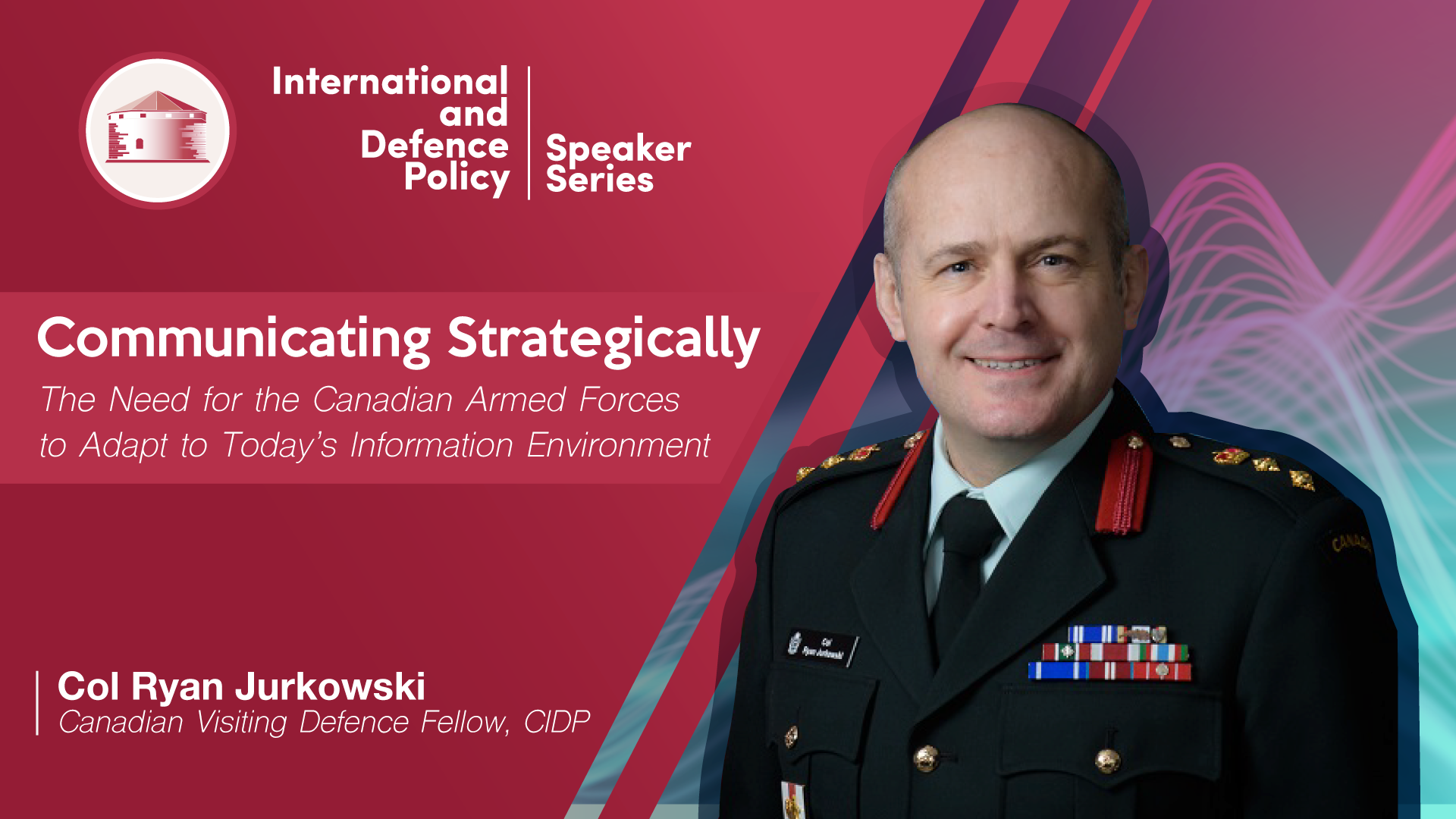
In a highly contested and competitive information environment that has national security implications, the Canadian Armed Forces must adapt how it communicates or risk irrelevance to itself, its nation, and to its Allies.
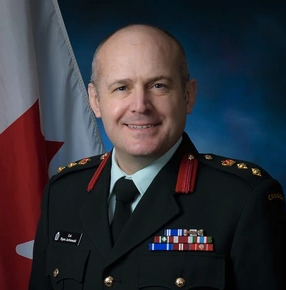
Colonel Ryan Jurkowski joined the Canadian Armed Forces as a Sapper in 1993 with 3 Field Engineer Squadron prior to receiving his commission and joining the Cameron Highlanders of Ottawa. Colonel Jurkowski then proudly served with the Van Doos from 1997-1999 prior to changing his Regimental Affiliation to the PPCLI in 1999.
Regimental service included participation in various domestic operations with tours to Bosnia from1999-2001 as the Anti-Armour Platoon Commander, Afghanistan in 2006 and 2009-2010 in Combat Teams, in Kuwait from 2014-2015 as the Combined Joint Task Force Operation Inherent Resolve DCJ5,and most recently in Iraq and Kuwait as the with Combined Joint Task Force Operation Inherent Resolve as the Director of Strategic Communications from 2021-2022.
Staff positions were with the Joint Staff under the then-DCDS Group as the Africa Operations Desk Officer from 2002-2005, Executive Assistant to Commander 3rd Cdn Div from 2007-2008, Executive Assistant to the Assistant Chief of Staff J5 in NATO’s Joint Force Command Brunssum from 2011-2013, Chief of Canadian Army Capability Integration at the Canadian Army Doctrine and Training Centre from2013-2014, Assistant Chief of Staff at the Canadian Army Doctrine and Training Centre from 2014-2015,the J3 at the 1st Cdn Div from 2017-2018, the Director of Programmes at the Canadian Forces College from 2018-2020, and the Canadian Defence Academy Chief of Staff from 2020-2021. Colonel Jurkowski had the privilege to command the 5th Cdn Div Training Centre from 2015-2017.
Colonel Jurkowski is currently a Visiting Defence Fellow at Queen's University.In addition to national and international commendations, Colonel Jurkowski has been awarded the US Joint Service Commendation Medal, a Mention-in-Dispatch, and the Meritorious Service Medal. Colonel Jurkowski has a Masters in Defence Studies.
Colonel Jurkowski is married and the couple have a son and a daughter.
Research areas of interest:


