Phillip Drew

Phillip Drew

Phillip Drew

Legal Researcher and Author

About

Dr. Phillip Drew is a former military Intelligence Officer and Legal Officer in the Canadian Armed Forces.  Recently retired, he was Assistant Dean of JD Programs at Queen's Faculty of Law.  Prior to joining Queen's he was an Associate Professor at the Australian National University College of Law, where he taught from 2016-2020.

Dr. Drew’s principal area of study is the Law of Armed Conflict, with a specialization in Maritime Blockade Law, starvation as a method of warfare, and maritime security.  He is also a Qualified Expert with the Organization for the Prohibition of Chemical Weapons.

While in the Canadian Forces, Phillip was operationally deployed to the Persian Gulf War and Rwanda as an Intelligence Officer, and to CTF 150/151 as a deployed legal officer.  Following his retirement from the military in 2014 he was employed by the United Nations Office on Drugs and Crime where he assisted West African countries with the development of legislation for counter piracy, drug trafficking, human smuggling, and other forms of maritime crime.

Research Interests

  • Maritime Blockade Law

  • The Law of Armed Conflict

  • Maritime Security Law

Recent Publications

  • Drew, Phillip. The Law of Maritime Blockade: Past, Present, and Future (Oxford: Oxford University Press, 2017).

  • Drew, P., Oswald, B., McLaughlin, R., & Farrall, J. (Eds.). Rwanda Revisited. (Leiden, The Netherlands: Brill | Nijhoff, 2021).

  • Mandsager, D., Cole, A., Drew, P., McLaughlin, R., Newport Rules of Engagement Handbook (Newport, US Naval War College, 2022).

  • Phillip J Drew, Blockade? A Legal Assessment of the Maritime Interdiction of Yemen’s Ports, Journal of Conflict and Security Law, Volume 24, Issue 1, Spring 2019, Pages 35–52.

  • Phillip J. Drew, Can We Starve the Civilians? Exploring the Dichotomy between the Traditional Law of Maritime Blockade and Humanitarian Initiatives, International Law Studies, Volume 302, 2019, pages 303-321.

Online

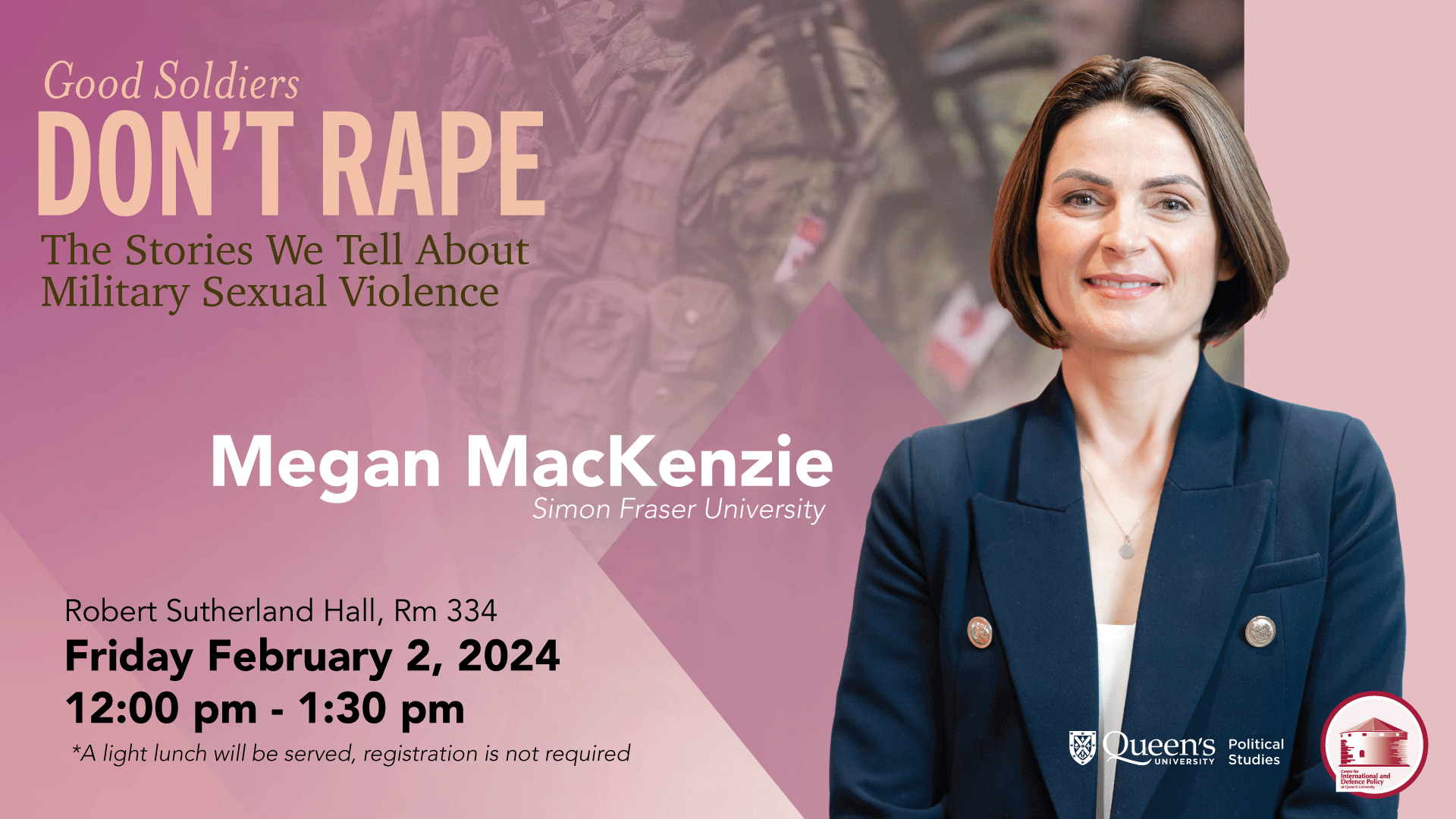
Good Soldiers Don't Rape: The Stories We Tell About Military Sexual Violence

Date

Friday February 2, 2024
12:00 pm - 1:30 pm

Location

Robert Sutherland Hall, Room 334 - Queen's University
Mega MacKenzie


In this presentation, Megan MacKenzie will draw out the key contributions of her recent book, Good Soldiers Don't Rape (Cambridge University Press), which focuses on sexual violence within defence forces. The book uses feminist theories of 'rape culture' and institutional gaslighting to identify the key stories, myths, and misconceptions about military sexual violence that have obstructed addressing and preventing it. It includes an analysis of nearly thirty years of media coverage of military sexual violence in three case countries – the US, Canada and Australia. MacKenzie will relate her book to the recent scandals and high profile cases of sexual misconduct that have plagued the Canadian Forces over the past three years.

*A light lunch will be served, registration for this Event is not required.


Biography:
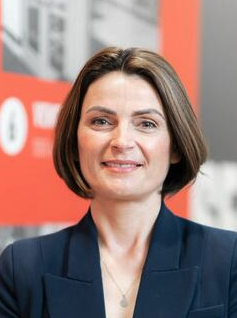
Megan MacKenzie PhotoMegan MacKenzie is a feminist scholar interested in war, security studies, post-conflict recovery and reconstruction, and military culture. Her work is broadly focused on the ways that gender matters in understanding war and insecurity and the ways that experiences of war and insecurity are shaped by gendered norms and sexism.

Megan has been studying military culture and gender integration in the military for over a decade, which includes projects on military sexual violence, the integration of women into combat roles, and military suicide. She also has worked on issues related to post-conflict transitions and feminist solutions to ending war. This work includes projects on disarmament programs, amnesty provisions in peace agreements, truth and reconciliation commissions, and a series and edited book on feminist solutions to ending war. Megan is also involved in a research hub on images and international relations, based at the University of Copenhagen.

Megan’s research has been funded by the Australian Research Council, the Independent Research Fund Denmark, and the Sydney Social Sciences and Humanities Advanced Research Centre. She held a fellowship at the Belfer Centre Center for Science and International Affairs and the Women and Public Policy Program at the Harvard Kennedy School.

Kevin Brushett

Kevin Brushett

Kevin Brushett

Associate Professor

Department of History

Royal Military College of Canada

About

Dr Kevin Brushett an Associate Professor and Department Chair in the Department of History at the Royal Military College of Canada. Dr Brushett's research focuses on the relationship between civil society organizations and the state in Canada in the latter half of the 20th century. He is currently finalizing a book on the Company of Young Canadians (Mirror of a Generation: The Company of Young Canadians and Youth Activism in the Long Sixties). He has also working a project that examines the growth and performance of Canadian international development policies between 1965 and 1985 through the lens of the Canadian International Development Agency's Non-Governmental Organization (NGO) Branch, which sponsored community development programs in the Global South between 1965 and 1990. Dr Brushett belongs to a number of research groups and organizations including the Political History Group, Canadian Historical Association, the Canadian Network for Humanitarian History, the Society for the History of American Foreign Relations, WIIS-Canada and the Interuniversity research group on the Quebec of the Sixties and its external relations (GRIQUERE).  Dr Brushett is also a co-founder of the Athena Women’s Network, a student focused organization that provides RMC Cadets with professional, academic, and social networking opportunities through a gender perspective.

Research Interests

  • Civil Society/Non-Governmental Organizations
  • Humanitarianism and Conflict
  • International Development Assistance 

Recent Publications

  •  

Online

  •  

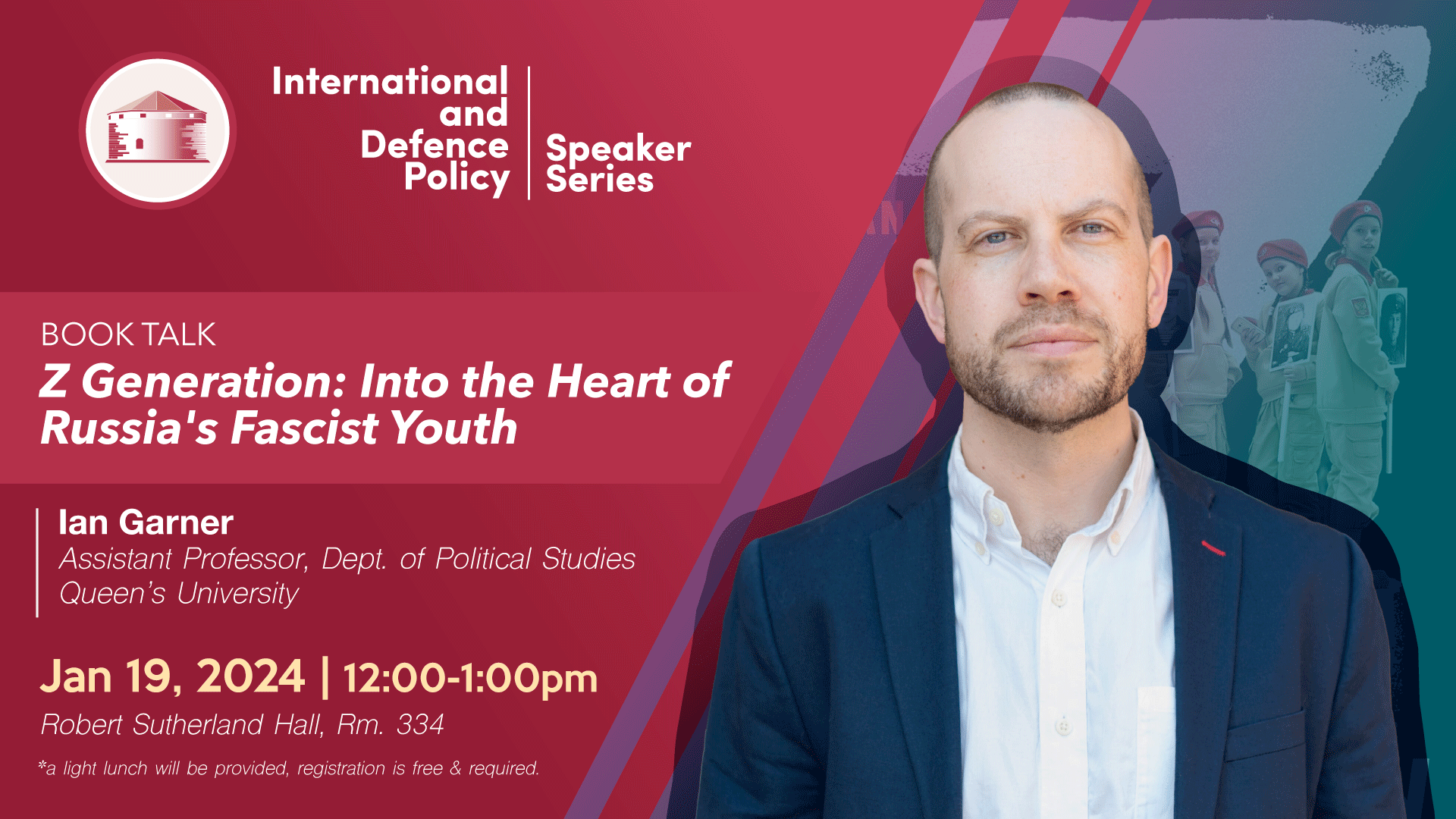
Speaker Series - Book Talk with Ian Garner

Date

Friday January 19, 2024
12:00 pm - 1:00 pm

Location

Robert Sutherland Hall, Room 334
Ian Garner Book Talk


Ian GarnerIan Garner’s research focuses on Russian culture and propaganda of war. He is particularly interested in combining methodologies from cultural studies, history, and political science to understand the changing impacts of communications and propaganda forms on subjects at war.
Garner completed his PhD in the Slavic Department at the University of Toronto after graduating from the University of Bristol (UK) and St. Petersburg Conservatory (Russia). His first book, Stalingrad Lives: Stories of Combat & Survival (McGill-Queen’s University Press), explored the nascence and afterlife of the myth of Stalingrad as a propaganda tool both historically and under the current Russian regime. His most recent work, Z Generation: Into the Heart of Russia’s Fascist Youth, charted experiences of burgeoning neo-fascist youth militarism since the year 2000, especially in light of the war in Ukraine. In his next project, tentatively titled I Killed For the Motherland, Garner seeks to chart a history of the ways in which propaganda and propagandists have (de)motivated Othered soldiers who have fought for the Russian state and to conceptualize how shifting digital landscapes may alter soldiering in the coming years.

Garner has written for media outlets including the Guardian, The Times, Foreign Policy, and The Washington Post, and makes regular appearances on global TV and radio networks including the BBC, CBC, Al Jazeera, and TVP World. He has worked with think tanks and policymakers in the UK, Canada, USA, Ukraine, and across Eastern Europe, and currently teaches in the Department of Political Studies at Queen’s University.

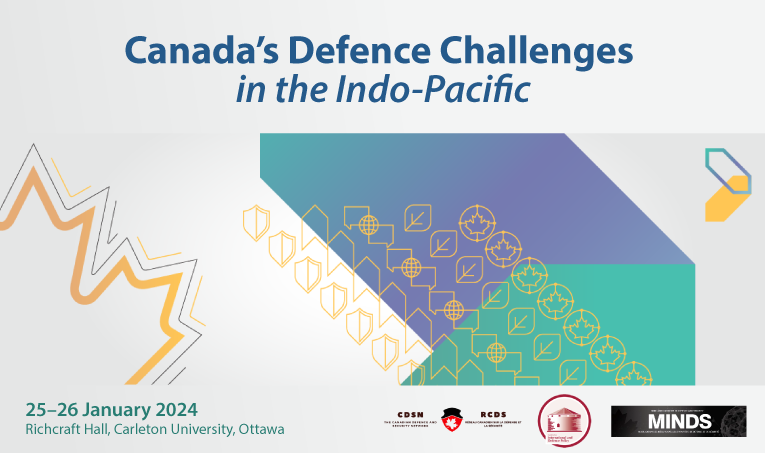
Canada’s Defence Challenges in the Indo-Pacific

Start Date

Thursday January 25, 2024

End Date

Friday January 26, 2024

Time

10:00 am - 12:00 pm

Location


Canada’s Defence Challenges in the Indo-Pacific

The purpose of this workshop is to explore the options for Canadian defence policy in the changing geostrategic environment of the Indo-Pacific region in the 2020s.

Workshop Briefs Coming soon...


Workshop Agenda

Thursday, 25 January

10h00–10h15: Welcome and introductory remarks

10h15–11h15: Presentation and discussion of briefs by Stephanie Carvin and Thomas Juneau, Deanna Horton, Stephen Nagy

11h15–11h30: Health break

11h30–12h30: Presentation and discussion of briefs by James A. Boutilier, Charlotte Duval-Lantoine

12h30–13h30: Lunch

13h30–15h15: Presentation and discussion of briefs by Jeremy Paltiel, Adam P. MacDonald, Ross O’Connor

15h15–15h30: Health break

15h30–16h30: Keynote address: Professor John Blaxland, Australian National University,

      “Canada’s defence challenges in the Indo-Pacific: A view from Down Under”

Friday, 26 January

9h00–10h15: Keynote plus-one: Responses to Professor Blaxland

10h15–10h30: Health break

10h30–11h45: Discussion of proposed policy paper

11h45–12h00: Concluding remarks and next steps

12h00: Workshop concludes


This workshop has been co-organized by the Centre for International and Defence Policy, Queen’s University, and the Canadian Defence and Security Network. We are most grateful to the Mobilizing Insights in Defence and Security (MINDS) program of the Department of National Defence for funding. Cover visual courtesy of Global Affairs Canada.

The workshop is being held under the Chatham House Rule (https://www.chathamhouse.org/about-us/chatham-house-rule): participants are free to use the information received, but neither the identity nor the affiliation of any participant may be revealed.

We acknowledge that the workshop is being held on the traditional, unceded territories of the Algonquin nation;
we recognize the Algonquin peoples as the traditional custodians of the land on which we are meeting.

Mike G. Fejes

Mike G. Fejes

Mike G. Fejes

Assistant Professor

Royal Military College of Canada

About

Mike G. Fejes is an Assistant Professor at The Royal Military College of Canada in Kingston, Ontario where he has taught since 2019. An infantry officer with 30 years of military service in both the regular and reserve force (including five international deployments and one domestic response operation). He is currently Employed in the Department of Political Science and Economics where he teaches IR Theory, Strategic Studies, Canadian Foreign and Defence Policy, and Civil-Military Relations at the undergraduate level, and Research Methodology and American Foreign Policy at the Graduate level . 

Research Interests

  • Civ-Mil Relations
  • Comparative Defence Policy

  • The Contemporary Use of Armed Force. 

Recent Publications

  • (Upcoming) Fejes, Mike G.  “The Curious Case of Mali: Explaining Why Deployment Decisions Can Take So Long?” in Stephen Saideman and Christopher Ankerson, eds.  Canadian Civil-Military Relations. 

  • (Upcoming) Fejes, Mike G.   “Schrodinger’s Soldiers: Reviewing How and Why the Military Colleges Create “Experts” In the Profession of Arms.” Canadian Military Journal in Vol 26.

  • Jean-Nicolas Bordeleau and Mike G. Fejes. “Do Fears of Normative Commitments Influence Nominations to Senior NATO Military Positions? The Case of Trudeau with Vance” International Journal, (July 2022):1-21.  https://journals.sagepub.com/doi/10.1177/00207020221112345

  • Fejes, Mike G. “The Canadian Armed Forces Primary Reserves and Aid to the Civil Power: Maximizing Service and Minimizing Risk for Canadians” Journal of Military and Strategic Studies, Vol 20, No. 2. (2021): 36-61. https://jmss.org/article/view/69657/54677

  • Fejes, Mike G. "Returning Foreign Fighters: The Law and Implications for Canadian National Security Policy." Canadian Foreign Policy Journal Vol 25, No. 1 (2019): 90-109. https://www.tandfonline.com/doi/abs/10.1080/11926422.2018.1530125

Online

Bibi Imre-Millei

Bibi Imre-Millei

Bibi Imre-Millei

PhD Student

Dept. of Political Science

Lund University, Sweden

About

Bibi Imre-Millei is a PhD student at the political science department at Lund University in Sweden. Her research for her PhD thesis focuses on identity and community among military drone operators in Canada and Sweden. Her methods are primarily qualitative and rely on interview and ethnographic methods as a way to investigate personal experiences. She is broadly interested in looking at topics involving both military personnel and military technology from critical and feminist perspectives. Bibi developed these skills in large part at the CIDP, where she was the project coordinator for the CIDP Gender Lab between 2019 and 2022, working on topics related to military personnel and gender in the CAF and beyond, in international organizations. Bibi has held a variety of research positions research the military and international organizations at Queen’s University, McMaster University, the University of Toronto, and the Royal Military College of Canada in Kingston. Bibi has published in the Canadian Military Journal and the Journal of Military, Veteran and Family Health among others on topics such as gender integration in the CAF. At Lund University, Bibi is involved in the PhD community as part of the Social Sciences Doctoral Student Union (SDR) 2023-2024, and also helps coordinate events for AI Lund, a university wide organization which engages with business, the public sector, and research. Bibi completed two Masters of Arts degrees at Queen’s University in political studies and sociology, and an undergraduate in political studies along with certificates in law and sexual and gender diversity.

Research Interests

  • Military Personnel

  • Critical Military Studies

  • Qualitative Methods

Recent Publications

Online:

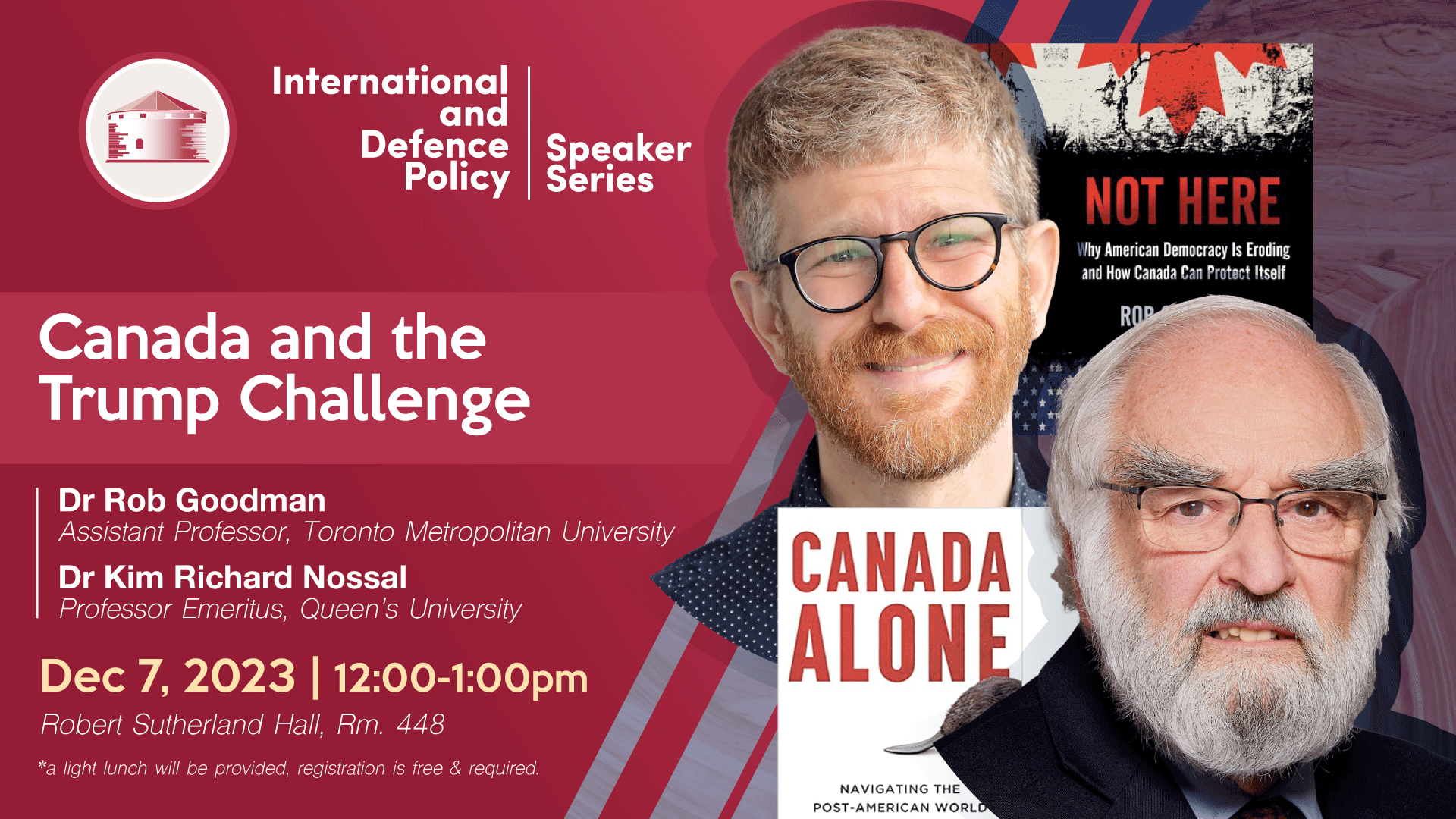
Canada and the Trump Challenge with Kim Nossal & Rob Goodman

Date

Thursday December 7, 2023
12:00 pm - 1:00 pm

Location

Robert Sutherland Hall, Room 448 - Queen's University

Kim Nossal and Rob Goodman


If a Republican becomes president in 2025, Canada will face numerous challenges. In this panel, Rob Goodman will look at the implications for democracy in Canada and Kim Nossal will examine the foreign and defence policy impacts of an America First administration.


*note: There is still room, please contact us at cidp@queensu.ca to be put on the registration list.


Our co-sponsor or this is event

Centre for the Study of Democracy and Diversity


Rob Goodman

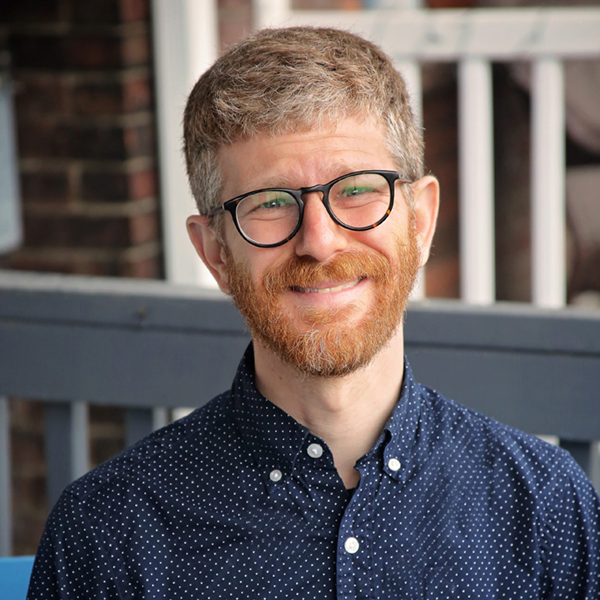
Dr. Rob Goodman is Assistant Professor in the Department of Politics and Public Administration and a member of the Yeates School of Graduate Studies at Toronto Metropolitan University. He holds a PhD in Political Science from Columbia University, as well as an MA in Public Policy from George Washington University and a BA in English from Duke University. He was previously an Andrew W. Mellon Postdoctoral Researcher at McGill University, a Core Curriculum instructor and Heyman Center for the Humanities Fellow at Columbia University, and a Research Exchange Fellow at the University of Glasgow.

Before beginning his doctoral studies, Dr. Goodman worked as speechwriter for US House Majority Leader Steny Hoyer and Senator Chris Dodd.

Kim Nossal

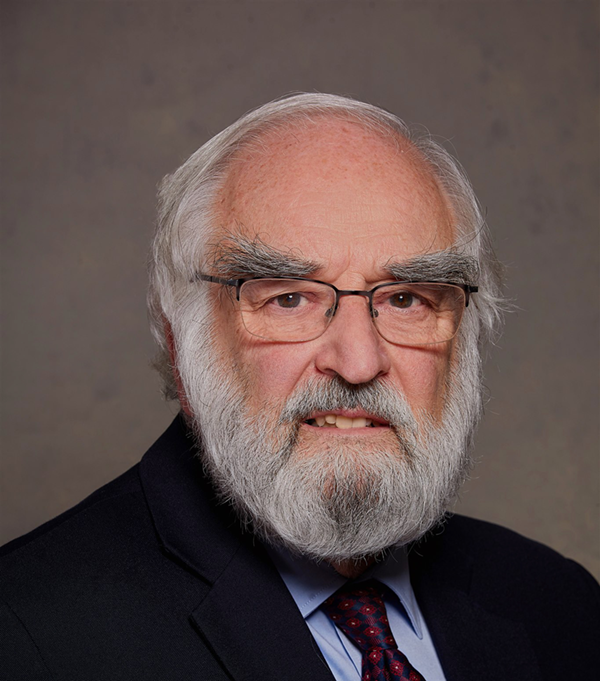
Kim Richard Nossal went to school in Melbourne, Beijing, Toronto, and Hong Kong and attended the University of Toronto, receiving his PhD in 1977. In 1976 he joined the Department of Political Science at McMaster University in Hamilton, Ontario, where he taught international relations and Canadian foreign policy, serving as chair of the Department from 1989–90 and 1992-1996. In 2001, he came to Queen’s University, heading the Department of Political Studies until 2009. He served as director of the Centre for International and Defence Policy from 2011 to 2013. From 2013 to 2015, he was the executive director of the Queen’s School of Policy Studies.

He has served as editor of International Journal, the quarterly journal of the Canadian International Council, Canada's institute of international affairs (1992-1997), and was president of the Canadian Political Science Association (2005-2006). He served as chair of the academic selection committee of the Security and Defence Forum of the Department of National Defence from 2006 to 2012. In 2017 he was awarded an honorary doctorate by the Royal Military College of Canada.