
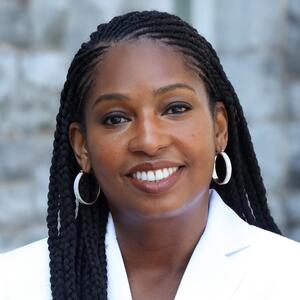
Lavonne Hood

Lavonne Hood

Lavonne Hood

Associate Vice-Principal (Human Rights, Equity, and Inclusion)

Lavonne has been the Associate Vice-Principal (Human Rights, Equity and Inclusion) since June 2023. Prior to joining the HREO, Lavonne served as the University Ombudsperson at Queen’s from August 2019.  

Throughout her career, Lavonne has been deeply committed to I-EDIAA. Before joining Queen’s in October 2018 as Senior Legal Counsel, she worked as Legal Counsel for the Department of Justice, where she served as the Co-Chair of the Advisory Committee on Visible Minorities. This work garnered her both the individual and team National Awards for Employment Equity and Diversity Leadership from the Department of Justice. 

Lavonne is a central point of contact with respect to providing expertise on statutory human rights matters, advancing equity and accessibility policy development and education, and establishing and fostering positive relationships with equity-deserving communities and organizations both internal to Queen’s and within the broader Kingston community. Lavonne also works closely with the Vice-Principal (Culture, Equity, and Inclusion) and senior leadership to develop and implement long-term strategic planning to guide institutional areas of focus and university wide objectives aimed at advancing human rights, equity, diversity, inclusion, anti-racism, and accessibility.

To schedule a meeting with Lavonne, please reach out to Meri Diamond at: diamondm@queensu.ca.
Accessibility Café: Neurodiversity Workshop

Date

Wednesday April 29, 2026
11:30 am - 1:00 pm

Location

In-Person & Online

Co-Hosts: Haley Clark and Cheryl Lee-Yow, PhD candidates in the Faculty of Education at Queen’s

Join Equity and Accessibility Services from the Human Rights and Equity Office (HREO) for the final Accessibility Café of the 2025-2026 academic year, held in partnership with the Centre for Teaching and Learning (CTL).

This workshop will focus on creating a more accessible classroom environment for disabled and neurodivergent students in higher education. Attendees will learn approaches to remove or reduce barriers for neurodivergent students through neuro-affirming and accessible “best practices” for teaching and learning. These strategies can be used to improve accessibility for all students in your courses.

The Café is open to all members of the Queen’s community and will be offered in-person (Ellis Hall, Room 333) and online.

Event Poster (8.34MB, PDF)

Register Now

Hiwot Mekuanent

Hiwot Mekuanent

Hiwot Mekuanent

Special Projects Officer

Equity & Accessibility Services and Human Rights Advisory Services

Hiwot is a legal scholar and human rights advocate specializing in disability rights, accessibility, inclusion, and equitable participation. Her work spans research, policy, and institutional initiatives that advance human rights and inclusive practice.

Since 2026, she has served as Special Projects Officer in the Human Rights and Equity Office (HREO) at Queen’s University, where she leads and supports university-wide initiatives that advance Indigenization, Equity, Diversity, Inclusion, Accessibility, and Anti-Racism (I-EDIAA) goals. Her role contributes to strategic projects across Equity and Accessibility Services and Human Rights Advisory Services to strengthen inclusive policies and practices across the university community.

Previously, she served as Director of the Disability Studies and Service Directorate at the University of Gondar, leading initiatives to create accessible and inclusive learning and working environments.

She holds a PhD in Law from Queen’s University, where her research examined the participation of persons with disabilities in Ethiopia’s law-making process, and a Master’s degree in Human Rights Law from Addis Ababa University.

Elisha Gunaratnam

Elisha Gunaratnam

Elisha Gunaratnam

Human Rights Advisor

Human Rights Advisory Services

Elisha joined the HREO in 2026 as a Human Rights Advisor. She has experience in research and student services and has worked with a number of organizations to bring attention to human rights abuses. Elisha supports students, staff and faculty at Queen’s by providing them with human rights-related policy advising and working with them to address human rights-related concerns. 

Elisha holds a Master of Laws in European and International Human Rights Law and a Bachelor of Arts Honours in Human Rights and Political Science.

Anti-Oppression (Staff / Faculty / Students)

Date

Tuesday May 26, 2026
10:00 am - 12:00 pm

Location

Online

In this session, participants will explore the concepts of identity, power, privilege and their relationship to oppression. Through the use of practical examples and strategies, attendees will gain a deeper understanding of anti-oppression.

Audience: Faculty, Staff Students.

Length: 2 hours

Register at: https://www.queensu.ca/hreo/education/anti-oppression

DEAP Demonstrations (Staff / Faculty)

Date

Monday May 11, 2026
1:30 am - 3:00 pm

Location

Online

The DEAP Tool has been developed by Queen's Equity Services to assist Units to better understand the environments and climate relating to equity and diversity in their Units.

Audience: Faculty, Staff

Length: 1.5 hours

Register at: https://www.queensu.ca/hreo/education/deap-demonstrations

Responding to Disclosures (Staff/Faculty)

Date

Tuesday June 2, 2026
9:30 am - 11:00 pm

Location

Online

This session is designed to give all employees an overview of how to effectively respond to student disclosures of sexual violence. Some policy considerations will be discussed.

Audience: Staff, Faculty, Senior Admin - Grades 10 and above.

Length: 1.5 hours

Register at: https://www.queensu.ca/hreo/education/responding-student-disclosures

Black Studies at Queen’s and Elsewhere

Date

Wednesday February 25, 2026
12:00 pm - 1:30 pm

Location

Online via Zoom

Speaker

Dr. Katherine McKittrick

Presentation

“Black Studies at Queen’s and Elsewhere"

Date and Time

February 25, 2026 (12 - 1:30 pm EST)

Event Registration

Please register using Eventbrite - a Zoom link will be sent to you closer to the date of the event.

Event Format

This session will include a 30-minute talk followed by a moderated 45-50-minute Q&A session with the attendees. 

Moderator

Dr. Tracy-Ann Johnson-Myers, Human Rights and Equity Office

About the Event

This conversation will highlight the development of Black Studies at Queen’s University. The discussion will highlight the field's history and ongoing focus on interdisciplinarity and freedom-making, while also attending to how activities, rather than simply the enumeration of Black people, sustain our work at Queen’s and elsewhere. 

About the Speaker

Katherine McKittrick

Katherine McKittrick is Professor of Gender Studies and CRC in Black Studies at Queen’s University. Her book projects include Dear Science, Demonic Grounds, Sylvia Wynter: On Being Human as Praxis, and Black Geographies and the Politics of Place. Her collaborative projects include, Trick Not Telos, Twenty Dreams, and the installation, A Smile Split by the Stars.

Public Talk with Dr. Aftab Erfan: Making Sense of Conflicts on Our Campuses in Polarizing Times

Date

Tuesday March 10, 2026
3:00 pm - 5:00 pm

Location

In-Person

Aftab HeadshotMaking Sense of Conflicts on Our Campuses in Polarizing Times

Date and Time: Monday, March 10, 2026; 3:00 - 5:00 pm

Collaborators: Human Rights and Equity Office; Centre for Teaching and Learning

Throughout the ages, the core purpose of the public university has been relatively consistent: to develop the capacity for disciplined and critical thinking, to pursue evidence and build new knowledge, and to prepare citizens for a pluralistic society. To do this, universities commit to protecting a multiplicity of perspectives, approaches and worldviews – a virtuous path that is inevitably paved with conflict. How do we understand conflict and the dynamics of its escalation at this moment in time? What does it mean to be inclusive and trauma-informed in our approach to working together without shying away from difficult or polarizing subjects? What are the qualities we need to foster in our collective social body to hold the complexities of this moment in time?

Open to the university community, this talk introduces a number of conceptual frameworks and weaves in stories of practice to help make sense of the dilemmas of pluralism we are facing and envision ways to navigate them. The idea is to be thought provoking, giving people language, inspiring/painting a picture of something better that may be possible. There will be a question-and-answer period following the talk. 

Register Here

Dr. Aftab Erfan is a scholar-practitioner, serving as the Executive Director of Simon Fraser University’s Centre for Dialogue, and Associate Member in the School of Public Policy. She was previously Director of Dialogue and Conflict Engagement at the University of British Columbia, and the inaugural Chief Equity Officer at the City of Vancouver. Educated as an urban planner, Dr. Erfan specializes in the study of deep-rooted conflicts and methods of deliberative democracy. She is a master facilitator who has worked on four continents. She is cautiously optimistic about the future of humanity.


This Series is supported by the Office of the Principal; Office of the Vice Principal Culture, Equity, Inclusion; Robert Sutherland Visitorship.

More information can be found at: https://www.queensu.ca/ctl/programs-and-events/public-talk-dr-aftab-erfan

Accessibility Café: Relational Accessibility in Higher Education: The Four R’s, Indigenous Knowledges, and Institutional Responsibility

Date

Friday February 27, 2026
10:30 am - 12:00 pm

Location

In-Person & Online via MS Teams

This Accessibility Café session is the second event connected to Dr. Rheanna Robinson’s Accessibility First talk, Decolonizing Disability.

How might teaching, learning, and student support change when accessibility is grounded in relationship rather than accommodation alone? This gathering invites educators, students, staff, and community members to explore how Indigenous knowledges can inform more inclusive, relational, and justice-oriented approaches to accessibility in higher education.

Together, participants will reflect on the Four R’s - Respect, Relevance, Reciprocity, and Responsibility - and consider how these principles can shape their roles and practices at Queen’s.

The session will also focus on institutional change and responsibility, with attention to different levels of influence and accountability: individual, unit/department, and institution. The guided discussion will explore:

  • What shifts could move Queen’s toward more decolonized approaches to accessibility?
  • What does accountability look like across individual, unit, and institutional levels?
  • How can reciprocity be meaningfully practiced in institutional change?

If you have time, participants are encouraged to read First Nations and Higher Education: The Four R’s - Respect, Relevance, Reciprocity, Responsibility by Verna J. Kirkness and Ray Barnhardt (1991) in advance. The article is available at the link provided here.

**This is a hybrid event!

Register Now