
Surgery is a common treatment for breast cancer. While, in some cases, the entire breast needs to be removed, in others, particularly when the disease is identified in its early stages, only the affected part of the breast is removed, leaving the remaining part as intact as possible.
The latter, known as a lumpectomy, is less invasive, but also risks leaving part of the tumour behind. A new tool developed by Queen’s researchers Gabor Fichtinger and Parvin Mousavi (Computing) and John Rudan (Medicine) can contribute towards the success of these surgeries.
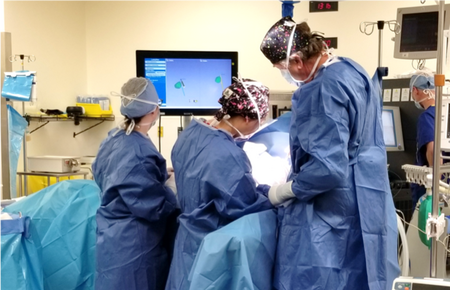
During lumpectomies, it is customary for surgeons to remove a margin of healthy tissue along with the tumour, to be safe. But how do surgeons know exactly how much tissue to remove?
Before the surgery, a patient will be sent to radiology, where their breast will be scanned using ultrasound and a needle inserted into the breast to mark the location at the centre of the tumour. The surgeons receive a drawing based on that.
Navi-Knife is a system developed to show surgeons the exact position and shape of the tumour relative to where they are operating with an electrocautery device. By using ultrasound directly in the operating room, Navi-Knife allows surgeons to see the 3D image and the position of the cautery relative to it in real time.
The scalpel in this case is a small probe that uses a current to burn through tissue. Attaching an electromagnetic sensor to a localization wire gives it the ability to track the centre of the tumour. Researchers are confident that the new technology will make lumpectomies less intrusive and reduce the need for reconstructive surgery afterwards.
Over the past few years, Drs. Rudan, Fichtinger, and Mousavi have also been collaborating with researchers at Imperial College in the United Kingdom to improve another surgical tool, iKnife. Preliminary trials show that the iKnife, combined with a navigation software, is not only effective at reducing the amount of healthy tissue removed but also at leaving no cancerous material behind.
The research team is working with Waters Corporation, manufacturer of the iKnife technology, to develop new ways to use the knife through harnessing navigation and AI technology.