
Queen's is committed to build a strong entrepreneurial ecosystem that helps researchers successfully translate innovation into growing companies. Building on world-class research across disciplines and strong regional innovation partners and integrated services, we support faculty, staff and students from ideation to real-world impact, catalyzing discovery into ventures, driving adoption, and creating meaningful change.
Can your innovation be commercialized?
The Commercialization and Ventures team provides support to faculty, staff, and students to commercialize their innovations. The process starts with an invention disclosure, which allows our team to:
- Determine eligibility for intellectual property protections
- Assist with market analysis and opportunity assessments
- Help you navigate licensing and agreements
- Provide commercialization strategies and advice
The commercialization pathway
All faculty, staff, and students at Queen’s should disclose commercially relevant ideas to our team for a no-commitment evaluation. This could include software, products, processes, surveys, or any other innovation. We will assess the intellectual property and commercial potential and work together to evaluate the next steps. You can disclose at any time, but the ideas are most valuable before you publicly present, publish, or otherwise share details about an innovation.
Protecting intellectual property can help preserve the opportunity to commercialize an invention and provide a foundation for working with industry partners. Depending on the nature of the innovation, protection may include patents, copyright, trademarks, and/or trade secrets. Our team can work with researchers to identify an appropriate IP strategy and coordinate protection where appropriate, including evaluating whether patent protection should be pursued and where other protections may be needed.
Working with an industry partner can help move research from the university into practical applications, products, and services. Partners may provide technical expertise, development capabilities, market knowledge, funding, manufacturing capacity, or access to customers and distribution channels. The Commercialization and Ventures team can help identify companies that may have a strategic interest in a technology and support researchers in developing relationships with potential partners.
Moving a technology toward the market often requires funding beyond traditional research grants. Depending on the technology and its stage of development, funding may be available through government programs, commercialization grants, industry partnerships, and other sources of support. Our team can help researchers identify relevant opportunities and determine what funding may be appropriate for activities such as proof-of-concept work, prototyping, validation, or further technology development.
Creating a new company can be an effective way to commercialize technologies that address a significant market opportunity or require substantial further development. A spin-off or start-up may allow a technology to attract investment, build a dedicated team, and pursue a market independently of an existing company. Our team can help determine whether a company-based approach makes sense for the technology and provide guidance on the commercialization process, including IP, business development, and relationships with potential investors or entrepreneurs.
Researchers do not necessarily need to become entrepreneurs themselves to see their technology reach the market. An experienced entrepreneur can bring business expertise, industry connections, fundraising experience, and the capacity to build and lead a new venture around a university technology. The Commercialization and Ventures team helps explore potential entrepreneurial connections and identify individuals or organizations that may be interested in taking a technology forward.
Queen’s intellectual property policy provides the framework for how intellectual property arising from university research is managed and how rights and responsibilities are shared between the university and its researchers. Understanding the policy can help researchers know what to disclose, how commercialization activities are handled, and how intellectual property rights may be managed if a technology is licensed or used to create a new company. Researchers should familiarize themselves with the policy early in the commercialization process and contact our team with any questions about how it applies to their work.
Commercialization can create situations where a researcher’s personal, professional, or financial interests overlap with their responsibilities at Queen’s. For example, a researcher may hold an ownership interest in a company commercializing their research or have a role in a company that is collaborating with the university. These situations do not necessarily prevent commercialization, but potential conflicts should be managed carefully to ensure that commercialization activities are conducted transparently and appropriately.
Guidelines, policies, and agreements
Please visit the University Secretariat's University Wide Policy Library page for more information.
- Intellectual Property Commercialization Policy
- Commercialization of Applicable Inventions Procedure
- Dispute Avoidance and Resolution Procedure
- Table Summarizing Policy Guideline
- Formation of a Startup to Commercialize Applicable Inventions Guideline
- Queen's - QUFA Collective Agreement
- Postdoctoral Fellows Collective Agreement
- Research Administration Policy (which includes useful links to related policies and procedures)
- Indirect costs of sponsored research
- Publication of research results
- Conflict of interest
- Integrity in research
- Queen's University Faculty Association (QUFA)
- Public Service Alliance of Canada, Unit 1 (Graduate TAs and TFs)
- Public Service Alliance of Canada, Local 901 Unit 2 (Post-doctoral Fellows)
- USW 2010, Unit 01 (Academic Assistants)
In the event of a conflict between the proposed Intellectual Property Commercialization Policy and a current/future collective agreement, the collective agreement will be the governing frame of reference.
Stories of impact

Date Published: May 27, 2025
Queen’s spinoff Dynamiris advances AI-enhanced eye tracking technology
Product can help clinicians detect and diagnose neurodegenerative disease, including Parkinson’s.

Date Published: Mar 20, 2023
Computer-enhanced imaging to support treatment of atrial fibrillation
Software pinpoints areas of the heart where fibrillations originate, making treatment procedures more precise.
Date Published: Jan 13, 2023
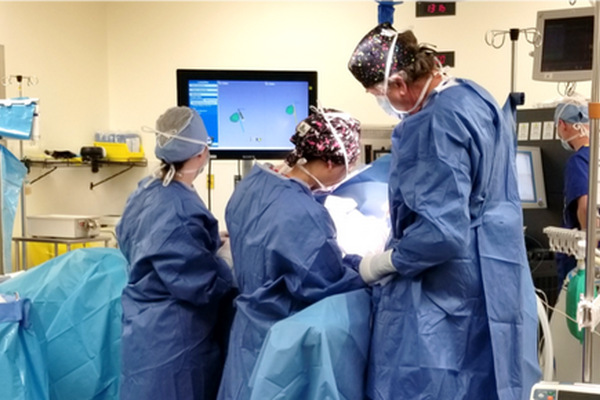
Making breast cancer surgery safer and less intrusive
New technology helps surgeons visualize tumours in real time in the operating room.
Questions? Talk to our team
The Commercialization and Ventures team has patent agents and other staff members who can provide advice on patentability, commercialization, and other intellectual property (IP) matters. They are responsible for drafting, filing, and prosecuting patent applications, managing patent portfolios, and providing strategies for intellectual property protection.