
Queen’s researchers are advancing knowledge and innovation across nuclear energy, materials science, safety, and energy policy. Our programs address complex challenges related to nuclear reactors, nuclear radiation, and emerging technologies such as small modular reactors (SMRs), contributing to a safer, more sustainable energy future in Canada and globally.
Through interdisciplinary collaboration, world-class facilities, and strong partnerships with industry, government, and international institutions, our researchers are shaping the future of nuclear science and engineering while training the next generation of experts.
Materials at Extremes Nuclear Research Institute
The Materials at Extremes and Nuclear Research Institute (MAX-Nuclear) is dedicated to advancing knowledge on how existing and emerging materials perform under the harsh conditions found in current and next-generation nuclear reactor environments. MAX-Nuclear's research strengths include corrosion of materials, structural materials, computational modelling of materials, and fundamentals of radiation effects.
Reactor Materials Testing Laboratory
The Reactor Materials Testing Laboratory (RMTL) is a state-of-the-art facility that houses a proton and helium accelerator to introduce radiation damage and transmutation products into materials, mimicking the changes to materials occurring in a nuclear reactor.
Advancing nuclear materials for safer, longer-lasting reactors
Canada Excellence Research Chair Yanwen Zhang is advancing materials science by studying how advanced alloys and ceramics perform under extreme heat and nuclear radiation. Her research is critical to improving the durability and safety of materials used in nuclear reactors and next generation nuclear energy systems.
Engineering materials for extreme conditionsUnderstanding the role of small modular reactors in clean energy
Queen’s researchers Mark Daymond and Suraj Persaud break down what small modular reactors (SMR) are and why they matter for Canada’s clean energy future. Their work explores SMR safety, materials performance, and the role these nuclear reactors could play in delivering reliable low-carbon power.
Five things you need to know about small modular reactorsPowering Canada’s small modular reactor future
Laurent Karim Béland is leading research that combines computational and experimental approaches to better understand materials performance in small modular reactors (SMR). His work supports Canada’s SMR Action Plan and the country’s transition to low-carbon nuclear energy.
Shaping Canada's energy transitionDriving technological advancements in the nuclear sector
Queen’s University has partnered with Kinectrics to advance innovation in nuclear energy through a five-year collaboration focused on research, training, and education. The partnership leverages Queen’s expertise in nuclear materials to support next-generation technologies and strengthen Canada’s low-carbon energy future.
Queen's and Kinectrics partner to explore nuclear energy innovationThe role of nuclear power in a low-carbon economy
Queen’s University is strengthening its role in Canada’s energy transition through a partnership with Canadian Nuclear Laboratories and Atomic Energy of Canada Limited. The collaboration brings together academia, government, and industry to advance nuclear research, support innovation, and develop technologies that contribute to a low-carbon energy future.
Partnering for energy transitionFeatured researchers
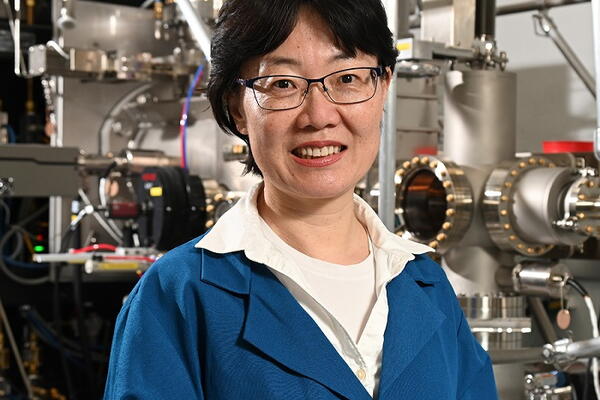
Yanwen Zhang
is exploring defect dynamics, ion beam modification and radiation effects, aiming to tailor these processes for targeted complex materials’ functionality and properties.

Mark Daymond
is examining deformation mechanisms in structural and nuclear materials, using advanced neutron and X-ray scattering techniques alongside experimental and modelling approaches to understand and optimize material behaviour.

Meng Li
combines atomistic simulation, machine learning, and experimental validation to investigate reaction mechanisms and unravel properties of energy materials to accelerate the discovery of advanced materials for clean energy conversion and storage.