
.png)
This advanced undergraduate-level course focusses on the fundamental biology underlying the major global change issues that humanity currently faces. Strong emphasis will be placed on the critical interconnections among issues across hierarchical levels from molecule to biosphere that explain the patterns and mechanisms which have led to our current environmental situation.
We will explore the biology underlying the major global change issues that our civilization currently faces (e.g. land-use change including deforestation, biodiversity loss, invasive species, climate change, nitrogen pollution, antibiotic resistance...). Together, in the spirit of mutual learning, we will address the following broad over-arching questions:
- What is our current scientific understanding of the specific biology underlying each of the major global change issues?
- In what ways do these biology-based insights: a) help us to understand why we are in the current environmental situation; b) point the way toward potential solutions; and c) ultimately influence perspectives on our civilization’s future?
Professor and student-lead seminars will introduce many of the major global change issues as well as a number of conceptual frameworks to understand them and their interactions. Specific concepts will include: Progress trap, Global Planetary Boundaries, Biogeochemical linkage interactions, The Anthropocene, Deep Ecology, Socio-Ecological Stewardship, and Complex Adaptive Systems.
The ultimate aim is to empower students so that they can develop their own perspectives on how to interpret, cope with, and constructively respond to the major global change issues that they will face through the 21stcentury.
Learning outcomes
On successful completion of this course, students will be able to:
- Explain and contrast the major global environmental issues that our civilisation faces.
- Develop and apply an over-arching conceptual framework to identify and organize the principal interactions among major global change issues that ramify their impacts.
- Describe the patterns and causes of previous civilisations’ rises and falls to appraise our current global environmental predicament within an historical context.
- Summarize the impacts of western ‘progress’-based, individualist, and capitalist ideologies on humanity’s relationship with the rest of the nature, and contrast those with the more holistic ideologies of Indigenous and eastern cultures.
- Use concepts such as Progress trap, Global Planetary Boundaries, The Anthropocene, Biogeochemical linkage interactions, Deep Ecology, Socio-Ecological Stewardship, and Complex Adaptive Systems to discuss, evaluate, and critique potential solutions for individual global change issues.
- Identify and analyze the fundamental biological root causes of our civilisation’s current environmental situation, and use that assessment to develop lasting personal solutions for coping with, and constructively responding to, the major global change issues of the 21st century.
Session times and locations: Mondays 1.00-2.30 (MacCorry A311); Thursdays 08.30-10.00 (Kingston Hall 304)
Professor: Paul Grogan Teaching Assistant: Colin St. James (colin.stjames@queensu.ca) Office: Room 2507)
Provisional Assessment plan:
- Participation in tutorial discussion (based on intellectual depth and relevance of contributions, not quantity) 15%
- Written questions provided in advance of each tutorial (based on intellectual depth and originality) 20%
- Group seminar 25%
- Outline of final synthesis exercise 7%
- Final synthesis exercise (peer marking) 28%
- Reflective writing exercises 5%
Provisional seminar topics:
- Introduction – conceptual frameworks
- Land-use change – patterns, drivers, and impacts
- Carbon Cycle and Climate Change
- Antibiotic Resistance and Virus epi/pandemics – rapid evolution of human pathogens
- Nitrogen Cycle – too much of a ‘good’ thing
- Phosphorus Cycle – humanity’s absolute need – peak phosphorus
- Biodiversity – 6th extinction; invasive species
- Freshwater extraction – growing demand, limited supply
- Ocean acidification – cause, thresholds, and biological impacts
- Atmospheric contaminants – mercury, nitrogen, .....
- Human population size – the elephant in the room
- Synthetic chemical proliferation?? – Rachel Carson’s Silent Spring...
- Anthropogenic Electromagnetic Radiation??
- Industrialised food production??
- Nuclear power, and/or nuclear weapons proliferation??
- Success stories: Ozone; Acid rain; ??
- Case study: Climate change and other recent perturbations in the Arctic
- Historical perspective – ‘The Short History of Progress’; Progress-traps
- Indigenous and other non-western cultural perspectives on humanity’s relationship with the rest of nature – Perspectives and Implications
- Emerging perspectives on sustainability: Socio-Ecological Stewardship, Complex Adaptive Systems, Well-being
- Deep Ecology and other Environmental Philosophies
- What can Biology tell us about our Future?
- Synthesis
Preliminary Schedule (to be updated through the course):
|
Date |
Topic |
Convenor |
Reading |
|
Sept. 4th |
Course introduction |
Paul |
|
|
Sept. 8th |
A Life on Our Planet: Discussion of documentary and associated papers
|
Paul |
Rockstrom et al. 2009. A safe operating space for humanity. Nature 461, 472–475.
Richardson et al, 2023. Earth beyond six of nine planetary boundaries. Science Advances 9 eadh2458.(Please read Introduction (pages 1-3) and final sub-section entitled ‘A systemic framework)
A Life on Our Planet (Documentary film by David Attenborough) |
|
Sept. 11th |
Food Inc. 2: Discussion of documentary and associated paper
|
Paul |
Foley, J et al. 2011. Solutions for a cultivated planet. Nature 478: 337–342
Food Inc. 2 (2023 documentary film following up from original Food Inc. from 2008) |
|
Sept. 15th |
Surviving Progress: Discussion of documentary and associated paper
|
Paul |
Bradshaw et al, 2021. Underestimating the Challenges of Avoiding a Ghastly Future. Frontiers in Conservation Science 1:615419.
Surviving Progress (Documentary film) |
|
Sept. 18th |
Surviving Progress: Discussion of documentary and associated paper (continued)
|
Paul |
|
|
Sept. 22nd |
No class – seminar preparation |
|
|
|
Sept. 25th |
Addressing climate change, why is economics taking precedence over science?
|
Sarah Sellens and Zoha Virk |
Graham, N. Fossil knowledge networks: science, ecology, and the “greening” of carbon extractive development. Studies in Political Economy, 101(2): 93-113 |
|
Sept. 29th |
Aquatic kelp farming as a new technique to address global food insecurity: Do we have the insight to learn from our past terrestrial farming mistakes and avoid another progress trap? |
Katrina Major and Stefan Kolbasnik |
Li., J et al, 2023. Life cycle assessment of a large commercial kelp farm in Shandong, China. Science of the Total Environment 903:1668661. |
|
Sept. 30th08.30-12.30 |
National Day for Indigenous Truth and Reconciliation: Optional field trip – Nature Walk focusing on enhancing student awareness of interconnection and impermanence, and in recognition of Indigenous perspectives on the human-nature relationship. |
Paul |
This will be a morning trip to the QUBS Elbow Lake Environmental Education Centre. We will be back at Queen’s in time for the Sacred Fire ceremony beginning at 1.15 pm so that we can join together across Queen’s to reflect on the harm brought to Indigenous Peoples by the residential school system. This is also a time to understand our collective role in advancing Truth and Reconciliation, not just at Queen’s, but across Canada. |
|
Oct. 2nd |
How does overexploitation of key species amplify biodiversity loss and trigger ecosystemic and anthropogenic changes on a global-scale? |
Clare Bowman and Alexandra Cosentino |
Estes, J. et al. 2011. Trophic Downgrading of Planet Earth. Science 333:301-306. |
|
Oct. 6th |
Should we be re-wilding for the past, present or future environment, and why? |
Payton Marsh and Sierra Byrne |
Perino , A. et al. 2019. Rewilding complex ecosystems. Science 364 (eaav5570): 1-8. |
|
Oct. 9th |
How can we modify our socio-economic systems so that they are more resilient to impacts of ocean acidification? |
Jillian Parks and Meghan Beaton |
Cooley, S. et al. 2016. Community-level actions that can Address Ocean Acidification. Frontiers in Marine Science 2(128): 1-12. |
|
Oct 13th-17th |
Thanksgiving and READING WEEK – No classes |
|
|
|
Oct. 20th |
How can we overcome the impacts of biotechnology in food production while still meeting global food demands? |
Catherine Orlicky and Tegan Lahey |
Falk, M. et al. 2002. Food Biotechnology: Benefits and Concerns. Journal of Nutrition132:1384-1390. |
|
Oct. 23rd |
What does food waste reveal about the inefficiencies of our global food system, and what is the most significant thing we can do to reduce it? |
Lucas Hertl and Luka Stankovic |
Conrad, Z. 2020. Daily cost of consumer food wasted, inedible, and consumed in the United States, 2001–2016. Nutrition Journal 19(35):1-9 |
|
Oct. 27th |
‘Forever chemicals’: Given their rapidly increasing use, but also their diverse impacts, should we focus more on prevention or on remediation? |
Ausha Guzzwell and Juhee Lee |
Beans, C. 2021. How ‘forever chemicals’ might impair the immune system. Proceedings of the National Academy of Sciences 118(15):1-5. |
|
Oct. 30th |
Is zoonotic disease the most serious threat to our growing human population? |
Tara Meikle and Maxine Haywood |
Blasdell, K. et al. 2022. Rats and the city: Implications of urbanization on zoonotic disease risk in Southeast Asia. Proceedings of the National Academy of Sciences 119(39):1-11. Spernovasilis, N. et al. 2021. Epidemics and Pandemics: Is Human Overpopulation the Elephant in the Room. Ethics, Medicine and Public Health 19:100728 |
|
Nov. 3rd |
Should A.I. be considered a global change biology issue? |
Marcus Hui and Freya Hurst |
Kaack, L. et al. 2022. Aligning artificial intelligence with climate change mitigation.Nature Climate Change 12:518-527. |
|
Nov. 6th |
Global pollinator declines and food insecurity: How can we avoid the positive feedback loop between the two? |
Marianna Masri and Ava Appleman |
Janousek, M., et al. 2023. Recent and future declines of a historically widespread pollinator linked to climate, land cover, and pesticides. Proceedings of the National Academy of Sciences 120(5):1-9. |
|
Nov. 10th |
If evidence shows that we are on the path toward a 6th mass extinction, why haven’t we seen sufficient behavioural change to address this? |
Ella Robbins and Olivia Kelly |
Barnosky et al, 2011. Has the Earth’s sixth mass extinction already arrived? Nature 471:51-57. |
|
Nov. 13th |
Informal session for development of group synthesis media projects – Brainstorming, and preparation of group outlines |
|
|
|
Nov. 17th |
Quest for Fire/The Day After: Discussion of these two films, and associated paper |
Paul |
Penn, D. 2003. The Evolutionary Roots of Our Environmental Problems: Toward a Darwinian Ecology. The Quarterly Review of Biology78(3): 275-301. |
|
Nov. 20th |
The Social Dilemma: Discussion of this documentary film, and associated paper
|
Paul |
Rees, W. 2010. What’s blocking sustainability? Human nature, cognition, and denial. Sustainability: Science, Practice and Policy, 6(2):13-25. https://doi.org/10.1080/15487733.2010.11908046 |
|
Nov. 24th |
Informal session for development of group synthesis media projects |
|
|
|
Nov. 27th |
Synthesis I |
Paul |
Grogan, P. 2013. Our Anthropocene Future - What can biology tell us? Free Inquiry.February/March issue. Vol. 32(2):16-19. |
|
Dec. 1st |
Synthesis II |
Paul |
Grogan, P. Draft summary article |
.jpeg)
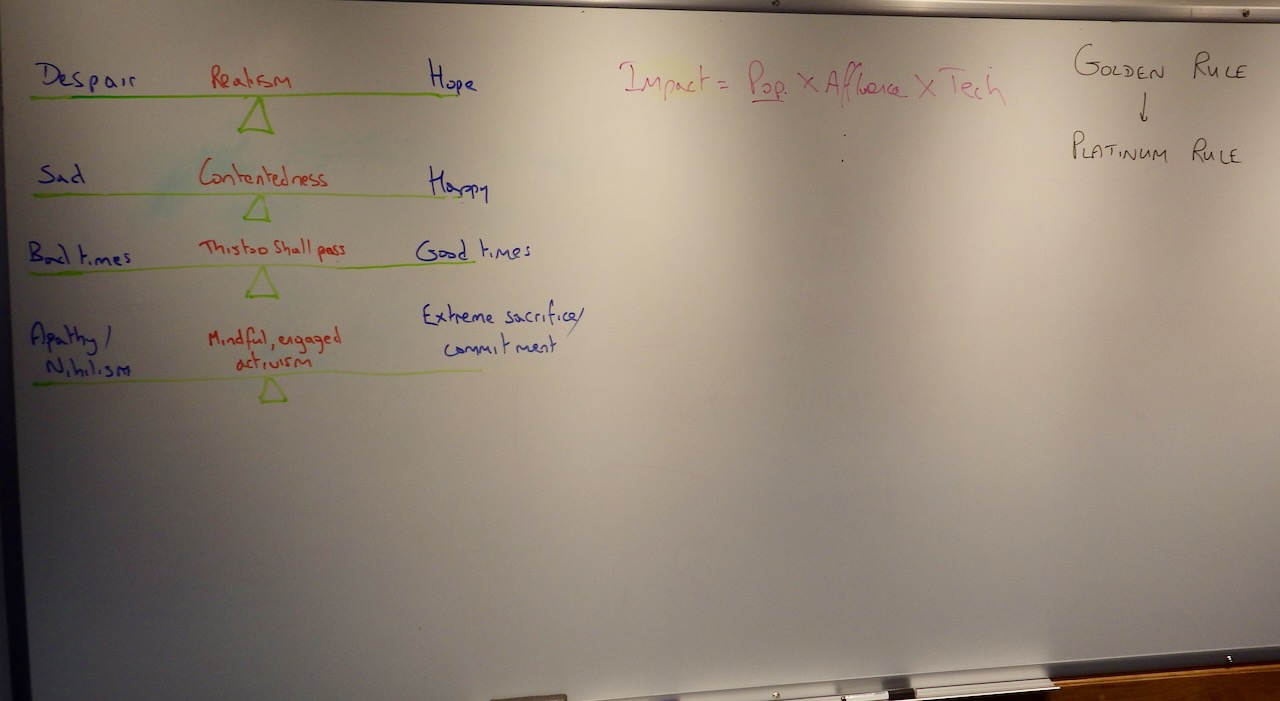
To see materials from previous iterations of this course, use the drop-down menu under the 'Teaching' tab at the top of this page
Last update: 6th January 2026