Tremblay, Michael

Tremblay, Michael

Michael Tremblay

Ph.D., 2021

Philosophy

Arts and Science

Research Interests

Ancient Philosophy (especially Stoicism), Ethics, Moral Education

Biography
  • Ph.D. (Philosophy), Queen's University
    • Dissertation: Theory and Training in Epictetus’ Program of Moral Education
    • Committee: Jon Miller (Chair), Brad Inwood, Bernard Kavanaugh, Daryn Lehoux, Elliot Paul
  • M.A. (Philosophy), Carleton University
  • B.A., Honours (Philosophy), Carleton University

Michael’s research focusses on ancient philosophy, specifically moral education in the Stoics. He is also interested in the Hellenistic conception of philosophy as a way of life, which is to be practiced in order to achieve virtue and happiness, and the conception of philosophy as a skill or craft. His work has appeared venues such as Apeiron: A Journal for Ancient Philosophy and Science and Journal of Ancient Philosophy.

Beyond philosophy, Michael is passionate about martial arts and competes regularly in Brazilian jiu-jitsu and wrestling. His academic work and its connection to his athletics are the focuses of a recent episode of CBC’s Ideas.

Publications
  • “Digestion and Moral Progress in Epictetus”, Journal of Ancient Philosophy 13(1), 100-119, 2019.
  • “Akrasia in Epictetus: A Comparison with Aristotle”, Apeiron 53(4), 397-417, 2020.
  • MMA as a path to stoic virtue”, in The Philosophy of Mixed Martial Arts, Routledge. Ed. Jason Holt and Marc Ramsay. 2021. Pg.122-133.
  • Athletic imagery as an educational tool in Epictetus”, The Journal of the Philosophy of Sport. 2021.

Personal Website

Elliott, Eden

Elliott, Eden

Eden Elliott

Ph.D. Candidate

Philosophy

Arts and Science

Research Interests

Philosophical Anthropology, Systematic Philosophy, Hermeneutical Phenomenology (Heidegger, Gadamer, Ricoueur), Metaphysics, Metaethics, Philosophy of Action, Philosophy of Mind.

Biography
  • B.A., Honours (Political Science & Philosophy), Laurentian University
  • M.A. Philosophy, Queens University

My interests are united by my interest in developing a Structural-Systematic Account of what the Human being is, particularly in conversation with Heidegger and the phenomenological tradition. This project is concerned with what Humans are and what Humans do, and so takes interest in a broad variety of philosophical literature to approach these questions. In addition to this main project, I also work on specific issues within the history of phenomenology, as well as in contemporary metaphysics, metaethics and philosophies of mind and action.

Livingstone, Joshua

Livingstone, Joshua

Joshua Livingstone

Ph.D., 2025

Philosophy

Arts and Science

Research Interests

Continental Philosophy, Existentialism, Phenomenology, Hermeneutics, Political Theory

Biography
  • B.A., Honours (Philosophy), King’s University College
  • M.A. (Theory and Criticism), Western University

Joshua’s work is rooted in the continental tradition, specifically the areas of existentialism, phenomenology, and hermeneutics. He received a B.A. in Philosophy from King’s University College, and an M.A. in Theory and Criticism from Western University. His master’s thesis explored the theme of questioning in Martin Heidegger’s Being and Time. At Queen's, Joshua’s work focuses on the political thinker Hannah Arendt. Specifically, he is interested in piecing together an Arendtian account of the imagination as “the source of action,” exploring both its creative and destructive political implications.

Publications

“Hannah Arendt and the Free Press” (2021) in the History of Women Philosophers and Scientists series at Springer.


Lawson, Kathryn

Lawson, Kathryn

Kathryn Lawson

Ph.D., 2022

Philosophy

Arts and Science

Research Interests

Environmental philosophy, Philosophy of religion, Phenomenology, Feminist perspectives, Simone Weil

Biography
  • B.A., Honours (Philosophy), King’s University College at Western University
  • M.A., (Theory and Criticism), Western University

Kate’s research interests include environmental philosophy, philosophy of religion, phenomenology, feminist perspectives, and the work of Simone Weil. She was a visiting graduate student at Cambridge University's Faculty of Divinity during the Lent 2020 term and she attended The School of Criticism and Theory Summer School at Cornell University in 2016. Kate's dissertation entitled Decreation for the Anthropocene places the philosophy of Simone Weil in conversation with our current environmental crisis.

Peer Reviewed Journal Articles
  • "Art and the Other: Aesthetic Intersubjectivity in Gadamer and Stein" Symposium: Canadian Journal of Continental Philosophy. 24.1 (2020): 74-91.
  • "The Ethical Imperative of Reincarnation in the Timeaus and The Bhagavad Gita" Symposia: The Journal of Religion. Toronto: University of Toronto, 2019.
Book Chapters
  • “Enacting Decreation,” in Rethinking Responses to Political Crisis and Collapse: Hannah Arendt, Edith Stein, Rosa Luxemburg, and Simone Weil, ed. Antonio Calcagno, forthcoming.
  • "One Hand Clapping" in The Art of Anatheism: The Philosophy of Richard Kearney. Edited by Matthew Clemente and Richard Kearney. London: Rowman and Littlefield, 2017.
Edited Collections
  • Breached Horizons: The Philosophy of Jean-Luc Marion. Co-edited with Rachel Bath, Antonio Calcagno, and Steve G. Lofts. Rowman and Littlefield: London, 2017.
Other Writing 
  • “The Pandemic of Force.” Review of Apollo’s Arrow: The Profound and Enduring Impact of Coronavirus on the Way we Live, by Nicholas A. Christakis. Attention: The Life and Legacy of Simone Weil. Forthcoming. Online: http://attentionsw.org/
  • “Attention in the Time of COVID-19.” Object Tales. Cambridge Faculty of Divinity Online. 2020.
 

Personal Website

Christine Sypnowich advocating for local input and transparency

Christine Sypnowich has published an article in The New Statesman on the importance of local input on siting decisions. Issues at the local level – such as where to locate a wind turbine or solar panels – are often controversial. People who are generally in favour of certain progressive policies may not want them implemented in their own neighbourhood. Such people are pejoratively called “NIMBYs” (taken from “Not In My Backyard”).

Departmental Colloquium: Jonathan Quong (USC)

Date

Thursday March 25, 2021
4:00 pm - 6:00 pm

Location

Queen's University, Zoom

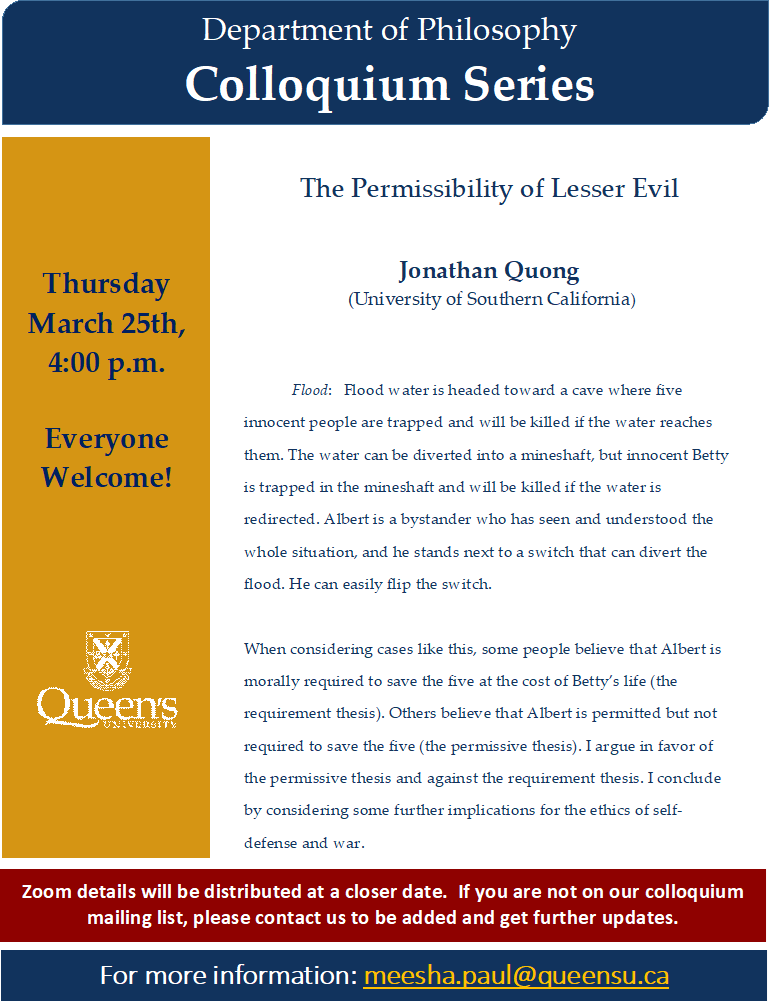
Title: The Permissibility of Lesser Evil

Abstract:

Flood: Flood water is headed toward a cave where five innocent people are trapped and will be killed if the water reaches them. The water can be diverted into a mineshaft, but innocent Betty is trapped in the mineshaft and will be killed if the water is redirected. Albert is a bystander who has seen and understood the whole situation, and he stands next to a switch that can divert the flood. He can easily flip the switch.

When considering cases like this, some people believe that Albert is morally required to save the five at the cost of Betty’s life (the requirement thesis). Others believe that Albert is permitted but not required to save the five (the permissive thesis). I argue in favor of the permissive thesis and against the requirement thesis. I conclude by considering some further implications for the ethics of self-defense and war.

Departmental Colloquium: Jonathan Quong (Poster PNG 87KB)

Departmental Colloquium: Anna Stilz (Princeton)

Date

Thursday February 25, 2021
4:00 pm - 6:00 pm

Location

Queen's University, Zoom

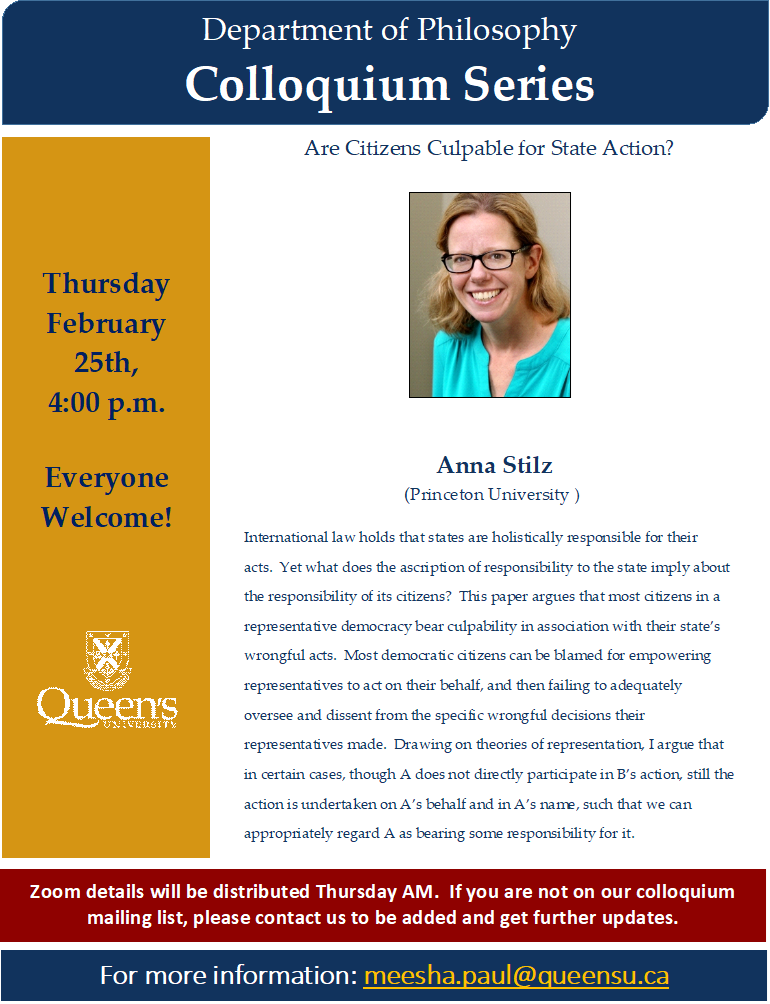
Title: Are Citizens Culpable for State Action?

Abstract: International law holds that states are holistically responsible for their acts. Yet what does the ascription of responsibility to the state imply about the responsibility of its citizens? This paper argues that most citizens in a representative democracy bear culpability in association with their state’s wrongful acts. Most democratic citizens can be blamed for empowering representatives to act on their behalf, and then failing to adequately oversee and dissent from the specific wrongful decisions their representatives made. Drawing on theories of representation, I argue that in certain cases, though A does not directly participate in B’s action, still the action is undertaken on A’s behalf and in A’s name, such that we can appropriately regard A as bearing some responsibility for it.

For further information, contact Meesha Paul (Meesha.Paul@queensu.ca).

Departmental Colloquium: Anna Stilz (Poster PNG 184KB)

Departmental Colloquium: Mary Krizan (U of Wisconsin)

Date

Thursday February 11, 2021
4:00 pm - 6:00 pm

Location

Queen's University, Zoom

Department of Philosophy Presents: Mary Kriza, University of Wisconsin – La Crosse

Date: Thursday, February 11th, 2021

Time: 4:00 pm

Location: Zoom (link distributed via email)

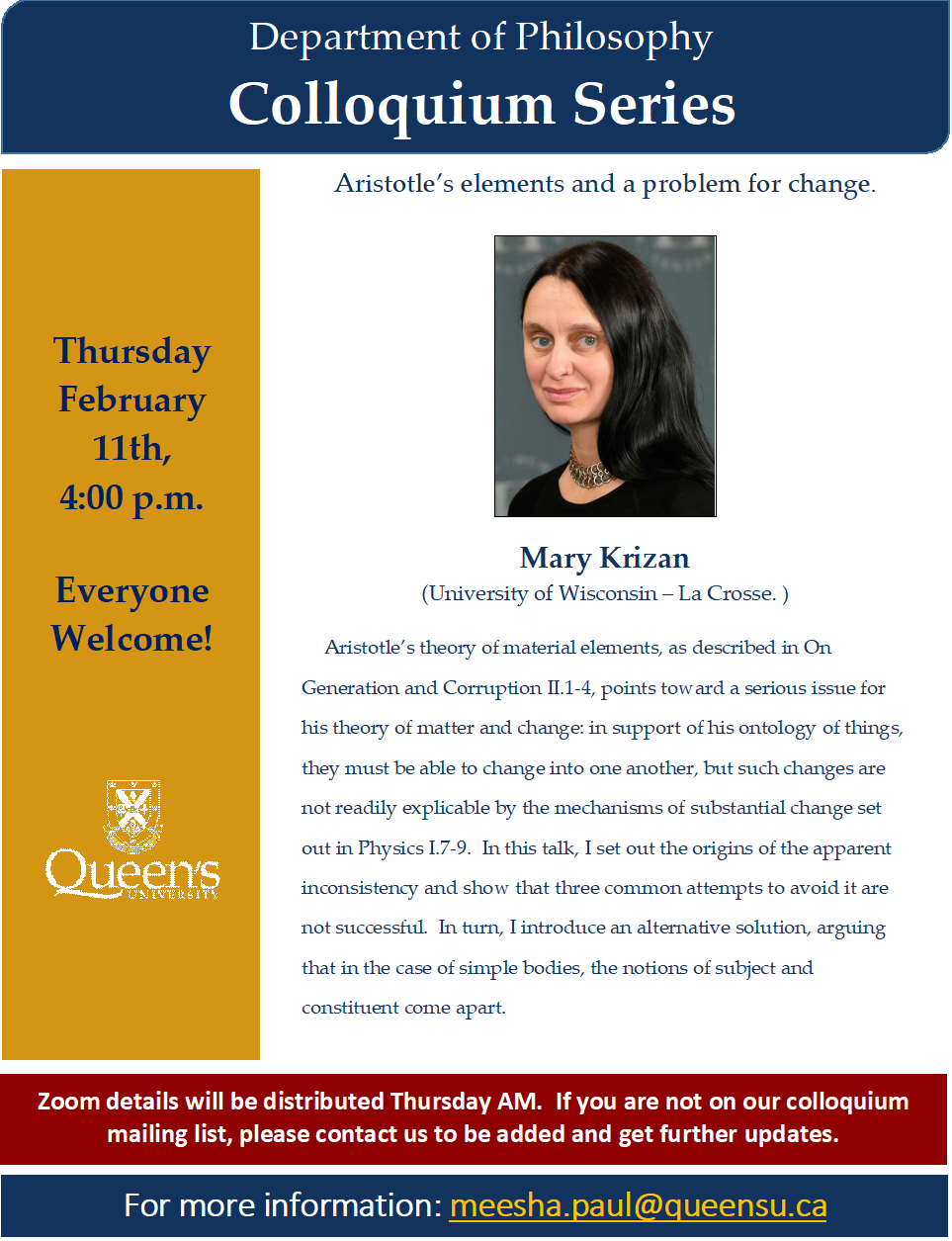
Title: Aristotle’s elements and a problem for change.

Abstract: Aristotle’s theory of material elements, as described in On Generation and Corruption II.1-4, points toward a serious issue for his theory of matter and change: in support of his ontology of things, they must be able to change into one another, but such changes are not readily explicable by the mechanisms of substantial change set out in Physics I.7-9. In this talk, I set out the origins of the apparent inconsistency and show that three common attempts to avoid it are not successful. In turn, I introduce an alternative solution, arguing that in the case of simple bodies, the notions of subject and constituent come apart.

For further information, contact Meesha Paul (Meesha.Paul@queensu.ca).

Departmental Colloquium: Mary Krizan (Poster)

Departmental Colloquium: Sukaina Hirji (U of Pennsylvania)

Date

Thursday January 28, 2021
4:00 pm - 6:00 pm

Location

Queen's University, Zoom

Department of Philosophy Presents: Sukaina Hirji, University of Pennsylvania

Date: Thursday, January 28th, 2021

Time: 4:00 pm

Location: Zoom

Title: Outrage and the Bounds of Empathy

Abstract:  Recent defenses of the political value of anger have focused on what I call “reform anger”, anger that serves to hold an abuser to account and to demand repair or reform. Defenders of the political value of anger have either ignored or unfairly dismissed a second kind anger that I call “outrage anger”. I argue that the very features that seem to be bad about outrage anger — that it is not aimed at repair or reform, and that it is insensitive to nuance or discrimination — are also the features that make it politically and morally important in some cases. Outrage anger, I will suggest, is valuable in certain cases precisely because of how it blocks one’s ability to feel empathy with an abuser. 

Sukaina Hirji, "Outrage and the Bounds of Empathy", Poster (PNG 295 KB)