
From the mysteries of dark matter to the origins of the cosmos, our researchers are pushing the boundaries of discovery in astroparticle physics, cosmology, and astronomy. Building on Nobel Prize–winning breakthroughs in neutrino science, they are strengthening Canada’s global leadership in astroparticle physics and inspiring the next generation of scientists.
Working in world-class facilities, our researchers are illuminating how the universe was formed, what it’s made of, and the forces that shape its evolution.
It has been said that behind every success there is effort, behind the effort there is passion, behind passion there are people with the courage to try.
Arthur McDonald
Spoken at the Nobel Banquet at Stockholm City Hall, December 10, 2015
McDonald Institute: Canada’s defining astroparticle physics research network
At the Arthur B. McDonald Canadian Astroparticle Physics Research Institute, based at Queen's, Canadian teams are collaborating with international partners to explore the universe’s most fundamental questions. Their work ranges from pursuing neutrinos and dark matter to developing new ways to observe distant galaxies with massive radio telescopes.
After the Nobel: trailblazing neutrino research continues to shape our understanding of the universe
Art McDonald’s Nobel-Prize-winning discovery paved the way for Canada’s global leadership in the study of subatomic particles that travel through space. At SNOLAB and other top research facilities around the world, Queen’s physics experts continue to advance neutrino and dark matter research.
The discovery that changed our understanding of the universeUnravelling astroparticle physics’ biggest mystery: next chapters in dark matter research
McDonald Institute researchers are leveraging world-class infrastructure to search for dark matter. "Finding it would open a new window into understanding cosmology and the formation of the universe,"says Tony Noble.
Dark matter mysteries (and our plan to solve them)Queen’s astrophysicist leads Canada’s participation in next-generation radio telescope initiative
Kristine Spekkens is the Canadian Science Director for the Square Kilometre Array Observatory. The billion-dollar initiative will combine the power of radio telescopes and supercomputing to study how galaxies evolve and unlock universe’s secrets beyond visible light.
Zooming in on deep, deep spaceA neutrino detector buried in Antarctica: meet the IceCube Neutrino Observatory
Nahee Park is part of an international collaboration chasing rare high-energy neutrinos at the South Pole. Tracking these elusive subatomic particles will help uncover where cosmic rays come from – a questions scientists have been trying to answer for 100 over years.
Frozen lab: detecting neutrinos in icePhysicists and geologists partner to uncover Earth's composition
A Queen's-led research group located at SNOLAB in Sudbury, Ontario investigates our planet's chemical composition using information from geoneutrinos, small subatomic particles from the Earth’s core.
What is the Earth made of?A deep dive in search of neutrinos
A seven-cluster, deep-sea detector off Canada's West coast is advancing high-energy neutrino research. The experiment hopes to support our understanding of the universe and the aspects and processes that shape it.
Deep-sea detector to unlock cosmic mysteriesFeatured researchers
![[Anthony Noble]](/research/sites/vp2www/files/styles/column_card_image/public/2025-12/BC_9043-w.jpg?h=10d202d3&itok=xb4yNWVP)
Anthony Noble
is building a next-generation bubble chamber detector to advance dark matter research.
![[Nahee Park]](/research/sites/vp2www/files/styles/column_card_image/public/2025-12/Nahee%20Park_1000x667.jpeg?h=db95da47&itok=q_xvzvZn)
Nahee Park
is chasing neutrinos using detectors buried in ice, submersed in water, or flying into the upper atmosphere.
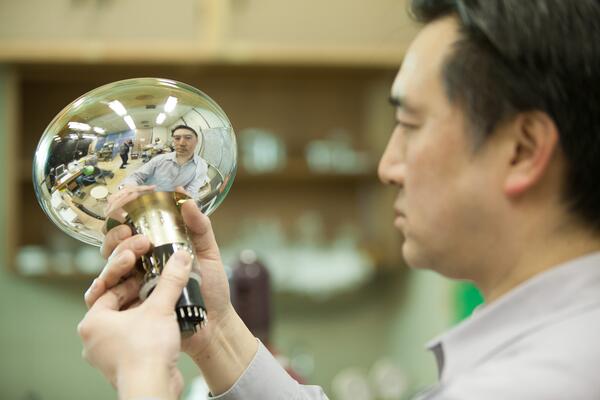
Mark Chen
filled out a giant sphere with liquid scintillator to observe rare neutrino interactions.

Kristine Spekkens
is exploring the structure and evolution of nearby galaxies.
![[Ken Clark]](/research/sites/vp2www/files/styles/column_card_image/public/2025-12/KenClark_PICO40L-1-w.jpg?h=804eb763&itok=_TaR6Qwp)
Ken Clark
uses state-of-the-art detectors to explore the most fundamental particles of the universe.
![[Michela Lai]](/research/sites/vp2www/files/styles/column_card_image/public/2025-12/Michela-Lai-w.jpg?h=e7f04ce2&itok=2ObvWwSK)
Michela Lai
is participating in dark mater research at underground detectors in Canada and abroad.