

It was early 2020, and in homes around Gondar, Ethiopia, Zelalem Demeke, OT'20, kept seeing the same thing: parents physically carrying children who needed wheelchairs, standing frames, or other assistive devices they just couldn’t access.
Demeke had recently returned from Queen’s with a master’s degree in occupational therapy in hand. He knew the difference the right support could make, and now he could help make that difference himself.
So, he got to work.
A few years earlier, several Queen’s professors had visited Gondar and introduced Demeke to occupational therapy. They were there as part of an ambitious, decade-long partnership between Queen’s, the University of Gondar, and the Mastercard Foundation.
Backed by a US$24.2-million investment from the Mastercard Foundation, the partnership set out to create new educational opportunities for people with disabilities, build teaching and research capacity in disability inclusion and rehabilitation, and establish Ethiopia’s first occupational therapy program.
Already a physiotherapist working with children with complex disabilities, Demeke had been looking for new ways to help when the Queen’s profs arrived.
“I didn’t know how to manage some of the conditions I was seeing,” Demeke remembers. “They were quite complex, and the tools I had weren’t enough to help these children and their families.”
By 2018, Demeke was on a plane to Canada – his first time moving abroad – and became one of 16 University of Gondar faculty members to pursue a master’s in occupational therapy at Queen’s during the 10-year partnership.
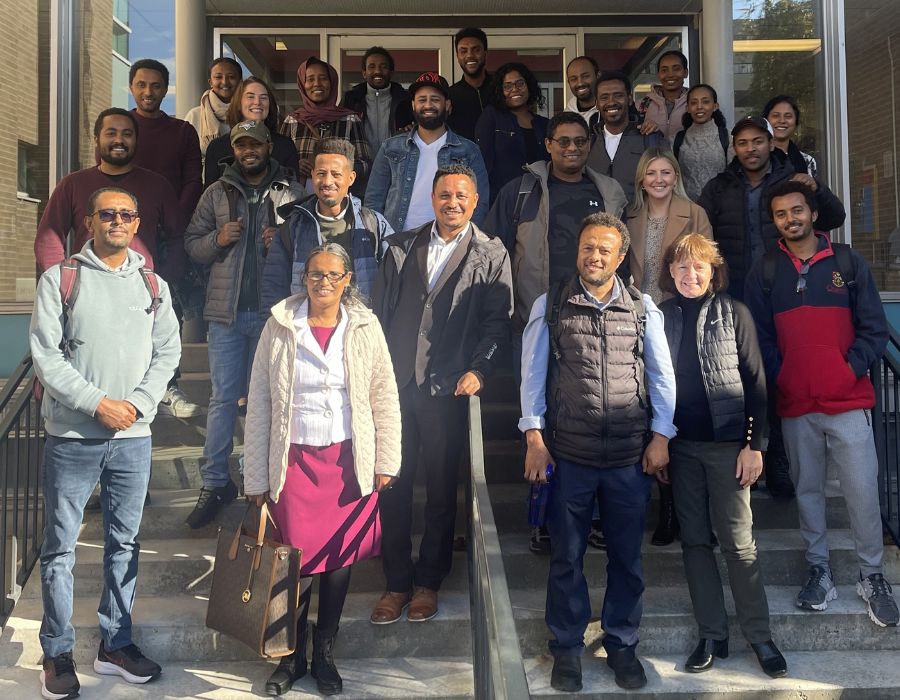
Fellows and colleagues from Queen’s and the University of Gondar gather at Queen’s in November 2022.
After graduating, Demeke returned home and helped lead the new occupational therapy department at the University of Gondar as Ethiopia’s first bachelor of science in occupational therapy program took shape.
The program welcomed its first students in 2021. Its first two graduating classes have now produced 31 occupational therapists pursuing careers across Ethiopia. More cohorts are projected to graduate every year.
For Heather Aldersey, a professor in Queen’s School of Rehabilitation Therapy and co-director of the 10-year partnership, that growth is one of the clearest examples of the partnership’s ripple effects.
“Each graduate has people whose lives they are touching,” she says.
Demeke’s ripple soon went beyond the University of Gondar. Working through the university’s community-based rehabilitation program, he went home to home and saw how limited access to assistive technology affected children and their families. With colleagues, he helped establish the Grand Assistive Technology Center, which provides therapy, childcare, and family support, as well as parent training. It also makes devices such as wheelchairs and standing frames locally.
One mother Demeke met had stopped working to care full time for her child with a disability. Today, she manages the centre’s daycare, earns an income, supports other parents, and helps lead a parent association. Her child also received therapy and assistive-device support.
Demeke and Aldersey stress that the partnership’s impact reaches beyond occupational therapy. Forty-four University of Gondar faculty members have pursued PhDs linked to disability inclusion at Queen’s across 11 departments, while eight jointly led research projects brought researchers and students from both universities together around disability inclusion and rehabilitation.
Jim Leech, MBA'73, LLD'24, Queen’s Chancellor Emeritus and former chair of the Mastercard Foundation’s Board of Directors, calls the partnership “a textbook case of coordinating the strengths of three organizations to achieve far greater impact than each one could do on their own.”
He describes Queen’s role as an “educate the educator” model designed to build capacity that can reach far beyond the people directly involved in the program.
“Gondar’s role, now strengthened through the expertise that they gained from Queen’s, can expand its offerings to an even larger underserved disabled community,” he says.
“Mastercard Foundation was the matchmaker that made it happen.”
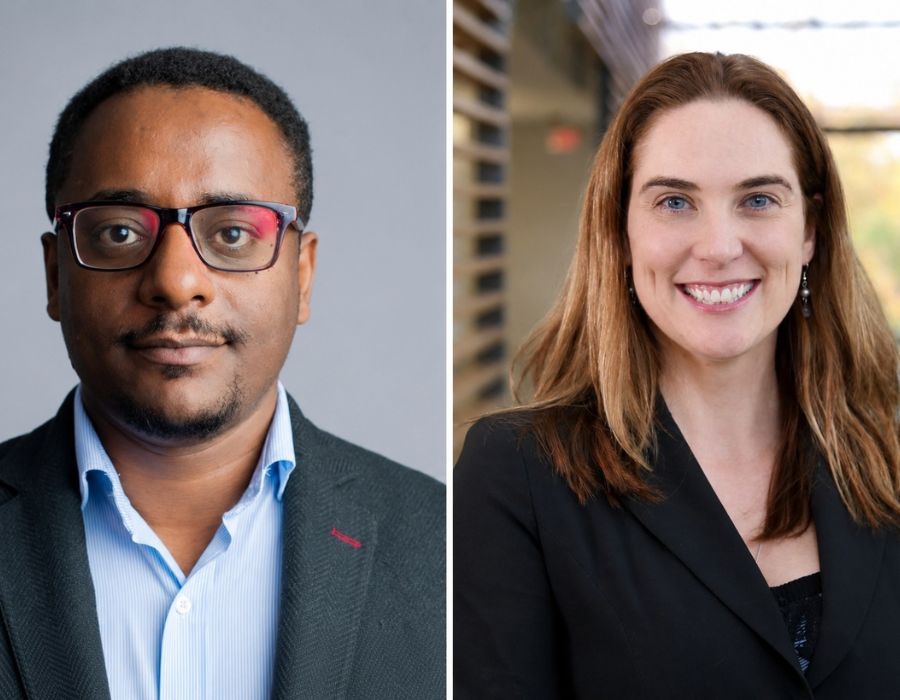
Zelalem Demeke (left), OT'20, an occupational therapist and alumnus of the program, and Heather Aldersey, professor in Queen’s School of Rehabilitation Therapy and co-director of the 10-year partnership.
Aldersey says the Mastercard Foundation’s decade-long commitment was critical to making this work possible.
“A longer-term investment makes possible the investment in relationships,” she says, adding that a “10-year runway” was essential for the kind of systems change the partners were trying to achieve.
And while this formal 10-year partnership is coming to an end, the collaboration between Queen’s, the University of Gondar, and the Mastercard Foundation will continue. Plans are now being developed to bring other universities into the fold and expand work around inclusive higher education in Africa.
For Demeke, the work is also still unfolding. Thanks in part to the Canada Impact+ Research Training Awards, he’s now back at Queen’s pursuing a PhD focused on power mobility for kids with disabilities. It’s another gap he encountered through his work in Ethiopia.
And he sees a change bigger than any one program or profession.
“We shifted the discourse in Ethiopia through this partnership,” he says. “It’s no longer only about impairment. We’ve increased people’s awareness about disability, and now the conversation is about disability rights, understanding barriers, and true inclusion.”
Learn more about the partnership between Queen’s, the University of Gondar, and the Mastercard Foundation.
