

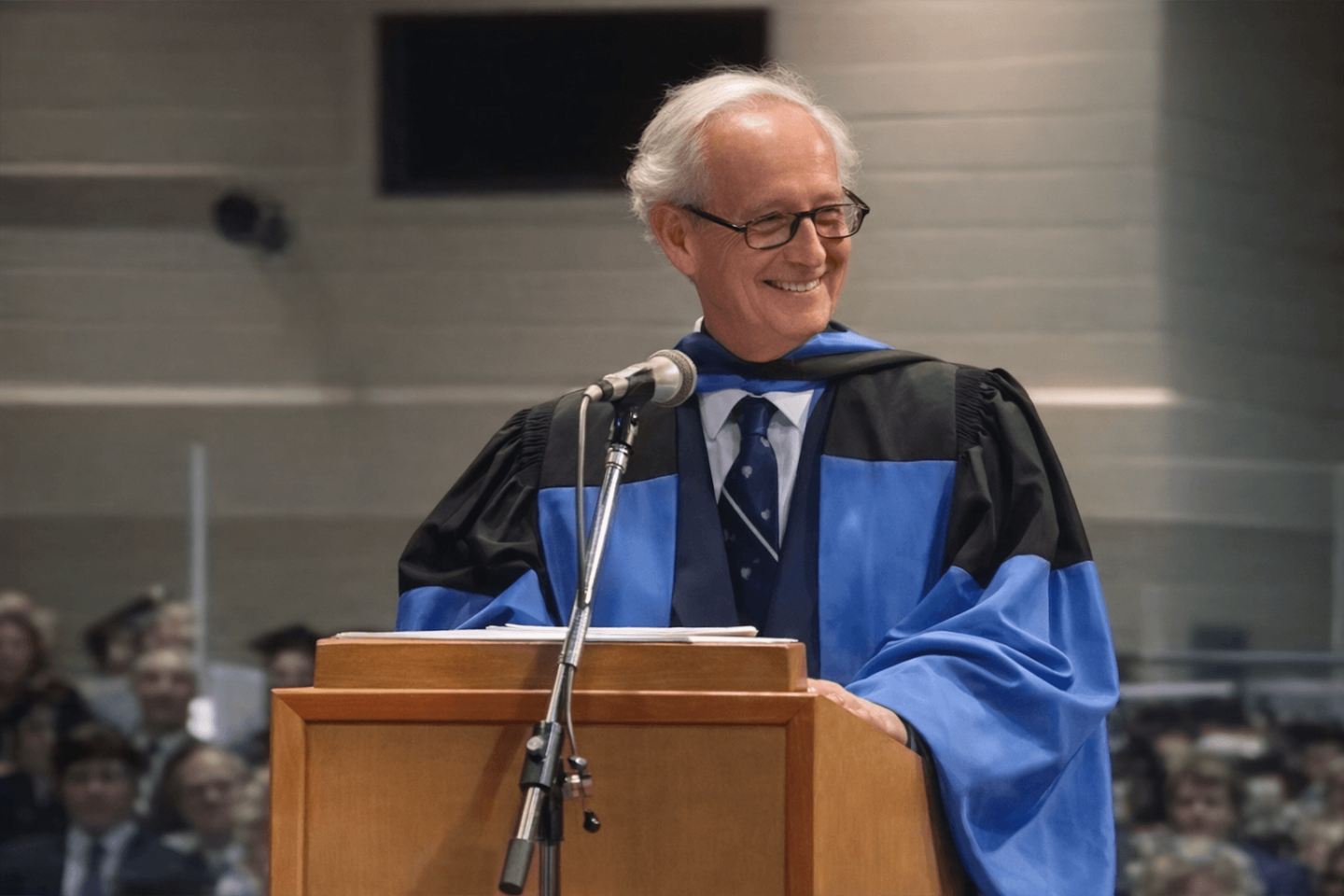
Stephen A. Jarislowsky, LLD’88, a prominent Canadian investor and philanthropist whose generosity helped advance research and scholarship at Queen’s, has died at the age of 101. Awarded an honorary Doctor of Laws by Queen’s in 1988, he was also a Companion of the Order of Canada and a Grand Officer of the National Order of Québec.
For Jarislowsky, giving was about more than financial contributions. A passionate advocate for education, ethics, and the arts, he believed universities had a unique ability to tackle important questions and make the world a better place.
“Universities have always been the place where, if you wanted to, you have the time and luxury to be able to think things through and gather the information and make major, major contributions to the world,” he said in 2016.
It was a conviction that guided decades of philanthropy, including at Queen’s, where his support has left a mark on fields as diverse as economic policy and art conservation.
Born in Germany in 1925, Jarislowsky spent much of his childhood in Europe before moving to North America. After studying at Cornell University, the University of Chicago, and Harvard Business School, he worked for Alcan Aluminium, including a stint as an engineer in Kingston, before founding the Montreal investment management firm Jarislowsky Fraser in 1955.
He went on to become an influential voice in corporate governance and business ethics. Through the Jarislowsky Foundation, he and his wife, Gail, helped establish more than 50 endowed chairs at universities and institutions across Canada.
At Queen’s, his generosity helped establish the Jarislowsky-Deutsch Chair in Economic and Financial Policy in 1990, alongside contributions from friends of former principal John Deutsch, Com’35, LLD’74, and others.
First held by the late economist Thomas Courchene, the chair has supported scholarship in economics, economic policy, and public affairs for more than three decades. Christopher Cotton, Professor of Economics and Director of the John Deutsch Institute, currently holds the position.
Through his role as chair, Cotton developed a close relationship with Jarislowsky over the past 12 years.
“He was a gracious, engaged, and exceptionally intelligent man who genuinely wanted to make Canada and the world a better place,” Cotton says. “Even at 101, he remained very sharp, insightful, and a joy to talk with.”
Cotton fondly recalls their conversations and tours of Jarislowsky’s art collection, as well as his deep commitment to education, public policy, and the broader community.
“I will miss him,” he says.
Jarislowsky’s passion for art was also reflected in his generosity at Queen’s.
In 2020, a $1-million gift from the Jarislowsky Foundation brought advanced scientific equipment to the university’s Art Conservation program. Among the acquisitions was Canada’s first Bruker M6 Jetstream X-ray fluorescence scanner, which allows researchers to map chemical elements across entire artworks, revealing insights into the materials and techniques used to create them.
The technology has helped researchers study everything from artists’ pigments to changes made during the creative process, including in Head of an Old Man in a Cap, a Rembrandt painting at Agnes.
Reflecting on Jarislowsky’s legacy at the university, Queen’s Principal and Vice-Chancellor Patrick Deane says his generosity will continue to make a difference.
“Stephen Jarislowsky recognized the important role universities play in shaping Canada’s future,” he says. “His philanthropy was an investment in ideas, discovery, and the next generation of leaders. His legacy at Queen’s reflects that vision, creating opportunities for research and scholarship that will have an impact for generations to come.”
A public statement from Jarislowsky’s family is available online.
