


The John Deutsch University Centre on Union Street is steeped in history, from the marker outside its doors commemorating Queen’s community members who served in war to the plaque inside honouring its namesake, just beyond the lobby.
But there’s another piece of Queen’s history in the JDUC that most people walk right by: the replica of the Queen’s Royal Charter. This precise reproduction of the historic document sits behind glass on the east wall of the building’s mezzanine.
How did it get here? Who created it? And why is it worth a look?
That story starts with the founding of Queen’s, spans the reign of one monarch to that of a future king, and includes an ambitious student- and faculty-led project in the 1990s to mark the university’s 150th anniversary.
The Royal Charter is Queen’s basic constitutional document. It dates to 1841, when Queen Victoria issued the Imperial Royal Charter that incorporated Queen’s College at Kingston.
The charter consists of three sheets of parchment covered in handwritten script and decorative borders. They are joined at the bottom by a red cord attached to a large green wax seal bearing images of Queen Victoria.
But the original charter had a rough ride after the school’s first principal sailed with it across the Atlantic to Canada in 1841.
Over most of the next century and a half, the document was kept rolled up in a box. For a while, it was stored in a bank vault and later in a library storeroom.
Without proper temperature and humidity controls, the parchment began to crease and deteriorate. The lettering faded and the wax seal fell apart.
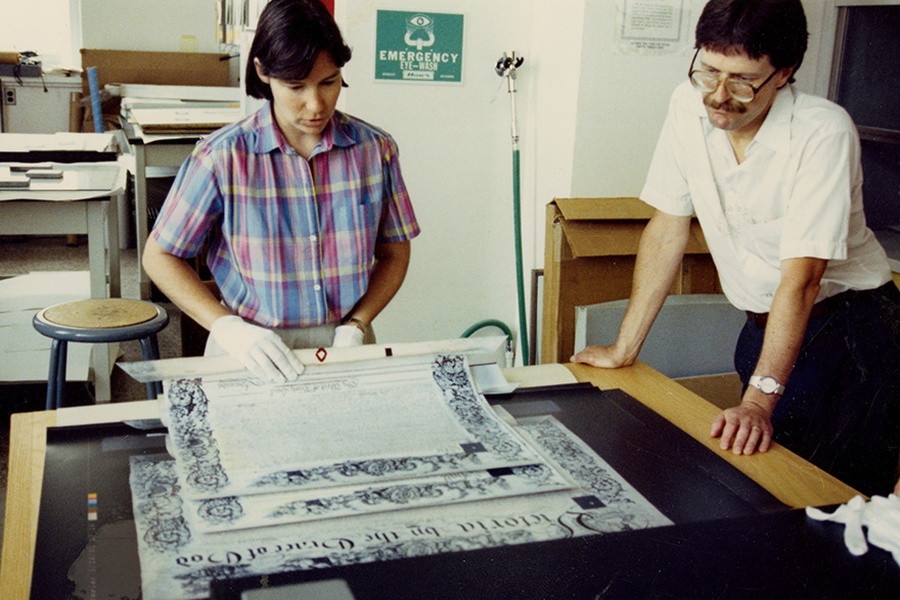
Queen’s conservator Margaret Bignell and archivist Paul Banfield examine the Royal Charter in 1991 during the project to restore the original and create a replica for public display. (Queen’s University Archives)
By the late 1980s, Queen’s was preparing to celebrate its sesquicentennial. A group of students and faculty decided the milestone was a good reason to give the historic document a new life – without putting the fragile original at risk.
That’s where the idea of creating a replica for display began.
The initiative was led by Queen’s professor Stuart Vandewater, who in the late 1980s and early 1990s was director of the sesquicentennial office.
In an interview with the Queen’s Gazette in 1991, Vandewater noted that the charter “is the most important document that Queen’s owns. It’s something that everybody has heard about or vaguely knows but few have seen.” Creating and displaying a replica charter, he added, would give people that opportunity on campus.
The project also involved staff at Queen’s Archives and two student associations: the Arts and Science Undergraduate Society (ASUS) and the Commerce Society.
Audrey Ready Holt, Artsci’92, was the ASUS representative on the project and recalls taking part in meetings over the course of a year that explored creating the replica.
“I was a history major, so this was really a great opportunity,” says Ready Holt, who now works in communications in Waterloo, Ont.
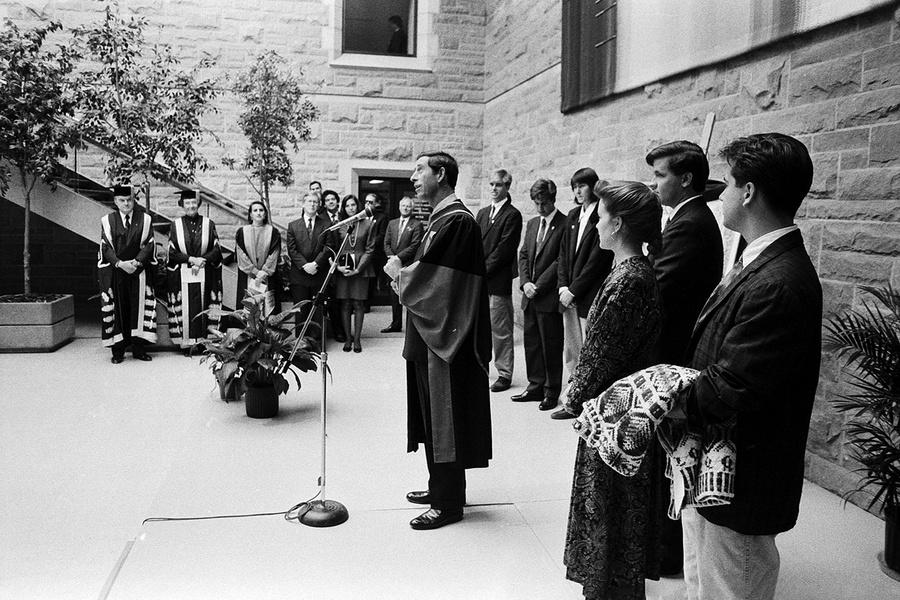
Prince Charles speaks at the JDUC in October 1991 before unveiling the replica of Queen’s Royal Charter during the university’s sesquicentennial celebrations. (Queen’s University Archives)
William LeMay, Com’93, the Commerce Society rep on the project, says everyone involved understood its importance. “We thought it was a good idea to showcase this part of Queen’s past.”
The result was a full-size replica, created using then-cutting-edge photographic technology at an imaging lab in Toronto. Technicians digitally enhanced photographs of the charter, restored the faded colours and lettering, and smoothed away the bumps and wrinkles that had accumulated over the years.
The replica even got a new green wax seal, made in England from the original mould with Queen Victoria’s image.
After all that work, the charter got a royal unveiling.
As the Queen’s community celebrated the sesquicentennial in 1991, Prince Charles and Diana, Princess of Wales, came to Queen’s that October.
The future king attended the ceremony for the replica charter at the JDUC.
“He was very relaxed and very interested in learning about Queen’s,” recalls Ready Holt, who attended the event and chatted with the prince.”
LeMay, who is now a justice of the Ontario Superior Court of Justice in Brampton, Ont., was there as well. The prince, he says, gave a speech that lasted around two minutes. “He was very charming.”
Both Ready Holt and LeMay say they’re pleased that the replica charter has remained on display all these years.
“It shows that Queen’s is serious about its history,” LeMay says. “Sometimes, you can forget about your history, and when you do, you can lose it.”
