
 Queen's 2015 Nobel Prize in Physics
Nayem Al Kayed has successfully defended his PhD thesis. His thesis title is "Programmable Photonic Ising Machines: Ultrafast, Scalable Architectures for Combinatorial Optimization". He conducted his research under the supervision of Prof. Bhavin Shastri.
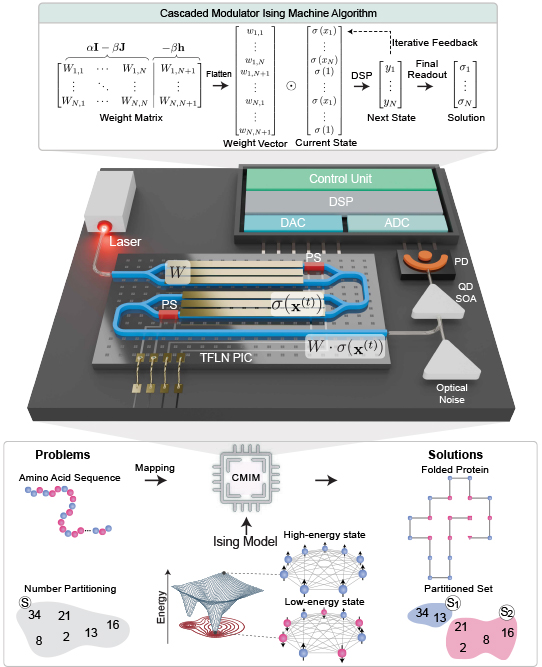
Modern computers are hitting physical limits — smaller chips, faster memory, and lower power are getting harder to achieve — even as demand grows for solving hard optimization problems in logistics, finance, and biology. One promising alternative is to use light as a computing platform, since many optimization problems can be reframed as a physics puzzle called the Ising model, where interacting "spins" settle into their lowest-energy arrangement to reveal the best solution, and light's speed and parallelism make it well-suited to simulating these interactions. In my thesis, we address the challenge of building a single light-based system that is scalable, programmable, fast, and stable by designing and testing three complementary photonic computers: a room-temperature system using fast light-modulating chips in a loop, shown solving real problems like graph coloring and protein folding; an upgraded version that packs in more computation using time, color, and space simultaneously with faster electronic controls; and a flexible, rewirable honeycomb-shaped system that can represent almost any optimization problem. Together, this work charts a practical path toward light-based computers with over a million interacting units, advancing faster optimization, brain-inspired computing, and new forms of artificial intelligence.
The selected figure shows how proposed photonic Ising machine maps a combinatorial problem, such as protein folding or number partitioning, onto an Ising model whose ground-state spin configuration represents the solution [Adapted from Al-Kayed et al., Nature (2025).]