

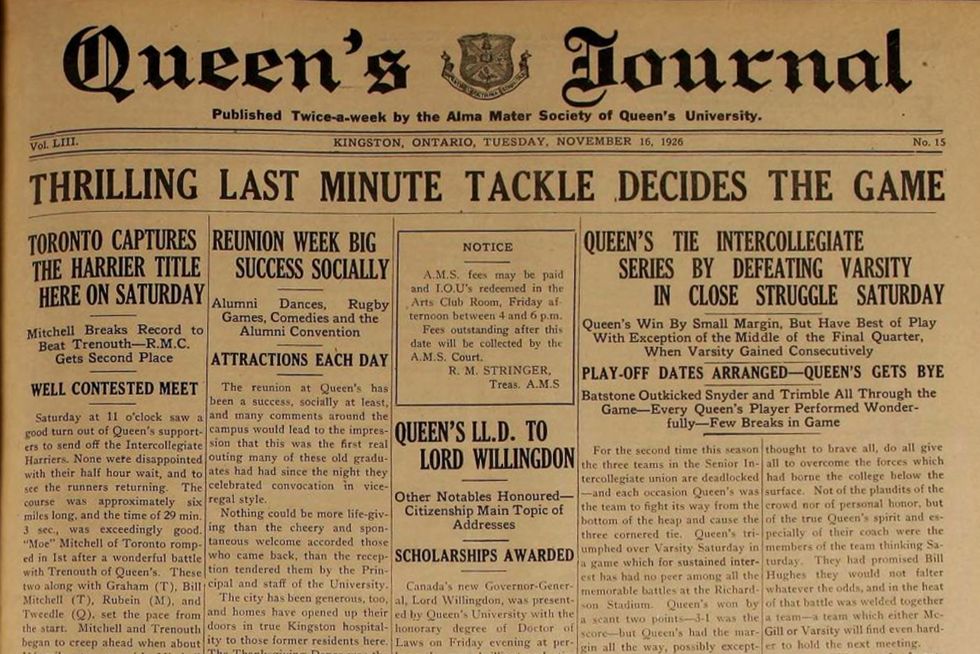
As Queen’s gets ready for the 100th anniversary of Homecoming this fall, Oct. 16-18, we’re kicking off “Countdown to 100,” a monthly story series all about this milestone tradition and the many ways alumni have shaped Queen's over the past century – and continue to shape its future. First up: a look back at the lively Reunion Week of 1926 that started it all.
For eight days in November 1926, Queen’s threw itself a homecoming before it had the word for one. Alumni poured back into Kingston from Nov. 6 to 13 for reunions, dances, a visit from the governor general, and one of the most famous football games in Queen’s history.
In the process, they set in motion a tradition that would help shape the university for the next century.
Queen’s was marking its 85th anniversary that year, but that first homecoming – or “Reunion Week,” as it was called – was about more than celebration. It was also an early answer to a growing problem: how to keep Queen’s grads connected to one another and their alma mater.
By the 1920s, Queen’s alumni were scattering across the country and beyond. Other universities had already landed on one answer for bringing alumni together: the annual homecoming, built around school spirit and a big football game. At Queen’s, the annual showdown with the University of Toronto Varsity Blues gave the idea a natural centrepiece.
The program for Queen’s Reunion Week promised there wouldn’t be ‘an idle moment' – and it delivered. There were class reunions in Theological Hall; a Thanksgiving-Day football game between alumni legends and the 1926 squad; a showcase of boxing, wrestling, and fencing in Grant Hall; and a packed slate of social events leading up to the big finale: Queen’s versus U of T at Richardson Stadium.
The week soon took on the feel of a campus-wide party.
There were dances on Monday, Thursday, and Saturday nights. The Armistice Ball was expected to be a “brilliant affair.” Alumni packed in to see the Faculty Players present Tillie of Bloomsbury, a hit musical at the time. Films of university life were shown. And in one of the week’s most remembered moments, Governor General Lord Willingdon visited campus to receive an honorary degree.
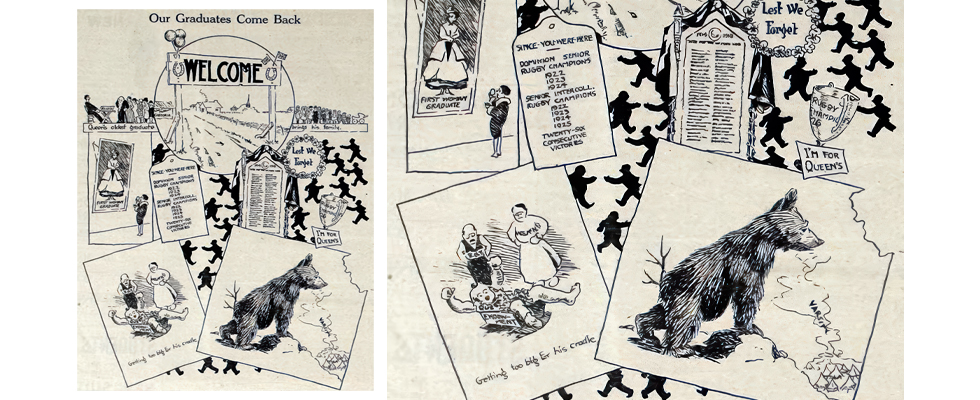
A graphic from the Nov. 12, 1926, edition of the Queen’s Journal advertising Reunion Week.
The Queen’s Journal noted grads were eager to see “everybody and everything”: the new library, the new tennis courts, the students hustling through the same buildings they once knew well. For many, the return was joyful and a little bittersweet. Queen’s had changed. So had they. But the old feeling was still there.
That was the point.
From the beginning, Reunion Week was about more than nostalgia. It was also about renewing the place of alumni in the life of the university. During that first homecoming, graduates voted unanimously to form the Alumni Association, with the goal of binding Queen’s thousands of alumni into a lifelong connection with their alma mater.
So even as the week was filled with fun, there was a bigger idea underneath it all: alumni were not just part of Queen’s past. They still had a significant role to play in its future.
That spirit carried right into the final football game of the week. On Saturday, Nov. 13, Queen’s beat Varsity 3-1 in a thriller remembered as one of the most dramatic games ever played at Richardson Stadium. The finish had everything: a blocked kick, a frantic late Varsity push, and a touchdown-saving tackle by Pee Wee Chantler that preserved the win and sent the crowd into a frenzy.
By the end, Reunion Week was widely seen as a success. And not just socially. Alumni had come back to reconnect and see what Queen’s had become, but they left with something more. As one account put it, they hoped the university would benefit “materially, as they did spiritually.”
A century later, that idea still sits at the heart of Homecoming. From the start, it was never just about looking back. It was about coming back – and staying part of the Queen’s story.
