

A Queen's alum reflects on the lasting impact of the Black Lives Matter movement on her life and work
For Black Histories and Futures Month, we invited Tianna Edwards, MA’23 – the Equity, Diversity, and Inclusion Co-ordinator at Queen’s Yellow House Student Centre for Equity and Inclusion – to write an essay about her own experience as a Black student, alumna, and community builder. In it, she explores how collective attention to anti-Black racism has waned since 2020 and the biggest lessons she’s learned over these five-plus years.
__________________________________________________________________________________
In the spring of 2020, during the height of the Black Lives Matter movement, I used my blog, Keep Up With Kingston, to shine a light on Kingston’s issues with racism. I wrote an impassioned post, “Being Black in Kingston,” with the intent of pulling accountability into our community and away from America’s tragic headlines.
The next time I opened my laptop, I was shocked by the traction it had received. My local community was affirming my feelings and sharing their own personal perspectives.
The momentum of that post propelled me to shift the attention from myself to something actionable. I curated a list of local Black-owned businesses for folks to reference as a way to support Black entrepreneurs and owners who are often overlooked and to connect Black community members.
Shortly after publishing “Being Black in Kingston,” a position was posted at Queen’s for an equity, diversity, and inclusion co-ordinator at Yellow House Student Centre for Equity and Inclusion. Placed within the Division of Student Affairs, the Yellow House was a recommendation from the historically marginalized students, staff, and alumni who were part of the Principal’s Implementation Committee on Racism, Diversity, and Inclusion (PICRDI) and who created the PICRDI report.
At the time, I was already working at Queen’s in Advancement and in the midst of my master’s degree. Encouraged by a colleague, I applied and was offered the role.
The Yellow House mandate is to create a space where queer and/or trans and/or Black and/or Indigenous and/or students of colour feel seen, heard, and find community. In my role, I aim to embody the person that I would have loved to have as a support if I had completed my undergrad at Queen’s. In this role, I’ve launched the Black at Queen’s program, which supports the Black student community.
The world has changed a lot since 2020. We’ve gone from lockdowns spent learning about the systemic impacts of anti-Black racism to experiencing and witnessing more global tragedies, all while transitioning back to “regular” life. The impacts of the past six years have created a form of collective, almost dystopian, numbness that allows us to scroll through social media feeds ranging from cute animals to alarming news alerts.
Understanding the systemic barriers that Black folks face is no longer a top priority the way it was in 2020, a moment in history when so many people paused to reflect. Yet the significance of that time remains with me in my life and work, even as evolving global issues persist.
With all of this in mind, I want to share my biggest lessons in navigating a world still heavily influenced by white supremacy, as a Black woman.
Know your history
I don’t mean broad strokes of history, like Martin Luther King Jr.’s “I Have a Dream” speech. I mean history with direct links to you and your community.
For example, a podcast I created in grad school called Kingston, The Black Experience focused on capturing stories from local Black community members. One of my interviewees was the late Judith Brown, a Queen’s alumna, community activist, and leader.
She often shared the tale of how “a Black man saved Queen’s!” She was referring to Robert Sutherland's generous donation to the university after his death in 1878, when Queen’s was on the verge of closing. The gift was roughly equivalent to the institution's annual operating budget.
I believe Judi did this to encourage Black folks – and particularly Black students – to feel a sense of belonging. She was also the first to note the significant change she had witnessed over her 50 years of living in Kingston.
This past year, I worked with a team at Agnes Etherington Art Centre and the City of Kingston to mount a very large portrait of Judith Brown, created by artist Sandra Brewster, in downtown Kingston. Each time I walk by, its size initiates conversations with passersby about Judith’s impact on our community.
I take comfort in knowing more people will learn and share her story.
This month until Feb. 11, you can also see an exhibit at Union Gallery inside Stauffer Library that’s dedicated to capturing Black history and current storytelling amongst Black Queen’s students.
Called “the black experience...time & memory,” the exhibit is curated by photographer and nursing student King-David Olajuwon and features archival storytelling of the Black community.
Seeing students like King-David reflect on the work of Black students before him has been incredibly moving.
Be in community
When students come to Queen’s, we often encourage them to find their community. And this looks different for everyone. But for Black folks navigating predominantly white spaces, connecting with students facing similar challenges is especially important.
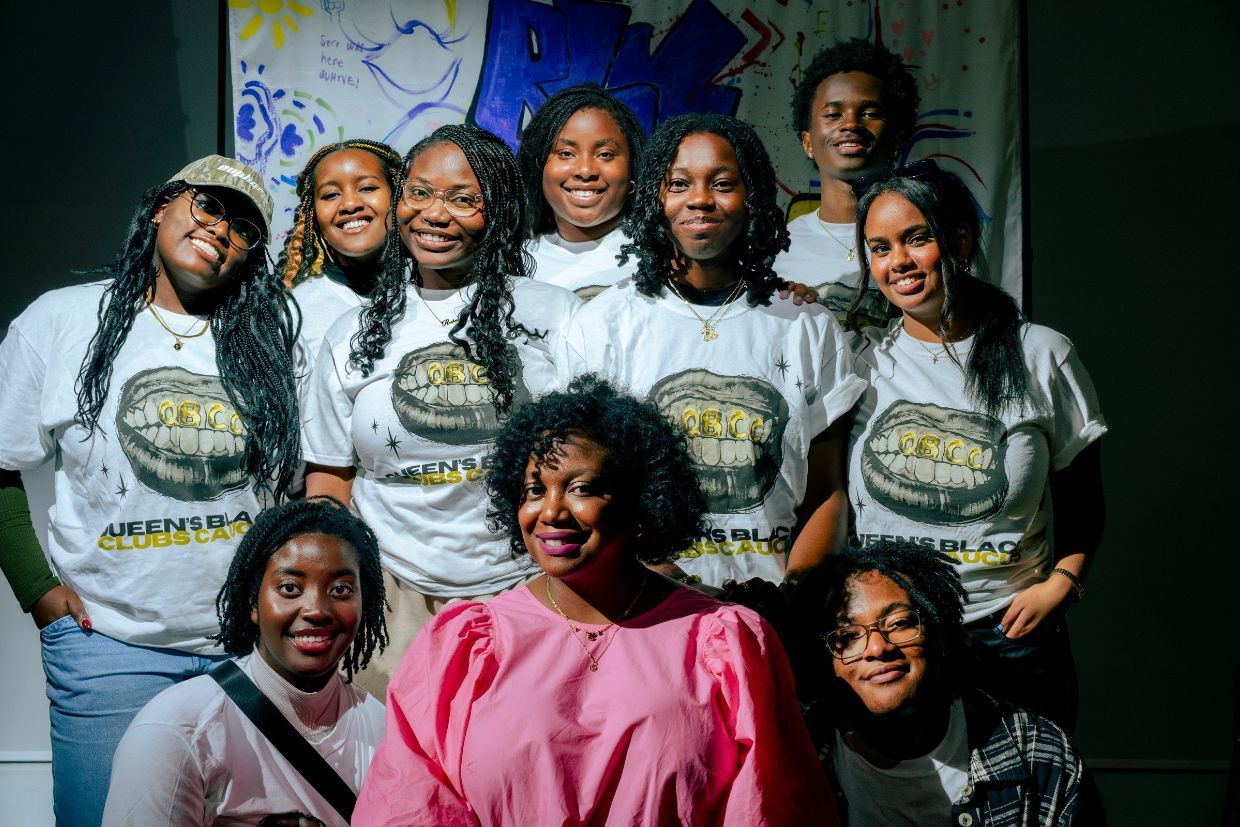
It’s been amazing to see student leaders of the Queen’s Black Clubs Caucus (QBCC) bring all of the Black student clubs together to be in community with each other and organize incredible events. These include the Queen’s Black Academic Society’s annual conference, the African-Caribbean Association’s Soul Food Sundays, and QBCC’s Black formal at the end of the academic year.
I’ve witnessed how these forms of community and connection give students much-needed lifelines to push through to convocation.
Live in your truth
The last and biggest lesson I've learned since 2020 is that while I can’t control the many layers of societal oppression and systemic barriers, living in my truth and sharing it with my community has brought the most alignment and fulfillment to my life.
That clarity has given me many opportunities to make an impactful change on campus and in the wider community.
If you’re an alumnus who identifies as Black and you’d like to connect to the Black at Queen’s program, don’t hesitate to contact Tianna at tre@queensu.ca. The program features opportunities for small moments of mentorship through Black Light, which offers four events each academic year, and student clubs are always looking for ways to connect.
