
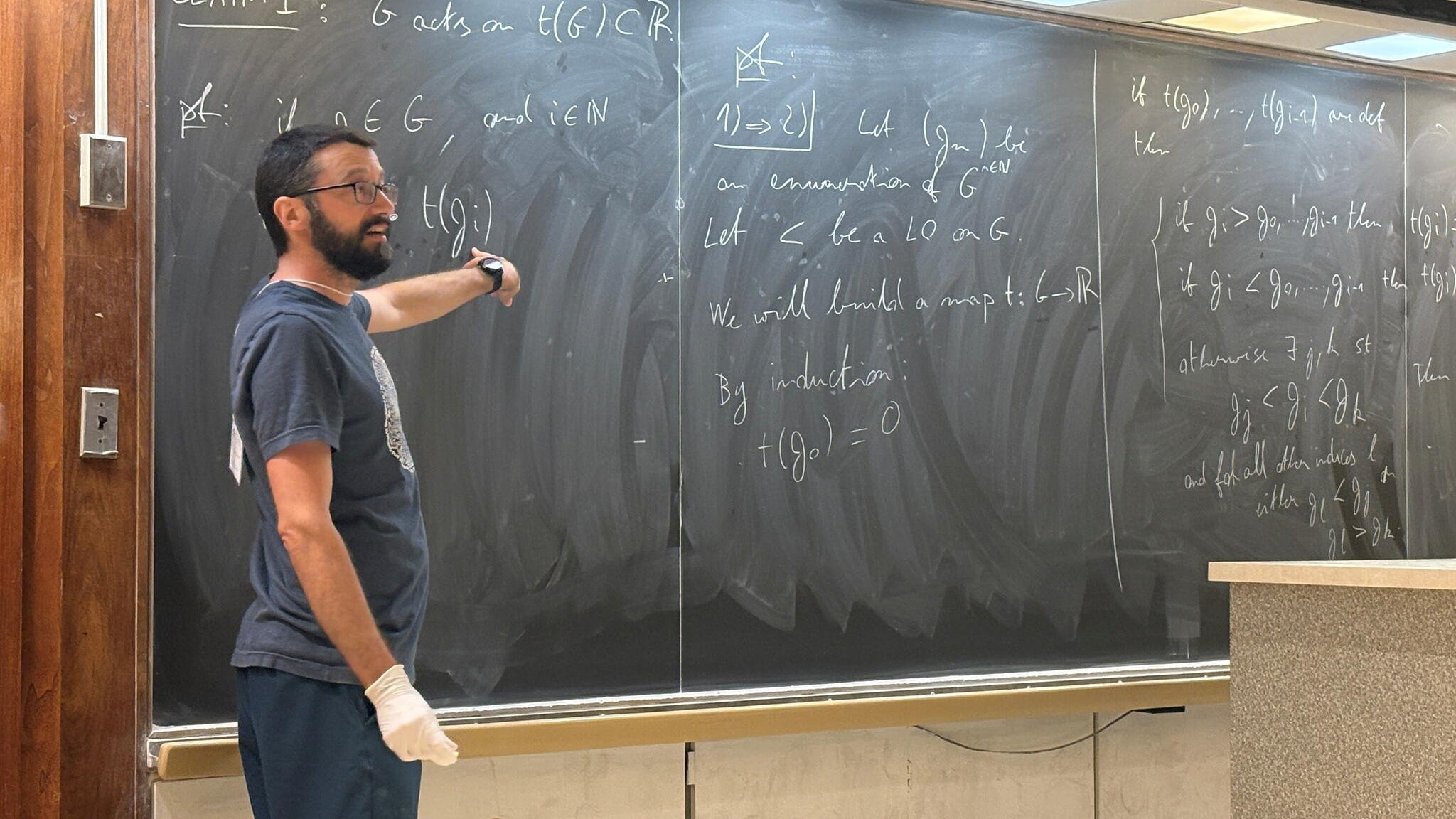
From June 22 to 26, 2026, Stirling Hall filled up each morning with students who had come to Queen's University for a single purpose: to spend a week doing mathematics that sits well beyond the standard curriculum. The occasion was the second edition of the Queen's Mathematics Summer School (QMSS), organized and funded by the Department of Mathematics and Statistics, and building on the success of the inaugural 2024 edition.
A diverse group of attendees
Sixty-seven students took part, coming from twenty-two institutions in five countries. The largest contingent (twenty-seven students) came from Queen's itself, but they were outnumbered by the thirty-one participants who travelled in from other Canadian universities. The University of Ottawa sent nine students and the University of Toronto six, across its St. George and Mississauga campuses; McMaster, Waterloo, and Toronto Metropolitan were also represented in numbers. Beyond the Ontario corridor, students arrived from Concordia in Quebec, Acadia in Nova Scotia, and the University of Victoria on the Pacific coast, along with York, Western, Guelph, and Nipissing.
Nine participants came from outside Canada. Six travelled from the United States, while three more made considerably longer journeys: from Austria, Colombia, and Ukraine.
The summer school is aimed squarely at students who are still early in their mathematical training, and the composition of the group reflected that. Forty-six participants were undergraduates. Sixteen were Master's students, and five doctoral students rounded out the cohort. The result was a room in which second- and third-year undergraduates sat alongside people already deep into a thesis, which is exactly the mix the organizers had hoped for.
The three courses
The week was built around three mini-courses, each running nine hours across the five days, and each deliberately chosen to point in a different direction.
Mathematical Phylodynamics, taught by Troy Day and Felicia Magpantay, introduced the mathematics behind reconstructing how pathogens spread. Phylodynamics asks what processes generate the phylogenetic trees that genomic surveillance now produces in abundance, and the field has grown faster than the supply of people trained to work in it. The course developed the necessary machinery (stochastic processes, Markov chains, Markov bridges) and then put it to work on stripped-down examples of inferring epidemiological parameters from tree data.
Root Systems, Generalizations and Applications, taught by Ivan Dimitrov, followed a thread that runs from Wilhelm Killing's 1889 classification of Lie algebras through to problems that look, on the surface, entirely unrelated. Root systems are one of those structures that keep reappearing across mathematics, and the course took students from the definitions through to a generalization of the notion, showing how it bears on questions such as hyperplane arrangements before closing with inversion sets of roots. Little was assumed beyond linear algebra and the first ideas of group theory.
Groups and Dynamics: Bifoliated Planes and Anosov-like Actions , taught by Thomas Barthelmé, took up a question that can be posed in a sentence and answered in a dozen different ways: when a group acts on a space, what can the action tell you about the group? The course began with the simplest case, actions on the real line, and worked up to actions on bifoliated planes, narrowing at the end to the Anosov-like actions that arise from certain flows on three-manifolds - a setting where examples, algebraic consequences, and even full classifications are all within reach.
The poster session
Midway through the week, on the Wednesday, participants moved to Jeffery Hall for a poster session that turned out to be one of the highlights of the program. Eleven students presented work of their own. Several posters came out of mathematical biology and epidemiology (modelling of cancer growth and treatment, to the compartmental modelling of infectious diseases, to the analysis mother-calf behaviour in Svalbard reindeer). Others involved complex dynamical networks, quantum proofs for NP-hard problems, strategies for a group isomorphism, a question in category theory, and a systematic review of statistical methods in species distribution modelling.
Presenters came from Queen's, Ottawa, McMaster, Toronto, Victoria, and the Universidad Industrial de Santander in Colombia, and the session did what poster sessions do best: it gave undergraduates a first audience for their own research, and gave everyone else a reason to talk to someone they had only nodded to over lunch at Ban Righ.
A successful event to be repeated
The week ended on Friday with a closing reception back in Jeffery Hall. For a program only in its second iteration, QMSS has established something worth continuing: an immersive week in which students with diverse backgrounds can find out what a piece of modern mathematics actually looks like from the inside, and discover that they are able to be part of it. Stay tuned for the next Queen's Mathematics Summer School in 2028!